Khatumo State
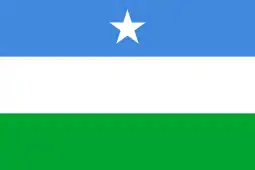
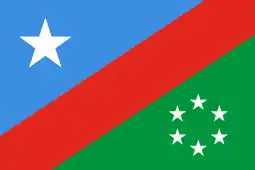
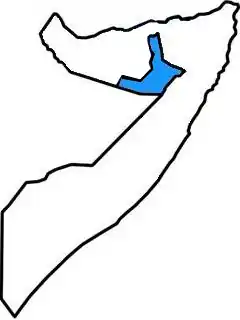
Khatumo State (Somali: Khaatumo; Arabic: ولاية خاتمة), officially the Khatumo State of Somalia (Somali: Dowlad Goboleedka Khaatumo ee Soomaaliya), was a proto-state in eastern Somaliland.[1] Centred on the Sool, Sanaag regions and the Buuhoodle district of Togdheer region, its leaders declared the territory an autonomous state in 2012.[2] By 2015 the proto-state practically ceased to function[3] and on 20 October 2017 in Aynaba, an agreement was signed with the Somaliland government which stipulated the amendment of Somaliland's constitution [4] and to re-integrate the territory into Somaliland.[5][6][7]
Khatumo State of Somalia | |
|---|---|
| 2012 | |
 | |
 | |
| Capital | Buuhoodle (de facto) 9°8′N 48°25′E |
| Largest city | Buuhoodle |
| Government | Autonomous presidential democracy |
• President | Ali Khalif Galaydh |
• Vice President | Abdul Agalule |
| Autonomy within Somalia | |
| History | |
• Established | 2012 |
| Currency | Somali shilling (SOS) |
| Time zone | UTC+3 (EAT) |
| UTC+3 (not observed) | |
| Calling code | +252 (Somalia) |
| ISO 3166 code | SO |
| Internet TLD | .so |
| Today part of | Somaliland |
History
Khatumo is derived from an Arabic term meaning a "positive conclusion." The administration's stated aim was to bring development and stability to the region through the establishment of a locally based government.[8] The most popular slogan among official Khatumites was midnimada which roughly translates as unity. Many inhabitants previously self-referred as being denizens of SSC, which became KS (Khatumo State).[9]
Control of the territory was disputed between Khatumo State (formerly HBM-SSC or Hoggaanka Badbaadada iyo Mideynta SSC), the autonomous Somalian region of Puntland, and the Republic of Somaliland.[10]
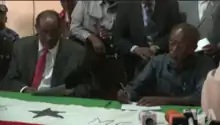
In 2012, the Khatumo State administration was finalized after a series of domestic and overseas conferences beginning in 2007 between prominent political figures, traditional leaders and local residents. The territory's capital was initially at Taleh.[8]
Dissolution
Within a year of its founding, Khaatumo began to dissolve due to a lack of palpable results[11] and by 2015 the proto-state practically ceased to function,[3] with the idea of an autonomous Khaatumo state having lost ground among the Dhulbahante, the clan that inhabits the area, a year after its establishment.[12]
In August 2016 Khatumo state commenced peace talks with Somaliland.[13][14] The talks, however, caused a major disagreement between the president and vice-president of the administration, Ali Khalif Galaydh and Abdulle Agalule respectively, which eventually produced two separate administrations that both claimed to be the legitimate government.[15] The group led by Ali Khalif reached an agreement with Somaliland, at the town of Aynabo in October 2017, which stipulated that under the condition of changing the constitution of Somaliland, the organisation would become integrated within the Somaliland government.[16]
Government

The Khatumo State governmental authority was structured somewhat differently from Somalia's other autonomous regional administrations. At its establishment, it had three presidents, four councils and various ministerial positions.[8] In August 2014, Member of the Federal Parliament of Somalia and former Prime Minister of Somalia Ali Khalif Galaydh was elected President of Khatumo State. He defeated former co-president Mohamed Yusuf Jama (Indhosheel) by 21 votes to 9. Assembly members, who had been appointed by traditional leaders, also selected Abdul Sulub as Vice President.[17]
Presidents
The last President was Ali Khalif Galaydh, who died on 8 October.
- Former
- Ahmed Elmi Osman (Karaash) - 2012- 2013
- Abdinuur Elmi Qaaji (Biindhe) - 2013-2013
- Mohamed Yusuf Jama (Indhosheel) - 2013-2014
- Ali Khalif Galaydh - 2014-2017
Vice President
- Abdul Agalule
Ministers

- Ahmed Gacmayare, Minister for Information and Culture
- Mahamoud Ismail Shabac, Minister for International Relations and federal
- Mohamed Ducaale Abdi, Minister for Security
- Ibrahim Jama Garab-Yare, Minister for Finance
- Abdikariim Farah Dhaaye, Minister for Development and Natural Resources
- Mohamoud Diiriye Abdi-Joof, Minister for Social Services
- Yaasin Ahmed Sulub, Minister for Interior Affairs
- Deputies
- Hasan Ali Jama, First Deputy Minister for International Relations
- Jama Hassan Khaliif, Deputy Minister for Security
- Ibraahim Mohamoud Guure, Deputy Minister for Development and Natural Resources
- Abdi Farah Mahad, Second Deputy Minister for Development and Natural Resources
- Hassan Muse Awl, First Deputy Minister for Interior Affairs
- Abshir Abdi Shiekh, Second Deputy Minister for Interior Affairs
- Abdifatah Osman Dhala, First Deputy Minister for Social Affairs
- Asia Hassan Jama, First Deputy Minister for Social Affairs
- Ali Osman Gedle, First Deputy Minister for Finance
Other
- Mukhatar Ibraahim Habashi, Chief of Cabinet
- Omar Jama Saleebaan, Spokesman for Khatumo State
- Eng. Mohamud Omar Isse (Xiirey)- Chair of Khaatumo, North America. Khaatumo State, Somalia
Military
Khatumo maintains its own security forces. Exclusively financed by the state administration, they are tasked with assuring local security and defending the region's borders. According to Khatumo President Abdinuur Elmi Qaaji, the forces are well trained and armed.[8] Khatumo troops have been deployed in defence operations against invading Somaliland troops in Buhoodle and other disputed towns within SSC territory.[8][18] As of 2012, Khatumo forces are led by Abdirisak Fanah, with Omar Jama Saleiman serving as official spokesman.[19][20]
Economy
Animal husbandry is the backbone of the economy of Khatumo State. Camel, cattle, goats and sheep are exported from the region and other parts of Somaliland to neighboring Gulf Arab countries, such as Saudi Arabia.[21] In rural areas, some farming is also practiced.[22]
Khatumo State's social and economic infrastructure is in the gradual process of rehabilitation after a prolonged period of conflict.[8] Remittances sent by Somali expatriates to relatives in the region contribute significantly to the local economy. Through the construction of a new air transportation facility, Khatumo officials have sought to encourage the repatriation of SSC residents. The returnees would in turn be accommodated in newly built hotels, restaurants and other businesses, which would serve to create additional employment opportunities.[22]
See also
References
- Stremlau, Nicole (2018). "Governance Without Government in the Somali Territories". Journal of International Affairs. 71 (2): 73–89. ISSN 0022-197X. JSTOR 26552330.
- "What is Khatumo State?". Somalia Report. 26 April 2012. Archived from the original on 12 March 2014. Retrieved 27 September 2013.
- Musa, Ahmed. "Lasanod: City at the margins" (PDF). Rift Valley Institute: 7. Retrieved 8 October 2021.
- "Somaliland iyo Khatumo oo kala saxiixday heshiisyo dhowr ah". BBC News Somali (in Somali). Retrieved 18 September 2021.
- Mahmood, Omar S. (1 November 2019). "Overlapping Claims by Somaliland and Puntland: The Case of Sool and Sanaag". Africa Portal. Retrieved 29 June 2020.
- "Khaatumo and Somaliland reach final agreement". somalilanddaily.com. 21 October 2017. Retrieved 29 June 2020.
- Doon, Run. "Current Affairs in the Horn of Africa" (PDF). Anglo-Somali Society Journal. Autumn 2017 (Somaliland, Khaatumo agreement reached).
- "What is Khatumo State?". Somalia Report. 26 April 2012. Archived from the original on 12 March 2014. Retrieved 27 September 2013.
- Pegg, Scott, and Pål Kolstø. "Somaliland: Dynamics of internal legitimacy and (lack of) external sovereignty." Geoforum 66 (2015): 193-202.
- Somaliland’s Quest for International Recognition and the HBM-SSC Factor Archived 28 May 2012 at the Wayback Machine
- Höhne, Markus Virgil (2015). Between Somaliland and Puntland : marginalization, militarization and conflicting political vision. London. p. 118. ISBN 978-1-907431-13-5. OCLC 976483444.
- Höhne, Markus Virgil (2015). Between Somaliland and Puntland : marginalization, militarization and conflicting political vision. London. p. 115. ISBN 978-1-907431-13-5. OCLC 976483444.
- "Wadahadallo u socda Somaliland iyo Khaatumo". BBC Somali. 16 August 2016. Retrieved 19 November 2017.
- "Somalia: Khatumo begins peace talks with Somaliland". Garowe Online. 8 August 2016. Retrieved 19 November 2017.
- "Khilaaf ballaaran oo soo kala dhexgalay madaxda Khaatumo". BBC Somali. 4 August 2017. Retrieved 19 November 2017.
- Mahmood, Omar S. (1 November 2019). "Overlapping Claims by Somaliland and Puntland: The Case of Sool and Sanaag". Africa Portal. Retrieved 29 June 2020.
- "Somalia: Puntland leader arrives back in Garowe after provincial tour". Garowe Online. 14 August 2014. Archived from the original on 14 August 2014. Retrieved 14 August 2014.
- "Somalia: Silanyo calls for peace after Somaliland forces clash with armed group". Garowe Online. 2 April 2012. Archived from the original on 27 September 2013. Retrieved 27 September 2013.
- Omar, Shiine (2 August 2012). "Deadly Fighting in Buhoodle". Somalia Report. Retrieved 27 September 2013.
- Said Ismail, Aweys Cadde (26 January 2012). "Somaliland Attacks Khatumo Militia". Somalia Report. Retrieved 27 September 2013.
- "Livestock: The Mainstay". FAO. Archived from the original on 27 September 2013. Retrieved 27 September 2013.
- Hashi, Ahmed. "Khatumo State Gains Access to International Air Travel". Awdalstate. Archived from the original on 12 December 2013. Retrieved 27 September 2013.
External links
| Federal Member States (federalist/unionist states) | |
|---|---|
| Proposed federal member states |
|
| Islamist Jamaats | |
| Former state entities |
|
| Former Islamist administrations |
|
| |

.svg.png.webp)