KiHa 80 series
The KiHa 80 series (キハ80系) was a diesel multiple unit type which was operated on express services from 1960 to 2002, under Japan National Railways and later under JR Hokkaido and JR Central. Two variants were initially built - the KiHa 81 series (キハ81系) specifically for Hatsukari services in 1960, and the KiHa 82 series (キハ82系) for other services was built from 1961 to 1967.
 KiHa 80 series KiHa 80 series | |
|---|---|
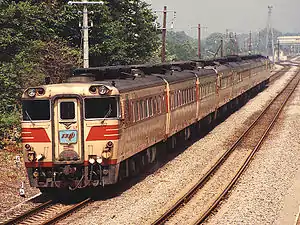 KiHa 82 series Ōtori service, 1986 | |
| In service | 1960–2002 |
| Constructed | 1960 (KiHa 81) 1961–1967 (KiHa 82) |
| Scrapped | 1982–2009 |
| Operator(s) | JNR (1960–1987) JR Hokkaido (1987–2002) |
| Specifications | |
| Car length | 21,300 mm (69 ft 11 in) (KiHa 81) 21,100 mm (69 ft 3 in) (KiHa 82) |
| Width | 2,903 mm (9 ft 6 in) |
| Maximum speed | 100 km/h (62 mph) |
| Engine type | Diesel |
| Track gauge | 1,067 mm (3 ft 6 in) |
| Notes | |
 ※ Awarded for KiHa 81 series ※ Awarded for KiHa 84 series Furano Express set | |
Later, three resort trains were built based on the series - two KiHa 84 series (キハ84系) trains (the Furano Express and Tomamu Sahoro Express) and one remodelled KiHa 82 train (the Resort Liner). Most cars were scrapped by 2009, but some were preserved, including a KiHa 81 lead car at the Kyoto Railway Museum, and a KiHa 82 lead car on the Hakkōda Maru.
Background
Prior to 1958, limited express services were limited to the Tokaido and Sanyo Main Lines and part of the Kagoshima Main Line. This was due to several reasons, one being that demand for express services in rural areas was low due to most of the population already residing on the Tokaido Main Line. Another reason was due to lack of electrification in many areas - only the Tokaido, Takasaki and Joetsu lines were electrified by 1956, necessitating the use of steam locomotives on most lines.[1]
In the fall of 1958, both 151 series EMUs and 20 series passenger cars were introduced for the then new Kodama service from Tokyo to Kobe and the Asakaze service respectively.[2]
In late 1958, the first meeting of the Asian Railways Conference was held in Tokyo - a decision was made to develop diesel cars to replace the steam-operated Hatsukari services, and in early 1960, the new cars were scheduled to start service in December of that year.[3]
Manufactured cars
KiHa 81 series
In 1960, two nine-car sets (along with eight extra cars) of what would be known as the KiHa 81 series were manufactured - these trains were also named the Hatsukari after the services they were introduced on. In 1961, these sets would receive the fourth Blue Ribbon Award from the Japan Railfan Club.[4]
Between 1968 and 1970, six of these cars (three KiRo 80 and three KiSaShi 80 cars) were refurbished into -900 series cars. These cars would eventually be scrapped by 1982, whilst the rest of the cars would be scrapped by 1983.
- KiHa 81 (1 - 6)
- A driving car with a capacity of 40 passengers, it was equipped with both an engine and a power generator. It was modeled on the 151 series trains, but with a few differences - the cab was set lower, and the car had increased width. Most of the hood was used to house the engine, and a wide opening structure was adopted for maintenance purposes. Six cars were built.[5]
- KiHa 80 (1 - 12)
- An intermediate car equipped with two running engines, it had a capacity of 72 passengers. Unlike the KiHa 81 driving car, which differed between the KiHa 81 and KiHa 82 sets, the KiHa 80 cars remained consistent in design. 12 cars were built - 10 of these would be in service until 1983, whilst the remaining two were scrapped in 1977.[5]
- KiRo 80 (1 - 5)
- An intermediate first-class car equipped with two engines, it had a capacity of 48 passengers. It was also equipped with a bathroom at both the front and the rear of the carriage. Initially, the sets made use of a radio antenna on the roof to provide in-seat radio, but it was removed due to difficulties with maintenance. Five cars were built - three were later converted to regular cars (1 and 5 were remodeled into KiHa 82-900 series lead cars, and 2 was remodeled into a KiRo 80-900 series car), whilst the remaining two were scrapped by 1977.[5]
- KiSaShi 80 (1 - 3)
- A dining car equipped with an engine, it had a capacity of 40 passengers. A train position indicator, which was also installed on Series 151 trains, was installed here. Later, all three cars were equipped with running engines and remodeled to KiShi 80-900 series cars.[5]
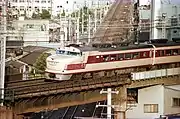
 KiHa 81 in the railyard of Tenri Station, 1978
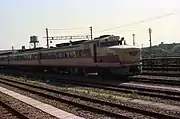
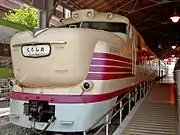 KiHa 81-3 in the Modern Transportation Museum, 2006
KiHa 82 series
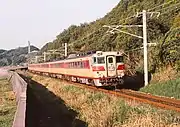
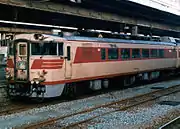
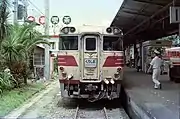
At the end of 1960, JNR started work on a redesign of the KiHa 81 series, with was focused on fixing the set's flaws and finding possible improvements. The KiHa 82 series, which included newly designed lead and intermediate cars, was manufactured after 1961.
- KiHa 82 (1 - 110)
- A lead power car equipped with a gangway, it had a capacity of 52 passengers, which was 12 more than the KiHa 81 lead car. This was the result of design improvements, which included the removal of the hood, along with adopting a walk-through cab. Other improvements included an addition of a toilet and washroom, alongside an enlarged cabin. 110 cars were built between 1961 and 1967.[5][6]
- KiHa 80 (13 - 166)
- These cars differed from those built in 1960 in that the bogies were changed and heat shielding was installed around the engine and exhaust. 154 cars were built between 1961 and 1967.[5][6]
- KiRo 80 (6 - 62)
- In addition to the bogie and engine changes like that on the KiHa 80 cars, the seat radio was eliminated due to poor reception in rural areas, alongside the difficulties of cleaning the earphones. A water tank was installed on the roof due to the addition of two bathrooms. As the formation for the Ōzora service in 1961 did not connect these cars to the dining car, all cars from 43 onwards added a bridge between carriages, and all other cars were modified in the same way. In addition, all cars from 48 onwards had a changed bogie. 57 cars were manufactured between 1961 and 1967.[5][6]
- KiShi 80 (1 - 37)
- It is almost similar to the 151, 481 and 489 series dining cars, but with a few differences - the water tank is mounted on the floor, reducing the capacity to 32 passengers. In addition, the number of windows in the dining room and kitchen aisles was reduced by one block each, and the men's restroom and the doors for business use, were installed closer to the center of the car. Initially, a carriage position indicator was installed on these cars, but these were removed when the cars were transferred to other lines. The last car (37) had larger windows in the dining room and Venetian blinds. Furthermore, an additional engine was installed. 37 cars were built between 1961 and 1967 - cars 29 (which would be converted to a -500 series car for the Tomamu Sahoro Express in 1988), 36 and 37 would be transferred to JR Hokkaido in 1987, whilst the cars which were operating on Ōtori and Okhotsk services were replaced by KiHa 183 series sets in October 1986. All cars were scrapped by June 6, 2007.[5][6]
Joyful Trains
In the 1980s, a number of Joyful Trains were built, which included the Furano Express and the Tomamu Sahoro Express, which were both converted and owned by JR Hokkaido, and the Resort Liner, which was converted and owned by JR Central.
Furano Express (KiHa 84 series)
| Furano Express (フラノエクスプレス) | |
|---|---|
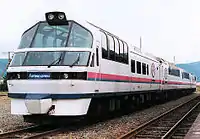 Furano Express set | |
| In service | 1986–1998 |
| Constructed | 1986–1987 |
| Scrapped | 2004 |
| Number scrapped | 4 cars |
| Specifications | |
| Maximum speed | 100 km/h (62 mph) |
Due to the popularity of the Alpha Continental Express, which was a modified KiHa 56 series car that entered service in 1985, the Furano area, which was attracting attention as a tourist destination, demanded a set that offered high-quality service and improved ride comfort and speed. The set won the 30th Blue Ribbon Award in 1987.[7]
From June to October 1987, as part of a collaboration with All Nippon Airways, the front destination board was changed to ANA, the train was reliveried with a band that had two shades of blue (which was similar to that on ANA aircraft), and the train's name was changed to the ANA Big Sneaker Train.[7]
The KiHa 184-11 car was added to make the set a 5-car formation in January 1990 - modifications included a new control circuit, new hood height, and new exterior paint color. The car was removed from the formation later that year and restored to its usual configuration, and would be eventually scrapped in March 1994 due to damage sustained in an accident on an Ōzora service in February that year. The set was withdrawn after the Last Run Furano service on November 1, 1998, and scrapped on September 27, 2004.[8][9]
- KiHa 84 (1 - 2)
- An end power car equipped with two engines, it had a raised section of seats for an observation deck, alongside a non-raised general section. The circuit voltage was lowered from 100V AC to 24V DC to enable joint working with KiHa 183 series trains. Two cars were rebuilt from the KiHa 80-164 and 80-165 cars in December 1986.[10]
- KiHa 83 (1)
- An intermediate power car equipped with one engine, it had an observation deck. One car was rebuilt from KiHa 82-109 in December 1986.[10]
- KiHa 80-500 (1)
- An intermediate power car equipped with two engines, it had a lounge. It was rebuilt from KiHa 82-110 and came into service in May 1987.[10]
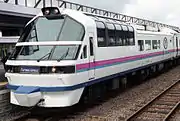 KiHa 84-1 at Furano, 1998
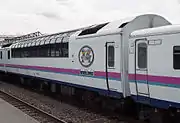 KiHa 83-1 at Furano, 1998
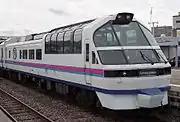 KiHa 84-2 at Furano, 1998
Tomamu Sahoro Express (KiHa 84-100 series)
| Tomamu Sahoro Express (トマムサホロエクスプレス) | |
|---|---|
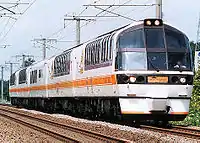 Tomamu Sahoro Express set | |
| In service | 1987–2002 |
| Constructed | 1987–1988 |
| Scrapped | 2004–2007 |
| Number scrapped | 5 cars |
| Specifications | |
| Maximum speed | 100 km/h (62 mph) |
Three cars (KiHa 84-101, KiHa 83-101 and KiHa 83-102) were completed on December 10, 1987, and in 1988, two further cars (KiHa 83-102 and KiShi 80-501) were added to the set, and it was converted to a five car formation - it began operating as a three-car set between Sapporo and Tomamu on December 27, 1987, immediately after its completion. In some seasons, it was operated as the Lavender Express to complement the Furano Express.[11]
As part of an 1989 event in Shikoku called the Joyful Train Gathering of Six JR Companies, the train ran between Takamatsu and Matsuyama (where it was put on temporary display) on November 4, and on November 5, it ran between Matsuyama and Tadotsu. It returned to Hokkaido via the Tokaido and Tohoku Main Lines from November 6 to 10 under locomotive power from Tadotsu.[12]
In 1999, the train was converted from Seasun to Mount Lake Onuma based in Hakodate, and to Night Cruise Ryobi, which travelled via the former Esashi Line. It was restored to the Tomamu Sahoro Express paint scheme after these services ended in August 2002, and was used on weekend services from September 14 to October 14 of the same year. After that, the cars were withdrawn, and were eventually scrapped in 2004 (with the exception of KiShi 80-501, which would be scrapped in 2007).[13]
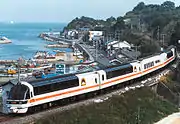 Tomamu Sahoro Express set running between Kikuma and Asanami on the Yosan Line as part of event, 1989
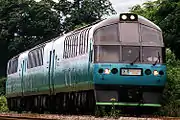 KiHa 84-100 in Mount Lake Onuma livery
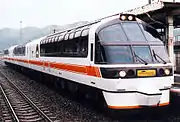 Tomamu Sahoro Express set at Shintoku, 2002
| Resort Liner (リゾートライナー) | |
|---|---|
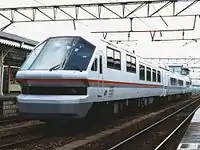 Resort Liner set, 1989 | |
| In service | 1988–1995 |
| Constructed | 1988 |
| Scrapped | 1995 |
| Number scrapped | 3 cars |
| Specifications | |
| Maximum speed | 100 km/h (62 mph) |
Resort Liner (KiRo 82-800 series)
This 3-car train was completed on July 29, 1988 and began commercial operation on August 16, 1988. Unlike the other joyful trains based on this series, they were to be used for special trains and group trains that were scheduled on a case-by-case basis. In addition, some of the trains were operated in conjunction with express trains of the KiHa 58 and KiHa 65 series - for this reason, the jumper couplers for the control circuits were replaced. The cars would eventually be scrapped in 1995.[14]
- KiRo 82-800 (1)
- A front power car which was converted from the KiHa 82-99 car, it had a capacity of 24 passengers - it was equipped with four private rooms that could seat six people each, along with a lounge that had a microwave and refrigerator.[14]
- KiRo 80-700 (1)
- An intermediate car which was converted from the KiRo 80-57 car, it could accommodate 44 passengers - it was equipped with a stage alongside four rows of reclining seats in front and behind it, along with an audiovisual system and monitors.[14]
- KiRo 80-800 (1)
- An end power car which was converted from the KiHa 80-96 car, it could accommodate 44 passengers - the front half of the car is a high-decker section with seats that had inbuilt TVs, whilst the back half had six private rooms that could seat four people each. It also had a bathroom, along with a luggage storage area.[14]
Preserved cars
- KiHa 81-3
- From 1980 to April 2014, it was preserved and exhibited at the Modern Transportation Museum in Osaka, before being moved to the Kyoto Railway Museum. The original KiHa 81-3 car was built by Teikoku Sharyo, but the car on display was built by Kinki Sharyo. The front name plate is not attached as before, and the word "Kuroshio" is painted directly on the plate.[15]
- KiHa 82-101
- It has been stored on the Hakkōda Maru.[16]
References
- Fukuhara, Shunichi. 国鉄特急電車物語 直流電車編 [The JNR Limited Express Train Story - Electric Train] (in Japanese). p. 45.
- Fukuhara, Shunichi. 国鉄特急電車物語 直流電車編 [The JNR Limited Express Train Story - Electric Train] (in Japanese). p. 78.
- "【第94回】「みちのく」" [Volume 94: Michinoku]. Hobbycom.jp (in Japanese). 15 October 2020. Retrieved 15 December 2021.
- "1961年 ブルーリボン・ローレル賞選定車両 – 鉄道友の会" [1961 Blue Ribbon Award & Laurel Prize - Japan Railfan Club]. Japan Railfan Club (in Japanese). Retrieved 2021-12-02.
- 『形式キハ80・181系』 [KiHa 80 and 181 Series]. イカロスMOOK 国鉄型車両の系譜シリーズ03 [IKAROS MOOK Genealogy of Japanese National Railways Type Vehicles Series 03] (in Japanese). Ikaros Publishing. 2008. pp. 64–73. ISBN 978-4-87149-833-3.
- Rail (in Japanese). 3. Eriei Publishing Department. Spring 1981. pp. 23–26. ISBN 4-87112-153-4.
- "1987年 ブルーリボン・ローレル賞選定車両 – 鉄道友の会" [1987 Blue Ribbon Award & Laurel Prize - Japan Railfan Club]. Japan Railfan Club (in Japanese). Retrieved 2021-12-02.
- "JR北海道 「フラノEXP」ラストラン 富良野駅で出発式" [Departure ceremony at Furano Station for the last run of JR Hokkaido's Furano Express]. Transportation News (in Japanese). Transportation News Co. Ltd. 9 November 1998.
- Japan Railfan Magazine (in Japanese). March 1997. p. 16.
- Railway Journal (in Japanese). 242. Railway Journal Co. Ltd. February 1987.
- "トマム・サホロエクスプレス JR北海道3番目のリゾート特急 札幌駅で出発式" [Tomamu Sahoro Express, JR Hokkaido's third resort express, departure ceremony at Sapporo Station]. Transportation News (in Japanese). Transportation News Co. Ltd. 23 December 1987. p. 2.
- JR Shikoku News (in Japanese). 24. October 1989.
- "JR北海道"トマムサホロエクスプレス"さよなら運転" [JR Hokkaido "Tomamu Sahoro Express" Farewell Operation]. Railway Timetable Journal (in Japanese). Transportation News Co. Ltd. 223: 75. November 2002.
- "新車ガイド JR東海 リゾートライナー" [JR Central New Car Guide - JR Central Resort Liner]. Japan Railfan Magazine (in Japanese). 330: 46–51. October 1988.
- "ひと足お先に 京都鉄道博物館へ。(中)" [Visit the Kyoto Railway Museum ahead of time.]. Hobidas (in Japanese). Neko Publishing. 2016-04-04. Retrieved 2017-09-07.
- "〔特集〕青函・宇高 鉄道連絡船廃止30年" [Special Feature: 30 Years after the Abolition of the Seikan/Ukko Rail Link]. j-train (in Japanese). Ikaros Publishing. 71: 6–57. October 2018.
 |
Wikimedia Commons has media related to JNR Kiha 80 series. |
.svg.png.webp) Multiple units of Hokkaido Railway Company Multiple units of Hokkaido Railway Company | ||||||||||||||||||||
|---|---|---|---|---|---|---|---|---|---|---|---|---|---|---|---|---|---|---|---|---|
| Current / active |
|  | ||||||||||||||||||
| Retired / withdrawn |
| |||||||||||||||||||
.svg.png.webp) Multiple units of Central Japan Railway Company Multiple units of Central Japan Railway Company | ||||||||||||||||||||||||||
|---|---|---|---|---|---|---|---|---|---|---|---|---|---|---|---|---|---|---|---|---|---|---|---|---|---|---|
| Current / active |
|  | ||||||||||||||||||||||||
| Future |
| |||||||||||||||||||||||||
| Retired / withdrawn |
| |||||||||||||||||||||||||