Killough
Killough (/kɪˈlɒx/ ki-LOKH; from Irish: Cill Locha, meaning 'church of the loch')[1][2] is a village and townland in County Down, Northern Ireland. It lies on the Irish Sea shore near Ardglass, five miles southeast of Downpatrick. It is notable for its sycamore-lined main street. In the 2001 Census it had a population of 845 people.[3]
Killough
| |
|---|---|
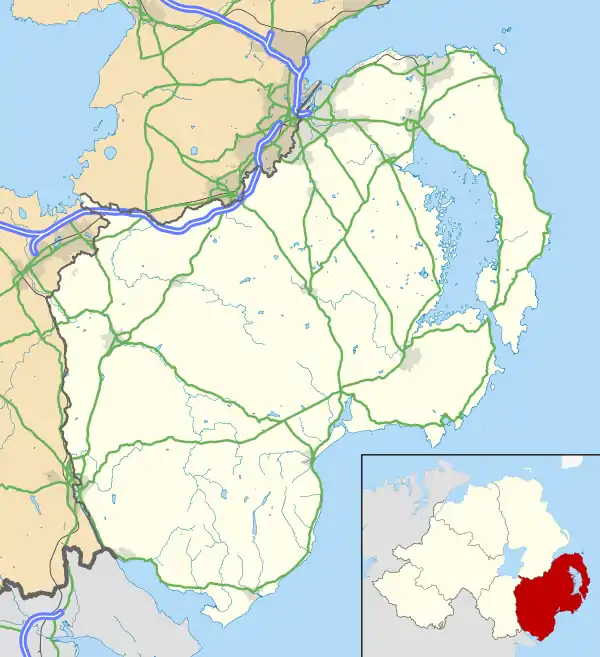  Location within County Down | |
| Population | 845 (2001 Census) |
| District |
|
| County | |
| Country | Northern Ireland |
| Sovereign state | United Kingdom |
| Post town | DOWNPATRICK |
| Postcode district | BT30 |
| Dialling code | 028 |
| UK Parliament | |
| NI Assembly | |
%252C_October_2009.JPG.webp)
History
The townland of Killough appears in the Down Survey as Kiltaghlins. The owner in 1641 was given as Thomas Cromwell Viscount of Lecale,[4] a direct descendent of Thomas Cromwell chief minister to Henry VIII.
The harbour was built in the 18th century by the Wards of Castle Ward house, just outside Strangford. A straight road still runs from Castle Ward to Killough. The village was renamed St Anne's Port but that name did not stick.[5]
After the outbreak of war between Great Britain and France in 1793 the growing of cereals increased in Lecale and Killough, as one of the ports of export, expanded to deal with it, until its population was almost double what it is today. The existing harbour facilities were soon inadequate and between 1821 and 1824, Michael Ward's son, the first Lord Bangor, employed the engineer Alexander Nimmo, to build new quays at a cost of £17,000. The piers, a long one of nearly 600 feet (180 m) on the Killough side and a short one of 100 feet (30 m) on the Coney Island side, enclosed a fine harbour. The village prospered and the grain merchants built their imposing houses in Castle Street, and their stores on the narrow lane leading to the quays.
Demography
Killough is classified as a small village or hamlet by the Northern Ireland Statistics and Research Agency (NISRA).[6] That is with a population between 500 and 1,000. On Census day (29 April 2001) there were 845 people living in Killough.[3] Of these:
- 28.5% were aged under 16 years and 13.3% were aged 60 and over
- 48.3% of the population were male and 51.7% were female
- 91.8% were from a Catholic background and 6.8% were from a Protestant background
- 7.3% of people aged 16–74 were unemployed
Places of interest
St John's Point lighthouse and ancient church are close to Killough.
Education
St. Joseph's Primary School is located on Main Street.
Killough Playgroup is located on Main Street.
Cultural references
Killough was used as one of 133 filming locations for the 2008 Kari Skogland film Fifty Dead Men Walking.
Killough was used as the main Irish filming location for The Shore, an Academy Award winning[7] short film about a man who emigrated to America to escape the Troubles bringing his daughter back to Northern Ireland to meet his childhood friends. The 30-minute film was shot entirely on location in Killough.
Scenes from Terry George's 2011 film Whole Lotta Sole[8] starring Brendan Fraser and Martin McCann were shot on location in the village, using Killough's harbour and beaches for many of the exterior shots.[9]
The village is the inspiration for the book Sweet Killough, Let Go Your Anchor by Irish politician Maurice Hayes, taken from the publication of the same name.
Notable people
- Jim Manley, artist
- Charles William Russell (1812–1880), priest and scholar.
- Paul George, Footballer
References
- "Placenames NI". Archived from the original on 11 June 2012. Retrieved 23 January 2011.
- Placenames Database of Ireland
- http://www.ninis.nisra.gov.uk/ NI Neighbourhood Information Service
- "Landowner by Name | The Down Survey Project". downsurvey.tcd.ie.
- "Place Names NI - Home". www.placenamesni.org. Retrieved 6 August 2021.
- NISRA – Northern Ireland Statistics and Research Agency
- "24 Frames". Los Angeles Times.
- https://www.imdb.com/title/tt1545328/ Whole Lotta Sole (2011)
- http://steveinbelfast.posterous.com/the-shore Stephen Conlon's Posterous
External links
 |
Wikimedia Commons has media related to Killough. |
Authority control  | |
|---|---|
| General | |
| National libraries | |