Vietnamese people
The Vietnamese people (Vietnamese: người Việt) or Kinh people (Vietnamese: người Kinh) are a Southeast Asian ethnic group originally native to modern-day Northern Vietnam and Southern China. The native language is Vietnamese, the most widely spoken Austroasiatic language. Its vocabulary was influenced by Chinese early on. During the French colonial era, French was an official language in Vietnam. Afterwards, the Vietnamese language codified in the Latin alphabet emerged.
 Vietnamese women wearing a Vietnamese dress called áo dài | |
| Total population | |
|---|---|
| c. 89 million | |
| Regions with significant populations | |
 Vietnam Vietnam | 82,085,826 (2019)[1] |
 United States United States | 2,162,610 (2018)[2] |
 Cambodia Cambodia | 400,000–1,000,000[3][4][5] |
 Japan Japan | 448,053[6] |
 France France | ~400,000[7][8] |
.svg.png.webp) Australia Australia | 294,798 (2016)[9] |
 Taiwan Taiwan | 243,734 (2021)[lower-alpha 1][10] |
.svg.png.webp) Canada Canada | 240,514[11] |
 South Korea South Korea | 224,518 (2020)[12] |
 Germany Germany | 188,000 (2019)[13] |
 Russia Russia | 13,954[14]–150,000[15] |
 Laos Laos | 122,000[16] |
 Thailand Thailand | 100,000[17]–500,000[18] |
 Czech Republic Czech Republic | 60,000[19]–200,000[20] |
 Malaysia Malaysia | 80,000[21] |
 Poland Poland | 25,000–60,000[22][23] |
 United Kingdom United Kingdom | 50,000–100,000[24] |
 Angola Angola | 45,000[25] |
 Ukraine Ukraine | 10,000[26]–50,000[27] |
 Mainland China Mainland China | 36,205 (2010)[lower-alpha 2][28] /33,112 (2020)[29][lower-alpha 3] |
 Philippines Philippines | 27,600 |
 Norway Norway | 27,366 (2020)[30] |
 Netherlands Netherlands | 23,488 (2019)[31] |
 Sweden Sweden | 20,676 (2020)[32] |
 Macau Macau | ~20,000 (2018)[33] |
 United Arab Emirates United Arab Emirates | 20,000[34] |
 Saudi Arabia Saudi Arabia | 20,000[35][36][37] |
 Denmark Denmark | 15,953 (2020)[38] |
.svg.png.webp) Belgium Belgium | 12,000-15,000[39][40] |
 Finland Finland | 12,051[41] |
 Singapore Singapore | 12,000 (2012)[42] |
 Cyprus Cyprus | ~12,000[43][44] |
 Slovakia Slovakia | 5,565[45]–20,000[46] |
 New Zealand New Zealand | 10,086 (2018)[47] |
 Switzerland Switzerland | ~8,000[48] |
 Hungary Hungary | 7,304 (2016)[49] |
 Italy Italy | 5,000[50] |
 Austria Austria | 5,000[51] |
 Romania Romania | 3,000[52] |
 Bulgaria Bulgaria | 2,500[53] |
| Languages | |
| Vietnamese | |
| Religion | |
| Predominantly Vietnamese folk religion syncretized with Mahayana Buddhism. Minorities of Christians (mostly Roman Catholics) and other groups.[54] | |
| Related ethnic groups | |
| Other Vietic ethnic groups (Gin, Muong, Chứt, Thổ peoples) | |
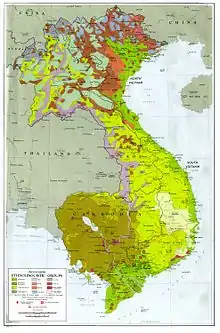
Vietnamese Kinh people account for just over 85.32% of the population of Vietnam in the 2019 census, and are officially known as Kinh people (người Kinh) to distinguish them from the other minority groups residing in the country such as the Hmong, Cham or Muong. The earliest recorded name for the ancient Kinh people in Vietnamese history books is Lạc or Lạc Việt. The Vietnamese are one of the four main groups of Vietic speakers in Vietnam, the others being the Muong, Thổ and Chứt people. They are related to the Gin or the Jing people, a Vietnamese ethnic group in China.
Terminology
Việt
The term "Việt" (Yue) (Chinese: 越; pinyin: Yuè; Cantonese Yale: Yuht; Wade–Giles: Yüeh4; Vietnamese: Việt) in Early Middle Chinese was first written using the logograph "戉" for an axe (a homophone), in oracle bone and bronze inscriptions of the late Shang dynasty (c. 1200 BC), and later as "越".[55] At that time it referred to a people or chieftain to the northwest of the Shang.[56] In the early 8th century BC, a tribe on the middle Yangtze were called the Yangyue, a term later used for peoples further south.[56] Between the 7th and 4th centuries BC Yue/Việt referred to the State of Yue in the lower Yangtze basin and its people.[55][56] From the 3rd century BC the term was used for the non-Chinese populations of south and southwest China and northern Vietnam, with particular ethnic groups called Minyue, Ouyue (Vietnamese: Âu Việt), Luoyue (Vietnamese: Lạc Việt), etc., collectively called the Baiyue (Bách Việt, Chinese: 百越; pinyin: Bǎiyuè; Cantonese Yale: Baak Yuet; Vietnamese: Bách Việt; "Hundred Yue/Viet"; ).[55][56] The term Baiyue/Bách Việt first appeared in the book Lüshi Chunqiu compiled around 239 BC.[57] By the 17th and 18th centuries AD, educated Vietnamese apparently referred to themselves as người Việt (Viet people) or người nam (southern people).[58]
Kinh
Beginning in the 10th and 11th centuries, a strand of Proto-Viet-Muong with influence from Annamese Middle Chinese started to become what is now the Vietnamese language.[59][60][61] Its speakers called themselves the "Kinh" people, meaning people of the "metropolitan" centered around the Red River Delta with Hanoi as its capital. Historic and modern Chữ Nôm scripture classically uses the Han character '京', pronounced "Jīng" in Mandarin, and "Kinh" with Sino-Vietnamese pronunciation. Other variants of Proto-Viet-Muong were driven to the lowlands by the Kinh and were called Trại (寨 Mandarin: Zhài), or "outpost" people," by the 13th century. These became the modern Muong people.[62] According to Victor Lieberman, người Kinh may be a colonial-era term for Vietnamese speakers inserted anachronistically into translations of pre-colonial documents, but literature on 18th century ethnic formation is lacking.[58]
History
Origins and pre-history
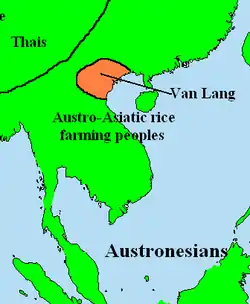
The forerunners of the ethnic Vietnamese were Proto-Vietic people who descended from Proto-Austroasiatic people who may have originated from somewhere in Southern China, Yunnan, the Lingnan, or the Yangtze River, together with the Monic, who settled further to the west and the Khmeric migrated further south. Most archaeologists and linguists, and other specialists like Sinologists and crop experts, believe that they arrived no later than 2000 BC bringing with them the practice of riverine agriculture and in particular the cultivation of wet rice.[63][64][65][66][67] Some linguists (James Chamberlain, Joachim Schliesinger) suggested that the Vietic-speaking people migrated from North Central Region to the Red River Delta, which had originally been inhabited by Tai-speakers.[68][69][70][71] However, Michael Churchman found no records of population shifts in Jiaozhi (centered around the Red River Delta) in Chinese sources, indicating that a fairly stable population of Austroasiatic speakers, ancestral to modern Vietnamese, inhabited in the delta during the Han-Tang periods.[72]
Another theory, based on linguistic diversity, locates the most probable homeland of the Vietic languages in modern-day Bolikhamsai Province and Khammouane Province in Laos as well as parts of Nghệ An Province and Quảng Bình Province in Vietnam. In the 1930s, clusters of Vietic-speaking communities were discovered in the hills of eastern Laos, are believed to be the earliest inhabitants of that region.[73] Archaeogenetics demonstrated that before the Dong Son period, the Red River Delta's inhabitants were predominantly Austroasiatic: genetic data from Phùng Nguyên culture's Mán Bạc burial site (dated 1,800 BC) have close proximity to modern Austroasiatic speakers;[74][75] meanwhile, "mixed genetics" from Đông Sơn culture's Núi Nấp site showed affinity to "Dai from China, Tai-Kadai speakers from Thailand, and Austroasiatic speakers from Vietnam, including the Kinh".[76]
According to Vietnamese legend The Tale the Hồng Bàng Clan written in the 15th century, the first Vietnamese descended from the dragon lord Lạc Long Quân and the fairy Âu Cơ. They married and had one hundred eggs, from which hatched one hundred children. Their eldest son ruled as the Hùng king.[77] The Hùng kings were claimed to be descended from the mythical figure Shen Nong.[78]
Early history and Chinese rule
Religion in Vietnam (2019)[1]

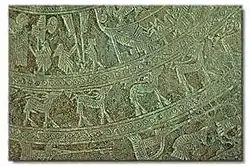
The earliest reference of the proto-Vietnamese or the Vietic in Chinese annals was the Lạc (Chinese: Luo), Lạc Việt, or the Dongsonian,[79] an ancient ethnic group of Mon-Khmer (Austroasiatic) stock occupied the Red River Delta.[80] The Lạc developed the sophisticated metal age Dong Son Culture and the Văn Lang chiefdom, ruled by the semi-mythical Hùng kings.[81] To the south of the Dongsonians was the Sa Huynh Culture of the Austronesian proto-Cham people.[82] Around 400–200 BC, the Lạc came to contact with the Âu Việt Tai people and the Sinitic people from the north.[80] According to a late third or early fourth century AD Chinese chronicle, the leader of the Âu Việt, Thục Phán, conquered Văn Lang and deposed the last Hùng king.[83] Having submissions of Lạc lords, Thục Phán proclaimed himself King An Dương of Âu Lạc kingdom.[81]
In 179 BC, Zhao Tuo, a Chinese general who has established the Nanyue state in modern-day Southern China, annexed Âu Lạc, and began the Sino-Vietic interaction that lasted in a millennium.[84] In 111 BC, the Han Empire conquered Nanyue, brought the Lac Viet region under Han rule.[85] By 2 AD, nearly one million people lived in northern Vietnam and central Vietnam (981,735 people according to Han census).[86] The Han Chinese began conducting their civilizing mission over the local people, which ultimately resulted in a violent uprising of the local Lac people led by Trung sisters in 40s AD.[87][88] The sisters' stronghold was annihilated in 43 AD, the rebelled Lạc lords were butchered, five thousand people were decapitated, and some hundred families were deported to China.[89] After 43 AD, the Han dynasty imposed direct imperial rule over the region. The Lạc Việt elites started adopting Chinese culture, techniques, and life style, while retaining their own customs.[90] Mahayana Buddhism arrived from India via sea routes in the 1st and 2nd centuries, while Taoism and Confucianism made their ways to early Vietnamese society at the same time.[91]
The Han empire declined in the late 2nd century and gave ways to the Three Kingdoms era. Chinese eyewitness reports in 231 stated that "In the two districts of Mê Linh in Jiaozhi and Do Long in Jiuzhen, it is usual for a younger brother to marry the widow of an older brother. Even the local officials cannot prevent it."[92] By the 7th century to 9th century AD, as the Tang Empire ruled over the region, historians such as Henri Maspero proposed that ethnic Vietnamese became separated from other Vietic groups such as the Muong and Chut due to heavier Chinese influences on the Vietnamese.[93] Other argue that a Vietic migration from north central Vietnam to the Red River Delta in the seventh century replaced the original Tai-speaking inhabitants.[94] At least 6 monks from northern Vietnam traveled to China, Srivijaya, India and Sri Lanka during the Tang period.[95] A bronze bell inscription dated 798 inscribes names of 100 female members of a local Buddhist sect that have the middle syllable thị (C. shi) that corresponding to the most common form of name for Vietnamese women.[96] In 816, Liêu Hữu Phương, a native Vietnamese scholar, traveled to Chinese capital Chang'an and passed the Imperial examination.[97] In the mid-9th century, local rebels aided by Nanzhao tore the Tang Chinese rule to nearly collapse.[98] The Tang reconquered the region in 866, causing half of the local rebels to flee into the mountains, which historians believe that was the separation between the Muong and the Vietnamese took at the end of Tang rule in Vietnam.[93][99] In 938, the Vietnamese leader Ngo Quyen who was a native of Thanh Hoa, led Viet forces defeated the Chinese Southern Han armada at Bạch Đằng River and proclaimed himself king, became the first Vietnamese king of the classical period.[100]
Classical and early modern period
Ngo Quyen died in 944 and his kingdom collapsed into chaos and disturbances between 12 Viet warlords and chiefs.[101] In 968, the Việt leader Đinh Bộ Lĩnh united them and established the Đại Việt (Great Việt) kingdom.[102] With assistance of powerful Buddhist monks, Đinh Bộ Lĩnh chose Hoa Lư in the southern edge of the Red River Delta as the capital instead of Tang-era Dai La, adopted Chinese-style imperial titles, coinage, and ceremonies and tried to preserve the T’ang administrative framework.[103] In 979 Dinh Bo Linh was assassinated, and Queen Duong Van Nga married with Dinh's general Le Hoan, appointed him as king. Disturbances in Dai Viet attracted attentions from neighbouring Chinese Song dynasty and Champa Kingdom, but they were defeated by Le Hoan.[104] In 982 the Vietnamese attacked and destroyed Champa's capital Indrapura and Đại Việt was recorded in Arab chronicle Al-Fihrist as the Luqin (Long Biên) kingdom.[105] A Khmer inscription dated 987 records the arrival of Vietnamese merchants (Yawana) in Angkor.[106] Chinese writers, Song Hao, Fan Chengda and Zhou Qufei, both reported that the Việt "tattooed their foreheads, crossed feet, black teeth, bare feet and blacken clothing."[107]
Successive Vietnamese royal families from the Đinh, Lê, Lý dynasties and Hoa-Chinese ancestry Trần and Hồ dynasties ruled the kingdom peacefully from 968 to 1407. King Lý Thái Tổ (r. 1009–1028) relocated the Vietnamese capital from Hoa Lư to Hanoi, the center of the Red River Delta in 1010.[108] They practiced elitist marriage alliances between clans and nobles in the country. Mahayana Buddhism became state religion, Vietnamese music instruments, dancing and religious worshipping were influenced by both Cham, Indian and Chinese styles,[109] while Confucianism slowly gained attention and influence.[110] The earliest surviving corpus and text in Vietnamese language dated early 12th century, and surviving chữ nôm script inscriptions dated early 13th century.[111]
One of the earliest ethnic Vietnamese that migrated to Korea during this time was Lý Dương Côn (李陽焜), an adopted son of King Lý Nhân Tông; following a succession crisis, he fled to Goryeo (918-1392 Korean Dynasty). He is known in modern-day Korea as a Vietnamese member of the Jeongseon-gun, Gangwon-do bon-gwan of the Lee family.[112] Later, a Vietnamese prince of the Lý Dynasty, Lý Long Tường (the seventh son of emperor Lý Anh Tông) and his crew of several thousand mandarins and servants escaped to Korea via Taiwan after hearing that the Lý Dynasty would be overthrown by the Trần Dynasty. Lý Long Tường and his crew sought refuge in the Goryeo Kingdom in 1226.
The Mongol Yuan dynasty unsuccessful invaded Dai Viet in the 1250s and 1280s, though they sacked Hanoi.[113] The Ming dynasty of China conquered Dai Viet in 1406, brought the Vietnamese under Chinese rule for 20 years, before they were driven out by Vietnamese leader Lê Lợi. The Chinese brought several thousands of Vietnamese artisans, skilled workers to China, resettled them in Beijing.[114] During the 15th century, Dai Viet's population skyrocketed from 1.9 million to 4.4 million.[115] The fourth grandson of Lê Lợi, king Lê Thánh Tông (r. 1460–1497), is considered one of the greatest monarchs in Vietnamese history. His reign is recognized for the extensive administrative, military, education, and fiscal reforms he instituted, and a cultural revolution that replaced the old traditional aristocracy with a generation of literati scholars, adopted Confucianism, and transformed a Dai Viet from a Southeast Asian style polity to a bureaucratic state, and flourished. Thánh Tông's forces, armed with gunpowder, overwhelmed the long-term rival Champa in 1471, occupied the Laotian and Lan Na kingdoms in the 1480s.[116]
16th century – Modern period
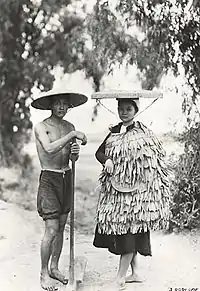
With the death of Thánh Tông in 1497, the Dai Viet kingdom swiftly declined. Climate extremes, failing crops, regionalism and factionism tore the Vietnamese apart.[117] From 1533 to 1790s, four powerful Vietnamese families: Mạc, Lê, Trịnh and Nguyễn, each ruled on their own domains. In northern Vietnam (Dang Ngoai–outer realm), the Lê kings barely sat on the throne while the Trịnh lords held power of the court. The Mạc controlled northeast Vietnam, Trà Kiệu and sometimes the Cambodian court. The Nguyễn lords ruled the southern polity of Dang Trong (inner realm).[118] Thousands of ethnic Vietnamese migrated south, settled on the old Cham lands.[119] European missionaries and traders from the sixteenth century brought new religion, ideas and crops to the Vietnamese (Annamites). By 1639, there were 82,500 Catholic converts throughout Vietnam. In 1651, Alexandre de Rhodes published a 300-pages catechism in Latin and romanized-Vietnamese (chu quoc ngu) or the Vietnamese alphabet.[120]
The Vietnamese Fragmentation period ended in 1802 as Emperor Gia Long, who was aided by French, Siamese, Malays,... defeated the Tay Son regime and reunited Vietnam. By 1847, the Vietnamese state under Emperor Thieu Tri, ethnic Vietnamese accounted for nearly 80 percent of the country's population (6.3 million people out of 8 million), while rest were Chams, Chinese, and Khmers.[121] This demographic model continues to persist through the French Indochina, Japanese occupation and modern day.
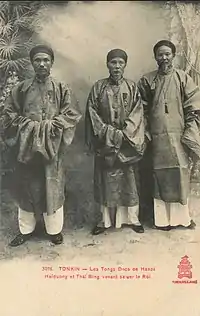
Between 1862 and 1867, the southern third of the country became the French colony of Cochinchina.[122] By 1884, the entire country had come under French rule, with the central and northern parts of Vietnam separated into the two protectorates of Annam and Tonkin. The three Vietnamese entities were formally integrated into the union of French Indochina in 1887.[123][124] The French administration imposed significant political and cultural changes on Vietnamese society.[125] A Western-style system of modern education introduced new humanist values into Vietnam.[126]
The French developed a plantation economy to promote the export of tobacco, indigo, tea and coffee.[127] However, they largely ignored the increasing demands for civil rights and self-government. A nationalist political movement soon emerged, with leaders like Phan Bội Châu, Phan Châu Trinh, Phan Đình Phùng, Emperor Hàm Nghi, and Hồ Chí Minh fighting or calling for independence.[128] This resulted in the 1930 Yên Bái mutiny by the Vietnamese Nationalist Party (VNQDĐ), which the French quashed. The mutiny caused an irreparable split in the independence movement that resulted in many leading members of the organisation becoming communist converts.[129][130][131]
The French maintained full control over their colonies until World War II, when the war in the Pacific led to the Japanese invasion of French Indochina in 1940. Afterwards, the Japanese Empire was allowed to station its troops in Vietnam while permitting the pro-Vichy French colonial administration to continue.[132][133] Japan exploited Vietnam's natural resources to support its military campaigns, culminating in a full-scale takeover of the country in March 1945. This led to the Vietnamese Famine of 1945, which resulted in up to two million deaths.[134][135]
In 1941, the Việt Minh, a nationalist liberation movement based on a Communist Ideology, led by Hồ Chí Minh. The Việt Minh sought independence for Vietnam from France and the end of the Japanese occupation.[136][137] Following the military defeat of Japan and the fall of its puppet Empire of Vietnam in August 1945, anarchy, rioting, and murder were widespread, as Saigon's administrative services had collapsed.[138] The Việt Minh occupied Hanoi and proclaimed a provisional government, which asserted national independence on 2 September.[137]
But as the French were weakened by the German occupation, British-Indian forces and the remaining Japanese Southern Expeditionary Army Group were used to maintain order and to help France reestablish control through the 1945–1946 War in Vietnam.[139] Hồ initially chose to take a moderate stance to avoid military conflict with France, asking the French to withdraw their colonial administrators and for French professors and engineers to help build a modern independent Vietnam.[137] But the Provisional Government of the French Republic did not act on these requests, including the idea of independence, and dispatched the French Far East Expeditionary Corps to restore colonial rule. This resulted in the Việt Minh launching a guerrilla campaign against the French in late 1946.[136][137][140] The resulting First Indochina War lasted until July 1954. The defeat of French colonialists and Vietnamese loyalists in the 1954 battle of Điện Biên Phủ allowed Hồ to negotiate a ceasefire from a favourable position at the subsequent Geneva Conference.[137][141]
The colonial administration was thereby ended and French Indochina was dissolved under the Geneva Accords of 1954. Vietnam was further divided into North and South administrative regions at the Demilitarised Zone, roughly along the 17th parallel north, pending elections scheduled for July 1956.[n 1] A 300-day period of free movement was permitted, during which almost a million northerners, mainly Catholics, moved south, fearing persecution by the communists. This migration was in large part aided by the United States military through Operation Passage to Freedom.[146][147] The partition of Vietnam by the Geneva Accords was not intended to be permanent, and stipulated that Vietnam would be reunited after the elections.[148] But in 1955, the southern State of Vietnam's prime minister, Ngô Đình Diệm, toppled Bảo Đại in a fraudulent referendum organised by his brother Ngô Đình Nhu, and proclaimed himself president of the Republic of Vietnam.[148] At that point the internationally recognised State of Vietnam effectively ceased to exist and was replaced by the Republic of Vietnam in the south—supported by the United States, France, Laos, Republic of China and Thailand—and Hồ's Democratic Republic of Vietnam in the north, supported by the Soviet Union, Sweden,[149] Khmer Rouge, and the People's Republic of China.[148]
On 2 July 1976, North and South Vietnam were merged to form the Socialist Republic of Việt Nam.[150] The war left Vietnam devastated, with the total death toll between 966,000 and 3.8 million.[151][152][153] In its aftermath, under Lê Duẩn's administration, there were no mass executions of South Vietnamese who had collaborated with the US or the defunct South Vietnamese government, confounding Western fears,[154] but up to 300,000 South Vietnamese were sent to reeducation camps, where many endured torture, starvation, and disease while being forced to perform hard labour.[155] The government embarked on a mass campaign of collectivisation of farms and factories.[156] In 1978, in response to the Khmer Rouge government of Cambodia ordering massacres of Vietnamese residents in the border villages in the districts of An Giang and Kiên Giang,[157] the Vietnamese military invaded Cambodia and removed them from power after occupying Phnom Penh.[158] The intervention was a success, resulting in the establishment of a new, pro-Vietnam socialist government, the People's Republic of Kampuchea, which ruled until 1989.[159]
At the Sixth National Congress of the Communist Party of Vietnam (CPV) in December 1986, reformist politicians replaced the "old guard" government with new leadership.[160][161] The reformers were led by 71-year-old Nguyễn Văn Linh, who became the party's new general secretary.[160] He and the reformers implemented a series of free-market reforms known as Đổi Mới ("Renovation") that carefully managed the transition from a planned economy to a "socialist-oriented market economy".[162][163] Though the authority of the state remained unchallenged under Đổi Mới, the government encouraged private ownership of farms and factories, economic deregulation, and foreign investment, while maintaining control over strategic industries.[163][164] The Vietnamese economy subsequently achieved strong growth in agricultural and industrial production, construction, exports, and foreign investment, although these reforms also caused a rise in income inequality and gender disparities.[165][166][167]
Religions
According to the 2019 Census, the religious demographics of Vietnam are as follows:[1]
- 86.32% Vietnamese folk religion or non religious
- 6.1% Catholicism
- 4.79% Buddhism (mainly Mahayana)
- 1.02% Hoahaoism
- 1% Protestantism
- <1% Caodaism
- 0.77 Others
It is worth noting here that the data is highly skewered, as a large majority of Vietnamese may declare themselves atheist, yet practice forms of traditional folk religion or Mahayana Buddhism.[168]
Estimates for the year 2010 published by the Pew Research Center:[169]
- Vietnamese folk religion, 45.3%
- Unaffiliated, 29.6%
- Buddhism, 16.4%
- Christianity, 8.2%
- Other, 0.5%
Diaspora
Originally from northern Vietnam and southern China, the Vietnamese have conquered much of the land belonging to the former Champa Kingdom and Khmer Empire over the centuries. They are the dominant ethnic group in most provinces of Vietnam, and constitute a small percentage of the population in neighbouring Cambodia.
Beginning around the sixteenth century, groups of Vietnamese migrated to Cambodia and China for commerce and political purposes. Descendants of Vietnamese migrants in China form the Gin ethnic group in the country and primarily reside in and around Guangxi Province. Vietnamese form the largest ethnic minority group in Cambodia, at 5% of the population.[170] Under the Khmer Rouge, they were heavily persecuted and survivors of the regime largely fled to Vietnam.
During French colonialism, Vietnam was regarded as the most important colony in Asia by the French colonial powers, and the Vietnamese had a higher social standing than other ethnic groups in French Indochina.[171] As a result, educated Vietnamese were often trained to be placed in colonial government positions in the other Asian French colonies of Laos and Cambodia rather than locals of the respective colonies. There was also a significant representation of Vietnamese students in France during this period, primarily consisting of members of the elite class. A large number of Vietnamese also migrated to France as workers, especially during World War I and World War II, when France recruited soldiers and locals of its colonies to help with war efforts in Metropolitan France. The wave of migrants to France during World War I formed the first major presence of Vietnamese people in France and the Western world.[172]
When Vietnam gained its independence from France in 1954, a number of Vietnamese loyal to the colonial government also migrated to France. During the partition of Vietnam into North and South, a number of South Vietnamese students also arrived to study in France, along with individuals involved in commerce for trade with France, which was a principal economic partner with South Vietnam.[172]
Forced repatriation in 1970 and deaths during the Khmer Rouge era reduced the Vietnamese population in Cambodia from between 250,000 and 300,000 in 1969 to a reported 56,000 in 1984.[173]
The Fall of Saigon and end of the Vietnam War prompted the start of the Vietnamese diaspora, which saw millions of Vietnamese fleeing the country from the new communist regime. Recognizing an international humanitarian crisis, many countries accepted Vietnamese refugees, primarily the United States, France, Australia and Canada.[174] Meanwhile, under the new communist regime, tens of thousands of Vietnamese were sent to work or study in Eastern Bloc counties of Central and Eastern Europe as development aid to the Vietnamese government and for migrants to acquire skills that were to be brought home to help with development.[175] However, after the fall of the Berlin Wall, a vast majority of these overseas Vietnamese decided to remain in their host nations.
See also
- Baiyue
- Lạc Việt
- Âu Lạc
- Vietnamese language
- List of Vietnamese people
- Overseas Vietnamese (Known as "Việt Kiều")
- Vietnamese culture
- Vietnamese cuisine
- Vietnamese music
- Vietnamese name
- List of ethnic groups in Vietnam
- History of Vietnam
- Southeast Asia
- Ethnic groups of Southeast Asia
- Vietnamese clothing
- Culture of Vietnam
Notes
- Neither the American government nor Ngô Đình Diệm's State of Vietnam signed anything at the 1954 Geneva Conference. The non-communist Vietnamese delegation objected strenuously to any division of Vietnam; however, the French accepted the Việt Minh proposal[142] that Vietnam be united by elections under the supervision of "local commissions".[143] The United States, with the support of South Vietnam and the United Kingdom, countered with the "American Plan",[144] which provided for United Nations-supervised unification elections. The plan, however, was rejected by Soviet and other communist delegations.[145]
- The number of Vietnamese citizens currently in Taiwan was 243,734 as of 31 July 2021 (145,271 males, 98,463 females) while the number of Vietnamese citizens holding a valid residence permit was 268,230 (157,914 males, 110,316 females)
- This data is only Vietnamese Nationals in Mainland China, Excluding Gin people and data in Hong Kong, Macau and Taiwan.
- this data is only Gin people in Mainland China.
References
- General Statistics Office of Vietnam (2019). "Completed Results of the 2019 Viet Nam Population and Housing Census" (PDF). Statistical Publishing House (Vietnam). ISBN 978-604-75-1532-5.
- "Asian and Pacific Islander Population in the United States census.gov". United States Census Bureau. Archived from the original on March 21, 2021. Retrieved February 14, 2021.
- Ponnudurai, Parameswaran (19 March 2014). "Ethnic Vietnamese in Cambodia Left in Limbo Without Citizenship". Radio Free Asia. RFA Khmer Service. Retrieved 13 March 2018.
- "Vietnamese in Cambodia". Joshua Project. Retrieved 13 March 2018.
- "A People in Limbo, Many Living Entirely on the Water". The New York Times. 2018-03-28.
- "Vietnam pips South Korea, becomes second largest foreigners group in Japan". VnExpress. 2021-04-03.
- "Les célébrations du Têt en France par la communauté vietnamienne" (in French). Le Petit Journal. Retrieved 2020-09-28.
- Étude de la Transmission Familiale et de la Practique du Parler Franco-Vietnamien (in French) Retrieved on 22-12-2015.
- "2016 Census Community Profiles". Australian Bureau of Statistics. Retrieved 11 April 2018.
- 統計資料. National Immigration Agency, Ministry of the Interior, Republic of China (Taiwan). 2021-07-31.
- "Census Profile, 2016 Census". Statistics Canada. 7 February 2017. Retrieved 19 July 2018.
- "Vietnam ranks second in number of foreigners staying in RoK". Vietnam Times. February 17, 2020.
- "Bevölkerung in Privathaushalten 2019 nach Migrationshintergrund". Federal Statistical Office of Germany (Statistisches Bundesamt). 28 July 2020.
- "Национальный состав населения по субъектам Российской Федерации". Retrieved April 5, 2020.
- L. Anh Hoang; Cheryll Alipio (2019). Money and Moralities in Contemporary Asia. Amsterdam University Press. p. 64. ISBN 9789048543151.
It is estimated that there are up to 150,000 Vietnamese migrants in Russia, but the vast majority of them are undocumented.
- "Vietnamese in Laos". joshuaproject.net.
- "Chủ tịch Quốc hội gặp gỡ cộng đồng người Việt Nam tại Thái Lan" (in Vietnamese). Retrieved 2021-02-02.
- "Người Việt bán hàng rong ở Thái Lan". Radio Free Asia.
- Foreigners, total by citizenship as at 31 December 2018 1). Czech Statistical Office
- "Die Vietnamesen, eine aktive Minderheit in Tschechien". Arte. 2 June 2009. Archived from the original on 12 December 2012.
- "Viet Nam, Malaysia's trade unions ink agreement to strengthen protection of migrant workers". International Labour Organization. 16 March 2015.
- (in Polish) SPOŁECZNOŚĆ WIETNAMSKA W POLSCE POLITYKA MIGRACYJNA WIETNAMU, Wydział Analiz Migracyjnych, Departament Polityki Migracyjnej Ministerstwo Spraw Wewnętrznych i Administracji, Warszawa, czerwiec 2007. P.34
- "Wietnamczycy upodobali sobie Polskę. Może być ich 60 tys. w naszym kraju". www.wiadomosci24.pl (in Polish). 4 September 2012. Retrieved 2015-11-02.
- "Vietnam who after 30 years in the UK". Retrieved 2021-02-06.
- "Cuộc sống người Việt ở Angola". RFA. 1 June 2013.
- "Protecting Vietnamese community in Ukraine". Vietnamese Embassy in Ukraine. Retrieved 2021-02-02.
- "Vietnamese come to Ukraine for a better life, although many long to return to homeland". Kyiv Post. December 3, 2009.
- "Major Figures on Residents from Hong Kong, Macao and Taiwan and Foreigners Covered by 2010 Population Census". National Bureau of Statistics of China. April 29, 2011. Archived from the original on May 14, 2011. Retrieved May 4, 2011.
- "2-22. Population by ethnic groups and gender". National Bureau of Statistics of China. Retrieved 10 December 2021.
- "Immigrants and Norwegian-born to immigrant parents". Retrieved 2021-02-02.
- "Population; sex, age, migration background and generation, 1 January". Statistics Netherlands. Retrieved 2021-02-02.
- "Population by country of birth and year". Retrieved 2021-02-02.
- "Việt Nam opens consulate office in China's Macau". Retrieved 2 February 2021.
- "Embassy of the UAE in Hanoi » Vietnam - UAE Relations-Bilateral relations between UAE - Vietnam". Archived from the original on 2014-01-10. Retrieved 2014-02-25.
- "CỘNG ĐỒNG NGƯỜI VIỆT NAM Ở Ả-RẬP XÊ-ÚT MỪNG XUÂN ẤT MÙI - 2015". Retrieved 2021-02-06.
- "Người trong cuộc kể lại cuộc sống "như nô lệ" của lao động Việt ở Ả Rập Saudi". 3 January 2020. Retrieved 2021-02-06.
- "Tình cảnh 'Ô-sin' Việt ở Saudi: bị bóc lột, bỏ đói". Retrieved 2021-02-06.
- "FOLK1C: Population at the first day of the quarter by region, sex, age (5 years age groups), ancestry and country of origin". Statistics Denmark.
- . Chimviet.free.fr(in French). Retrieved on 2019-11-19.
- "Người Việt ở Bỉ và Đảng cộng sản kiểu mới, trẻ và hiện đại". BBC. 22 May 2019.
- "Population 31.12. by Area, Background country, Sex, Year and Information". Tilastokeskuksen PX-Web tietokannat.
- "Cộng đồng người Việt Nam tại Singapore đón xuân Nhâm Thìn".
- "Vietnamese in Cyprus, Laos celebrate traditional New Year". Vietnamplus. Retrieved 2015-10-31.
- Deputy FM meets Vietnamese nationals in Cyprus. Retrieved 2015-10-31.
- https://www.minv.sk/swift_data/source/policia/hranicna_a_cudzinecka_policia/rocenky/rok_2019/2019-rocenka-UHCP_EN.pdf
- a.s, Petit Press (July 28, 2015). "Slovakia's 'invisible minority' counters migration fears". spectator.sme.sk.
- "2018 Census ethnic groups dataset | Stats NZ". www.stats.govt.nz.
- "Vietnamese community in Switzerland support fight against coronavirus". vietnamnews.vn.
- Vukovich, Gabriella (2018). Mikrocenzus 2016 - 12. Nemzetiségi adatok [2016 microcensus - 12. Ethnic data] (PDF). Hungarian Central Statistical Office (in Hungarian). Budapest. ISBN 978-963-235-542-9. Retrieved 9 January 2019.
- "Người Việt tại tâm dịch của Italia" (in Vietnamese). VOV. 2020-03-27.
- "Truyền "ngọn lửa" văn hóa cho thế hệ trẻ người Việt tại Áo" (in Vietnamese). 2020-02-23.
- "Condiții inumane pentru muncitorii vietnamezi din România". Digi24 (in Romanian). 21 March 2019.
- "Lấy quốc tịch Châu Âu thông qua con đường Bulgaria" (in Vietnamese). Tuổi Trẻ. 2019-03-13.
- Pew Research Center: The Global Religious Landscape 2010.
- Norman, Jerry; Mei, Tsu-lin (1976). "The Austroasiatics in Ancient South China: Some Lexical Evidence". Monumenta Serica. 32: 274–301. doi:10.1080/02549948.1976.11731121.
- Meacham, William (1996). "Defining the Hundred Yue". Bulletin of the Indo-Pacific Prehistory Association. 15: 93–100. doi:10.7152/bippa.v15i0.11537. Archived from the original on 2014-02-28.
- The Annals of Lü Buwei, translated by John Knoblock and Jeffrey Riegel, Stanford University Press (2000), p. 510. ISBN 978-0-8047-3354-0. "For the most part, there are no rulers to the south of the Yang and Han Rivers, in the confederation of the Hundred Yue tribes."
- Lieberman 2003, p. 405.
- Phan, John (2010). "Re-Imagining "Annam": A New Analysis of Sino–Viet–Muong Linguistic Contact" (PDF). Chinese Southern Diaspora Studies. 4.
- Taylor 2013, p. 5.
- https://www.google.ca/books/edition/Viet_Nam/hNoWDgAAQBAJ?hl=en&gbpv=1&dq=annamese+middle+chinese&pg=PT174&printsec=frontcover
- Taylor 2013, pp. 4–6.
- Blench, Roger. 2018. Waterworld: lexical evidence for aquatic subsistence strategies in Austroasiatic. In Papers from the Seventh International Conference on Austroasiatic Linguistics, 174-193. Journal of the Southeast Asian Linguistics Society Special Publication No. 3. University of Hawaiʻi Press.
- Blench, Roger. 2017. Waterworld: lexical evidence for aquatic subsistence strategies in Austroasiatic. Presented at ICAAL 7, Kiel, Germany.
- Sidwell, Paul. 2015b. Phylogeny, innovations, and correlations in the prehistory of Austroasiatic. Paper presented at the workshop Integrating inferences about our past: new findings and current issues in the peopling of the Pacific and South East Asia, 22–23 June 2015, Max Planck Institute for the Science of Human History, Jena, Germany.
- Reconstructing Austroasiatic prehistory. In P. Sidwell & M. Jenny (Eds.), The Handbook of Austroasiatic Languages. Leiden: Brill. (Page 1: “Sagart (2011) and Bellwood (2013) favour the middle Yangzi”
- Peiros, Ilia (2011). "Some thoughts on the problem of the Austro-Asiatic homeland" (PDF). Journal of Language Relationship. Retrieved 4 August 2019.
- Chamberlain 2000, p. 40.
- Schliesinger (2018a), pp. 21, 97.
- Schliesinger (2018b), pp. 3–4, 22, 50, 54.
- Kiernan 2019, pp. 46–47.
- Churchman (2010), p. 36.
- Kiernan 2019, p. 52.
- Lipson, Mark; Cheronet, Olivia; Mallick, Swapan; Rohland, Nadin; Oxenham, Marc; Pietrusewsky, Michael; Pryce, Thomas Oliver; Willis, Anna; Matsumura, Hirofumi; Buckley, Hallie; Domett, Kate; Hai, Nguyen Giang; Hiep, Trinh Hoang; Kyaw, Aung Aung; Win, Tin Tin; Pradier, Baptiste; Broomandkhoshbacht, Nasreen; Candilio, Francesca; Changmai, Piya; Fernandes, Daniel; Ferry, Matthew; Gamarra, Beatriz; Harney, Eadaoin; Kampuansai, Jatupol; Kutanan, Wibhu; Michel, Megan; Novak, Mario; Oppenheimer, Jonas; Sirak, Kendra; Stewardson, Kristin; Zhang, Zhao; Flegontov, Pavel; Pinhasi, Ron; Reich, David (2018-05-17). "Ancient genomes document multiple waves of migration in Southeast Asian prehistory". Science. American Association for the Advancement of Science (AAAS). 361 (6397): 92–95. Bibcode:2018Sci...361...92L. bioRxiv 10.1101/278374. doi:10.1126/science.aat3188. ISSN 0036-8075. PMC 6476732. PMID 29773666.
- Corny, Julien, et al. 2017. "Dental phenotypic shape variation supports a multiple dispersal model for anatomically modern humans in Southeast Asia." Journalof Human Evolution 112 (2017):41-56. cited in Alves, Mark (2019-05-10). "Data from Multiple Disciplines Connecting Vietic with the Dong Son Culture". Conference: "Contact Zones and Colonialism in Southeast Asia and China's South (~221 BCE - 1700 CE)"At: Pennsylvania State University
- McColl et al. 2018. "Ancient Genomics Reveals Four Prehistoric Migration Waves into Southeast Asia". Preprint. Published in Science. https://www.biorxiv.org/content/10.1101/278374v1 cited in Alves, Mark (2019-05-10). "Data from Multiple Disciplines Connecting Vietic with the Dong Son Culture". Conference: "Contact Zones and Colonialism in Southeast Asia and China's South (~221 BCE - 1700 CE)"At: Pennsylvania State University
- Kelley 2016, pp. 165–167.
- Kelley 2016, p. 175.
- Kiernan 2019, pp. 41–42.
- Schafer 1967, p. 14.
- Kiernan 2019, p. 53.
- Kiernan 2019, p. 56.
- Kelley 2016, pp. 167–168.
- Kiernan 2019, p. 69.
- Kiernan 2019, p. 75.
- Kiernan 2019, p. 73.
- Kiernan 2019, pp. 75–77.
- Schafer 1967, p. 81.
- Kiernan 2019, p. 81.
- Kiernan 2019, p. 84.
- Kiernan 2019, p. 92.
- Kiernan 2019, p. 91.
- Maspero 1912, p. 10.
- Kiernan 2019, p. 43.
- Kiernan 2019, p. 109.
- Kiernan 2019, p. 110.
- Kiernan 2019, p. 111.
- Schafer 1967, p. 63.
- Taylor 1983, p. 248.
- Kiernan 2019, p. 127.
- Kiernan 2019, p. 139.
- Kiernan 2019, p. 141.
- Lieberman 2003, p. 352.
- Kiernan 2019, pp. 144–145.
- Bellwood & Glover 2004, p. 229.
- Kiernan 2019, p. 157.
- Marsh 2016, pp. 84–85.
- Kiernan 2019, p. 148.
- Kiernan 2019, pp. 153–154.
- Kiernan 2019, p. 155.
- Kiernan 2019, pp. 135, 138.
- Trung Nghia (2006-11-14), "Đi tìm dòng họ Lý ở Hàn Quốc: 800 năm hoài cố hương (Looking for the Lee family in Korea)", Tuoi Tre, retrieved 2007-07-02
- Kiernan 2019, pp. 169, 170.
- Kiernan 2019, pp. 194–197.
- Kiernan 2019, p. 212.
- Kiernan 2019, pp. 204–211.
- Kiernan 2019, pp. 213–214.
- Kiernan 2019, pp. 221–223.
- Kiernan 2019, pp. 224–225.
- Kiernan 2019, pp. 233–234.
- Lieberman 2003, p. 433.
- McLeod 1991, p. 61.
- Ooi 2004, p. 520.
- Cook 2001, p. 396.
- Frankum Jr. 2011, p. 172.
- Nhu Nguyen 2016, p. 37.
- Lim 2014, p. 33.
- Largo 2002, p. 112.
- Khánh Huỳnh 1986, p. 98.
- Odell & Castillo 2008, p. 82.
- Thomas 2012.
- Miller 1990, p. 293.
- Gettleman et al. 1995, p. 4.
- Thanh Niên 2015.
- Vietnam Net 2015.
- Joes 1992, p. 95.
- Pike 2011, p. 192.
- Gunn 2014, p. 270.
- Neville 2007, p. 124.
- Tonnesson 2011, p. 66.
- Waite 2012, p. 89.
- Gravel 1971, p. 134.
- Gravel 1971, p. 119.
- Gravel 1971, p. 140.
- Kort 2017, p. 96.
- Olson 2012, p. 43.
- DK 2017, p. 39.
- van Dijk et al. 2013, p. 68.
- Guttman, John (25 July 2013). "Why did Sweden support the Viet Cong?". History Net. Retrieved 25 September 2019.
- The New York Times 1976.
- Hirschman, Preston & Manh Loi 1995.
- Shenon 1995.
- Obermeyer, Murray & Gakidou 2008.
- Elliott 2010, pp. 499, 512–513.
- Sagan & Denny 1982.
- Spokesman-Review 1977, p. 8.
- Kissi 2006, p. 144.
- Meggle 2004, p. 166.
- Hampson 1996, p. 175.
- BBC News 1997.
- Văn Phúc 2014.
- Murray 1997, pp. 24–25.
- Bich Loan 2007.
- Howe 2016, p. 20.
- Goodkind 1995.
- Gallup 2002.
- Wagstaff, van Doorslaer & Watanabe 2003.
- Pew Research Center: .
- CIA – The World Factbook, Cambodia, retrieved 11 December 2012
- Carine Hahn, Le Laos, Karthala, 1999, page 77
- La Diaspora Vietnamienne en France un cas particulier Archived 2013-12-03 at the Wayback Machine (in French)
- "Cambodia – Population". Library of Congress Country Studies.
- "Online Exhibitions - Exhibitions - Canadian Museum of History". www.civilization.ca.
- Hillmann 2005, p. 87
Bibliography
Books
- Akazawa, Takeru; Aoki, Kenichi; Kimura, Tasuku (1992). The evolution and dispersal of modern humans in Asia. Hokusen-sha. ISBN 978-4-938424-41-1.
- Anderson, David (2005). The Vietnam War (Twentieth Century Wars). Palgrave. ISBN 978-0333963371.
- Alterman, Eric (2005). When Presidents Lie: A History of Official Deception and Its Consequences. Penguin. ISBN 978-0-14-303604-3.
- Anderson, James A.; Whitmore, John K. (2014). China's Encounters on the South and Southwest: Reforging the Fiery Frontier Over Two Millennia. Brill Publishers. ISBN 978-90-04-28248-3.
- Bellwood, Peter; Glover, Ian, eds. (2004). Southeast Asia: From Prehistory to History. Routledge. ISBN 9780415297776.
- Brigham, Robert Kendall (1998). Guerrilla Diplomacy: The NLF's Foreign Relations and the Viet Nam War. Cornell University Press. ISBN 978-0-8014-3317-7.
- Brindley, Erica (2015). Ancient China and the Yue: Perceptions and Identities on the Southern Frontier, C.400 BCE-50 CE. Cambridge University Press. ISBN 978-1107084780.
- Buttinger, Joseph (1958). The Smaller Dragon: A Political History of Vietnam. Praeger Publishers.
- Buttinger, Joseph (1968). Vietnam: A Political History. Praeger.
- Chua, Amy (2003). World On Fire. Knopf Doubleday Publishing. ISBN 978-0385721868.
- Chua, Amy (2018). Political Tribes: Group Instinct and the Fate of Nations. Penguin Press. ISBN 978-0399562853.
- Cima, Ronald J. (1987). Vietnam: A Country Study. United States Library of Congress. ISBN 978-0160181436.
- Cook, Bernard A. (2001). Europe Since 1945: An Encyclopedia. Taylor & Francis. ISBN 978-0-8153-4057-7.
- Cortada, James W. (1994). Spain in the Nineteenth-century World: Essays on Spanish Diplomacy, 1789–1898. Greenwood Press. ISBN 978-0-313-27655-2.
- Cottrell, Robert C. (2009). Vietnam. Infobase Publishing. ISBN 978-1-4381-2147-5.
- Đào Duy Anh (2016) [First published 1964]. Đất nước Việt Nam qua các đời: nghiên cứu địa lý học lịch sử Việt Nam (in Vietnamese). Nha Nam. ISBN 978-604-94-8700-2.
- Dennell, Robin; Porr, Martin (2014). Southern Asia, Australia, and the Search for Human Origins. Cambridge University Press. ISBN 978-1-107-72913-1.
- van Dijk, Ruud; Gray, William Glenn; Savranskaya, Svetlana; Suri, Jeremi; et al. (2013). Encyclopedia of the Cold War. Routledge. ISBN 978-1-135-92311-2.
- DK (2017). The Vietnam War: The Definitive Illustrated History. Dorling Kindersley Limited. ISBN 978-0-241-30868-4.
- Dohrenwend, Bruce P.; Turse, Nick; Wall, Melanie M.; Yager, Thomas J. (2018). Surviving Vietnam: Psychological Consequences of the War for US Veterans. Oxford University Press. ISBN 978-0-19-090444-9.
- Duy Hinh, Nguyen; Dinh Tho, Tran (2015). The South Vietnamese Society. Normanby Press. ISBN 978-1-78625-513-6.
- Eggleston, Michael A. (2014). Exiting Vietnam: The Era of Vietnamization and American Withdrawal Revealed in First-Person Accounts. McFarland Publishing. ISBN 978-0-7864-7772-2.
- Elliott, Mai (2010). RAND in Southeast Asia: A History of the Vietnam War Era. RAND Corporation. ISBN 978-0-8330-4915-5.
- Fitzgerald, C. P (1972). The Southern Expansion of the Chinese People. Barrie & Jenkins.
- Frankum Jr., Ronald B. (2011). Historical Dictionary of the War in Vietnam. Scarecrow Press. ISBN 978-0-8108-7956-0.
- Gettleman, Marvin E.; Franklin, Jane; Young, Marilyn B.; Franklin, H. Bruce (1995). Vietnam and America: A Documented History. Grove Press. ISBN 978-0-8021-3362-5.
- Gibbons, William Conrad (2014). The U.S. Government and the Vietnam War: Executive and Legislative Roles and Relationships, Part III: 1965–1966. Princeton University Press. ISBN 978-1-4008-6153-8.
- Gilbert, Adrian (2013). Encyclopedia of Warfare: From the Earliest Times to the Present Day. Taylor & Francis. ISBN 978-1-135-95697-4.
- Gravel, Mike (1971). The Pentagon Papers: The Defense Department History of United States Decision-making on Vietnam. Beacon Press. ISBN 978-0-8070-0526-2.
- Gunn, Geoffrey C. (2014). Rice Wars in Colonial Vietnam: The Great Famine and the Viet Minh Road to Power. Rowman & Littlefield Publishers. ISBN 978-1-4422-2303-5.
- Hampson, Fen Osler (1996). Nurturing Peace: Why Peace Settlements Succeed Or Fail. US Institute of Peace Press. ISBN 978-1-878379-55-9.
- Heneghan, George Martin (1969). Nationalism, Communism and the National Liberation Front of Vietnam: Dilemma for American Foreign Policy. Department of Political Science, Stanford University.
- Hiẻ̂n Lê, Năng (2003). Three victories on the Bach Dang river. Nhà xuất bản Văn hóa-thông tin.
- Hoàng, Anh Tuấn (2007). Silk for Silver: Dutch-Vietnamese Relations, 1637–1700. Brill Publishers. ISBN 978-90-04-15601-2.
- Holmgren, Jennifer (1980). Chinese Colonization of Northern Vietnam: Administrative Geography and Political Development in the Tonking Delta, First To Sixth Centuries A.D. Australian National University Press.
- Hong Lien, Vu; Sharrock, Peter (2014). Descending Dragon, Rising Tiger: A History of Vietnam. Reaktion Books. ISBN 978-1-78023-388-8.
- Howe, Brendan M. (2016). Post-Conflict Development in East Asia. Routledge. ISBN 978-1-317-07740-4.
- Hyunh, Kim Khanh (1986). Vietnamese Communism, 1925-1945. Cornell University Press. ISBN 978-0801493973.
- Isserman, Maurice; Bowman, John Stewart (2009). Vietnam War. Infobase Publishing. ISBN 978-1-4381-0015-9.
- Jamieson, Neil L (1995). Understanding Vietnam. University of California Press. ISBN 9780520201576.
- Joes, Anthony James (1992). Modern Guerrilla Insurgency. ABC-CLIO. ISBN 978-0-275-94263-2.
- Jukes, Geoffrey (1973). The Soviet Union in Asia. University of California Press. ISBN 978-0-520-02393-2.
- Karlström, Anna; Källén, Anna (2002). Southeast Asian Archaeology. Östasiatiska Samlingarna (Stockholm, Sweden), European Association of Southeast Asian Archaeologists. International Conference. Museum of Far Eastern Antiquities, Stockholm. ISBN 978-91-970616-0-5.
- Keith, Charles (2012). Catholic Vietnam: A Church from Empire to Nation. University of California Press. ISBN 978-0-520-95382-6.
- Kelley, Liam C. (2014). "Constructing Local Narratives: Spirits, Dreams, and Prophecies in the Medieval Red River Delta". In Anderson, James A.; Whitmore, John K. (eds.). China's Encounters on the South and Southwest: Reforging the Fiery Frontier Over Two Millennia. United States: Brills. pp. 78–106. ISBN 978-9-004-28248-3.
- Kelley, Liam C. (2016), "Inventing Traditions in Fifteenth-century Vietnam", in Mair, Victor H.; Kelley, Liam C. (eds.), Imperial China and its southern neighbours, Institute of Southeast Asian Studies, pp. 161–193, ISBN 978-9-81462-055-0
- Keyes, Charles F. (1995). The Golden Peninsula: Culture and Adaptation in Mainland Southeast Asia. University of Hawaii Press. ISBN 978-0-8248-1696-4.
- Khánh Huỳnh, Kim (1986). Vietnamese Communism, 1925–1945. Cornell University Press. ISBN 978-0-8014-9397-3.
- Khoo, Nicholas (2011). Collateral Damage: Sino-Soviet Rivalry and the Termination of the Sino-Vietnamese Alliance. Columbia University Press. ISBN 978-0-231-15078-1.
- Kiernan, Ben (2017). Việt Nam: A History from Earliest Times to the Present. Oxford University Press. ISBN 978-0-19-516076-5.
- Kiernan, Ben (2019). Việt Nam: a history from earliest time to the present. Oxford University Press. ISBN 978-0190053796.
- Kissi, Edward (2006). Revolution and Genocide in Ethiopia and Cambodia. Lexington Books. ISBN 978-0-7391-1263-2.
- Kleeman, Terry F. (1998). Ta Chʻeng, Great Perfection – Religion and Ethnicity in a Chinese Millennial Kingdom. University of Hawaii Press. ISBN 0-8248-1800-8.
- Kort, Michael (2017). The Vietnam War Re-Examined. Cambridge University Press. ISBN 978-1-107-04640-5.
- Largo, V. (2002). Vietnam: Current Issues and Historical Background. Nova Science. ISBN 978-1590333686.
- Leonard, Jane Kate (1984). Wei Yuan and China's Rediscovery of the Maritime World. Harvard Univ Asia Center. ISBN 978-0-674-94855-6.
- Lewy, Guenter (1980). America in Vietnam. Oxford University Press. ISBN 978-0-19-991352-7.
- Li, Tana (1998). Cornell University. Southeast Asia Program (ed.). Nguyễn Cochinchina: Southern Vietnam in the Seventeenth and Eighteenth Centuries. Volume 23 of Studies on Southeast Asia (illustrated ed.). SEAP Publications. ISBN 0877277222. Retrieved 4 January 2013.
|volume=has extra text (help) - Li, Xiaobing (2012). China at War: An Encyclopedia. ABC-CLIO. ISBN 978-1-59884-415-3.
- Lieberman, Victor (2003). Strange Parallels: Integration of the Mainland Southeast Asia in Global Context, c. 800-1830, Vol 1. Cambridge University Press.
- Lim, David (2014). Economic Growth and Employment in Vietnam. Taylor & Francis. ISBN 978-1-317-81859-5.
- Lockard, Craig A. (2010). Societies, Networks, and Transitions, Volume 2: Since 1450. Cengage Learning. ISBN 978-1-4390-8536-3.
- Marsh, Sean (2016), "CLOTHES MAKE THE MAN: Body Culture and Ethnic Boundaries on the Lingnan Frontier in the Southern Song", in Mair, Victor H.; Kelley, Liam C. (eds.), Imperial China and its southern neighbours, Institute of Southeast Asian Studies, pp. 80–110
- McLeod, Mark W. (1991). The Vietnamese Response to French Intervention, 1862–1874. Greenwood Publishing Group. ISBN 978-0-275-93562-7.
- Meggle, Georg (2004). Ethics of Humanitarian Interventions. Walter de Gruyter. ISBN 978-3-11-032773-1.
- Miksic, John Norman; Yian, Go Geok (2016). Ancient Southeast Asia. Taylor & Francis. ISBN 978-1-317-27903-7.
- Miller, Robert Hopkins (1990). United States and Vietnam 1787–1941. DIANE Publishing. ISBN 978-0-7881-0810-5.
- Moïse, Edwin E. (2017). Land Reform in China and North Vietnam: Consolidating the Revolution at the Village Level. University of North Carolina Press. ISBN 978-0-8078-7445-5.
- Muehlenbeck, Philip Emil; Muehlenbeck, Philip (2012). Religion and the Cold War: A Global Perspective. Vanderbilt University Press. ISBN 978-0-8265-1852-1.
- Murphey, Rhoads (1997). East Asia: A New History. Pearson. ISBN 978-0205695225.
- Murray, Geoffrey (1997). Vietnam Dawn of a New Market. St. Martin's Press. ISBN 978-0-312-17392-0.
- Neville, Peter (2007). Britain in Vietnam: Prelude to Disaster, 1945–46. Routledge. ISBN 978-1-134-24476-8.
- Olsen, Mari (2007). Soviet-Vietnam Relations and the Role of China 1949–64: Changing Alliances. Routledge. ISBN 978-1-134-17413-3.
- Olson, Gregory A. (2012). Mansfield and Vietnam: A Study in Rhetorical Adaptation. MSU Press. ISBN 978-0-87013-941-3.
- Ooi, Keat Gin (2004). Southeast Asia: A Historical Encyclopedia, from Angkor Wat to East Timor. ABC-CLIO. ISBN 978-1-57607-770-2.
- Ooi, Keat Gin; Anh Tuan, Hoang (2015). Early Modern Southeast Asia, 1350–1800. Routledge. ISBN 978-1-317-55919-1.
- Oxenham, Marc; Buckley, Hallie (2015). The Routledge Handbook of Bioarchaeology in Southeast Asia and the Pacific Islands. Routledge. ISBN 978-1-317-53401-3.
- Oxenham, Marc; Tayles, Nancy (2006). Bioarchaeology of Southeast Asia. Cambridge University Press. ISBN 978-0-521-82580-1.
- Page, Melvin Eugene; Sonnenburg, Penny M. (2003). Colonialism: An International, Social, Cultural, and Political Encyclopedia. ABC-CLIO. ISBN 978-1-57607-335-3.
- Phan, Huy Lê; Nguyễn, Quang Ngọc; Nguyễn, Đình Lễ (1997). The Country Life in the Red River Delta.
- Phuong Linh, Huynh Thi (2016). State-Society Interaction in Vietnam. LIT Verlag Münster. ISBN 978-3-643-90719-6.
- Pike, Francis (2011). Empires at War: A Short History of Modern Asia Since World War II. I.B.Tauris. ISBN 978-0-85773-029-9.
- Rabett, Ryan J. (2012). Human Adaptation in the Asian Palaeolithic: Hominin Dispersal and Behaviour During the Late Quaternary. Cambridge University Press. ISBN 978-1-107-01829-7.
- Ramsay, Jacob (2008). Mandarins and Martyrs: The Church and the Nguyen Dynasty in Early Nineteenth-century Vietnam. Stanford University Press. ISBN 978-0-8047-7954-8.
- Richardson, John (1876). A school manual of modern geography. Physical and political. Publisher not identified.
- Schafer, Edward Hetzel (1967), The Vermilion Bird: T'ang Images of the South, Los Angeles: University of California Press, ISBN 9780520011458
- Smith, T. (2007). Britain and the Origins of the Vietnam War: UK Policy in Indo-China, 1943–50. Palgrave Macmillan UK. ISBN 978-0-230-59166-0.
- Taylor, Keith Weller (1983). The Birth of the Vietnam. University of California Press. ISBN 978-0-520-07417-0.
- Taylor, Keith W. (2013). A History of the Vietnamese. Cambridge University Press. ISBN 9781107244351.
- Thomas, Martin (2012). Rubber, coolies and communists: In Violence and Colonial Order: Police, Workers and Protest in the European Colonial Empires, 1918–1940 (Critical Perspectives on Empire from Part II – Colonial case studies: French, British and Belgian). pp. 141–176. doi:10.1017/CBO9781139045643.009. ISBN 978-1-139-04564-3.
- Tonnesson, Stein (2011). Vietnam 1946: How the War Began. University of California Press. ISBN 978-0-520-26993-4.
- Tran, Anh Q. (2017). Gods, Heroes, and Ancestors: An Interreligious Encounter in Eighteenth-Century Vietnam. Oxford University Press. ISBN 978-0-19-067760-2.
- Tucker, Spencer (1999). Vietnam. University of Kentucky Press. ISBN 978-0813121215.
- Tucker, Spencer C. (2011). The Encyclopedia of the Vietnam War: A Political, Social, and Military History, 2nd Edition [4 volumes]: A Political, Social, and Military History. ABC-CLIO. ISBN 978-1-85109-961-0.
- Turner, Robert F. (1975). Vietnamese communism, its origins and development. Hoover Institution Press, Stanford University. ISBN 978-0-8179-6431-3.
- Vo, Nghia M. (2011). Saigon: A History. McFarland & Company. ISBN 978-0-7864-8634-2.
- Waite, James (2012). The End of the First Indochina War: A Global History. Routledge. ISBN 978-1-136-27334-6.
- Walker, Hugh Dyson (2012). East Asia: A New History. ISBN 978-1477265161.
- Willbanks, James H. (2013). Vietnam War Almanac: An In-Depth Guide to the Most Controversial Conflict in American History. Skyhorse Publishing. ISBN 978-1-62636-528-5.
- Woods, L. Shelton (2002). Vietnam: a global studies handbook. ABC-CLIO. ISBN 978-1-57607-416-9.
- Yü, Ying-shih (1986), "Han foreign relations", in Twitchett, Denis C.; Fairbank, John King (eds.), The Cambridge History of China: Volume 1, The Ch'in and Han Empires, 221 BC-AD 220, Cambridge: Cambridge University Press, pp. 377–463
Journal articles and theses
- Crozier, Brian (1955). "The Diem Regime in Southern Vietnam". Far Eastern Survey. 24 (4): 49–56. doi:10.2307/3023970. JSTOR 3023970.
- Gallup, John Luke (2002). "The wage labor market and inequality in Viet Nam in the 1990s". Policy Research Working Paper Series, World Bank. Policy Research Working Papers. doi:10.1596/1813-9450-2896. hdl:10986/19272. S2CID 18598221 – via Research Papers in Economics.
- Gittinger, J. Price (1959). "Communist Land Policy in North Viet Nam". Far Eastern Survey. 28 (8): 113–126. doi:10.2307/3024603. JSTOR 3024603.
- Goodkind, Daniel (1995). "Rising Gender Inequality in Vietnam Since Reunification". Pacific Affairs. 68 (3): 342–359. doi:10.2307/2761129. JSTOR 2761129.
- Hirschman, Charles; Preston, Samuel; Manh Loi, Vu (1995). "Vietnamese Casualties During the American War: A New Estimate". Population and Development Review. 21 (4): 783–812. doi:10.2307/2137774. JSTOR 2137774.
- Matsumura, Hirofumi; Lan Cuong, Nguyen; Kim Thuy, Nguyen; Anezaki, Tomoko (2001). "Dental Morphology of the Early Hoabinian, the Neolithic Da But and the Metal Age Dong Son Civilized Peoples in Vietnam". Zeitschrift für Morphologie und Anthropologie. 83 (1): 59–73. doi:10.1127/zma/83/2001/59. JSTOR 25757578. PMID 11372468.
- Matsumura, Hirofumi; Yoneda, Minoru; Yukio, Dodo; Oxenham, Marc; et al. (2008). "Terminal Pleistocene human skeleton from Hang Cho Cave, northern Vietnam: implications for the biological affinities of Hoabinhian people". Anthropological Science. 116 (3): 201–217. doi:10.1537/ase.070416. Archived from the original (PDF) on 24 September 2018. Retrieved 16 October 2018 – via J-STAGE.
- Maspero, Henri (1912). "Études sur la phonétique historique de la langue annamite" [Studies on the phonetic history of the Annamite language]. Bulletin de l'École française d'Extrême-Orient (in French). 12 (1). doi:10.3406/befeo.1912.2713.
- Ngo, Lan A. (2016). Nguyễn–Catholic History (1770s–1890s) and the Gestation of Vietnamese Catholic National Identity (PDF). Georgetown University Graduate School of Arts and Sciences (Thesis). Archived from the original (PDF) on 28 September 2018. Retrieved 16 October 2018 – via DigitalGeorgetown.
- Nhu Nguyen, Quynh Thi (2016). "The Vietnamese Values System: A Blend of Oriental, Western and Socialist Values" (PDF). International Education Studies. 9 (12). Archived from the original (PDF) on 15 October 2018 – via Institute of Education Sciences.
- Obermeyer, Ziad; Murray, Christopher J L; Gakidou, Emmanuela (2008). "Fifty years of violent war deaths from Vietnam to Bosnia: analysis of data from the world health survey programme [Table 3]". BMJ. 336 (7659): 1482–6. doi:10.1136/bmj.a137. PMC 2440905. PMID 18566045.
- Odell, Andrew L.; Castillo, Marlene F. (2008). "Vietnam in a Nutshell: An Historical, Political and Commercial Overview" (PDF). NYBSA International Law Practicum. 21 (2). Archived from the original (PDF) on 12 October 2018 – via Duane Morris.
- Quach Langlet, Tâm (1991). "Charles Fourniau : Annam-Tonkin 1885–1896. Lettrés et paysans vietnamiens face à la conquête coloniale. Travaux du Centre d'Histoire et Civilisations de la péninsule Indochinoise". Bulletin de l'École Française d'Extrême-Orient (in French). 78 – via Persée.

- Taylor, Keith (1980). "An Evaluation of the Chinese Period in Vietnamese History". The Journal of Asiatic Studies 23(1).
- Wagstaff, Adam; van Doorslaer, Eddy; Watanabe, Naoko (2003). "On decomposing the causes of health sector inequalities with an application to malnutrition inequalities in Vietnam". Journal of Econometrics. 112 (1): 207–223. doi:10.1016/S0304-4076(02)00161-6. hdl:10986/19426. S2CID 122165846.
- Zinoman, Peter (2000). "Colonial Prisons and Anti-Colonial Resistance in French Indochina: The Thai Nguyen Rebellion, 1917". Modern Asian Studies. 34 (1): 57–98. doi:10.1017/S0026749X00003590. JSTOR 313112. S2CID 145191678.
Web sources
- BBC News (1997). "Vietnam: changing of the guard". BBC News.
- Gillet, Kit (2011). "Riding Vietnam's Ho Chi Minh trail". The Guardian.
- McKinney, Brennan (2009). "The Human Migration: Homo Erectus and the Ice Age". Yahoo! Voices. Archived from the original on 12 November 2012. Retrieved 22 January 2013.
- The New York Times (3 July 1976). "2 Parts of Vietnam Officially Reunited; Leadership Chosen". The New York Times.
- Shenon, Philip (23 April 1995). "20 Years After Victory, Vietnamese Communists Ponder How to Celebrate". The New York Times.
- Spokesman-Review (1977). "Vietnam outlines collectivization goals". The Spokesman-Review.
- Thanh Niên (2015). "Horrific photos recall Vietnamese Famine of 1945". Vo An Ninh. Thanh Niên.
- Vietnam Net (2015). "Rare photos of Vietnam's famine in 1945". Vo An Ninh. Vietnam Net.
Further reading
- Dutton, George; Werner, Jayne; Whitmore, John K., eds. (2012). Sources of Vietnamese Tradition. Columbia University Press. ISBN 978-0-231-51110-0.
- Lockhart, Bruce M.; Duiker, William J. (14 April 2010). The A to Z of Vietnam. Scarecrow Press. ISBN 978-1-4617-3192-4.
- Ray, Nick; et al. (2010), Vietnam, Lonely Planet, ISBN 978-17-42203898
- McLeod, Mark; Nguyen, Thi Dieu (2001). Culture and Customs of Vietnam. Greenwood. ISBN 978-0-313-361135.
- Taylor, Keith Weller (1983). The Birth of the Vietnam. University of California Press. ISBN 978-0-520-07417-0.
- Taylor, Keith Weller (2013). A History of the Vietnamese. Cambridge University Press. ISBN 978-0-521-87586-8.
- Amer, Ramses (1996). Vietnam's Policies and Ethnic Chinese since 1975, Sojourn, Vol. 11, Issue 1: 76–104.
- Andaya, Barbara Watson (2006). The flaming womb: repositioning women in early modern Southeast Asia. University of Hawaii Press. p. 146. ISBN 0-8248-2955-7. Retrieved 28 June 2010.
- Bob Baulch; Truong Thi Kim Chuyen; Dominique Haughton; Jonathan Haughton (May 2002). "Ethnic Minority Development in Vietnam –A Socioeconomic Perspective" (PDF). WPS 2836. The World Bank–Development Research Group. Retrieved 13 December 2012. Cite journal requires
|journal=(help) - Chen, King C. (1987). China's War With Vietnam, 1979: Issues, Decisions, and Implications. Hoover Press. ISBN 0817985727. Retrieved 8 May 2012.
- Cœdès, George. (1966). The Making of South East Asia (illustrated, reprint ed.). University of California Press. ISBN 0520050614. Retrieved 7 August 2013.
- Cooke, Nola; Li, Tana; Anderson, James, eds. (2011). The Tongking Gulf Through History (illustrated ed.). University of Pennsylvania Press. ISBN 978-0812243369. Retrieved 4 January 2013.
- Cooke, Nola; Li, Tana (2004). Water Frontier: Commerce and the Chinese in the Lower Mekong Region, 1750–1880. Rowman & Littlefield. ISBN 0742530833. Retrieved 28 June 2012.
- Cœdès, George (1968). The Indianized States of South-East Asia (3 ed.). University of Hawaii Press. ISBN 082480368X. Retrieved 4 January 2013.
- The New Encyclopædia Britannica. 8. 2003. ISBN 0-85229-961-3. Missing or empty
|title=(help) - Contributor: Far-Eastern Prehistory Association Asian Perspectives, Volume 28, Issue 1. (1990) University Press of Hawaii. Retrieved 7 August 2013.
- Gernet, Jacques (1996). A History of Chinese Civilization (2, illustrated, revised, reprint ed.). Cambridge University Press. ISBN 0521497817.
- Hall, Kenneth R., ed. (2008). Secondary Cities and Urban Networking in the Indian Ocean Realm, C. 1400–1800. Volume 1 of Comparative urban studies. Lexington Books. ISBN 0739128353. Retrieved 7 August 2013.
- Hall, Kenneth R. (2010). A History of Early Southeast Asia: Maritime Trade and Societal Development, 100–1500 (illustrated ed.). Rowman & Littlefield Publishers. ISBN 978-0742567627. Retrieved 4 January 2013.
- Gibney, Matthew J; Hansen, Randall (2005-06-30). Immigration and Asylum: From 1900 to the Present. ABC-CLIO. p. 664. ISBN 1576077969. Retrieved 26 April 2012.
hoa refugee -wikipedia.
- Heng, Derek (2009). Sino-Malay Trade and Diplomacy from the Tenth Through the Fourteenth Century. Ohio University Press. ISBN 978-0-89680-271-1. Retrieved 28 June 2010.
- "Journal of Southeast Asian studies". 37 (1). 2006. Retrieved 4 January 2013. Cite journal requires
|journal=(help) - Khánh, Trâǹ (1993). The Ethnic Chinese and Economic Development in Vietnam. Institute of Southeast Asian Studies. ISBN 9789813016675. Retrieved 26 April 2012.
- Lai, H. Mark (2004). On Becoming Chinese American: A History of Communities and Institutions. Rowman Altamira. ISBN 0759104581.
- Diana Lary, ed. (2007). The Chinese State at the Borders (illustrated ed.). UBC Press. ISBN 978-0774813334. Retrieved 4 January 2013.
- Logan, William Stewart (2000). Hanoi: Biography of a City. UNSW Press. ISBN 0868404438. Retrieved 13 December 2012.
- MacKerras, Colin (2003). Ethnicity in Asia. Routledge-Curzon. ISBN 0415258170. Retrieved 26 April 2012.
- Marr, David G.; White, Christine Pelzer (1988). Postwar Vietnam: Dilemmas in Socialist Development–Issue 3 of Southeast Asia Program Series. SEAP Publications. ISBN 0877271208. Retrieved 6 May 2012.
- Marr, David G. (2010). Vietnamese, Chinese, and Overseas Chinese during the Chinese Occupation of Northern Indochina (1945-1946), Chinese Southern Diaspora Studies, Vol. 4: 129-139.
- Stratton, Eric (2002). Evolution Of Indian Stupa Architecture In East Asia (illustrated ed.). Vedams eBooks (P) Ltd. ISBN 8179360067. Retrieved 4 January 2013.
- Suryadinata, Leo (1997-09-15). Ethnic Chinese As Southeast Asians. Palgrave Macmillan. ISBN 0312175760. Retrieved 21 October 2012.
- Taylor, Keith Weller; Whitmore, John K., eds. (1995). Essays Into Vietnamese Pasts. SEAP Publications. ISBN 0877277184. Retrieved 4 January 2013.
- Taylor, Philip (2007). Cham Muslims of the Mekong Delta: place and mobility in the cosmopolitan periphery. NUS Press. ISBN 978-9971-69-361-9. Retrieved 9 January 2011.
- Tetsudosho (1917). An Official Guide to Eastern Asia: East Indies, Vol. 5. Imperial Japanese Government Railways.
- Tong, Chee Kiong (2010). Identity and Ethnic Relations in Southeast Asia: Racializing Chineseness. Springer. ISBN 978-9048189083. Retrieved 28 June 2012.
- Tsai, Shih-Shan Henry (1996). The Eunuchs in the Ming Dynasty (Ming Tai Huan Kuan) (illustrated ed.). SUNY Press. ISBN 0791426874. Retrieved 5 January 2013.
- Ungar, E. S. (1988). The Struggle Over the Chinese Community in Vietnam, 1946-1986, Pacific Affairs, Vol. 60, Issue 4: 596–614.
- Wade, Geoff (2005), Southeast Asia in the Ming Shi-lu: an open access resource, Asia Research Institute and the Singapore E-Press, National University of Singapore, retrieved 6 November 2012
- West, Barbara A. (2010-05-19). Encyclopedia of the Peoples of Asia and Oceania. Infobase Publishing. ISBN 9781438119137. Missing or empty
|title=(help) - Wicks, Robert S. (1992). Money, markets, and trade in early Southeast Asia: the development of indigenous monetary systems to AD 1400. SEAP Publications. p. 215. ISBN 0-87727-710-9. Retrieved 28 June 2010.
- Santasombat, Yos (2017). Chinese Capitalism in Southeast Asia: Cultures and Practices. Palgrave Macmillan. ISBN 978-9811046957.
- Kiernan, Ben (2019). Việt Nam: a history from earliest time to the present. Oxford University Press. ISBN 978-0-190-05379-6.
- Dutton, George; Werner, Jayne; Whitmore, John K., eds. (2012). Sources of Vietnamese Tradition. Introduction to Asian Civilizations. Columbia University Press. ISBN 978-0-231-13862-8.
- Chapuis, Oscar (1995). A History of Vietnam: From Hong Bang to Tu Duc. Greenwood Press. ISBN 0313296227.
- Kim, Nam; Lai Van Toi; Trinh Hoang Hiep (2010). "Co Loa: an investigation of Vietnam's ancient capital". Antiquity. 84 (326): 1011–1027. doi:10.1017/S0003598X00067041. S2CID 162065918.
- Nam C. Kim (2015). The Origins of Ancient Vietnam. Oxford University Press. ISBN 9780199980895.
- McLeod, Mark; Nguyen, Thi Dieu (2001). Culture and Customs of Vietnam. Greenwood (published June 30, 2001). ISBN 978-0-313-36113-5.
- Miksic, John Norman; Yian, Goh Geok (2016). Ancient Southeast Asia. Routledge. ISBN 978-0415735544.
- Huang, Lan Xiang (黃蘭翔); 本院台灣史研究所副研究員 (December 2004). "華人聚落在越南的深植與變遷:以會安為例" (PDF). Research Center for Humanities and Social Sciences, Academica Sinica. Retrieved 10 February 2014. Cite journal requires
|journal=(help) - Lee, Qingxin (李庆新) (2010-11-30). "越南明香与明乡社" (PDF). 广东省社会科学院 历史研究所广东 广州 510610. Retrieved 27 June 2012. Cite journal requires
|journal=(help) - Nguyen, Xuan Tinh; et al. (2007). Thông báo văn hoá dân gian 2006. Vietnam: Nhà xuá̂t bản Khoa học xa̋ hội. Retrieved 13 December 2010.
- Goscha, Christopher (2016). Vietnam: A New History. Basic Books. ISBN 978-0-465-09436-3.
- Dror, Olga (2018). Making Two Vietnams: War and Youth Identities, 1965–1975. Cambridge University Press. ISBN 978-1-108-47012-4.
- Nguyen, Duy Lap (2020). The Unimagined Community: Imperialism and Culture in South Vietnam. Manchester University Press. ISBN 978-1-5261-4396-9.
- Nguyen, Lien-Hang T. (2012). Hanoi's War: An International History of the War for Peace in Vietnam. University of North Carolina Press. ISBN 978-0-8078-3551-7.
- Thái Nguyên, Văn; Mừng Nguyẽ̂n, Văn (1958). A Short History of Viet-Nam. Vietnamese-American Association.
- Chesneaux, Jean (1966). The Vietnamese Nations: Contribution to a History. Current Book Distributors.
- Peasant and Labour. 1972.
- Yue Hashimoto, Oi-kan (1972). Phonology of Cantonese. Cambridge University Press. ISBN 978-0-521-08442-0.
- Phan, Khoang (1976). Việt sử: xứ đàng trong, 1558–1777. Cuộc nam-tié̂n của dân-tộc Việt-Nam. Nhà Sách Khai Trí (in Vietnamese). University of Michigan.
- Vu, Tu Lap (1979). Vietnam: Geographical Data. Foreign Languages Publishing House.
- Holmgren, Jennifer (1980). Chinese colonisation of northern Vietnam: administrative geography and political development in the Tongking Delta, first to sixth centuries A.D. Australian National University, Faculty of Asian Studies: distributed by Australian University Press. ISBN 978-0-909879-12-9.
- Taylor, Keith Weller (1983). The Birth of Vietnam. University of California Press. ISBN 978-0-520-04428-9.
- Zeitschrift für Morphologie und Anthropologie. E. Schweizerbart'sche. 1985.
- Miettinen, Jukka O. (1992). Classical Dance and Theatre in South-East Asia. Oxford University Press. ISBN 978-0-19-588595-8.
- Adhikari, Ramesh; Kirkpatrick, Colin H.; Weiss, John (1992). Industrial and Trade Policy Reform in Developing Countries. Manchester University Press. ISBN 978-0-7190-3553-1.
- Proceedings of the Regional Dialogue on Biodiversity and Natural Resources Management in Mainland Southeast Asian Economies, Kunming Institute of Botany, Yunnan, China, 21–24 February 1995. Natural Resources and Environment Program, Thailand Development Research Institute Foundation. 1995.
- de Laet, Sigfried J.; Herrmann, Joachim (1996). History of Humanity: From the seventh century B.C. to the seventh century A.D. Routledge. ISBN 978-92-3-102812-0.
- Tonnesson, Stein; Antlov, Hans (1996). Asian Forms of the Nation. Routledge. ISBN 978-0-7007-0442-2.
- Jones, John R. (1998). Guide to Vietnam. Bradt Publications. ISBN 978-1-898323-67-9.
- Li, Tana (1998). Nguyễn Cochinchina: Southern Vietnam in the Seventeenth and Eighteenth Centuries. SEAP Publications. ISBN 978-0-87727-722-4.
- Vietnam: Selected Issues. International Monetary Fund. 1999. ISBN 978-1-4519-8721-8.
- Litvack, Jennie; Litvack, Jennie Ilene; Rondinelli, Dennis A. (1999). Market Reform in Vietnam: Building Institutions for Development. Greenwood Publishing Group. ISBN 978-1-56720-288-5.
- Đức Trần, Hồng; Thư Hà, Anh (2000). A Brief Chronology of Vietnam's History. Thế Giới Publishers.
- Selections from Regional Press. 20. Institute of Regional Studies. 2001.
- Green, Thomas A. (2001). Martial Arts of the World: A-Q. ABC-CLIO. ISBN 978-1-57607-150-2.
- Levinson, David; Christensen, Karen (2002). Encyclopedia of Modern Asia. Charles Scribner's Sons. ISBN 978-0-684-31247-7.
- Pelley, Patricia M. (2002). Postcolonial Vietnam: New Histories of the National Past. Duke University Press. ISBN 978-0-8223-2966-4.
- Largo, V. (2002). Vietnam: Current Issues and Historical Background. Nova Publishers. ISBN 978-1-59033-368-6.
- Dodd, Jan; Lewis, Mark (2003). Vietnam. Rough Guides. ISBN 978-1-84353-095-4.
- Protected Areas and Development Partnership (2003). Review of Protected Areas and Development in the Four Countries of the Lower Mekong River Region. ICEM. ISBN 978-0-9750332-4-1.
- Smith, Anthony L. (2005). Southeast Asia and New Zealand: A History of Regional and Bilateral Relations. Victoria University Press. ISBN 978-0-86473-519-5.
- Anderson, Wanni Wibulswasdi; Lee, Robert G. (2005). Displacements and Diasporas: Asians in the Americas. Rutgers University Press. ISBN 978-0-8135-3611-8.
- Englar, Mary (2006). Vietnam: A Question and Answer Book. Capstone Publishers. ISBN 978-0-7368-6414-5.
- Tran, Nhung Tuyet; Reid, Anthony, eds. (2006). Viet Nam: Borderless Histories. University of Wisconsin Press. ISBN 978-0-299-21773-0.
- Jeffries, Ian (2007). Vietnam: A Guide to Economic and Political Developments. Routledge. ISBN 978-1-134-16454-7.
- Koskoff, Ellen (2008). The Concise Garland Encyclopedia of World Music: The Middle East, South Asia, East Asia, Southeast Asia. Routledge. ISBN 978-0-415-99404-0.
- Calò, Ambra (2009). Trails of Bronze Drums Across Early Southeast Asia: Exchange Routes and Connected Cultural Spheres. Archaeopress. ISBN 978-1-4073-0396-3.
- Sharma, Gitesh (2009). Traces of Indian Culture in Vietnam. Rajkamal Prakashan. ISBN 978-81-905401-4-8.
- Koblitz, Neal (2009). Random Curves: Journeys of a Mathematician. Springer Science + Business Media. ISBN 978-3-540-74078-0.
- Asian Development Bank (2010). Asian Development Outlook 2010 Update. Asian Development Bank. ISBN 978-92-9092-181-3.
- Gustafsson, Mai Lan (2010). War and Shadows: The Haunting of Vietnam. Cornell University Press. ISBN 978-0-8014-5745-6.
- Jones, Daniel (2011). Cambridge English Pronouncing Dictionary. Cambridge University Press. ISBN 978-0-521-76575-6.
- Lewandowski, Elizabeth J. (2011). The Complete Costume Dictionary. Scarecrow Press. ISBN 978-0-8108-4004-1.
- Vierra, Kimberly; Vierra, Brian (2011). Vietnam Business Guide: Getting Started in Tomorrow's Market Today. John Wiley & Sons. ISBN 978-1-118-17881-2.
- Cooke, Nola; Li, Tana; Anderson, James (2011). The Tongking Gulf Through History. University of Pennsylvania Press, Incorporated. ISBN 978-0-8122-4336-9.
- Zwartjes, Otto (2011). Portuguese Missionary Grammars in Asia, Africa and Brazil, 1550–1800. John Benjamins Publishing Company. ISBN 978-90-272-4608-0.
- Kỳ Phương, Trần; Lockhart, Bruce M. (2011). The Cham of Vietnam: History, Society and Art. NUS Press. ISBN 978-9971-69-459-3.
- Thaker, Aruna; Barton, Arlene (2012). Multicultural Handbook of Food, Nutrition and Dietetics. John Wiley & Sons. ISBN 978-1-118-35046-1.
- Vo, Nghia M. (2012). Legends of Vietnam: An Analysis and Retelling of 88 Tales. McFarland & Company. ISBN 978-0-7864-9060-8.
- Chico, Beverly (2013). Hats and Headwear around the World: A Cultural Encyclopedia: A Cultural Encyclopedia. ABC-CLIO. ISBN 978-1-61069-063-8.
- Boobbyer, Claire; Spooner, Andrew (2013). Vietnam, Cambodia & Laos Footprint Handbook. Footprint Travel Guides. ISBN 978-1-907263-64-4.
- Fröhlich, Holger L.; Schreinemachers, Pepijn; Stahr, Karl; Clemens, Gerhard (2013). Sustainable Land Use and Rural Development in Southeast Asia: Innovations and Policies for Mountainous Areas. Springer Science + Business Media. ISBN 978-3-642-33377-4.
- Choy, Lee Khoon (2013). Golden Dragon And Purple Phoenix: The Chinese And Their Multi-ethnic Descendants In Southeast Asia. World Scientific. ISBN 978-981-4518-49-9.
- Cosslett, Tuyet L.; Cosslett, Patrick D. (2013). Water Resources and Food Security in the Vietnam Mekong Delta. Springer Science + Business Media. ISBN 978-3-319-02198-0.
- de Mora, Javier Calvo; Wood, Keith (2014). Practical Knowledge in Teacher Education: Approaches to teacher internship programmes. Taylor & Francis. ISBN 978-1-317-80333-1.
- Yao, Alice (2016). The Ancient Highlands of Southwest China: From the Bronze Age to the Han Empire. Oxford University Press. ISBN 978-0-19-936734-4.
- Thanh Hai, Do (2016). Vietnam and the South China Sea: Politics, Security and Legality. Taylor & Francis. ISBN 978-1-317-39820-2.
- Ozolinš, Janis Talivaldis (2016). Religion and Culture in Dialogue: East and West Perspectives. Springer Publishing. ISBN 978-3-319-25724-2.
- Howard, Michael C. (2016). Textiles and Clothing of Việt Nam: A History. McFarland & Company. ISBN 978-1-4766-2440-2.
- Travel, DK (2017). DK Eyewitness Travel Guide Vietnam and Angkor Wat. Dorling Kindersley Limited. ISBN 978-0-241-30136-4.
- Hinchey, Jane (2017). Vietnam: Discover the Country, Culture and People. Redback Publishing. ISBN 978-1-925630-02-2.
- Trieu Dan, Nguyen (2017). A Vietnamese Family Chronicle: Twelve Generations on the Banks of the Hat River. McFarland Publishing. ISBN 978-0-7864-8779-0.
- Tran, Tri C.; Le, Tram (2017). Vietnamese Stories for Language Learners: Traditional Folktales in Vietnamese and English Text (MP3 Downloadable Audio Included). Tuttle Publishing. ISBN 978-1-4629-1956-7.
- Cosslett, Tuyet L.; Cosslett, Patrick D. (2017). Sustainable Development of Rice and Water Resources in Mainland Southeast Asia and Mekong River Basin. Springer Publishing. ISBN 978-981-10-5613-0.
- Zhu, Ying; Ren, Shuang; Collins, Ngan; Warner, Malcolm (2017). Business Leaders and Leadership in Asia. Taylor & Francis. ISBN 978-1-317-56749-3.
- Lamport, Mark A. (2018). Encyclopedia of Christianity in the Global South. Rowman & Littlefield Publishers. ISBN 978-1-4422-7157-9.
- Dinh Tham, Nguyen (2018). Studies on Vietnamese Language and Literature: A Preliminary Bibliography. Cornell University Press. ISBN 978-1-5017-1882-3.
- Dayley, Robert (2018). Southeast Asia in the New International Era. Taylor & Francis. ISBN 978-0-429-97424-3.
- Chen, Steven (2018). The Design Imperative: The Art and Science of Design Management. Springer Publishing. ISBN 978-3-319-78568-4.
- Wilcox, Wynn, ed. (2010). Vietnam and the West: New Approaches. Ithaca, NY: SEAP Publications, Cornell University Press. ISBN 978-0-87727-782-8.
- The Harvard Crimson (1972). "Med School Professor Praises North Vietnam's Medical Care". The Harvard Crimson.
- Swanson, Susan (1978). "Vietnamese Celebrate 'Women's Day' in Old and New Ways". The Washington Post.
- Cockburn, Patrick (1994). "US finally ends Vietnam embargo". The Independent.
- Mitchell, Alison (12 July 1995). "Opening to Vietnam: The Overview; U.S. Grants Vietnam Full Ties; Time for Healing, Clinton Says". The New York Times.
- BBC News (2004). "Vietnam's new-look economy". BBC News.
- BBC News (2005). "The legacy of Agent Orange". BBC News.
- DigInfo (2007). "TOSY TOPIO – Table Tennis Playing Robot". DigInfo. Archived from the original on 21 May 2009.
- China Daily (2008). "Vietnam win first int'l title". China Daily. Sina English.
- The Economist (2008). "A bit of everything [Vietnam's quest for role models]". The Economist. Archived from the original on 21 October 2012. Retrieved 16 October 2018.
- Vietnam+ (2008). "High speed railway engineers to be trained in Japan". Vietnam+.
- Khanh, Vu (2008). "Cultural values of traditional Vietnamese wedding". Sài Gòn Giải Phóng.
- BBC News (2009). "Vietnam lawyer charged with subversion". BBC News.
- Mydans, Seth (24 December 2009). "Vietnam Charges Lawyer With Capital Crime". The New York Times.
- The Japan Times (2009). "Vietnam opts for Japanese bullet trains". The Japan Times Online. The Japan Times.
- Corapi, Annie (2010). "The 10 healthiest ethnic cuisines". CNN Health.
- Borel, Brooke (2010). "A Ping-Pong-Playing Terminator". Popular Science.
- Huong, Minh (2010). "Folk poetry preservation a labour of love". Việt Nam News.
- Thanh Niên (2010). "Vietnam's 2010 growth fastest in three years". Thanh Niên.
- Việt Nam News (2010). "Tech, science spending too low". Việt Nam News.
- Nguyen, Andrea (2011). "Heaven in a Bowl: The Original *Pho*". Saveur.
- Kinver, Mark (2011). "Javan rhino 'now extinct in Vietnam'". BBC News.
- Nhân Dân (2011). "Pink lotus leads vote for Vietnam's national flower". Nhân Dân.
- Ha, K. Oanh; Giang, Nguyen Kieu; Denslow, Neil (2012). "Vietnam Air Aims to Win Southeast Asia's No. 2 Title by 2020". Bloomberg L.P. Archived from the original on 29 October 2013.
- MacLeod, Calum (2012). "Fifty years later, U.S., Vietnam deal with Agent Orange". USA Today.
- Pham, Hiep (2012). "Government's student loan scheme inadequate to ensure access". University World News.
- Phuong, Le (2012). "Vietnam's cultural integration seen by researchers". Voice of Vietnam.
- The Telegraph (2012). "Vietnam begins naval exercises with the US". The Daily Telegraph.
- Cham, Tran (2012). "China continues its plot in the East Sea". VNE. Vietnam Net.
- Tuổi Trẻ News (2012). "Vietnam to be listed top economies by 2050: HSBC". Tuổi Trẻ. Archived from the original on 16 January 2012.
- Việt Nam News (2012). "Top three telecoms control 95 per cent of market share". Việt Nam News.
- UPI.com (2013). "Oil production starts offshore Vietnam". United Press International.
- Summers, Chris (2014). "How Vietnam became a coffee giant". BBC News.
- Haberman, Clyde (12 May 2014). "Agent Orange's Long Legacy, for Vietnam and Veterans". The New York Times.
- Constitution of Vietnam (2014). "The constitution of the socialist republic of Viet Nam". XIIIth National Assembly of the Socialist Republic of Vietnam. Việt Nam News.
- Batruny, Joe (2014). "20 Vietnamese dishes and drinks you need to try". Matador Network.
- Le, Pha (2014). "Marble Mounts – The 'rockery' masterpiece in the heart of Da Nang". Vietnam Net.
- Yan News (2014). "Nhóm nhạc Hàn Quốc tiết lộ lý do hợp tác cùng Thanh Bùi" [Korean music group revealed the reason for co-operation with Thanh Bùi] (in Vietnamese). Yan.vn.
- Norton, Barley (2015). "Ca Trù Singing in Vietnam". Smithsonian Folkways Magazine.
- Minh Do, Anh (2015). "Vietnam's chat app Zalo challenges Facebook with 30 million registered users". Tech in Asia.
- The Japan Times (2015). "Japan defense vessel to stop at Vietnam naval base in South China Sea". The Japan Times Online. The Japan Times.
- Agence France-Presse (2016). "The US is helping to clean up Agent Orange residue, 50 years since the Vietnam War". Agence France-Presse. TheJournal.ie.
- van Khè, Tran (1972). "Means of Preservation and Diffusion of Traditional Music in Vietnam". Asian Music. 3 (1): 40–44. doi:10.2307/834104. JSTOR 834104.
- Riehl, Herbert; Augstein, Ernst (1973). "Surface interaction calculations over the Gulf of Tonkin". Tellus Institute. 25 (5): 424–434. Bibcode:1973Tell...25..424R. doi:10.3402/tellusa.v25i5.9694.
- Fraser, SE (1980). "Vietnam's first census". POPLINE. Intercom.
- Higham, C.F.W. (1984). "Prehistoric Rice Cultivation in Southeast Asia". Scientific American. 250 (4): 138–149. Bibcode:1984SciAm.250d.138H. doi:10.1038/scientificamerican0484-138. JSTOR 24969352.
- Van Khê, Trân (1985). "Chinese Music and Musical Traditions of Eastern Asia". The World of Music, Verlag für Wissenschaft und Bildung. 27 (1): 78–90. JSTOR 43562680.
- Gough, Kathleen (1986). "The Hoa in Vietnam". Contemporary Marxism, Social Justice/Global Options (12/13): 81–91. JSTOR 29765847.
- Kimura, Tetsusaburo (1986). "Vietnam—Ten Years of Economic Struggle". Asian Survey. 26 (10): 1039–1055. doi:10.2307/2644255. JSTOR 2644255.
- Huu Chiem, Nguyen (1993). "Geo-Pedological Study of the Mekong Delta" (PDF). Southeast Asian Studies. 31 (2). Archived from the original (PDF) on 2 October 2018. Retrieved 16 October 2018 – via Kyoto University.
- Thayer, Carlyle A. (1994). "Sino-Vietnamese Relations: The Interplay of Ideology and National Interest". Asian Survey. 34 (6): 513–528. doi:10.2307/2645338. JSTOR 2645338.
- Greenfield, Gerard (1994). "The Development of Capitalism in Vietnam". Socialist Register. Archived from the original on 30 September 2018. Retrieved 8 November 2018.
- Amer, Ramses (1996). "Vietnam's Policies and the Ethnic Chinese since 1975". Journal of Social Issues in Southeast Asia, ISEAS–Yusof Ishak Institute. 11 (1): 76–104. JSTOR 41056928.
- Momoki, Shiro (1996). "A Short Introduction to Champa Studies" (PDF). Kyoto University Research Information Repository, Kyoto University. Archived from the original (PDF) on 18 October 2018 – via CORE. Cite journal requires
|journal=(help) - Jacques, Roland (1998). "Le Portugal et la romanisation de la langue vietnamienne. Faut- il réécrire l'histoire ?". Outre-Mers. Revue d'Histoire (in French). 318 – via Persée.
- Xuan Dinh, Quan (2000). "The Political Economy of Vietnam's Transformation Process". Contemporary Southeast Asia. 22 (2): 360–388. doi:10.1355/CS22-2G. JSTOR 25798497.
- Endres, Kirsten W. (2001). "Local Dynamics of Renegotiating Ritual Space in Northern Vietnam: The Case of the "Dinh"". Journal of Social Issues in Southeast Asia, ISEAS–Yusof Ishak Institute. 16 (1): 70–101. doi:10.1355/sj16-1c. JSTOR 41057051. PMID 19195125.
- McLeod, Mark W.; Thi Dieu, Nguyen (2001). Culture and Customs of Vietnam. Culture and Customs of Asia. Greenwood Press. ISBN 978-0-313-30485-9. ISSN 1097-0738.
- Wai-ming, Ng (2002). "The Impact of Japanese Comics and Animation in Asia" (PDF). Journal of Japanese Trade & Industry – via Chinese University of Hong Kong.
- Freeman, Nick J. (2002). "United States's economic sanctions against Vietnam: International business and development repercussions". The Columbia Journal of World Business. 28 (2): 12–22. doi:10.1016/0022-5428(93)90038-Q.
- Wilkey, Robert Neil (2002). "Vietnam's Antitrust Legislation and Subscription to E-ASEAN: An End to the Bamboo Firewall Over Internet Regulation". The John Marshall Journal of Information Technology and Privacy Law. 20 (4).
- Van Tho, Tran (2003). "Economic development in Vietnam during the second half of the 20th century: How to avoid the danger of lagging behind" (PDF). The Vietnamese Economy: Awakening the Dorming Dragon (2). Archived from the original (PDF) on 5 October 2018 – via Waseda University.
- Miguel, Edward; Roland, Gérard (2005). "The Long Run Impact of Bombing Vietnam" (PDF). University of California, Berkeley. Archived from the original (PDF) on 3 October 2018. Retrieved 16 October 2018. Cite journal requires
|journal=(help) - Manyin, Mark E. (2005). "U.S. Assistance to Vietnam" (PDF). CRS Report for Congress. Archived from the original (PDF) on 9 October 2018 – via Federation of American Scientists.
- Van Nam, Nguyen; de Vries, Peter J.; Van Toi, Le; Nagelkerke, Nico (2005). "Malaria control in Vietnam: the Binh Thuan experience". Tropical Medicine & International Health. 10 (4): 357–365. doi:10.1111/j.1365-3156.2005.01387.x. PMID 15807800. S2CID 22083432.
- Berg, M; Stengel, C; Pham, TK; Pham, HV; et al. (2007). "Magnitude of arsenic pollution in the Mekong and Red River Deltas—Cambodia and Vietnam". Science of the Total Environment. 372 (2–3): 413–25. Bibcode:2007ScTEn.372..413B. doi:10.1016/j.scitotenv.2006.09.010. PMID 17081593.
- Zuckerman, Phil (2007). "Atheism: Contemporary Rates and Patterns" (PDF). Cambridge Companion to Atheism. Archived from the original (PDF) on 12 June 2009 – via Pitzer College.
- Van De, Nguyen; Douglas, Ian; McMorrow, Julia; Lindley, Sarah; et al. (2008). "Erosion and Nutrient Loss on Sloping Land under Intense Cultivation in Southern Vietnam". Geographical Research. 46 (1): 4–16. doi:10.1111/j.1745-5871.2007.00487.x.
- Nasuchon, Nopparat (2008). "Coastal Management and Community Management in Malaysia, Vietnam, Cambodia and Thailand, with a case study of Thai Fisheries Management" (PDF). United Nations-Nippon Foundation Fellow Research Presentation. Archived from the original (PDF) on 2 October 2018. Retrieved 16 October 2018 – via United Nations.
- Hoang Vuong, Quan; Dung Tran, Tri (2009). "The Cultural Dimensions of the Vietnamese Private Entrepreneurship". The IUP Journal of Entrepreneurship Development. SSRN 1442384 – via Social Science Research Network.
- Lieberman, Samuel S.; Wagstaff, Adam (2009). Health financing and delivery in Vietnam. World Bank. doi:10.1596/978-0-8213-7782-6. ISBN 978-0-8213-7782-6.
- Cuong Le, Duc; Kubo, Tatsuhiko; Fujino, Yoshihisa; Minh Pham, Truong; et al. (2010). "Health Care System in Vietnam: Current Situation and Challenges". Asian Pacific Journal of Disease Management. 4 (2). Archived from the original on 5 October 2018 – via J-STAGE.
- Cira, Dean; Dastur, Arish; Kilroy, Austin; Lozano, Nancy; et al. (2011). Vietnam Urbanization Review (Report). World Bank. doi:10.13140/2.1.5100.6249 – via ResearchGate.
- Buiter, Willem; Rahbari, Ebrahim (2011). "Global growth generators: Moving beyond emerging markets and BRICs". Centre for Economic Policy Research. Archived from the original on 17 October 2018.
- Pincus, Jonathan (2015). "Why Doesn't Vietnam Grow Faster?: State Fragmentation and the Limits of Vent for Surplus Growth" (PDF). Southeast Asian Economies. 32 (1): 26. doi:10.1355/ae32-1c. S2CID 154680467. Archived from the original (PDF) on 17 October 2018 – via Flanders Investment and Trade.
- Hong Phuong, Nguyen (2012). "Seismic Hazard Studies in Vietnam" (PDF). GEM Semi-Annual Meeting – Academia Sinica. Archived from the original (PDF) on 10 October 2018 – via Taiwan Earthquake Research Center.
- McCaig, Brian; Pavcnik, Nina (2013). "Moving out of agriculture: structural change in Vietnam" (PDF). Dartmouth College. Archived from the original (PDF) on 9 October 2018. Retrieved 16 October 2018. Cite journal requires
|journal=(help) - Chapman, Bruce; Liu, Amy Y.C. (2013). "Repayment Burdens of Student Loans for Vietnamese Higher Education". Crawford School Research Paper. SSRN 2213076 – via Social Science Research Network.
- Huu Duc, Nguyen; Mai Hoa, Duong Thi; Thien Huong, Nguyen; Ngoc Bao, Nguyen (2013). "On Various Essential Data Related to Status Quo of Motorcycles in Vietnam". Journal of the Eastern Asia Society for Transportation Studies. 10. Archived from the original on 6 October 2018 – via J-STAGE.
- Ngoc Vo, Anne; Le, V (2014). "Governmental influences on the evolution of agricultural cooperatives in Vietnam: an institutional perspective with case studies". Faculty of Business, University of Wollongong Research Online. 20 (3). Archived from the original on 4 October 2018. Retrieved 8 November 2018 – via University of Wollongong.
- Banout, Jan; Urban, Ondrej; Musil, Vojtech; Szakova, Jirina; et al. (2014). "Agent Orange Footprint Still Visible in Rural Areas of Central Vietnam". Journal of Environmental and Public Health. 2014: 1–10. doi:10.1155/2014/528965. PMC 3930020. PMID 24639878.
- Różycka-Tran, Joanna; Anh Tran, Quan (2014). "Self-regulation techniques in Vietnamese Zen Truc Lam Monastery" (PDF). Terebess Online. Archived from the original (PDF) on 8 October 2018. Cite journal requires
|journal=(help) - Crook, Joe (2014). "Traveling Through Space: A Look at the Evolution of Transportation in Vietnam and its Implications". Independent Study Project (ISP) Collection. Archived from the original on 6 October 2018 – via SIT Digital Collections.
- Grigoreva, Nina V. (2014). "Legendary Ancestors, National Identity, and the Socialization of Children in Contemporary Vietnam" (PDF). Centre for Asian and African Studies. Archived from the original (PDF) on 15 October 2018.
- Merola, R. B.; Hien, T. T.; Quyen, D. T. T.; Vengosh, A. (2014). "Arsenic exposure to drinking water in the Mekong Delta". Science of the Total Environment. 511: 544–552. Bibcode:2015ScTEn.511..544M. doi:10.1016/j.scitotenv.2014.12.091. PMID 25585157.
- Ha Trân, Thi Thai (2014). "Education financing in Vietnam". Revue Internationale d'Éducation de Sèvres – via OpenEdition Journals.
- Kim Phuong, Tran (2014). "Vietnam: Highland bauxite Projects and initial economic effects". Vietnam Institute of Geosciences and Mineral Resources. Archived from the original on 4 October 2018 – via Metal Bulletin.
- Pham, Alice (2015). "The Vietnam Telecommunications Sector: Good Practices in Regulatory Reform in Relation to Competition Policy & Law Issues" (PDF). Toronto, Geneva and Brighton. Archived from the original (PDF) on 25 February 2019 – via CUTS International. Cite journal requires
|journal=(help) - Tung Hieu, Ly (2015). "Confucian Influences on Vietnamese Culture". Vietnam Social Sciences. 5 (169). Archived from the original on 15 October 2018 – via Vietnam Journals Online.
- Sohr, Alexander; Brockfeld, Elmar; Sauerländer, Anke; Melde, Eric (2016). "Traffic Information System for Hanoi". Procedia Engineering. 142: 221–228. doi:10.1016/j.proeng.2016.02.035.
- BirdLife International (2016). "Lophura edwardsi". The IUCN Red List of Threatened Species. doi:10.2305/IUCN.UK.2016-3.RLTS.T45354985A95145107.en.
- Viet Trung, Le; Quoc Viet, Tran; Van Chat, Pham (2016). "An Overview of Vietnam's Oil and Gas Industry" (PDF). Petroleum Economics & Management. 10. Archived from the original (PDF) on 10 October 2018 – via Vietnam Petroleum Institute.
- Trinh, Q. M.; Nguyen, H. L.; Do, T. N.; Nguyen, V. N.; et al. (2016). "Tuberculosis and HIV co-infection in Vietnam". International Journal of Infectious Diseases. 46 (2): 12–22. doi:10.1016/0022-5428(93)90038-Q. PMID 27044521.
- Feinberg, Richard E. (2016). "Principles and Power". Problems of Post-Communism. 63 (2): 75–83. doi:10.1080/10758216.2015.1083377. S2CID 156148830 – via Taylor & Francis.
- Linh Le, Thi Phuong; Anh Trinh, Tu (2016). "Encouraging Public Transport Use to Reduce Traffic Congestion and Air Pollutant: A Case Study of Ho Chi Minh City, Vietnam". Procedia Engineering. 142: 236–243. doi:10.1016/j.proeng.2016.02.037.
- Anh Dinh, Thuy (2016). "The Causes and Effects of Korean Pop Culture on Vietnamese Consumer Behavior" (PDF). Thammasat University. Archived from the original (PDF) on 12 October 2018. Cite journal requires
|journal=(help) - Minh Hoang, Truong; van Lap, Nguyen; Kim Oanh, Ta Thi; Jiro, Takemura (2016). "The influence of delta formation mechanism on geotechnical property sequence of the late Pleistocene–Holocene sediments in the Mekong River Delta". Heliyon. 2 (11): e00165. doi:10.1016/j.heliyon.2016.e00165. PMC 5114594. PMID 27882357.
- Shaofei, YE; Guoqing, Zhang (2016). "The relationship between Nanyue and Annam in the ancient historical records of China and Vietnam". Honghe Prefecture Center for Vietnamese Studies, Honghe University – via CNKI Journal Translation Project.
- Van Hoang, Chung (2017). "Evangelizing Post-Đổi Mới Vietnam: The Rise of Protestantism and the State's Response" (PDF). Perspective. ISEAS–Yusof Ishak Institute (34). ISSN 2335-6677. Archived from the original (PDF) on 14 October 2018.
- H. Dang, Hai-Anh; Glewwe, Paul W. (2017). "Well Begun, but Aiming Higher: A Review of Vietnam's Education Trends in the Past 20 Years and Emerging Challenges" (PDF). Archived from the original (PDF) on 5 October 2018 – via Research on Improving Systems of Education. Cite journal requires
|journal=(help) - Overland, Indra (2017). "Impact of Climate Change on ASEAN International Affairs: Risk and Opportunity Multiplier". Norwegian Institute of International Affairs (NUPI) and Myanmar Institute of International and Strategic Studies (MISIS). ISSN 1894-650X – via ResearchGate.
- Baccini, Leonardo; Impullitti, Giammario; Malesky, Edmund J. (2017). "Globalization and State Capitalism: Assessing Vietnam's Accession to the WTO". CESifo Working Paper Series. SSRN 3036319 – via Social Science Research Network.
- Hong Truong, Son; Ye, Qinghua; Stive, Marcel J. F. (2017). "Estuarine Mangrove Squeeze in the Mekong Delta, Vietnam". Journal of Coastal Research. 33 (4): 747–763. doi:10.2112/JCOASTRES-D-16-00087.1. S2CID 131892649 – via BioOne.
- Nang Chung, Trinh; Giang Hai, Nguyen (2017). "Dong Son Culture in First Ten Centuries AD". Institute of Archaeology, Vietnam Academy of Social Sciences. Archived from the original on 18 October 2018.
- Dang Vu, Hoai Nam; Nielsen, Martin Reinhardt (2018). "Understanding utilitarian and hedonic values determining the demand for rhino horn in Vietnam". Human Dimensions of Wildlife. 23 (5): 417–432. doi:10.1080/10871209.2018.1449038. S2CID 46933047 – via Taylor & Francis.
- Trương, Ngân (2018). "Solid Waste Management in Vietnam" (PDF). Degree Programme in Environmental Engineering. Archived from the original (PDF) on 8 January 2019.
- Truong, Nhu; Vo, Dang H.; Nguyen, Dzung (2018). "Mekong State of Land" (PDF). Archived from the original (PDF) on 6 October 2018. Retrieved 16 October 2018 – via Mekong Region Land Governance. Cite journal requires
|journal=(help) - Quang Vinh, Bui. "Vietnam 2035: Toward Prosperity, Creativity, Equity, and Democracy" (PDF). George Washington University. Archived from the original (PDF) on 17 October 2018. Cite journal requires
|journal=(help) - Chamberlain, James R. (2000). "The origin of the Sek: implications for Tai and Vietnamese history" (PDF). In Burusphat, Somsonge (ed.). Proceedings of the International Conference on Tai Studies, July 29–31, 1998. Bangkok, Thailand: Institute of Language and Culture for Rural Development, Mahidol University. ISBN 974-85916-9-7. Retrieved 29 August 2014.
- Churchman, Michael (2010). "Before Chinese and Vietnamese in the Red River Plain: The Han–Tang Period" (PDF). Chinese Southern Diaspora Studies. 4.
- Cornell University. "Rice in Vietnamese Culture and Economy". Mario Einaudi Center for International Studies – Southeast Asia Program.
- Van Van, Hoang. "The Current Situation and Issues of the Teaching of English in Vietnam" (PDF). 22 (1). Ritsumeikan Asia Pacific University. Archived from the original (PDF) on 12 October 2018. Cite journal requires
|journal=(help) - Schliesinger, Joachim (2018a). Origin of the Tai People 5―Cradle of the Tai People and the Ethnic Setup Today Volume 5 of Origin of the Tai People. Booksmango. ISBN 978-1641531825.
- Schliesinger, Joachim (2018b). Origin of the Tai People 6―Northern Tai-Speaking People of the Red River Delta and Their Habitat Today Volume 6 of Origin of the Tai People. Booksmango. ISBN 978-1641531832.
External links
 Media related to Vietnamese people at Wikimedia Commons
| Austroasiatic, Vietic | |
|---|---|
| Austroasiatic (non-Vietic) | |
| Hmong–Dao | |
| Tai–Kadai | |
| Sino-Tibetan languages | |
| Malayo-Polynesian | |
| |


| Lao-Tai | |
|---|---|
| Vietic |
|
| Mon–Khmer | |
| Hmong–Mien | |
| Tibeto-Burman | |
| General groupping |
|
| Laos portal | |
| Khmer | | ||||||||||||||||
|---|---|---|---|---|---|---|---|---|---|---|---|---|---|---|---|---|---|
| Chinese Cambodian | |||||||||||||||||
| Austronesian | |||||||||||||||||
| Austroasiatic |
| ||||||||||||||||
| Tai peoples | |||||||||||||||||
| Hmong–Mien | |||||||||||||||||
| Tibeto-Burman | |||||||||||||||||
| Other |
| ||||||||||||||||
| |||||