KolibriOS
KolibriOS, or Kolibri, is a small, open-source x86 operating system written completely in assembly. It was forked from MenuetOS in 2004 and has run under independent development since.[3]
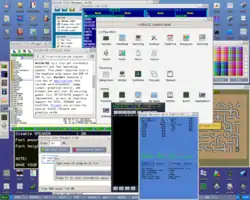 | |
| Developer | KolibriOS Project Team |
|---|---|
| Written in | FASM |
| Working state | Active |
| Source model | Open source |
| Latest release | 0.7.7.0 r8929 / June 23, 2021[1] |
| Repository | websvn |
| Available in | English, Russian, Italian, Spanish |
| Platforms | x86 |
| Kernel type | Monolithic |
| Default user interface | KolibriOS Kernel API |
| License | GPL-2.0-only with binary blobs[2] |
| Preceded by | MenuetOS |
| Official website | www |
In a 2009 review piece on alternative operating systems, TechRadar called it "tremendously impressive", noting its performance and streamlined code-base.[4]
Features
- Pre-emptive multitasking, streams, parallel execution of system calls
- Boots in few seconds from various devices; NTFS and Ext2/3/4 also supported. Can be started from Coreboot and Windows (Windows will shut down)
- Graphical user interface based on and optimized for VESA
- Development kit: code editor with a macro assembler (FASM) integrated
- Most distributions will fit on a single 1.44 MB floppy disk image
System requirements
Supported hardware
- USB 1.1 and 2.0 are supported (UHCI, OHCI and EHCI). There is also support for USB hubs. Only USB HID devices are supported: keyboard, mouse and USB-sticks.
- Internal hard disks with PATA/IDE and SATA/ACHI interfaices are supported nativelly.
- Supported file systems are FAT12, FAT16, FAT32 (long names support), ext2, ext3 and ext4 (partially), CDFS (including multisession, read only), NTFS (read and write but no extended functions like encrition), XFS (read only)
- Audio: AC'97 audio codec support for Intel, nForce, nForce2, nForce3, nForce4, SIS7012, FM801, VT8233, VT8233C, VT8235, VT8237, VT8237R, VT8237R Plus and EMU10K1X chipsets
- Audio: Intel High Definition Audio support for certain motherboards
- Video: works on any card and specific drivers are available for AMD and Intel chipsets
- Network: TCP/IP stack and certain Ethernet network cards support[7]
Development branches
Reception
Dedoimedo reviewed KolibriOS in 2012:[8]
I allocated a more than sufficient 64MB of RAM to KolibriOS and let it fly. Now, to really show you how fast this thing is, I recorded a boot session. It shows the simple KolibriOS boot menu. Next, I press the Enter key. Soon thereafter, we are inside a fully functional desktop. How soon? Well, you can enjoy the video embedded below or follow the Youtube link if you hate embedded stuff. Now, keep your eyes on the screen, as the video is rather short. I mean, really, really short.
Jesse Smith from DistroWatch Weekly wrote review about KolibriOS:[9]
The application menu is broken down into familiar groupings, such as Development, Games, Data Processing, Network and Help. There are also demo programs showing off various graphics and screensavers. Programs are easy to find and most applications work well. The help documentation is a bit scattered, as it covers a number of different topics, but there doesn't seem to be a pattern to what is explained and what isn't. In short, finding help is hit or miss, but what is explained is done so clearly.
See also
- MenuetOS - MenuetOS 32-bit version is a base of KolibriOS
References
- "WebSVN - Kolibri OS". websvn.kolibrios.org. Retrieved 23 June 2021.
- Is there any proprietary software in this? Board.KolibriOS.org, 2014.
- "KolibriOS official site". www.kolibrios.org. Retrieved 2020-05-22.
- 10 operating systems you've never heard of Archived 2016-04-27 at the Wayback Machine, TechRadar, 2009
- "Shell - KolibriOS wiki".
- KolibriOS – A tiny operating system on a 1.44MB floppy Archived 2014-01-29 at the Wayback Machine
- "Hardware Support - KolibriOS wiki".
- KolibriOS - The art of small, Dedoimedo
- DistroWatch Weekly, Issue 318, 31 August 2009
Further reading
- Kolibri-A: a lightweight 32-bit OS for AMD platforms—University of Exeter, PCCAT 2011 p. 20-22 (2011)
External links
 |
Wikimedia Commons has media related to KolibriOS. |

|


Real-time operating systems (RTOS) | |
|---|---|
| Open-source | |
| Proprietary | |
| Discontinued | |
| Developers | |