Komi language
The Komi language (Коми кыв, 𐍚𐍞𐍜𐍙 𐍚𐍣𐍮, Komi kyv), also known as Zyryan, Zyrian or Komi-Zyryan,[2] is one of the two regional varieties of the pluricentric Komi language, the other regional variety being Permyak.
| Komi language | |
|---|---|
| Коми кыв
Komi kyv 𐍚𐍞𐍜𐍙 𐍚𐍣𐍮 | |
| Native to | Russia |
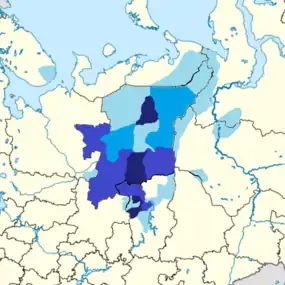
| Region | Komi Republic , Nenetsia, Permyakia, Yamalia, Yugra, elsewhere in Russia |
Native speakers | 160,000 (2010 census)[1] |
Uralic
| |
| Cyrillic, Permian (formerly) | |
| Official status | |
Official language in | Komi Republic |
| Language codes | |
| ISO 639-1 | kv |
| ISO 639-3 | kpv |
| Glottolog | komi1268 |
Komi is natively spoken by the Komi peoples native to the Komi Republic and other parts of Russia. There were 285,000 speakers in 1994. Komi has a standard form.
It was written in the Old Permic alphabet (Komi: 𐍐𐍝𐍑𐍣𐍒 Анбур Anbur) for liturgical purposes in the 14th century. The Cyrillic script was introduced by Russia missionaries in the 17th century, replacing the Old Permic script. A tradition of secular works of literature in the modern form of the language dates back to the 19th century.
Dialects
Komi has ten dialects: Prisyktyvkarsky, Lower Vychegdan, Central Vychegdan, Luzsko-letsky, Upper Sysolan, Upper Vychegdan, Pechoran, Izhemsky, Vymsky, and Udorsky. Prisyktyvkarsky is spoken in the region of Syktyvkar and forms the model for the generic standard dialect of the language. Dialects are divided based primarily on their use of /v/ and /l/:[3]
- Older */l/ remains unchanged in upper Vychegdan and Pechoran dialects (also in most dialects of Komi-Permyak).
- In Central dialects, /*l/ changed to /v/ syllable-finally; for instance, in literary Komi */kɨl/ → /kɨv/ "tongue".
- In Northern dialects, changes of /l/ continued with complete vocalization of syllable-final /l/, resulting in long vowels.
The start of the change date to the 17th century. It is not seen in the oldest Komi texts from the 14th century, nor in loanwords from Komi to Khanty, dated to the 16th; though it fully occurred before Russian loanwords that entered the language in the 18th century as /l/ remains unchanged in these.
Some dialects are further distinguished based on the palatalized alveolars /dʲ tʲ/, which have unpacked in syllable-final position as clusters /jd jt/.[3]
Writing system
The Old Permic script is the first writing system for Komi. It was invented in the 14th century by the missionary Stepan Khrap. The alphabet resembled medieval Greek and Cyrillic. The script was also known as Anbur (Komi: 𐍐𐍝𐍑𐍣𐍒, Анбур), named for the first 2 letters of the script, “an” & “bur” (𐍐 & 𐍑, respectively). It is no longer in use today, though it has received Unicode Support as “Old Permic” in recent times.[4] The script saw use in Komi-inhabited areas, primarily the Principality of Great Perm & parts of Bjarmaland.
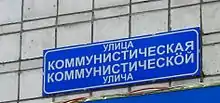
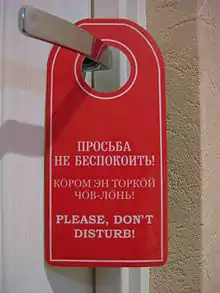
In the 16th century, this alphabet was replaced by the Russian alphabet with certain modifications for affricates. In the 1920s the language was written in the Molodtsov alphabet, which also derived from Cyrillic. In the 1930s, during the Latinisation in the Soviet Union, Komi was briefly written with a version of the Latin script. Since the 1940s it uses the Russian-based Cyrillic alphabet with additional letters І, і and Ӧ, ӧ.
Komi alphabet (Коми анбур)
| Cyrillic | Latin | IPA | Letter name | Notes |
|---|---|---|---|---|
| А а | A a | [ɑ] | а | |
| Б б | B b | [b] | бе | |
| В в | V v | [v] | ве | |
| Г г | G g | [g] | ге | |
| Д д | D d Ď ď | [d] [ɟ] before е, ё, и, ю, я | дэ | |
| ДЖ дж | DŽ dž | [dʒ] | дже | |
| ДЗ дз | DZ dz Đ đ | [dz] [dʑ] before е, ё, и, ю, я | дзе | |
| Е е | JE je E, e | [ʲe] [je] word-initially and after vowels [e] after palatalized coronals | е | |
| Ё ё | JO jo | [jo] word-initially and after vowels [o] after [c, ɟ, ɕ, ʑ, ɲ, ʎ] | ё | |
| Ж ж | Ž ž | [ʒ] | же | |
| З з | Z z Ź ź | [z] [ʑ] before е, ё, и, ю, я | зэ | |
| И и | JI ji I i | [ʲi] [ji] word-initially and after vowels [i] after [c, ɟ, ɕ, ʑ, ɲ, ʎ] | небыд и ("soft i") | |
| І і | I i | [i] after т, д, с, з, н, л | чорыд и ("hard i") | Non-palatalized form of и. |
| Й й | J j | [j] | и краткӧй | |
| К к | K k | [k] | ка | |
| Л л | L l Ľ ľ | [ɫ] [ʎ] before е, ё, и, ю, я | эл | |
| М м | M m | [m] | эм | |
| Н н | N n Ñ ñ | [n] [ɲ] before е, ё, и, ю, я | эн | |
| О о | O o | [o] | о | |
| Ӧ ӧ | Õ õ | [ɘ~ə] | ӧ | |
| П п | P p | [p] | пе | |
| Р р | R r | [r] | эр | |
| С с | S s Ś ś | [s] [ɕ] before е, ё, и, ю, я | эс | |
| Т т | T t Ť ť | [t] [c] before е, ё, и, ю, я | тэ | |
| ТШ тш | Č č | [tʃ] | тше | |
| У у | U u | [u] | у | |
| Ф ф | F f | [f] | эф | In loanwords. |
| Х х | H h | [x] | ха | In loanwords. |
| Ц ц | C c | [ts] | це | In loanwords. |
| Ч ч | Ć ć | [tɕ] | че | |
| Ш ш | Š š | [ʃ] | ша | |
| Щ щ | ŠČ šč | [ɕ(ː)] | ща | In loanwords. |
| Ъ ъ | - | - | чорыд знак ("hard sign") | Same usage in Russian. |
| Ы ы | Y y | [ɨ] | ы | |
| Ь ь | - | [ʲ] | небыд знак ("soft sign") | Same usage in Russian. |
| Э э | E e | [e] | э | Non-palataized form of е. |
| Ю ю | JU ju | [ju] [u] after т, д, с, з, н, л | ю | |
| Я я | JA ja | [jɑ] [ɑ] after т, д, с, з, н, л | я |
Letters particular to the Molodtsov alphabet include ԁ, ԃ, ԅ, ԇ, ԉ, ԋ, ԍ, ԏ, most of which represent palatalized consonants.
| А а | Б б | В в | Г г | Ԁ ԁ | Ԃ ԃ | Д д | Е е | Ж ж | Ԅ ԅ | Ԇ ԇ | |
| И и | Ј ј | К к | Л л | Ԉ ԉ | М м | Н н | Ԋ ԋ | О о | П п | Р р | |
| С с | Ԍ ԍ | Т т | Ԏ ԏ | У у | Ф ф | Х х | Ч ч | Ш ш | Щ щ | Ы ы |
Phonology
Grammar
Komi has 17 cases, with a rich inventory of locative cases. Like other Uralic languages, Komi has no gender. Verbs agree with subjects in person and number (sg/pl). Negation is expressed with an auxiliary verb, which is inflected for person, number and tense.
Komi is an agglutinative language and adheres to a subject–object–verb order.[5]
Notes
- Komi language at Ethnologue (18th ed., 2015)
- Komi language Britannica.
- Bartens 2000, p. 47-49
- Everson, Michael (2012-04-26). "Revised proposal for encoding the Old Permic script in the SMP of the UCS" (PDF).
- Grenoble, L. A. (31 July 2003). Language Policy in the Soviet Union. ISBN 9781402012983.
Bibliography
- Bartens, Raija (2000). Permiläisten kielten rakenne ja kehitys (in Finnish). Helsinki: Suomalais-Ugrilainen Seura. ISBN 952-5150-55-0.
- Abondolo, Daniel (2015). The Uralic Languages. Routledge
- R. M. Batalova. 1993. Komi(-Zyryanskij) Jazyk. In V. N. Jartseva (ed.), Jazyki Mira: Ural'skie Jazyki, 214–229. Moskva: Nauka.
- Fed'un'ova, G.V. Önija komi kyv ('The Modern Komi Language'). Morfologia/Das’töma filologijasa kandidat G.V.Fed'un'ova kipod ulyn. Syktyvkar: Komi n’ebög ledzanin, 2000. 544 pp. ISBN 5-7555-0689-2.
External links
 Media related to Komi language at Wikimedia Commons
 |
Komi edition of Wikipedia, the free encyclopedia |
- Books in Komi-Zyrian from Finno-Ugric Electronic Library (by the Finno-Ugric Information Center in Syktyvkar, Komi Republic (interface in Russian and English, texts in Mari, Komi, Udmurt, Erzya and Moksha languages))
- Komi–Russian & Russian–Komi Online Dictionaries
- Tarabukin I.I. Komi–Russian Phraseological Dictionary.
- Komi Grammar. (in Russian)
- Komi-language courses
Authority control  | |
|---|---|
| General | |
| National libraries | |