Kriwe-Kriwajto
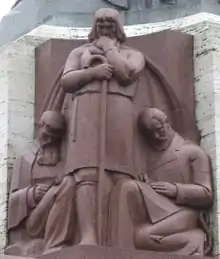
Kriwe-Kriwajto (Latvian: krīvu krīvs, Lithuanian: krivių krivaitis) or simply Kriwe (Latvian: krīvs, Lithuanian: krivis), was the chief priest in the Baltic mythology. He lived in the Prussian sanctuary Romuva that was a central worship place in the region and once a capital city of Prussia.[1] Kriwe-Kriwajto was one of the most influential persons in the Prussian society and people from all of their tribes visited Romuva to make sacrifices. He was responsible for all the major rituals and his influence was recognized by other tribes of Balts, such as Curonians and Lithuanians.[2]
| Part of a series on |
| Baltic religion |
|---|
 |
|


Some historians, rather, present the theory that Krivis was a name for a specific person made up by the chroniclers. Others present that Kriwe instead was a community officer, that had the right to call up a grand meeting Kriwule (krivulė).
Origins
According to legend, the first Kriwe-Kriwajto (criwo cyrwaito) was Bruteno, one of the legendary kings of Prussia alongside his youngest brother Widewuto. He was responsible for the religious life in Prussia. At the end of their lives, both legendary brothers burned themselves in a religious ceremony in Romuva temple.[3] Kriwe-Kriwajto had dozens of lower rank priests, such as waidelottes, who assisted him in the rituals and were responsible for the burning of the holy fire under the sacred oak in Romuva.[1]
References
- "The short course about Prussians & their mythology". History & Culture Academy of Latgale. Retrieved 2019-10-14.
- "Herkus Monte, the hero of Old Prussians". Skyforger.lv. Retrieved 2012-02-27.
- Bojtár, Endre (1999). Foreword to the Past: A Cultural History of the Baltic People. CEU Press. pp. 210–211. ISBN 963-9116-42-4.