Läther
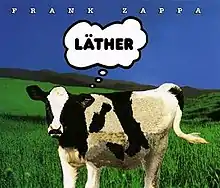
''Läther'' (/lɛðɜːr/, or "Leather") is the sixty-fifth official album by Frank Zappa. It was released posthumously as a three-CD set on Rykodisc in 1996. The album's title is derived from bits of comic dialog that link the songs.
| Läther | ||||
|---|---|---|---|---|
 | ||||
| Studio album by | ||||
| Released | September 24, 1996 | |||
| Recorded | 1969; 1972–1977 | |||
| Genre | ||||
| Length | 173:18 | |||
| Label | Rykodisc | |||
| Producer | Frank Zappa | |||
| Frank Zappa chronology | ||||
| ||||
| 2012 Re-issue | ||||
 | ||||
Läther integrates many aspects of Zappa's musical oeuvre — heavy rock, orchestral works, and complex jazz flavored instrumentals, along with Zappa's distinctive electric guitar solos and satirical lyrics, all assembled in a seemingly random way.[1]
The Läther album was intended for release in 1977 as a four-LP box set, but it never appeared officially in this format. A variety of bootleg recordings of this material were widely distributed. One of these was a four-LP box on the "Edison Record" label and appeared to be professionally packaged.[2] The cover had a small repeated picture of Zappa, but his name did not actually appear anywhere on the package. Despite this, some fans may have been led to believe that the Edison album or other bootlegs were authorized releases.
Background
Zappa's relationship with manager Herb Cohen ended in May 1976.[3] Zappa sued Cohen for skimming more than he was allocated from the DiscReet Records label. The company was co-owned by Zappa and Cohen and distributed by Warner Bros. Records. Zappa was also upset with Cohen for signing acts of which Zappa did not approve.[4][5]
Cohen filed a lawsuit against Zappa in return, which froze the money Zappa and Cohen had gained from an out-of-court settlement with MGM/Verve over the rights to Zappa's early Mothers of Invention recordings. Legal issues also prevented Zappa having access to any of his previously recorded material during the trials. Zappa then had his contract re-assigned and took his personal master copies of the album Zoot Allures directly to Warner in October 1976 while bypassing DiscReet.[6] Cohen claimed that this action violated the terms of his contract with Zappa, so the final four albums of Zappa's contract were then assigned back to DiscReet.
Recording sessions
Läther was compiled by Zappa in 1977 from a wide variety of recording sessions stretching back as far as eight years. The tracks utilize a constantly changing cast of backing musicians. Most of the songs on Läther are linked together with bits of musical sound effects (musique concrète) and comic dialog from Zappa band members, Terry Bozzio, Patrick O'Hearn, and Davey Moire.[7][8] More of these same bits, or "grouts" as Zappa called them, appear on other albums such as Sheik Yerbouti.[9]
Basic tracks for Lemme Take You to the Beach were recorded during 1969 sessions for Hot Rats. The track was finished in 1976 at the Record Plant in Los Angeles. Down in De Dew comes from November 1972 sessions in New York and Los Angeles. For The Young Sophisticate is a 1973 studio recording from Bolic Sound and is different from the later live version on Tinsel Town Rebellion.
The album's opener Re-Gyptian Strut comes from December 1974 sessions at Caribou Ranch in Colorado. Flambe' and Spider of Destiny were also recorded at the ranch with additional overdubs in 1976 at the Los Angeles Record Plant.[10] These three are among the songs written by Zappa in 1972 for a stage musical called Hunchentoot. A full script exists, but the recordings of this project were never completed.[11]
Orchestral pieces come from a September 1975 session with the 37-piece Abnuceals Emuukha Electric Symphony Orchestra, which was recorded at Royce Hall at UCLA with conductor Michael Zearott. According to Zappa, these orchestral sessions cost him about $200,000.[12]
Most of the live tracks were recorded in December 1976 at the Palladium in New York City. The last recordings are live tracks including Tryin' to Grow a Chin from a February 1977 London show at the Hammersmith Odeon.[13] This song also appeared in a different later recording on Sheik Yerbouti.
History
An album titled Six Things was cut as a demo acetate disc at Kendun Recorders in Burbank, California in April 1976. This was an unreleased early edit of music from the orchestral sessions.[14] The same year Zappa tried to negotiate release of an orchestral album with Columbia Masterworks, but the deal fell through when the label did not agree to Zappa's terms.[15]
During the fall 1976 tour the Zappa band performed in front slide projector images, one of which said "Warner Bros. Sucks!". Zappa was upset over what he felt was inadequate promotion. By late 1976 he was determined to complete his Warner contract as soon as possible.[16] Contractual obligations then stipulated that Zappa deliver four new albums to Warner for release on DiscReet. In December 1977 Zappa said:
"Between last October and December 31 of this year I was required to deliver to Warner Brothers four completed albums. I delivered all four in March of this year."[17]
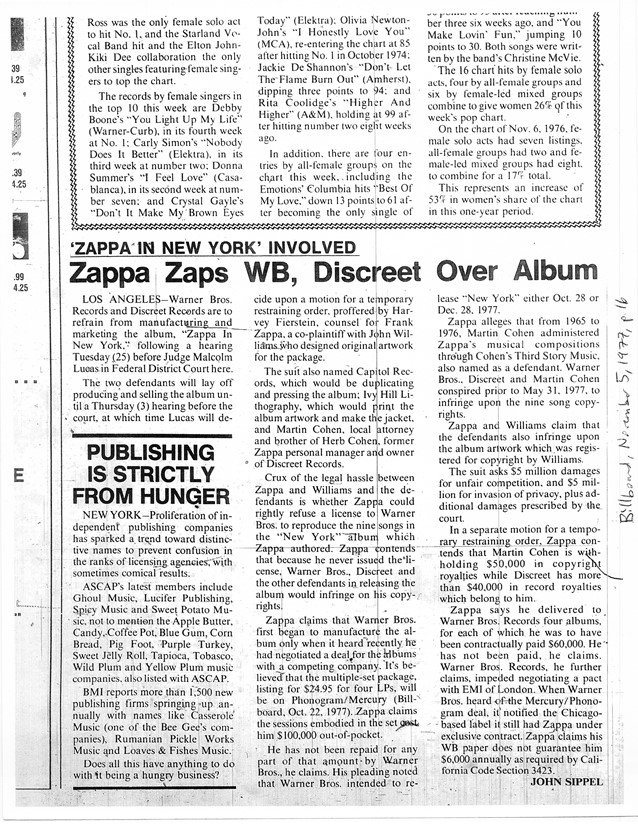
Warner was expecting to receive only one album at a time. The label was required to pay Zappa $60,000 per album and release the recordings in the United States within six weeks. Warner failed to honor these contractual terms.[18][19][20]
A long legal battle between Zappa and Warner occurred, during which no Zappa material was released for more than a year. Much of the material on Läther would eventually be released on four separate albums during 1978 and 1979: Zappa in New York, Studio Tan, Sleep Dirt (previously titled Hot Rats III), and Orchestral Favorites. In an October 1978 radio interview, Zappa identified these four individual albums as the ones he previously delivered to Warner and added "Läther was made out of four albums. Warners has released two of them already and they have two more that they're probably gonna release."[21]
The first of these four albums was a two-LP live jazz rock album and was produced with Zappa approved cover art. Two others were single disc jazz rock studio albums, while the last was made up of orchestral recordings. Therefore, the complete four individual album collection actually fills a total of five full length LPs.
After having violated the contract with Zappa, Warner scheduled the release of Zappa in New York on DiscReet in mid 1977. A "Dateline Burbank" ad in the June 30, 1977 issue of Rolling Stone magazine described the release of the album as "imminent".[22] A few uncensored full length copies appeared by late 1977 but the album was quickly pulled from stores. Zappa objected to the release at this time, however, Warner's decision to belatedly issue and then pull the album has never been fully explained.
At approximately the same time Zappa was also planning a four-LP box set titled Läther.[23] But Warner, wary of a four-LP box, declined to release the material in this format.[1][24][25][26] Both sets of recordings (five-LP and four-LP) have much of the same music, but each also has unique content.
Zappa attempted to get Läther released in the four-LP box configuration as the first release on the Zappa Records label. He briefly negotiated distribution with Capitol/EMI and then Phonogram Inc. At Phonogram the project reached the test pressing stage and was scheduled for a Halloween, October 31, 1977 release.[27] But Warner interfered with both negotiations by claiming rights over the material.[28] At this point Zappa had refused a music copyright license to Warner to reproduce the songs[29] and counterclaimed that they did not have the rights.[30]
Following this Zappa responded by appearing on the Pasadena, California radio station KROQ in December 1977. He played the entire test pressing of Läther, while encouraging listeners to make tape recordings of it.[31] Bootlegs of Läther eventually appeared. Some came directly from the test pressing, while most were lower quality ones sourced from tapes of the radio broadcast. The bootlegs circulated widely before the album's official release in 1996.[31]
Eventually, Warner issued all four individual albums starting in March 1978 and running through May of 1979.[1][25][26] However, the label censored the 1978 version of Zappa in New York by removing the song Punky's Whips as well as other references to Punky Meadows, a member of the American glam rock band Angel. The change of album title from "Hot Rats III" to "Sleep Dirt" and editing of the material were also done in violation of Zappa's contract. [32] Since Zappa had supplied only the tapes for the final three albums they were released without musician or songwriting credits. Also, the artwork for these three albums was not approved by Zappa. Instead, Warner commissioned the designs from cartoonist Gary Panter. All four individual albums went out of print when the DiscReet/Warner distribution agreement ended in 1982.
CD issues
After contracts with Warner and DiscReet expired Zappa chose to re-issue the four previously released individual albums on CD in 1991 along with the Panter artwork and added credits. Each of them were either remixed and or altered in various ways. The 1991 releases appeared in the US on Zappa's Barking Pumpkin label.
In 1995 Rykodisc again reissued Zappa's entire catalog up to that date. None of the four albums related to Läther were altered from the original CD issues, though new analog to digital transfers were made.
One year later, Läther was released officially for the first time through Rykodisc as a three-CD album with four bonus tracks. This edition used new 1996 artwork and was released in a plastic jewel case.
Frank's wife Gail Zappa confirmed that the stereo master tapes for the four-LP Läther box were located while producing the 1996 version.[1] While the released official CD version of Läther is reportedly identical to the test pressings for the four-LP box, four bonus tracks were also added to the 1996 release. Interspersed among the bonus tracks is commentary from Zappa about the album taken from his 1977 KROQ radio broadcast. Also, the title of the song "One More Time for the World" was changed to "The Ocean is the Ultimate Solution", the title under which the same song appears on the album Sleep Dirt.
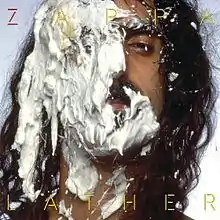
Along with most of Zappa's material, a "mini-LP" CD edition was also released by Rykodisc in Japan, with the artwork reformatted to resemble the packaging of a vinyl album.[25] In December 2012 an official reissue of Läther appeared in cardboard packaging with the original intended 1977 artwork. This version omits the 1996 bonus tracks.
Release and reception
| Review scores | |
|---|---|
| Source | Rating |
| Allmusic |   [25] [25] |
The official version of Läther was finally released with the authorization of Gail Zappa in September 1996, nearly three years after Frank's death.
It remains debated as to whether Zappa had conceived the material as a four-LP box set from the beginning, or only later when approaching Phonogram around September-October 1977.[33] In the liner notes to the 1996 release, Gail states that "As originally conceived by Frank, Läther was always a 4-record box set."[1] Despite this claim, however, there is no evidence that Zappa ever delivered the four-LP Läther set to Warner, only the four individual albums. Zappa himself actually contradicted Gail's posthumous claims that Warner had broken up Läther into other albums.[34] Several interviews published in 1978 and an album review from 1996 explicitly state that Zappa re-edited the four individual albums into the Läther four-LP box and then presented it to Phonogram.[35][20][36]
In a January 1978 Zappa interview the British publication New Musical Express said:
"Since his (Warner) contract had allegedly been breached, Zappa took his copy tapes of the four albums, added some new material, subtracted some old, and prepared a four-record set called "Läther", but pronounced "Leather".[37]
Allmusic writer Richie Unterberger praised the album, but wrote that it would "appeal far more to the Zappa cultist than the general listener, though the Zappa cult – which has been craving Läther in its original format for years – is a pretty wide fan base in and of itself."[25]
Track listing
All tracks are written by Frank Zappa.
| No. | Title | Original release | Length |
|---|---|---|---|
| 1. | "Re-Gyptian Strut" | Sleep Dirt | 4:36 |
| 2. | "Naval Aviation in Art?" | Orchestral Favorites | 1:32 |
| 3. | "A Little Green Rosetta" | Previously unreleased. A reworked version appears on Joe's Garage. This version has a guitar solo that can be heard on "Ship Ahoy" from Shut Up 'n Play Yer Guitar. | 2:48 |
| 4. | "Duck Duck Goose" | Previously unreleased | 3:01 |
| 5. | "Down in De Dew" | Previously unreleased | 2:57 |
| 6. | "For the Young Sophisticate" | Previously unreleased. A different version appears on Tinsel Town Rebellion. [38] | 3:14 |
| 7. | "Tryin' to Grow a Chin" | Previously unreleased. A different version appears on Sheik Yerbouti. | 3:26 |
| 8. | "Broken Hearts Are for Assholes" | Previously unreleased. A different version appears on Sheik Yerbouti. | 4:40 |
| 9. | "The Legend of the Illinois Enema Bandit" | Zappa in New York | 12:41 |
| 10. | "Lemme Take You to the Beach" | Studio Tan | 2:46 |
| 11. | "Revised Music for Guitar & Low Budget Orchestra" | Studio Tan | 7:36 |
| 12. | "RDNZL" | Studio Tan | 8:14 |
| No. | Title | Original release | Length |
|---|---|---|---|
| 1. | "Honey, Don't You Want a Man Like Me?" | Zappa in New York. | 4:56 |
| 2. | "The Black Page #1" | Zappa in New York | 1:57 |
| 3. | "Big Leg Emma" | Zappa in New York | 2:11 |
| 4. | "Punky's Whips" | Zappa in New York (1977 edition) | 11:06 |
| 5. | "Flambé" | Sleep Dirt | 2:05 |
| 6. | "The Purple Lagoon" | Zappa in New York | 16:20 |
| 7. | "Pedro's Dowry" | Orchestral Favorites | 7:45 |
| 8. | "Läther" | Zappa in New York (under the title "I Promise Not to Come In Your Mouth") | 3:50 |
| 9. | "Spider of Destiny" | Sleep Dirt | 2:40 |
| 10. | "The Duke of Orchestral Prunes" | Orchestral Favorites | 4:21 |
| No. | Title | Original release | Length |
|---|---|---|---|
| 1. | "Filthy Habits" | Sleep Dirt | 7:12 |
| 2. | "Titties & Beer" | Zappa in New York | 5:23 |
| 3. | "The Ocean Is the Ultimate Solution" | Sleep Dirt | 8:31 |
| 4. | "The Adventures of Greggery Peccary" | Studio Tan | 21:00 |
| No. | Title | Original release | Length |
|---|---|---|---|
| 1. | "Regyptian Strut (1993)" | Sleep Dirt (remixed) | 4:42 |
| 2. | "Leather Goods" | Previously unreleased | 6:01 |
| 3. | "Revenge of the Knick Knack People" | Previously unreleased | 2:25 |
| 4. | "Time Is Money" | Sleep Dirt | 3:04 |
Personnel
- Disc One, Track 1
- Frank Zappa – percussion
- George Duke – keyboards
- Bruce Fowler – all brass
- James "Bird Legs" Youman – bass
- Ruth Underwood – percussion
- Chester Thompson – drums
- Disc One, Track 2; Disc Two, Track 7 & 10
- Frank Zappa – guitar
- Dave Parlato – bass
- Terry Bozzio – drums
- Emil Richards – percussion
- Orchestra conducted by Michael Zearott
- Disc One, Track 3 (Part One)
- Frank Zappa – vocal
- George Duke – keyboards
- Disc One, Track 3 (Part Two)
- Frank Zappa – lead guitar
- Andre Lewis – keyboards
- Roy Estrada – bass
- Terry Bozzio – drums
- Disc One, Track 4, 7 & 8; Disc Three Track 6
- Frank Zappa – guitar, vocals
- Ray White – guitar, vocals
- Eddie Jobson – violin, keyboards
- Patrick O'Hearn – bass
- Terry Bozzio – drums, vocals
- Disc One, Track 5
- Frank Zappa – all guitars, bass
- Jim Gordon – drums
- Disc One, Track 6
- Frank Zappa – lead guitar, vocals
- George Duke – keyboards
- Tom Fowler – bass
- Ralph Humphrey – drums
- Ricky Lancelotti – vocals
- Disc One, Track 9; Disc Two, Track 1, 2, 3, 4, 6, 8; Disc Three, Track 2
- Frank Zappa – lead guitar, vocals
- Ray White – rhythm guitar, vocals
- Eddie Jobson – violin, keyboards, vocals
- Patrick O'Hearn – bass, vocals
- Terry Bozzio – drums, vocals
- Ruth Underwood – percussion, synthesizer
- Dave Samuels – timpani, vibes
- Randy Brecker – trumpet
- Michael Brecker – tenor sax, flute
- Lou Marini – alto sax, flute
- Ronnie Cuber – baritone sax, clarinet
- Tom Malone – trombone, trumpet, piccolo
- Don Pardo – sophisticated narration
- Disc One, Track 10
- Frank Zappa – guitar, vocals
- Davey Moire – vocals
- Eddie Jobson – keyboards, yodeling
- Max Bennett – bass
- Paul Humphrey – drums
- Don Brewer – bongos
- Disc One, Track 11; Disc Three, Track 4
- Frank Zappa – guitar, vocals
- George Duke – keyboards
- Bruce Fowler – trombone
- Tom Fowler – bass
- Chester Thompson – drums
- Disc One, Track 12; Disc Three, Track 8
- Frank Zappa – guitar
- George Duke – keyboards
- James "Bird Legs" Youman – bass
- Ruth Underwood – percussion
- Chester Thompson – drums
- Disc Two, Track 5 & 9
- Frank Zappa – guitar
- George Duke – keyboards
- Patrick O'Hearn – bass
- Ruth Underwood – percussion
- Chester Thompson – drums
- Disc Three, Track 1
- Frank Zappa – guitar, keyboards
- Dave Parlato – bass
- Terry Bozzio – drums
- Disc Three, Track 3
- Frank Zappa – guitar, synthesizer
- Patrick O'Hearn – bass
- Terry Bozzio – drums
- Disc Three, Track 5
- Frank Zappa – percussion
- George Duke – keyboards
- Bruce Fowler – all brass
- James "Bird Legs" Youman – bass
- Ruth Underwood – percussion
- Chad Wackerman – drum overdubs
- Production credits
- Digital Mastering & EQ – Spencer Chrislu
- Transfer Engineers – David Dondorf, Spencer Chrislu
- Vaultmeisterment – Joe Travers
- Bonus Section Assembly, Edits & Mastering – Spencer Chrislu
- Cover Concept – Dweezil Zappa
- Forward Motion – Gail Zappa
- Deep-dish Descriptions – Simon Prentis
- Cover Execution & Layout Design – Steven Jurgensmeyer
References
- Zappa, Gail (1996). Läther (Media notes). Frank Zappa. Rykodisc.
- https://www.discogs.com/Frank-Zappa-L%C3%A4ther/release/5056347
- http://www.donlope.net/fz/chronology/1976-1980.html
- https://www.afka.net/Articles/1977-12_The_Valley_News.htm
- Miles (2004). Frank Zappa, p. 250.
- Miles, 2004, Frank Zappa, p. 253; pp. 258–259.
- https://www.donlope.net/fz/songs/Leather.html
- http://www.donlope.net/fz/chronology/1976-1980.html
- http://www.donlope.net/fz/songs/Leather.html
- http://www.donlope.net/fz/lyrics/Lather.html
- "Frank Zappa Interview in 1992". SoundCloud. Retrieved 2021-02-23.
- https://www.afka.net/Articles/1977-12_The_Valley_News.htm
- http://www.donlope.net/fz/lyrics/Lather.html
- https://www.popsike.com/FRANK-ZAPPA-Lather-Six-Things-1976-6Song-12-Metal-Acetate-LP/382184734213.html
- http://www.tieyourshoesreviews.com/1976/10/frank-zappa-fort-homer-hesterly-armory-10-14-76/
- http://www.tieyourshoesreviews.com/1976/10/frank-zappa-fort-homer-hesterly-armory-10-14-76/
- https://www.afka.net/Articles/1977-12_The_Valley_News.htm
- https://www.afka.net/Articles/1978-01_New_Musical_Express.htm
- https://www.afka.net/images/Magazines/1977/1977-11-05%20Billboard%2016a.jpg
- https://www.afka.net/Mags/Eggz.htm#1978Apr19
- http://www.donlope.net/fz/radio/1978-10-02_CFNY_Toronto.html
- http://fzpomd.net/biffyshrew/lather.html
- Miles, Barry (2014). Frank Zappa. Atlantic Books Ltd. p. 217. ISBN 978-1-78239-678-9.
- Lowe, 2006, The Words and Music of Frank Zappa, p. 131.
- Unterberger, R. (2011). "Läther – Frank Zappa | AllMusic". allmusic.com. Retrieved 22 July 2011.
- Miles, 2004, Frank Zappa, p. 267.
- https://www.discogs.com/Frank-Zappa-L%C3%A4ther/release/9226988
- Miles, 2004, Frank Zappa, p. 261.
- https://www.afka.net/images/Magazines/1977/1977-11-05%20Billboard%2016a.jpg
- KROQ radio interview 1977
- Slaven, 2003, Electric Don Quixote, p. 248.
- https://www.afka.net/Articles/1979-04_Record_Review.htm
- Watson, 2005, Frank Zappa. The Complete Guide to His Music, p. 49.
- http://www.donlope.net/fz/radio/1978-10-02_CFNY_Toronto.html
- https://www.afka.net/Articles/1978-01_Melody_Maker.htm
- http://fzpomd.net/biffyshrew/review.html
- https://www.afka.net/Articles/1978-01_New_Musical_Express.htm
- http://www.lukpac.org/~handmade/patio/misc/lather.html
Authority control  |
|---|