L-8
L-8, popularly known as the "Ghost Blimp," was a United States Navy L-class airship whose crew disappeared over the Pacific Ocean on August 16, 1942. At 11:15 a.m., several hours after the airship lifted off from Treasure Island, San Francisco, California, L-8 reappeared off the shore of Ocean Beach near Fort Funston. L-8 briefly made contact with the ground at Ocean Beach, causing damage to the airship, then drifted over San Francisco and crashed on Bellevue Avenue, Daly City. No traces of its crewmen, Lieutenant Ernest DeWitt Cody and Ensign Charles Adams, have ever been found.
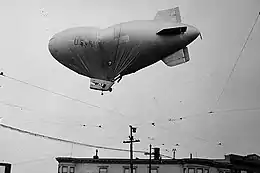 The derelict L-8, floating over San Francisco after the disappearance of its crew. | |
| Occurrence | |
|---|---|
| Date | 16 August 1942; 79 years, 3 months ago |
| Summary | Cause unknown, aircraft recovered |
| Site | Pacific Ocean, off the coast of San Francisco, California, U.S. |
| Aircraft | |
| Aircraft type | L-class blimp |
| Operator | .svg.png.webp) United States Navy United States Navy |
| Registration | L-8 |
| Flight origin | Treasure Island, San Francisco, California, U.S. |
| Destination | Treasure Island, San Francisco, California, U.S. |
| Occupants | 2 |
| Passengers | 0 |
| Crew | 2 |
| Fatalities | 2 (presumed) |
| Survivors | 0 (presumed) |
Background
The L-class was a series of non-rigid airships (blimps), produced for the United States Navy in 1937, based upon the small commercial airships produced by the Goodyear Aircraft Company that were used for advertising Goodyear tires. When the United States entered World War II, the Navy took over the operation of Goodyear's five-airship fleet and incorporated them into the L-class, giving them the designations of L-4 through L-8. While L-class airships were too small for any extensive operational use, they were considered ideal for training missions and coastal patrols. The airships mainly operated out of the Navy's two major lighter-than-air bases in Lakehurst, New Jersey, and Moffett Field, California.[1]
Several months prior to the incident, in April 1942, L-8 delivered vital B-25 modification parts to the aircraft carrier USS Hornet (CV-8) after she departed California carrying the Doolittle Raiders, ahead of their assault on Tokyo.[2]
Incident
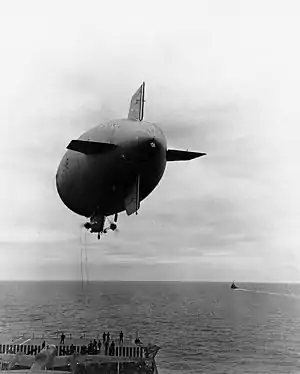
At 6:03 a.m., on August 16, 1942, L-8 – having been assigned to Airship Patrol Squadron 32 – lifted off from Treasure Island, San Francisco, on a coastal antisubmarine patrol. Its scheduled route would have taken the airship over the Farallon Islands, Point Reyes, and the locality of Montara before circling back towards the Golden Gate Bridge. Inside the control car were Lieutenant Ernest DeWitt Cody, aged 27, and his co-pilot, Ensign Charles Adams, aged 35; it was Adams's first flight as a commissioned officer.[3] L-8 was armed with two depth charges and one .30-caliber machine gun. At the time of the incident, the airship had made 1,092 previous trips without incident and had recently been inspected. Conditions on the morning of the flight were clear.[1]
At 7:38 a.m., L-8's crew radioed to Treasure Island and reported observing an oil slick four miles off the coast of the Farallon Islands. A Liberty ship and a fishing boat in the area both witnessed L-8 descending to within thirty feet of the ocean surface and circling the oil slick. This would constitute the last confirmed sighting of the airship with the crew aboard. Controllers at Treasure Island lost contact with the crew at 8:50 a.m.[3] Shortly after 9:00 a.m., L-8 dumped ballast, ascended, and headed east – contrary to its intended course towards Point Reyes, which was to the northwest.[1]
At 11:15 a.m., L-8 reappeared off the coast of Ocean Beach and drifted towards the coastline at low elevation. The airship touched down on the beach, where two surf fishermen tried to hold it down by its tie lines. Upon looking inside its control car, the fishermen observed that no crew were inside. As the fishermen were unable to hold the airship down any longer, it rose briefly into the air before running into a hill, causing damage to its starboard propeller and dislodging one of its depth charges, relieving it of enough weight to gain altitude.[4] An automatic valve inside L-8 was opened and began releasing helium gas, causing the airship to take a sagging, V-shaped appearance as it deflated.[3] L-8 drifted inland over the Olympic Club golf course and Mission Street, attracting the attention of a large crowd of onlookers who followed its journey. Floating over San Francisco's Crocker-Amazon neighborhood, the airship lost elevation and began scraping telephone poles and residential houses. L-8 finally crashed in front of a house at 419 Bellevue Avenue, Daly City.[1]
Investigation
Police and military personnel immediately descended upon the crash site. While the control car doors were found hanging open, and the crash had been so gentle that the crewmen would have walked away unharmed, neither Cody nor Adams were found inside. Searches of the coastline from air, land and sea found no trace of the missing pilots, and the search was abandoned on August 18.[5] Authorities initially theorized that Cody and Adams had bailed out of L-8 over the ocean, but all three parachutes and a rubber life raft were found aboard the control car. Furthermore, the airship's radio and engines were switched on, and no distress transmissions had been sent, indicating that the crewmen's disappearance had been abrupt. A board of investigation convened by the Navy could only determine that L-8 had not been shot down, burned, or made contact with the ocean, and that Cody and Adams had not engaged in misconduct. Cody and Adams were declared legally dead in 1943.[1][3]
Theories
Various scenarios were immediately put forward attempting to explain Cody and Adams's disappearances and the circumstances of L-8's mysterious flight. It was theorized that the crewmen had either been captured by a Japanese submarine or had been spies who had defected to Japan; that their disappearance was the result of a love triangle or an AWOL scheme gone awry; that a stowaway had managed to overcome the pilots and also vanished; that the airship had made contact with the ocean and caused the crewmen to be washed away; or that the crewmen had been abducted by aliens.[1]
Otto Gross, a New Jersey resident who has researched L-8 since 2009 and maintains a website about the case, maintains that the airship had been secretly testing radar and that the crewmen fell out of the control car after being overwhelmed by inadequately-shielded microwaves; no evidence exists that the airship had been handling experimental equipment on the day of the incident. John J. Geoghegan, a writer for Aviation History magazine, believes that the likeliest explanation is that one crewmember had fallen into the ocean, either in the process of investigating the oil slick or repairing an engine, and that the remaining crewmember had gone into the water in an attempt to rescue him.[1]
Aftermath
L-8 was quickly repaired and returned to service following the incident. After the war, the airship was sold back to the Goodyear company and renamed America, flying over sporting events as part of Goodyear's blimp fleet until it was retired in 1982.[1] Its control car was then repainted back to its L-8 markings and given to the National Naval Aviation Museum in Pensacola, Florida, where it sits on static display.[2]
References
- Gary Kamiya, "Ghost blimp's enduring mystery: How did crew vanish before Bay Area crash?", San Francisco Chronicle, September 29, 2018.
- "L-8 Ghost Ship". National Naval Aviation Museum. Archived from the original on 1 August 2018. Retrieved 23 April 2021.
- "Crash of the L-8". www.check-six.com. Retrieved 10 October 2021.
- "The Mystery of the L-8". U.S. Naval Institute. 1 March 1970. Retrieved 11 October 2021.
- "Navy L-8 Blimp Disappears off San Francisco Coast - 1942". www.sfmuseum.org. Retrieved 23 August 2019.