Lanternfish
Lanternfishes (or myctophids, from the Greek μυκτήρ myktḗr, "nose" and ophis, "serpent") are small mesopelagic fish of the large family Myctophidae. One of two families in the order Myctophiformes, the Myctophidae are represented by 246 species in 33 genera, and are found in oceans worldwide. Lanternfishes are aptly named after their conspicuous use of bioluminescence. Their sister family, the Neoscopelidae, are much fewer in number but superficially very similar; at least one neoscopelid shares the common name "lanternfish": the large-scaled lantern fish, Neoscopelus macrolepidotus.
| Lanternfish Temporal range: Cretaceous to present, | |
|---|---|
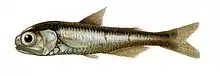 | |
| Myctophum punctatum | |
Scientific classification  | |
| Kingdom: | Animalia |
| Phylum: | Chordata |
| Class: | Actinopterygii |
| Order: | Myctophiformes |
| Family: | Myctophidae T. N. Gill, 1893 |
| Genera | |
|
See text | |
Lanternfish are among the most widely distributed, diverse and populous vertebrates, with some estimates suggesting that they may have a total global biomass of 550–660 million tonnes, accounting for up to 65% of all deep-sea fish biomass. Commercial fisheries for them exist off South Africa, in the sub-Antarctic, and in the Gulf of Oman.
Description
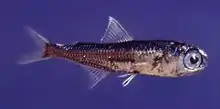
Lanternfish typically have a slender, compressed body covered in small, silvery deciduous cycloid scales (ctenoid in four species), a large bluntly rounded head, large elliptical to round lateral eyes (dorsolateral in Protomyctophum species), and a large terminal mouth with jaws closely set with rows of small teeth. The fins are generally small, with a single high dorsal fin, a forked caudal fin, and an adipose fin. The anal fin is supported by a cartilaginous plate at its base, and originates under, or slightly behind, the rear part of the dorsal fin. The pectoral fins, usually with eight rays, may be large and well-developed to small and degenerate, or completely absent in a few species. In some species, such as those of the genus Lampanyctus, the pectorals are greatly elongated. Most lanternfish have a gas bladder, but it degenerates or fills with lipids during the maturation of a few species. The lateral line is uninterrupted.
In all but one species, Taaningichthys paurolychnus, a number of photophores (light-producing organs) are present; these are paired and concentrated in ventrolateral rows on the body and head. Some may also possess specialised photophores on the caudal peduncle, in proximity to the eyes (e.g., the "headlights" of Diaphus species), and luminous patches at the base of the fins. The photophores emit a weak blue, green, or yellow light, and are known to be arranged in species-specific patterns. In some species, the pattern varies between males and females. This is true for the luminous caudal patches, with the males' being typically above the tail and the females' being below the tail.[2]
Lanternfish are generally small fish, ranging from about 2 to 30 cm (0.79 to 11.81 in) in length, with most being under 15 cm (5.9 in). Shallow-living species are an iridescent blue to green or silver, while deeper-living species are dark brown to black.
Ecology
Lanternfish are well known for their diel vertical migrations: during daylight hours, most species remain within the gloomy bathypelagic zone, between 300 and 1,500 m (980 and 4,920 ft) deep, but towards sundown, the fish begin to rise into the epipelagic zone, between 10 and 100 m (33 and 328 ft) deep. The lanternfish are thought to do this to avoid predation, and because they are following the diel vertical migrations of zooplankton, upon which they feed. After a night spent feeding in the surface layers of the water column, the lanternfish begin to descend back into the lightless depths and are gone by daybreak.[2]
Most species remain near the coast, schooling over the continental slope. Different species are known to segregate themselves by depth, forming dense, discrete conspecific layers, probably to avoid competition between different species. Due to their gas bladders, these layers are visible on sonar scans and give the impression of a "false bottom"; this is the so-called deep-scattering layer that so perplexed early oceanographers (see below).
Great variability in migration patterns occurs within the family. Some deeper-living species may not migrate at all, while others may do so only sporadically. Migration patterns may also depend on life stage, sex, latitude, and season.
The arrangements of lanternfish photophores are different for each species, so their bioluminescence is thought to play a role in communication, specifically in shoaling and courtship behaviour. The concentration of the photophores on the flanks of the fish also indicate the light's use as camouflage; in a strategy termed counterillumination, the lanternfish regulate the brightness of the bluish light emitted by their photophores to match the ambient light level above, effectively masking the lanternfishes' silhouette when viewed from below.
A major source of food for many marine animals, lanternfish are an important link in the food chain of many local ecosystems, being heavily preyed upon by whales and dolphins, large pelagic fish such as salmon, tuna and sharks, grenadiers and other deep-sea fish (including other lanternfish), pinnipeds, sea birds, notably penguins, and large squid such as the jumbo squid, Dosidicus gigas. Lanternfish themselves have been found to feed on bits of plastic debris accumulating in the oceans.[3] At least one lanternfish was found with over 80 pieces of plastic chips in its gut, according to scientists monitoring ocean plastic in the Pacific Ocean's eastern garbage patch.[4]
Deep scattering layer
Sonar operators, using the newly developed sonar technology during World War II, were puzzled by what appeared to be a false sea floor 300–500 metres deep at day, and less deep at night. This turned out to be due to millions of marine organisms, most particularly small mesopelagic fish, with swimbladders that reflected the sonar. These organisms migrate up into shallower water at dusk to feed on plankton. The layer is deeper when the moon is out, and can become shallower when clouds pass over the moon.[5]
Sampling via deep trawling indicates that lanternfish account for as much as 65% of all deep sea fish biomass.[2] Indeed, lanternfish are among the most widely distributed, populous, and diverse of all vertebrates, playing an important ecological role as prey for larger organisms. The estimated global biomass of lanternfish is 550–660 million tonnes, several times the entire world fisheries catch. Lanternfish also account for much of the biomass responsible for the deep scattering layer of the world's oceans. Sonar reflects off the millions of lanternfish swim bladders, giving the appearance of a false bottom.[6]
Rise to dominance
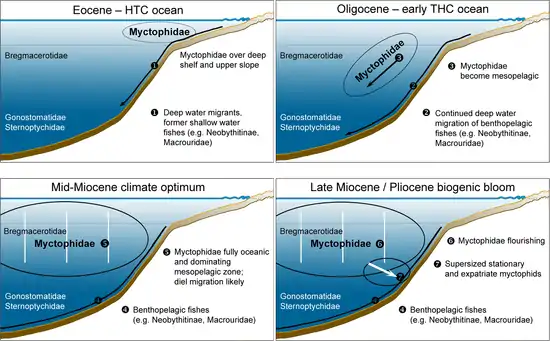
Lanternfishes currently represent one of the dominant groups of mesopelagic fishes in terms of abundance, biomass, and diversity. Their otolith record dominates pelagic sediments below 200 m in dredges, especially during the entire Neogene. The diversity and rise to dominance of lanternfishes can be examined by analysing these otolith records. The earliest unambiguous fossil myctophids are known based on otoliths from the late Paleocene and early Eocene. During their early evolutionary history, myctophids were likely not adapted to a high oceanic lifestyle but occurred over shelf and upper-slope regions, where they were locally abundant during the middle Eocene.[7]
A distinct upscaling in otolith size is observed in the early Oligocene, which also marks their earliest occurrence in bathyal sediments. We interpret this transition to be related to the change from a halothermal deep-ocean circulation to a thermohaline regime and the associated cooling of the deep ocean and rearrangement of nutrient and silica supply. The early Oligocene myctophid size acme shows a remarkable congruence with diatom abundance, the main food resource for the zooplankton and thus for myctophids and whales. The warmer late Oligocene to early middle Miocene period was characterised by an increase in disparity of myctophids but with a reduction in their otolith sizes. A second and persisting secular pulse in myctophid diversity (particularly within the genus Diaphus) and increase in size begins with the "biogenic bloom" in the late Miocene, paralleled with diatom abundance and mysticete gigantism.[7]
Lanternfishes) are one of the dominant group of fishes in the mesopelagic zone of the oceans, together with the bristlemouths of the genus Cyclothone.[8][9][10][11][12] Due to their abundance, myctophids constitute a major part of the oceanic biomass and to a large extent are responsible for the deep scattering sonar layers in the oceans.[13][10][11][12] For instance, according to Hulley,[14] about 46% to 87% of mesopelagic fishes caught in the eastern Atlantic are lanternfishes, although these percentages are dependent on the gear type used. Myctophids exhibit a very high degree of speciation compared with most other mesopelagic fishes, the mechanisms of which are still incompletely understood.[15] The order Myctophiformes contain two extant families, the Neoscopelidae, with 3 genera containing 6 extant species, and the Myctophidae, with 31 genera and 248 extant species currently considered valid,[16] the latter arranged in five subfamilies (Gymnoscopelinae, Notolychninae, Lampanyctinae, Diaphinae, and Myctophinae) according to Martin et al.[17] The genus Diaphus is the most speciose within the family, with 77 extant valid species,[16] and is also the richest in the fossil record. Many myctophid species live high oceanic lifestyles [14] and are widely distributed in the world oceans, often cosmopolitan, with their distribution patterns primarily controlled by water temperature, food availability, and currents. However, a number of species are restricted to certain oceanic environments or basins or exhibit a "pseudoceanic" lifestyle.[18][19][15] The life cycle of myctophids is relatively short; they reach maturity 1 to 2 years after hatching and rarely surpass 5 years in total.[10] Many are adapted to occupy the oxygen minimum zones during the day [20] and undertake diel vertical migration to the ocean surface layers at night.[21] They occupy a midtrophic level, relying mainly on zooplankton, mostly crustaceans such as copepods, amphipods, and euphasiids.[22] Although the diel vertical migration by zooplankton and myctophids is driven by escaping visually hunting predators, they can fall prey to predators along their migration route.[23] Thus, they represent a major source of food in the oceanic trophic web for a vast array of predators (e.g., large fishes, squids, sea birds, beaked whales, dolphins, balaenopterid whales).[23] The excreta produced by their predators are regarded as the prime source for sedimentary accumulation of their otoliths.[24] A study of sub-Recent otoliths obtained from sediments dredged along transects from 30 to 3500 m water depth in the Gulf of Guinea and off the Azores has revealed a dominance of myctophid otoliths below 200 m in the range of 75% to 95% of all the specimens collected.[25] This observation is consistent with the abundance and spatial distribution of myctophid otoliths in the otolith assemblages of Neogene pelagic sediments.[7]
Genera
Benthosema
Bolinichthys
Centrobranchus
Ceratoscopelus
Diaphus
Diogenichthys
Electrona
Gonichthys
Gymnoscopelus
Hintonia
Hygophum
Idiolychnus
Krefftichthys
Lampadena
Lampanyctodes
Lampanyctus
Lampichthys
Lepidophanes
Lobianchia
Loweina
Metelectrona
Myctophum
Nannobrachium
Notolychnus
Notoscopelus
Parvilux
Protomyctophum
Scopelopsis
Stenobrachius
Symbolophorus
Taaningichthys
Tarletonbeania
Triphoturus
References
- "Myctophidae Gill 1893". Paleobiology Database. Fossilworks. Retrieved 27 April 2019.
- Hulley, P. Alexander (1998). Paxton, J.R.; Eschmeyer, W.N. (eds.). Encyclopedia of Fishes. San Diego: Academic Press. pp. 127–128. ISBN 0-12-547665-5.
- Rochman, Chelsea; et al. (2014). "Polybrominated diphenyl ethers (PBDEs) in fish tissue may be an indicator of plastic contamination in marine habitats". Science of the Total Environment. 476–477: 622–633. Bibcode:2014ScTEn.476..622R. doi:10.1016/j.scitotenv.2014.01.058. PMID 24496035.
- Barboza, Tony (11 March 2011). "Ingestion of plastic found among small ocean fish". Los Angeles Times. Los Angeles Times. Retrieved 30 July 2020.
- Ryan P "Deep-sea creatures: The mesopelagic zone" Te Ara - the Encyclopedia of New Zealand. Updated 21 September 2007.
- R. Cornejo; R. Koppelmann & T. Sutton. "Deep-sea fish diversity and ecology in the benthic boundary layer".
- Schwarzhans, Werner; Carnevale, Giorgio (19 March 2021). "The rise to dominance of lanternfishes (Teleostei: Myctophidae) in the oceanic ecosystems: a paleontological perspective". Paleobiology. Cambridge University Press (CUP). 47 (3): 446–463. doi:10.1017/pab.2021.2. ISSN 0094-8373. S2CID 233678539.
 Material was copied from this source, which is available under a Creative Commons Attribution 4.0 International License.
 - Gjøsæter, Jakob (1980). A review of the world resources of mesopelagic fish. Rome: Food and Agriculture Organization of the United Nations. ISBN 92-5-100924-4. OCLC 7123917.
- Lam, V. and Pauly, D. (2005) "Mapping the global biomass of mesopelagic fishes". Sea Around Us Project Newsletter, 30(4): 4.
- Catul, Venecia; Gauns, Manguesh; Karuppasamy, P. K. (2011). "A review on mesopelagic fishes belonging to family Myctophidae". Reviews in Fish Biology and Fisheries. 21 (3): 339–354. doi:10.1007/s11160-010-9176-4. S2CID 42988401.
- Kaartvedt, S.; Staby, A.; Aksnes, DL (2012). "Efficient trawl avoidance by mesopelagic fishes causes large underestimation of their biomass". Marine Ecology Progress Series. 456: 1–6. Bibcode:2012MEPS..456....1K. doi:10.3354/meps09785.
- Irigoien, Xabier; Klevjer, T. A.; Røstad, A.; Martinez, U.; Boyra, G.; Acuña, J. L.; Bode, A.; Echevarria, F.; Gonzalez-Gordillo, J. I.; Hernandez-Leon, S.; Agusti, S.; Aksnes, D. L.; Duarte, C. M.; Kaartvedt, S. (2014). "Large mesopelagic fishes biomass and trophic efficiency in the open ocean". Nature Communications. 5: 3271. Bibcode:2014NatCo...5.3271I. doi:10.1038/ncomms4271. PMC 3926006. PMID 24509953.
- Gj∅Saeter, Jakob (1984). "Mesopelagic fish, a large potential resource in the Arabian Sea". Deep Sea Research Part A. Oceanographic Research Papers. 31 (6–8): 1019–1035. Bibcode:1984DSRA...31.1019G. doi:10.1016/0198-0149(84)90054-2.
- Hulley, P.A. (1981). "Results of the research cruises of FRV Walther Herwig to South America". LVIII. Family Myctophidae (Osteichthyes, Myctophiformes).
- Freer, J.J. (2018) "Ecological niches and geographic distributions of lanternfishes", Doctoral dissertation, University of Bristol.
- Froese, R., and Pauly, D. (Eds) (2020) FishBase. Version 12/2019. Accessed July 2020.
- Martin, Rene P.; Olson, Emily E.; Girard, Matthew G.; Smith, Wm. Leo; Davis, Matthew P. (2018). "Light in the darkness: New perspective on lanternfish relationships and classification using genomic and morphological data". Molecular Phylogenetics and Evolution. 121: 71–85. doi:10.1016/j.ympev.2017.12.029. PMID 29305244.
- Hulley, P.A. (1989) "Lanternfishes of the southern Benguela region. Part 3: The pseudoceanic-oceanic interface". Ann. S. Afr. Mus., 98: 409–435.
- Hulley, P. Alexander (1992). "Upper-slope distributions of oceanic lanternfishes (Family: Myctophidae)". Marine Biology. 114 (3): 365–383. doi:10.1007/BF00350027. S2CID 85358899.
- Douglas, Everett L.; Friedl, William A.; Pickwell, George V. (1976). "Fishes in Oxygen-Minimum Zones: Blood Oxygenation Characteristics". Science. 191 (4230): 957–959. Bibcode:1976Sci...191..957D. doi:10.1126/science.1251208. PMID 1251208.
- Marshall, Norman (1979). Developments in deep-sea biology (in Dutch). Poole England: Blandford Press. ISBN 978-0-7137-1281-0. OCLC 6145515.
- Tanaka, H., Ohshimo, S., Sassa, C., and Aoki, I. (2007) [https://meetings.pices.int/publications/presentations/PICES_16/BIO_P_Tanaka.pdf "Feeding habits of mesopelagic fishes off the coast of western Kyushu, Japan". Pices 16th: BIO_P-4200.
- Robison, Bruce H.; Sherlock, Rob E.; Reisenbichler, Kim R.; McGill, Paul R. (2020). "Running the Gauntlet: Assessing the Threats to Vertical Migrators". Frontiers in Marine Science. 7. doi:10.3389/fmars.2020.00064.
- Nolf, D. (1985) "Otolithi Piscium". Page 145 in Handbook of Paleoichthyology, Vol. 10. Gustav Fischer Verlag, Stuttgart.
- Schwarzhans, W. (2013) "Otoliths from dredges in the Gulf of Guinea and off the Azores: An actuo-paleontological case study". Palaeo Ichthyologica, 13:7–40.
Further references
 |
Wikimedia Commons has media related to Myctophidae. |
- Froese, Rainer, and Daniel Pauly, eds. (2004). "Myctophidae" in FishBase. December 2004 version.
- "Order Myctophiformes: Blackchins and Lanternfishes". Bethune-Cookman College, Moser, G. H., Watson, W. Retrieved December 13, 2004. (Retrieved from web archive July 10, 2006)
- "Lanternfishes in General". Iziko Museums of Cape Town. Hulley, P. A. Retrieved December 13, 2004.
Authority control  | |
|---|---|
| National libraries | |
| Other | |