Leader of the Islamic Emirate of Afghanistan
The leader of the Islamic Emirate of Afghanistan[2] (Pashto: د مش د افغانستان اسلامي امارت, romanized: Damshīr Də Afġānistān Islāmī Imārat)[lower-alpha 1] is the supreme leader of the Taliban, formally known as the Islamic Emirate of Afghanistan, and the de facto leader of Afghanistan. During the Taliban’s first regime from 1996 to 2001, the title was officially the head of the Supreme Council of the Islamic Emirate of Afghanistan, which was only held by Mohammed Omar.[3]
| Leader of the Islamic Emirate of Afghanistan | |
|---|---|
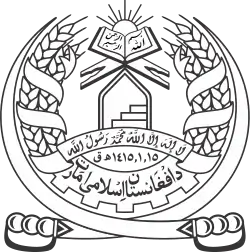 | |
| Style | Amir al-Mu'minin |
| Type | Supreme leader |
| Member of | Supreme Council (1996–2001) Rahbari Shura (2021–present) |
| Residence | Kandahar |
| Term length | Life tenure |
| Precursor | President of Afghanistan |
| Formation | 27 September 1996 |
| First holder | Mohammed Omar |
 Afghanistan portal Afghanistan portal |
History
The office was established by Mullah Mohammed Omar, who founded both the Taliban and the original Islamic Emirate of Afghanistan in the 1990s. In 1996, in Kandahar, followers of Omar bestowed upon him the title Amir al-Mu'minin (أمير المؤمنين), meaning "Commander of the Faithful", as Omar had donned a cloak taken from its shrine in the city, asserted to be that of the Islamic Prophet Muhammad.[4][5] Commander of the Faithful was not a governmental position but rather a religious and honorary title. After the Taliban seized the Afghan capital of Kabul in 1996, the organization instated a "Supreme Council of Afghanistan" and proclaimed Omar as the council's head on 27 September of that year; in this capacity, Omar acted as the country's head of state.[6][7]
Following the September 11 attacks and the United States invasion of Afghanistan in 2001, Omar was deposed and the office of Head of the Supreme Council was replaced by a presidency.[8] Nevertheless, all subsequent leaders of the Taliban have borne the title of Commander of the Faithful.[9]
Following its offensive in 2021, the Taliban recaptured Kabul after the United States withdrew its forces on 15 August of that year and became Afghanistan's new de facto government again.[10][11][12]
Selection
Under the draft constitution of the first Islamic Emirate of Afghanistan the head of state would be selected by an Islamic Council and hold the title "Leader of the Faithful".[13]
Powers and duties
Under Mohammed Omar, the Head of the Supreme Council held absolute power, and the Taliban’s interpretation of Sharia was entirely his decision.
It is unclear what exactly the current role of the Emir is, but under the 1998 draft constitution of the first Islamic Emirate, the Leader of the Faithful would appoint justices of the Supreme Court.[14]
Under the current government however, the Emir has final authority on political appointments, as well as political, religious, and military affairs. The Emir carries out much of his work through the Rabbari Shura, or the Leadership Council, which oversees the work of the Cabinet of Afghanistan, and appointment of individuals to key posts within the cabinet.[15]
However, in a report from Al Jazeera, the cabinet has no authority, with all decisions being made confidentiality by Akhundzada and the Rahbari Shura in Kandahar.[16]
List of heads
| No. | Portrait | Name (Birth–Death) |
Additional position(s) held | Term of office | Ref. | ||
|---|---|---|---|---|---|---|---|
| Took office | Left office | Time in office | |||||
| 1 |  |
Amir al-Mu'minin Mullah Mohammed Omar (1960–2013) |
Head of the Supreme Council of Afghanistan (1996–2001) | 27 September 1996 | 23 April 2013 † | 16 years, 208 days | [17] |
| Position vacant (23 April 2013 – 29 July 2015) | |||||||
| 2 | |
Amir al-Mu'minin Mullah Akhtar Mansour (1968–2016) |
– | 29 July 2015 | 21 May 2016 | 297 days | [17] |
| 3 | |
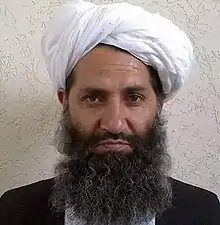
Amir al-Mu'minin Mullah Mawlawi Hibatullah Akhundzada |
– | 25 May 2016 | Incumbent | 5 years, 206 days | [1] |
Timeline

See also
Notes
- Because the Taliban continued to refer to itself as the Islamic Emirate of Afghanistan after the United States invasion of Afghanistan, this was the official title used to identify the supreme commander within the movement
References
- "Afghan Taliban announce successor to Mullah Mansour". BBC News. 25 May 2016. Archived from the original on 18 April 2018. Retrieved 25 May 2016.
- "Statement of the Leadership Office regarding Policies of Islamic Emirate following announcement of New Islamic Government and Cabinet – Islamic Emirate of Afghanistan". Retrieved 2021-11-26.
- Malashenko, Alexey. "Where Will the New Taliban Leader Lead His People?". Carnegie Moscow Center. Retrieved 2021-11-12.
- "Man in the News; Seizing the Prophet's Mantle: Muhammad Omar". www.nytimes.com. Retrieved 2021-08-17.
- "Kandahar residents feel betrayed". www.sfgate.com. Retrieved 2021-08-17.
- Malashenko, Alexey (11 August 2015). "Where Will the New Taliban Leader Lead His People?". Russian International Affairs Council. Retrieved 2021-08-17 – via Carnegie Moscow Center.
- Waraich, Omar (30 July 2015). "Mullah Mohammed Omar: Co-founder and leader of the Taliban who fought the Soviets before presiding over a brutal Afghan regime". www.independent.co.uk. Retrieved 2021-08-17.
- "Karzai declared elected president". news.bbc.co.uk. Retrieved 2021-08-17.
- "Statement by the Leadership Council of Islamic Emirate regarding the martyrdom of Amir ul Mumineen Mullah Akhtar Muhammad Mansour and the election of the new leader". jihadology.net. Retrieved 2021-08-17.
- Mistlin, Alex; Sullivan, Helen; Harding, Luke; Harding, Luke; Borger, Julian; Mason, Rowena (15 August 2021). "Afghanistan: Kabul to shift power to 'transitional administration' after Taliban enter city – live updates". The Guardian. ISSN 0261-3077. Archived from the original on 15 August 2021. Retrieved 15 August 2021.
- "Afghanistan: Heavy fighting ongoing on the outskirts of Kabul as of early Aug. 15; a total blackout reported in the city". Archived from the original on 15 August 2021. Retrieved 15 August 2021.
- "Taliban officials: there will be no transitional government in Afghanistan". Reuters. 15 August 2021. Archived from the original on 15 August 2021. Retrieved 15 August 2021.
- "Taliban Constitution Offers Glimpse Into Militant Group's Vision For Afghanistan". www.rferl.org. Retrieved 2021-08-17.
- "Beyond Republic or Emirate: Afghan Constitutional System at Crossroads". www.iconnectblog.com. Retrieved 2021-08-17.
- "What Role Will the Taliban's 'Supreme Leader' Play in the New Government?". thediplomat.com. Retrieved 2021-09-24.
- Latifi, Ali M. "Taliban divisions deepen as hardliners seek spoils of war". www.aljazeera.com. Retrieved 2021-09-24.
- CNN Umair (29 July 2015). "Mullah Omar: Life chapter of Taliban's supreme leader comes to end". ireport.cnn.com. Faisalabad, Pakistan: CNN. Archived from the original on 5 March 2016. Retrieved 17 August 2021.
.svg.png.webp) Republic (President) Republic (President) | |
|---|---|
.svg.png.webp) Democratic Republic (Chairman) Democratic Republic (Chairman) | |
.svg.png.webp) Islamic State (President) Islamic State (President) | |
| First Islamic Emirate (Head) | |
| Islamic State (President) | |
.svg.png.webp) Transitional Islamic State (President) Transitional Islamic State (President) | |
.svg.png.webp) Islamic Republic (President) Islamic Republic (President) | |
| Second Islamic Emirate (Leader) | |
| |
| Leadership |
| |
|---|---|---|
| Government | ||
| Human rights/violations | ||
| Military | ||
| Conflicts |
| |
| Events | ||
| Related topics | ||