Lease of Life
Lease of Life is a 1954 British film drama made by Ealing Studios and directed by Charles Frend.[1] The film was designed as a star-vehicle for Robert Donat, representing his return to the screen after an absence of over three years during which he had been battling the chronic asthma which plagued his life and career.[2] It was a prestige production which was generally respectfully, if not over-enthusiastically, received and gained Donat a nomination as 'Best British Actor' at the 1955 British Academy Film Awards.[3] In common with a number of other Ealing films of the era, Lease of Life focuses on a specific English milieu – in this case a Yorkshire village and its nearby cathedral city – and examines the nuances, quirks and foibles of its day-to-day life. The film is unique in the Ealing canon in having religion as its dominant theme.
| Lease of Life | |
|---|---|
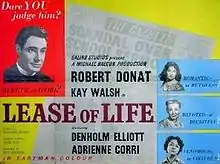 UK release poster | |
| Directed by | Charles Frend |
| Written by | Eric Ambler (from novel by Pat Jenkins) |
| Produced by | Jack Rix |
| Starring | Robert Donat Kay Walsh Adrienne Corri Denholm Elliott |
| Cinematography | Douglas Slocombe |
| Edited by | Peter Tanner |
| Music by | Alan Rawsthorne |
| Distributed by | Ealing Studios |
Release date |
|
Running time | 94 minutes |
| Country | United Kingdom |
| Language | English |
Plot
Rev William Thorne (Robert Donat) is the vicar of the village of Hinton St. John, living with his wife Vera (Kay Walsh) and his daughter Susan (Adrienne Corri) (an exceptionally gifted pianist). Although the church is the focus of the local community, the Thornes live a frugal life of having to struggle and scrimp to make ends meet financially. Vera is a typical clergy wife, having to sublimate her own needs and desires to the exigencies of her husband's position, as a result tending to live life vicariously through her daughter, whose musical gifts she is determined must not be wasted.
While working hard on a sermon he has been asked to present for a boys school, he collapses in his library.
On discovering from his doctor that he has less than a year to live, Thorne reevaluates his own life and that of his parishioners, and he finds himself happier than before. He adopts a "live and let live" attitude to the minor indiscretions of his parishioners, and turns a blind eye to the pious village gossip.
Unaware that the sermon to the boys is a test to see if he is fit to act as School Chaplain, he rips up his prepared speech in front of the boys and gives an ad lib sermon regarding the benefits of not obeying rules and enjoying life. The boys love the sermon, but the Dean, headmaster and assembled parents see it as inciting rebellion. A reporter prints the story and a wider story of inciting unrest spreads.
He now feels able to speak completely honestly about his beliefs and does his best to demonstrate to his parishioners that religion is not a matter of unthinking adherence to a fixed set of rules, but of freedom to act according to one's conscience. However some of his pronouncements are willfully misunderstood and deemed provocative and controversial. There also remains the worry about how to secure the necessary funds to pay for Susan's tuition at a music college, and fate happens to put temptation in the way.
Cast
- Robert Donat as Rev. William Thorne
- Kay Walsh as Vera Thorne
- Adrienne Corri as Susan Thorne
- Denholm Elliott as Martin Blake
- Walter Fitzgerald as the Dean
- Reginald Beckwith as Foley
- Cyril Raymond as Headmaster
- Vida Hope as Mrs. Sproatley
- Beckett Bould as Mr. Sproatley
- Jean Anderson as Miss Calthorp
- Russell Waters as Russell
- Alan Webb as Dr. Pembury
- Richard Wattis as Solicitor
- Richard Leech as Carter
- Frederick Piper as Jeweller
- Mark Daly as Spooner
- Frank Atkinson as Verger
- Edie Martin as Miss. Calthorp's Friend (non-speaking)
Location filming
Exterior sequences for Lease of Life were filmed in Beverley (East Yorkshire) and the nearby village of Lund (Hinton St. John) in the East Riding of Yorkshire.[4] The railway scenes in the film were filmed at Windsor & Eton Central station. The church scenes were filmed in Beverley Minster, East Yorkshire.
References
- "Lease of Life (1954)".
- "Mr. Donat has a new Lease of Life" Sydney Morning Herald, 28 October 1954. Retrieved 27 July 2010
- BAFTA Best British Actor nominations - 1954 Retrieved 27 July 2010
- "Yorkshire on Film - Lease of Life". Dalesman. 78 (1): 28. April 2016. ISSN 0011-5800.
External links
- Lease of Life at IMDb
- Lease of Life at AllMovie
- Lease of Life at BritMovie (archived)