Leeds Supertram
The Leeds Supertram was a proposed light rail/tram system in Leeds and West Yorkshire in England. It would have been a three-line, 17-mile (27 km) system with 50 stations. It received provisional government approval in 2001, and was specifically for corridors ill-served by the existing heavy rail network. Supertram would have been 75% funded from the public sector, with final contracts for construction and a 27-year operating concession due to have been awarded in 2003.[2] By 2004, disquiet about rising costs had caused the scheme to be scaled back, and it was finally cancelled in 2005 by the Transport Secretary, Alistair Darling.
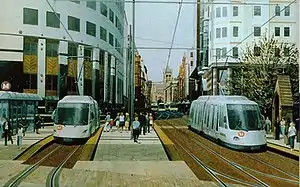 A 2001 artist's impression of Supertram in City Square | |||
| Overview | |||
|---|---|---|---|
| Locale | Leeds | ||
| Transit type | Electrified tramway | ||
| Number of lines | 3 | ||
| Number of stations | 50 | ||
| Operation | |||
| Operator(s) | West Yorkshire Metro | ||
| Technical | |||
| System length | 28 km (17 mi)[1] | ||
| Track gauge | 1,435 mm (4 ft 8+1⁄2 in) standard gauge | ||
| |||
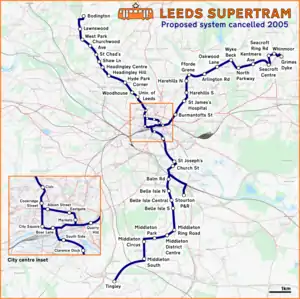
The northern branch would have served the universities and Headingley, running to a park and ride site at Lawnswood. The eastern branch would have run to Seacroft and Whinmoor, and the southern arm would have served Hunslet, Belle Isle and Middleton with another park and ride by the M621 motorway. In the city centre, trams were to have linked to the bus and rail stations and shopping areas. Most of the double track route would have been segregated.[1]
Proposals
Proposals for the reinstatement of trams or a light rail system in Leeds which were withdrawn in 1959 have been ongoing since the 1970s with various plans for varying light rail systems including ones which had planned partially or fully underground routes in the city centre. The cancelled plans mentioned in this article had dated back to the early 1990s.
Route
The planned system included three lines, which were to have been:
- Line 1 (South Line), to Stourton and Tingley via Hunslet, Belle Isle and Middleton
- Line 2 (North Line), to Weetwood via the University of Leeds, Hyde Park and Headingley
- Line 3 (East Line), to Whinmoor via St James's Hospital, Harehills and Seacroft
All three lines would have met in Leeds city centre in a loop line running along The Headrow, Park Row, Boar Lane, Kirkgate and behind Kirkgate Market.
The three lines were to have been the start of a wider system which included plans for other tram lines from Leeds city centre to Bradford via Armley, Bramley and Stanningley and to Alwoodley via Chapeltown, Chapel Allerton and Moortown (the latter being mentioned in the draft Leeds Unitary Development Plan).
Funding delays
Following long standing delays in attempting to gain funding throughout the 1990s due to rejections by the previous John Major administration, in 2002 Leeds was successful in acquiring central government funding for the construction of the scheme. Four consortia were shortlisted:[3][4]
- Airelink: (Arriva, Siemens, Anglian Water, Morrison Construction)
- Leeds Tramways: (Stagecoach, John Mowlem, WS Atkins)
- Leeds Tram Link: (Amey, Bechtel, MTR, Egis)
- Momentis: (FirstGroup, Bombardier, Bouygues, Jarvis)
Preparation work on Leeds Supertram had started in 2003 where preparatory work was done at City Square and around the junction of the A61 South Accommodation Road and A639 Hunslet Road.
Project suspension and cancellation
However work to construct the system that was due to start in earnest in 2004 was suspended because of costs that were originally £500 million had risen far above this level to figures around £1 billion. This had resulted in a cut back to the system that would have seen Line 1 only go from the city centre to the park and ride site at Stourton and this would have saved £250 million from the construction of the scheme and efforts were made to lower development costs along the other planned routes. However despite this in late 2005, Transport Minister Alistair Darling said that he would not give the go-ahead for the scheme, despite £40 million having already been spent into the development of the scheme.[5]
Kieran Preston, the Director General of West Yorkshire Metro at the time of the Supertram project, claimed in 2013 that money could have been saved by finding new solutions to engineering problems, and by postponing a 4.3-mile (6.9 km) stretch of the southern line so that it would only run from Leeds city centre to Stourton park and ride. Preston said that the business case for Leeds Supertram was stronger than those for Nottingham or Manchester, but that the Labour government had spent the transport budget on railways and distorted the figures to say that Leeds could not afford it.[6][2]
Future alternatives
Alternatives for the future of transport in Leeds are now being discussed, in particular a Bus Rapid Transport (BRT) system, which the government claims can deliver some of the benefits of Supertram with lower capital costs due to unsegregated routes and greater flexibility but a higher long-term cost due to shorter life expectancy of rolling stock. No system of this type has yet been delivered in the UK, which introduces an element of risk, although similar systems in the US have experienced lower ridership than comparable light rail lines. Another possibility currently being investigated by the local transport authority is a tram-train system. On such a system trams are capable of running onto mainline railways, being either built to handle 25 kV AC electrification or being partially diesel-powered (UK trams are electrified at 750 V DC).
The Leeds supertram could be revived if the eastern leg of hs2 is scrapped. Reports have emerged that Leeds could finally get its own tram network if rumours that the Leeds HS2 leg is set to be scrapped prove to be true.[7]
References
- "Leeds Supertram -, United Kingdom". Railway-Technology.com. Retrieved 31 March 2015.
- "Leeds is back at a rail crossroads". RAIL. No. 805. 20 July 2016. pp. 46–51.
- Supetram shortlist Railway Gazette International April 2002 page 168
- Leeds tram bidders named Rail issue 432 3 April 2002 page 18
- "The not so super tram". Yorkshire Evening Post. 5 June 2007. Archived from the original on 8 March 2016. Retrieved 31 March 2015.
- "Kieran Preston: My life of public successes and private tragedy: the journey of transport chief". The Yorkshire Post. 26 April 2013. Archived from the original on 11 March 2016. Retrieved 15 February 2021.
- Pagnelli, Joe (7 November 2021). "Reports Leeds tram network could finally happen if HS2 link scrapped". LeedsLive. Retrieved 14 November 2021.
- "Proposed Leeds Supertram". Light Rail Transit Association. Retrieved 14 November 2007.
External links
- Announcement of withdrawal of funding and new emphasis on BRT
- Summary of BRT study with links to full document



| Tramways |
|  | ||||||
|---|---|---|---|---|---|---|---|---|
| Metro |
| |||||||
| People mover | ||||||||
| Preserved | ||||||||