Legion of French Volunteers Against Bolshevism
The Legion of French Volunteers Against Bolshevism (French: Légion des volontaires français contre le bolchévisme, or LVF) was a unit of the German Army (Wehrmacht) formed by French collaborationist volunteers to participate in the German invasion of the Soviet Union in 1941. It was officially designated the 638th Infantry Regiment (Infanterieregiment 638) and was among a number of units formed at the same time in other parts of German-occupied Western Europe.
| Legion of French Volunteers Against Bolshevism | |
|---|---|
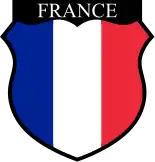 Sleeve insignia of the LVF, incorporating the French tricolor. | |
| Active | 1941–1944 |
| Country | .svg.png.webp) Vichy France Vichy France |
| Allegiance | .svg.png.webp) Nazi Germany Nazi Germany |
| Branch | .svg.png.webp) Wehrmacht Wehrmacht |
| Size | 5,800 men (total, 1941–44)[1] |
| Motto(s) | Plus est en nous (lit. 'More is in us')[2] |
| March | La Marche Consulaire (The Consular March)[2] |
| Engagements | |
| Commanders | |
| Notable commanders | Edgar Puaud (1943–44) |
Created in July 1941, the LVF originated as part of a coalition of far-right political factions including Marcel Déat's National Popular Rally, Jacques Doriot's French Popular Party, Eugène Deloncle's Social Revolutionary Movement and Pierre Costantini's French League which were more explicitly supportive of Nazi ideology and collaboration with Nazi Germany. By contrast, the conservative and authoritarian Vichy regime considered itself neutral and were more ambiguous about its dependence on German support. However, the LVF was tolerated by the Vichy regime and received limited personal endorsement from its leading figures.
Smaller than originally anticipated, the LVF was sent to the Eastern Front in October 1941. It participated in the Battle of Moscow in November and December 1941 but performed poorly in combat and suffered heavy losses. It was deployed for most of its existence in to so-called bandit-fighting operations (Bandenbekämpfung) behind the front line in German-occupied Byelorussia and Ukraine. In total, 5,800 men served in the unit over the course of its existence. After the Allied landings in Normandy and Liberation of France, the LVF was disbanded in September 1944 and its personnel incorporated into the Waffen SS within the short-lived SS "Charlemagne" Waffen-Grenadier Brigade.
Background
France declared war on Nazi Germany in September 1939 at the same time as the United Kingdom. It was invaded and occupied by German forces in May–June 1940 after a disastrous military campaign which pre-war critics of the country's republican regime attributed to the failure of democracy and the corrupting influence of communism, freemasonry and Jews. These were the organising principles of the "National Revolution" declared by the authoritarian Vichy regime under Marshal Philippe Pétain in the aftermath of the defeat. Although a puppet state, the Vichy regime considered itself to be neutral and not part of an alliance with Germany. However, the Vichy regime could not control large parts of France under direct German occupation and was challenged by more extreme right-wing French political factions (groupuscules) which often shared a more explicitly Nazi and pro-German ideology than Vichy.[3] Although there had been interest within the German Foreign Ministry about closer ties with France after the defeat, these were vetoed by Adolf Hitler who wanted total freedom to decide on the country's future after the war and was determined to preserve the weakness of the Vichy regime.[4]
The three main radical factions which emerged as leading proponents of radical collaborationism in France were Marcel Déat's National Popular Rally (Rassemblement national populaire, RNP), Jacques Doriot's French Popular Party (Parti populaire français, PPF), and Eugène Deloncle's Social Revolutionary Movement (Mouvement social révolutionnaire, MSR).[5] Small in size and widely considered as extremists, these groups looked to German support for their influence but often had poor relations with one another.[6] German overtures towards these collaborationist factions placed great pressure on Vichy to change this stance and encouraged deep suspicion in Pétain's entourage.[6] The German invasion of the Soviet Union which began in June 1941 provided them with an opportunity to consolidate this support by demonstrating their loyalty and political importance to the German occupiers.[7]
Formation
Origins of the LVF
The exact origins of the Legion of French Volunteers Against Bolshevism (Légion des volontaires français contre le Bolchévisme, LVF) are unclear. However, it is generally believed that Doriot was first to suggest a French unit for the Eastern Front days after the invasion of the Soviet Union in June 1941.[7] Rather than looking for Vichy support, he reached out to the German ambassador Otto Abetz.[8] Hitler approved the unit's creation on 5 July 1941 but mandated that it be organised privately and limited to 10,000 men. This was much smaller than the 30,000 that Doriot and his supporters had imagined but the historian Owen Anthony Davey observes that "the prospect of 30,000 armed French fanatics must have been frightening even to the Germans".[9][10] At around the same time, numerous similar volunteer units were formed in other parts of German-occupied Europe in Belgium, the Netherlands, Denmark, and Norway as well as Francoist Spain.
As part of the LVF's recruitment effort, Doriot, Déat, and Deloncle as well as Pierre Costantini's French League (Ligue française) agreed, at Abetz's initiative, to establish a Central Committee to manage recruitment and publicity for the unit.[9] They were assisted by even smaller factions in the French extreme-right, such as Jean Boissel's Frankish Front (Front franc), Marcel Bucard's Frankish Movement (Mouvement franciste) and Maurice-Bernard de la Gatinais's French Crusade for National Socialism (Croisade française du national-socialisme).[11] In order to provide more respectability, figures from France's intelligentsia and Catholic Church were brought in to the LVF's organising committee and Catholic symbolism remained ubiquitous throughout the LVF's existence.[12][13]
Recruitment and training
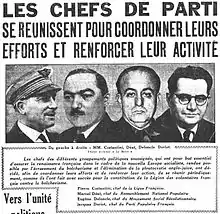
By July 1941, the LVF was actively recruiting and fundraising across France. Its propaganda emphasised its supposed participation in a Europe-wide "crusade" against communism, drawing from France's medieval history and making little mention of Germany. It established a nation-wide network of 137 recruitment offices, sometimes stationed in expropriated Jewish homes.[14][15] However, recruitment remained poor and struggled to enlist more than 3,000 men in its initial phase.[16] Attempts were made to recruit former soldiers from among the large numbers of French prisoners of war in Germany but this was complicated by the German authorities.[17] The Vichy regime provided no direct support to enlistment, although it did act to remove existing laws prohibiting French citizens from enlisting in foreign armies. In some contexts, Vichy officials may even have hindered recruitment in the "free zone" it controlled and there were few volunteers from Vichy's own army.[18][10] The number of recruits was disappointing and reflected the additional limitations imposed on the LVF in comparison to other foreign volunteer units in light of France's political importance within German-occupied Europe.[19] As Davey noted:
Such organizations were to serve the diplomatic interests of the Reich, not the interests of a nationalist revival in France. If the Legion had ever become truly popular, German support would in all probability have waned or been withdrawn. The limitation on the size of the Legion was an early indication of the restrictive German attitude towards the growth of collaborationist power. No collaborationist leader would ever receive German support for a nationalist movement in France. The LVF, like all their other enterprises, was destined for failure at the moment of birth.[20]
Despite racialised admission criteria, the unit included several non-white individuals from the French colonial empire. These included the Algerian anti-colonial nationalist Saïd Mohammedi (1912–1994) who later fought for the National Liberation Front (Front de libération nationale, FLN) during the Algerian War and was active in post-independence politics in Algeria.[21] There were also a number of White Russian émigrés who had lived in France before the war.[22] The LVF drew recruits from across the social strata of French society, many of whom had nothing in common beyond a strong adherence to anticommunism. Doriot, for example, believed that participation in a "crusade" against communism revealed the true meaning of the war and that the LVF would pave the way towards the resurrection of France as a great power.[23]
The first contingent of recruits was assembled at Versailles for a public parade on 27 August 1941 to mark the LVF's creation. At the ceremonies, Pétain's deputy Pierre Laval and Déat were shot and wounded in an attempted assassination by a follower of Deloncle.[20] The following day, German Army doctors rejected almost half of the recruits on medical grounds.[24] Although 10,000 recruits would volunteer for the unit in its first two years of existence, almost half were rejected on these grounds and the unit remained far below the "ceiling" imposed in 1941.[25] Doriot himself enlisted for service in the first contingent, boosting the prestige of the French Popular Party among collaborationist sympathisers in France.[25]
The recruits had been promised that they would fight in French uniforms but, amid continuing Vichy hostility, were folded into the German Army (Wehrmacht). Contrary to promises that it would be an truly French formation, its soldiers were given ordinary Wehrmacht uniform with only a small shield-shaped badge worn on the right arm in the colors of the French flag to signify their origin.[26][27] Its first commander was Colonel Roger Henri Labonne who had previously been French military attaché in Turkey.[28] The LVF was designated the 638th Infantry Regiment (Infanterieregiment 638) and was sent for basic training in October 1941 at Deba, near Warsaw, in the General Government run by French-speaking German officers.[28] It was then integrated into the 7th Infantry Division drawn mainly from Bavaria.[4] Even before leaving training, 60 men were repatriated for various reasons including refusing to wear German uniforms. Others were repatriated for disciplinary issues. A small number refused to swear an oath of allegiance to Hitler and were imprisoned.[29]
Operational history
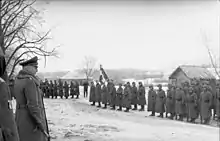
By October 1941, there were two battalions of 2,271 men which had 181 officers and an additional staff of 35 German officers. They were equipped with light weapons and machine guns but also a small number of 3.7 cm Pak 35/36 anti-tank guns.[30] The internal cohesion of the unit was poor and significant internal rivalries existed, losing 400 men to desertion and disease before ever seeing action.[31] There were also confrontations between supporters of Doriot and Deloncle.[32] Many of the officers were also inadequate and highly politicised. By contrast, the historian Oleg Beyda notes:
The military training the soldiers had received was poor; little attention was paid to them, and the weapons they were given were of low quality. For the most part, the personnel were unsuited to military service. Food supplies were inadequate and of unsatisfactory quality. Because of an almost complete lack of facilities, hygiene was poor, and lice began to appear while the troops were still in the camp. Letters from home came irregularly, and the legionnaires learned soon after their arrival that their families were not receiving the whole sums stipulated in the contracts, which gave rise to general discontent.[33]
The LVF was deployed to Smolensk and then sent as reinforcements to participate in the fighting before Moscow in November and December 1941. Beyda notes that, even by the time of its arrival at the front, the unit "was on its last legs".[34] It had been widely feared in collaborationist circles that the unit might arrive too late at the front and its training had been cut short for this reason.[30] It was first deployed in combat near the village of Vygliadovka. It participated in a successful frontal assault against Soviet positions on 1 December but was hit by a large Soviet counterattack several days later.[35] It suffered extremely high casualties. In a matter of months, the LVF had lost around half its manpower in action or through frostbite. There was also a serious outbreak of dysentry.[36] Some individual soldiers deserted to the Red Army or even committed suicide.[37][38][39] After two weeks, they were withdrawn from the front line and returned to Smolensk. They were subsequently used only for role behind the front-line.[32][40] At the same time, the Germans purged the unit of more prominent political activists and removed White Russian and Arab and African personnel.[41]
"On the evening of 8 January 1943, in the course of an operation, the behavior of some 20 men aged around 18 to 40 years who had stayed in place and maintained an obstinate silence was sufficiently clear that I did not hesitate to apply the instructions received at Krutchin. [...] I gave the order to shoot all the men and the order was executed. I knew the situation was the same in the neighbouring village of Tcherneschevskaya on the return route. I gave the order for it to be burned."
Report from an LVF member about a "bandit-fighting" operation in German-occupied Russia or Ukraine.[42]
In 1942 the LVF were assigned to so-called "bandit-fighting" operations (Bandenbekämpfung) against supposed partisans in the rear-echelons of Army Group Centre in the region around Smolensk. It was re-organised into two, rather than three battalions, which were each posted to separate German security divisions. By this time, the LVF had grown slightly to 3,641 men.[43] French soldiers became particularly known for looting the civilian population and otherwise acted with similar violence to their German counterparts who routinely killed civilians and Jews who fell into their hands.[43] According to historian Rolf-Dieter Müller, "brute force was used against the population, including the plundering and destruction of villages".[43] The historian Aleksandr Vershinin states that the personnel of the LVF thought the Soviet citizens they encountered were backward, culturally inferior and even subhuman, and sometimes drew parallels between their situation and those of French colonial troops engaged in punitive expeditions in French North Africa.[44]
As Laval's influence increased within Vichy, the creation of a new unit called the Tricolor Legion (Légion tricolore) was announced in July 1942 as a truly French unit for service as an independent contribution on the Eastern Front. It was supported directly by the Vichy regime but was rejected by the German authorities. It was disbanded in October 1942 and many of its recruits were folded into the LVF soon afterwards.[45] Vichy was invaded and occupied in November 1942 but the development failed to produce a large number of new recruits for the LVF as had been hoped.[43]
Labonne was relieved of his command in mid-1942 and the unit was subsequently attached to various German divisions. Colonel Edgar Puaud who had enlisted in the Tricolor Legion took command in June 1943.[46] The two independent battalions were again united in a single regiment under Puaud's command and integrated into the 186th Security Division. Amid a shortage of manpower, it was hoped that numbers could be made up by drafting in Turkestani hiwis but these plans were abandoned when the Turkestan Legion was created soon afterwards.[47] It participated in operations against partisans and civilians around the Desna river in German-occupied Ukraine. It was deployed in a large-scale operation known as Operation Morocco against supposed partisans in a large forested area near Somry in Byelorussia in January 1944. In its aftermath, the LVF was ambushed as it returned to the Ukraine and suffered heavy losses.[47]
Shortly after the Allied landings in Normandy, the LVF was redeployed to front-line operations at the time of the major Soviet offensive into Byelorussia in June 1944.[47] It was attached to the 4th SS Police Regiment and fought a successful delaying action with the support of a German tank unit.[48][47] It retreated to Minsk and was redeployed to Pomerania were it was disbanded in September 1944.[47]
Unit commanders
- Colonel Roger Henri Labonne (September 1941 to March 1942)
- Colonel Edgar Puaud (September 1943 to August 1944)
Disbandment
The Western Allies staged landings at Normandy in June 1944 and soon began to advance into the rest of France. The LVF was ordered to be dismantled in July 1944 and its soldiers incorporated into the Waffen-SS, which had begun to integrate French recruits since July 1943 as part of the SS Volunteer Sturmbrigade France. It was officially disbanded on 1 September 1944 by which time most of France had been Liberated. Its remaining personnel were integrated, together with other French collaborationists, into the new "Charlemagne" Waffen Grenadier Brigade of the SS (Waffen-Grenadier-Brigade der SS "Charlemagne") within the Waffen-SS. The transfer to the SS was apparently opposed by some soldiers within the LVF and unconfirmed sources suggest that some soldiers refused to swear the new oath and were sent to concentration camps.[49]
Charlemagne was officially reclassified as a division in February 1945 but was significantly under-strength at just 7,340 men. It was almost totally destroyed in its first deployment against Soviet forces in Pomerania in March and April 1945. Puaud, who had become commander of the new formation after the LVF's dissolution, was killed.[50] Around 100 men remaining in the unit participated in the Battle in Berlin in April–May 1945.[51]
See also
- Normandy-Niemen Regiment — a Gaullist air unit which fought for the Soviet Union on the Eastern Front
- Category:Legion of French Volunteers Against Bolshevism personnel
References
Citations
- Beyda 2018, p. 304.
- Bene 2012, p. 175.
- Beyda 2018, p. 289.
- Müller 2014, p. 118.
- Davey 1971, p. 29.
- Davey 1971, p. 31.
- Davey 1971, p. 32.
- Beyda 2018, p. 297.
- Davey 1971, p. 33.
- Beyda 2018, p. 298.
- Beyda 2018, p. 290, 292.
- Davey 1971, p. 34.
- Vershinin 2019, p. 59.
- Davey 1971, p. 36.
- Beyda 2018, p. 302.
- Davey 1971, p. 37.
- Davey 1971, p. 38.
- Beyda 2018, pp. 297–8.
- Beyda 2018, p. 288.
- Davey 1971, p. 40.
- Le Monde.fr 1962.
- Beyda 2018, pp. 310–1.
- Vershinin 2019, pp. 57–9.
- Davey 1971, p. 41.
- Jackson 2001, p. 194.
- Littlejohn 1987, pp. 146, 147.
- Beyda 2016, p. 502.
- Beyda 2016, p. 501.
- Beyda 2016, p. 503.
- Beyda 2016, p. 504.
- Beyda 2018, p. 313.
- Jackson 2001, p. 193.
- Beyda 2016, p. 507.
- Beyda 2016, p. 518.
- Müller 2014, pp. 121–2.
- Beyda 2016, p. 509.
- Littlejohn 1987, p. 149.
- Beyda 2018, p. 314.
- Beyda 2016, p. 507, 515.
- Müller 2014, pp. 122–3.
- Beyda 2016, p. 517.
- Vershinin 2019, p. 61.
- Müller 2014, p. 122.
- Vershinin 2019, pp. 64–5.
- Littlejohn 1987, pp. 149, 150, 155–157.
- Littlejohn 1987, pp. 149, 157.
- Müller 2014, p. 124.
- Littlejohn 1987, p. 157.
- Müller 2014, p. 125.
- Littlejohn 1987, pp. 170, 172.
- Jackson 2001, p. 569.
Bibliography
- Bene, K. (2012). La collaboration militaire française dans la Seconde guerre mondiale (in French). Éditions Codex. ISBN 978-2-918783-03-9.
- Davey, Owen Anthony (1971). "The Origins of the Légion des volontaires français contre le Bolchévisme". Journal of Contemporary History. 6 (4): 29–45. doi:10.1177/002200947100600402. S2CID 153579631.
- Littlejohn, David (1987). Foreign Legions of the Third Reich. 1 Norway, Denmark, France. Bender Publishing. ISBN 978-0912138176.
- "Le premier gouvernement algérien est formé". Le Monde.fr (in French). 1 October 1962.
- Beyda, Oleg (2016). "'La Grande Armeé in Field Gray': The Legion of French Volunteers Against Bolshevism, 1941". Journal of Slavic Military Studies. 29 (3): 500–18. doi:10.1080/13518046.2016.1200393. S2CID 148469794.
- Beyda, Oleg (2018). "France". In Stahel, David (ed.). Joining Hitler's Crusade: European Nations and the Invasion of the Soviet Union, 1941. Cambridge: Cambridge University Press. pp. 288–316. ISBN 978-1-316-51034-6.
- Jackson, Julian (2001). France: The Dark Years, 1940-1944. Oxford: Oxford University Press. ISBN 9780198207061.
- Müller, Rolf-Dieter (2014). The Unknown Eastern Front: The Wehrmacht and Hitler's Foreign Soldiers. London: I.B. Tauris. ISBN 978-1-78076-890-8.
- Vershinin, Aleksandr (2019). "Français à la recherche d'eux-mêmes : "la légion des volontaires français contre le bolchevisme" au front de l'Est (1941-1944)". Guerres Mondiales et Conflits Contemporains (275): 55–67. doi:10.3917/gmcc.275.0055. S2CID 203045474.
Further reading
- Carrard, Philippe (2010). The French Who Fought for Hitler: Memories from the Outcasts. Cambridge: Cambridge University Press. ISBN 978-0521198226.
External links
 Media related to Legion of French Volunteers Against Bolshevism at Wikimedia Commons
.svg.png.webp)
Authority control  | |
|---|---|
| General | |
| National libraries | |