Leonard Stanley Priory
Leonard Stanley Priory was a priory in Gloucestershire, England. Over the years following the dissolution most of the buildings of the priory complex have been destroyed.[1]
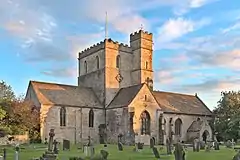
Leonard Stanley is a small village situated about 4 miles southwest of the town of Stroud in Gloucestershire. A priory dedicated to St Leonard was founded there by the Berkeley family in about 1130. This housed Austin cannons, a secular order of Augustinians. In 1146, the priory was appropriated by Gloucester Abbey and became a Benedictine cell until its dissolution in September 1538.
The priory church, being of Augustinian origin, housed both the conventual and parish churches under a single roof. The church remains in use today as a parish church and is now known as St Swithun's church. On the western wall of the south transept corbel stones that supported the roof of the cloister are visible. Close to the southwest of the church, also extant is a chapel of earlier construction currently in use as a farm building. Nearby to the west is a pond once used as a fishpond by the priory. A large tithe barn built in the 14th century lies nearby.
Founding of the Priory
In 1094 Roger de Berkley, II, succeeded his father to the honour of Berkeley. In 1116 after consultation with Theulf, Bishop of Worcester, Roger II gave the church of St Leonard to his clerk Sabricht and founded a house of Austin canons sometime between 1128 and 1131.[2]
By 1128 an alien Augustinian house already existed at Beckford in north Gloucestershire which was connected to the Augustinian Abbey at Sainte-Barbe-en-Auge in Normandy. It is probable that the clerics appointed by Sabricht to assist him at Leonard Stanley came from Beckford. By 1130 Sabricht had become a canon.
The pipe rolls record that Roger II died before Michaelmas 1131 and that the honour of Berkeley was then managed by his nephew William de Berkeley. Roger’s son, Roger de Berkeley, III eventually returned to claim his inheritance in 1139 or 1140.[3] The reason for this delay in succession is likely to be due to Roger’s absence at the crusades. In the interim and in accordance the wishes of the late Roger II, William Berkeley and Sabricht are believed to have supervised construction of the priory church and priory. From the style of the stonework, building does not appear to have been interupted by the civil unrest of the time. While construction of the priory church was underway the earlier chapel dedicated to St Leonard served as a place of worship for the monks and the villagers and later served as a private and guest chapel for the prior.
There are very few records about the early history of the collegiate foundation. The college was dedicated to St Leonard and consisted of a small group of canons and the prior. Roger II had endowed the college with gifts of land which included the curacies of Arlingham, Slimbridge and Uley.[4]
In 1146 a conflict occurred between Roger de Berkeley, III, and Roger earl of Hereford. As an act of placation Roger III granted the church, priory with all its rights, and possessions to the Benedictine Abbey of St. Peter at Gloucester.[5] This was with the consent of Prior Sabricht, and Simon Bishop of Worcester. This arrangement was brought about through the brokerage of Gilbert Foliot, abbot of Gloucester abbey. The change from an Augustinian to Benedictine house took place during a time of upheaval and civil war, known as ‘the Anarchy’. This conflict occurred between 1135 and 1153 and was between supporters of Queen Matilda and King Stephen. Roger III had sympathies for King Stephen and in 1146 was captured and imprisoned by Walter de Hereford, Roger Earl of Hereford’s brother, and supporter of Queen Matilda.The tithes and profits of the parish were valued at £6 in 1291 and had increased to £7 6s 8d by 1535.[4]
In August 1535 Henry VIII’s court spent almost the entire month in Gloucestershire. After staying at Gloucester Abbey the king travelled to Leonard Stanley arriving there on 6 August 1535. After visiting the priory and staying overnight he then travelled on to Berkeley the following day. It was almost exactly three years later, on 11 June 1538, that Henry sent an imperative request to the Abbot of Gloucester to recall the monks from Stanley St Leonard.[6] The priory had remained a Benedictine cell until its dissolution in 1538. The number of monks living there throughout the period is unknown though it is likely to have been relatively small perhaps two or three. Three monks are recorded as being resident at the priory in 1538 when it was dissolved.
A ninety nine year lease for the priory estate was granted to Sir William Kingston in September 1538. When William died on 14 September 1540 tenure passed onto his son Anthony.[7] In February 1549 Edward VI granted the purchase of the estate to John Sandford . After the dissolution the curate’s stipend was paid by the owners of the priory estate and parishioners were subsequently granted access to the bell tower.
References
- J, Middleton (1880). "Stanley St Leonards. The college of canons and the collegiate church". Trans of the Bristol and Gloucester Archeological Society. 5: 119–132.
- R.B, Patterson (1998). The Original Acta of St Peter's Abbey Gloucester c.1122 to 1263. pp. 285 to 286.
- Pipe Roll 31. p. 61.
- Page, William (1907). A History of the County of Gloucester. pp. 72–73.
- Turnock, Jonathan (2014). Reconsidering the Reign of King Stephen. Durham University. p. 152.
- Holinshed, Mark. Henry VIII the Reign - a new look.
- Swynnerton, C (1921). "The Priory of St. Leonard of Stanley, Co Gloucester. in the light of recent discoveries documentary and structural". Archaeologia. 71: 223.
| Augustinian |   | |
|---|---|---|
| Benedictine | ||
| Carmelite | ||
| Carthusian |
| |
| Cistercian |
| |
| Crutched Friars | ||
| Dominican | ||
| Franciscan | ||
| Gilbertine | ||
| Knights Hospitaller | ||
| Knights Templar |
| |
| Independent |
| |