Lightvessel stations of Great Britain
The history of lightvessels stations in Great Britain goes back over 250 years.
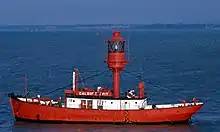
A lightvessel station is a named position at which a lightvessel was placed, rather than a particular vessel. Individual vessels were often transferred between different stations during their existence. Stations themselves were occasionally changed, especially during wartime, when lights were only displayed in response to specific shipping needs. It is likely that photographs on various websites showing named lightvessels, may appear to be structurally different to comparable records on other web pages due to the fact that the particular vessel might have been withdrawn from a station after photographing and being towed away for drydocking, overhaul and possible direction to a new station and therefore a different lightvessel would have been substituted at the named station on withdrawal of the previous lightvessel. This has been most evident on those vessels that have been withdrawn and shipped to another port at home or abroad to become a floating museum, floating restaurant, 'clubhouse', etc. Scarweather LV and Helwick LV have for instance changed their rôle in their lifetime and their appearance on various records varies considerably.
History
The world's first lightvessel was the result of a business partnership between Robert Hamblin, a former barber and ship manager from King's Lynn, and David Avery, an investor.[1] In 1730 the pair secured a government licence to moor a ship, with a prominent light affixed to it, to serve as a navigation aid at the Nore in the Thames mouth. Hamblin and Avery intended to profit from the vessel by collecting a fee from passing merchant vessels. The licence was opposed by Trinity House, which considered that it possessed a monopoly on construction and maintenance of navigation aids in British waters. After extensive legal dispute the licence was revoked in 1732 and Trinity House assumed direct responsibility for the proposed lightship; Hamblin and Avery were granted nominal lease revenues in exchange.[2] The Nore lightship commenced operations in 1734.[3]
A second lightvessel was placed at the Dudgeon station, off the Norfolk coast, in 1736, with others following at Owers Bank (1788) and the Goodwin Sands (1793).[3] While the Admiralty had opposed the Nore lightvessel, claiming it would aid enemy powers, it placed three vessels of its own during the Napoleonic Wars to protect the fleet; they were taken over by Trinity House a few years later.[4] Many others were commissioned during the nineteenth century, especially off England's east coast and the approaches to the Thames, where there were many treacherous shoals.
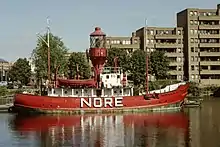
Following their acquisition of the Admiralty ships, all English and Welsh lightvessels were maintained by Trinity House, with the exception of the four vessels in the approaches to the River Mersey, which were maintained by the Mersey Docks and Harbour Board until 1973, and those in the Humber Estuary, which were the responsibility of the Humber Conservancy Board. In order to act as effective daymarks Trinity House lightvessels were painted red, with the station name in large white letters on the side of the hull, and a system of balls and cones at the masthead for identification. The first revolving light was fitted to the Swin Middle lightvessel in 1837: others used occulting or flashing lights. White lights were preferred for visibility though red and very occasionally green (as with the Mouse lightvessel) were also used.[5]
Communications and safety
Communication with lightvessels proved to be a major problem for Trinity House; lightvessel crews were well-placed to observe ships in distress, but could not always alert lifeboats on shore. After a series of shipwrecks, an experiment was conducted whereby a nine-mile undersea cable was run from the Sunk lightvessel in the Thames Estuary to the post office at Walton-on-the-Naze. This was intended to commence in 1884, but was plagued by delays;[6] the trial was unsuccessful as the cable repeatedly broke. As a result of a motion brought forward by Sir Edward Birkbeck, a Royal Commission was established to look at the issue of 'electrical communication' and gave its first Report in 1892;[7][8] the East Goodwin lightvessel was used during one of Guglielmo Marconi's early experiments in radio transmission in 1896.[9] The world's first radio distress signal was transmitted by the East Goodwin lightvessel's radio operator on 17 March 1899, after the merchant vessel Elbe ran aground on the Goodwins, while on 30 April that year, the East Goodwin vessel transmitted a distress signal on its own behalf, when the SS R. F. Matthews rammed it in a dense fog. Safety was further improved by the development of more powerful lamps and through the replacement by foghorns of the gongs previously used as fog signals.
Crew
Until the second half of the 20th century, all Trinity House vessels were permanently manned. An 1861 article in the Cornhill Magazine described lightshipmen as being paid 55 shillings a month (in addition to drawing 1 shilling and sixpence a week "in lieu of 3 gallons of small-beer"): the vessels were supplied, and the crews relieved, once a month. It was also noted that "a general tone of decent, orderly and superior conduct" was observed, that the men were "very respectable [...] swearing and profane language are [...] prohibited" and that every man was supplied with a Bible as well as "a library of varied and entertaining literature".[10]
By the start of the 20th century, Trinity House lightvessels had a crew of 11, of whom seven (a master and six ratings) would be on active duty at any one time. It was an extremely demanding and dangerous profession, and it would take 15 to 20 years of service to be promoted to master.[11]
Replacement
The majority of British lightvessels were decommissioned during the 1970s - 1980s and replaced with light floats or LANBY buoys, which were vastly cheaper to maintain: in 1974 at the time of Trinity House's original development project, lightship annual running costs at £30,000 were ten times those of the LANBY.[12]
The remaining UK lightvessels have now been converted to unmanned operation and most now use solar power.
Vessels
England
Active stations
The following are active stations at which Trinity House still maintains unmanned lightships, which also act as weather stations.
| Name | Image | Position | Characteristic | Vessels employed |
|---|---|---|---|---|
Foxtrot 3  | 🌍 [13] | Fl W 10s | LV93 (from 2001 until 2003), LV17[14] | |
| East Goodwin | 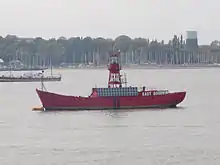 | Goodwin Sands 🌍 | Fl W 15s[15][16] | LV93 (from 1947 until 1953), Lightvessel no. 21 |
| Greenwich | .jpg.webp) | 🌍 | Fl W 5s[15][17] | Light vessel no. 5[18] |
| Sandettie | 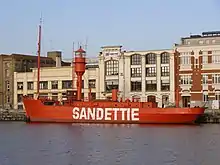 | Sandettie Bank 🌍 | Fl W 5s[19] | Sandettié (from 1978 until 1989) |
| Sevenstones | .jpg.webp) | 🌍 | Fl(3) W 30s[15][20] | Sevenstones Lightship (1841) (from 1841 until 1879), Lightvessel no. 50 (from Sep 1879 until 1883) |
| Sunk Inner | 🌍 [21] | Fl(5) 15s | ||
| Varne | 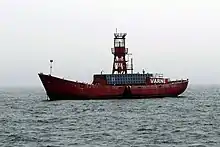 | Varne Bank 🌍 [22] | Fl R 5s[15] | Varne, Lightvessel no. 21 (from 1980) |
Former stations
| Name | Position | Operator | Sea | Vessels employed | Notes |
|---|---|---|---|---|---|
| Sunk Centre | 🌍 [23] | ||||
| Mersey Bar | 🌍 [24] | Mersey Docks and Harbour Company | River Mersey | Alarm[25] (from 1913 until 1960), Planet[26] (from 1960 until 1972) | |
| Barrow Deep | Barrow Deep | Thames Estuary | |||
| Black Deep | Black Deep | Thames Estuary | Station established 1889[27] | ||
| Brake | Brake Bank | Lightship no. 38[28] (from 1930 until 1940) | Station established 1930, replacing Gull LV station, due to narrowing of the navigable Gull Stream[29] | ||
| Bull | Bull Sand | Humber Conservancy Board | Humber | Spurn[30] (from 1959) | |
| Calshot Spit | Calshot Spit | Southampton Water | Lightvessel no. 78[31] (from 1914), Lightvessel no. 50 (from 1943 until 1951), Light vessel no. 16[32] | ||
| Channel | 🌍 | English Channel | Planet, Light vessel no. 3[33] | ||
| Cockle | Great Yarmouth | North Sea | Light vessel no. 88[34] (from 1936) | ||
| Cork | Harwich | LV86 | |||
| Corton | Lowestoft | North Sea | |||
| Crosby | Crosby Channel | Mersey Docks and Harbour Company | Liverpool Bay | ||
| Inner Dowsing | Inner Dowsing | North Sea | Light vessel no. 16[32], Light vessel no. 95[35], LV93[36] (1998) | The last manned lightship station, replaced by the Dowsing lighthouse in 1991.[37] | |
| Outer Dowsing | Outer Dowsing | North Sea | Outer Dowsing[38] | ||
| Dudgeon | Dudgeon Shoals 🌍 [39] | North Sea | Bombed by the Luftwaffe on 29 January 1940. Only one crew member, John Sanders, survived. The incident was the subject of a 1940 British Government propaganda film, Men of the Lightship.[40] | ||
| Edinburgh Channel | Edinburgh Channels | Thames Estuary | LV86[41] | Station established 1889 replacing the S.W. Longsand buoy[27] | |
| English and Welsh Grounds | Bristol Channel | Light Vessel 72, Light vessel no. 55 | |||
| Falls | 🌍 [39] | Strait of Dover | |||
| North Folkestone Gate | Strait of Dover | Discontinued 1919[42] | |||
| South Folkestone Gate | Strait of Dover | LV75[43] | LV75 attacked on station and sunk by German bombers in July 1940, with the loss of two crew members, Jack Wade and Harry North[44] | ||
| Formby | Formby Beach | Mersey Docks and Harbour Company | Liverpool Bay | ||
| Galloper | Galloper Shoal | North Sea | LV93[36] (from 1954 until 1974) | Station first established by the Admiralty in 1803 to protect the fleet during the Napoleonic Wars;[4] replaced by buoy 1977[45] | |
| Girdler | Girdler Shoal | Thames Estuary | In 1884 the Girdler lightship was rammed and sunk by Indus; no lives were lost.[46] | ||
| Gull | Goodwin Sands | North Sea | Lightship no. 38 (from 1929 until 1930) | Marked the Gull Stream: station first established by the Admiralty in 1809 and taken over by Trinity House in 1826.[47] Narrowing of the channel led to Gull being replaced by Brake LV in 1930[29] | |
| Gunfleet | Gunfleet Sands | Trinity House | Thames Estuary | Replaced by Gunfleet Lighthouse in 1850. | |
| Haisborough | Haisborough Sands | North Sea | Light vessel no. 3[48], Lightvessel no. 68[49] | ||
| Humber | Humber Conservancy Board | Humber | Light vessel no. 91[50] (from 1937 until 1942) | Maintained by Humber Conservancy Board. | |
| Kentish Knock | Kentish Knock | North Sea | Light vessel no. 3[33], Lightship 2000, Jenni Baynton[51] (from 1949 until 1953) | ||
| Smiths Knoll | Smiths Knoll 🌍 [39] | Trinity House | North Sea | ||
| Leman and Ower | Trinity House | North Sea | |||
| Longsand | 🌍 [52] | Trinity House | Thames Estuary | ||
| Morecambe Bay | Trinity House | Morecambe Bay | Breeveertien, LV94[53] | ||
| Mouse | Trinity House | Thames Estuary | Lightship no. 38 | ||
| Nab | Nab Rock | Trinity House | The Solent | Replaced by the Nab Tower in 1920. | |
| Newarp | Newarp Banks | Trinity House | North Sea | Light vessel no. 44, Lightvessel no. 21[54] (1972), LV83[55] (1967) | |
| Nore | Nore | Trinity House | Thames Estuary | LV86[56] (from 1941 until 1942) | The world's first manned lightship, 1731. |
| North Goodwin | Goodwin Sands | Trinity House | North Sea | ||
| North West | Mersey Docks and Harbour Company | River Mersey | Good Intent[57] (from 1813) | ||
| Outer Gabbard | Outer Gabbard 🌍 [39] | Trinity House | North Sea | Light vessel no. 3[33], Jenni Baynton[51] (from 1962 until 1965), Lightvessel no. 50[58] (1911) | |
| Owers | The Owers, off Selsey Bill | Trinity House | English Channel | Light vessel no. 3 | Replaced with a beacon. LV Owers now a wreck in Tel Aviv harbour. |
| Royal Sovereign | Royal Sovereign Shoals | Trinity House | English Channel | Lightship 2000[59] | Replaced with Royal Sovereign lighthouse 1971. |
| Selker | Selker Rocks 🌍 [60] |
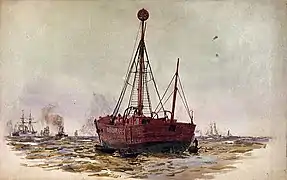 Drawing of the Nore lightvessel by William Lionel Wyllie circa 1900
 Lightvessel on Crosby station during WW2
- Shambles (the Shambles Bank, off Portland Bill)
- Shipwash (North Sea, off Harwich)
- South Goodwin lightvessel replaced the land based South Foreland Low lighthouse, also known as Old St Margaret's Lighthouse. On 25 October 1940, the South Goodwin Lightship was bombed by the Germans and sunk. The replacement lightvessel, LV90 sank on 27 November 1954 when cables to her two sea anchors broke in a hurricane-force storm, the worst storm in two centuries. The ship ran onto the Goodwin Sands close to the Keller Gut and turned on her side. The seven crew members perished, the only survivor being Ronald Murton, an ornithologist from the Ministry of Agriculture and Fisheries. The wreck of the ship can still be seen at low tide. The next replacement ship was decommissioned and was towed away on 26 July 2006.[61][62][63]
- Spurn (Spurn Head). Maintained by Humber Conservancy Board. A former Spurn lightvessel is preserved at Hull Marina.
- Swin Middle (Swin Channel, Thames Estuary)
- Tongue (Tongue Sands, Thames Estuary)
- Lynn Well (entrance to The Wash); replaced with a LANBY (Large Automatic Navigation BuoY) September 1973
- Would (North Sea)
Scotland, Isle of Man
Lightvessels in Scotland and the Isle of Man were maintained by the Northern Lighthouse Board, with the exception of one maintained by the Clyde Lighthouse Trust. Only the North Carr station was manned.
- Bahama Bank (off Maughold Head, Isle of Man; replaced by Maughold Head lighthouse 1914)
- North Carr, Dundee
- Otter Rock (south-west of the Isle of Mull). Scottish Maritime Museum in Irving has a small scale coloured General Arrangement (1923) from Builder (Clyde Shipbuilding and Engineering Co. Ltd. hull #249, 60 ft [183 m]).
- Skeirinoe (Sgeir In-ao, near Scalpay, Harris)[64]
Wales
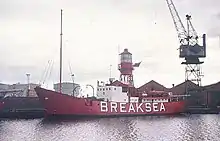
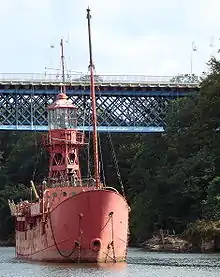
Former Welsh lightships were maintained by Trinity House. Remaining substitute navigational aids still are.
- Breaksea (off Barry (Breaksea Spit), Bristol Channel) Replaced by a LANBY, then a lightfloat and currently a lighted buoy with RACON radar facility
- Helwick (off Worms Head)
- Milford Haven Lightvessel
- Scarweather (Swansea Bay; replaced with buoy 1989)
- St Gowan (off Pembrokeshire coast). The station once carried the name St Govan, i.e., spelling change
See also
References
- Naish, J. M. Seamarks: Their History and Development, Stanford Maritime, 1985, ISBN 978-0-540-07309-2, p. 107
- The Nautical Magazine and Naval Chronicle for 1865. Cambridge University Press. 2013. p. 624. ISBN 9781108054911.
- Marcus, G.J. (1975). Heart of Oak: A Survey of British Sea Power in the Georgian Era. Oxford University Press. pp. 53–54. ISBN 0192158120.
- Renton (2001) Lost Sounds: the story of coast fog signals, Dundurn, p.148
- Miltoun, F. (ed) Ships and Shipping, Moring Ltd, 1903, Ch. 11
- BOARD OF TRADE — TELEGRAPHIC COMMUNICATION WITH LIGHT VESSELS, Hansard 16-05-1884
- COAST COMMUNICATIONS, Hansard 26-04-1892
- COMMUNICATION WITH LIGHTHOUSES, Hansard 21-03-1893
- Baker, W. J. (1998). History of the Marconi Company. Routledge. pp. 39–40. ISBN 978-0-415-14624-1.
- Light-Vessels, The Cornhill Magazine, III (1861), 39.
- Trinity House, portcities.org, accessed 02-09-08
- Rowlands, D. "Points of Reference", Design 310 (1974)
- https://www.marinetraffic.com/en/ais/details/ships/shipid:849825/mmsi:992351033/imo:0/vessel:FOXTROT_3_LV
- https://www.ibiblio.org/lighthouse/lightships.htm
- NGA List of Lights, Radio Aids and Fog Signals, National Geospatial-Intelligence Agency, Wikidata Q13872896
- https://www.trinityhouse.co.uk/lighthouses-and-lightvessels/east-goodwin-lightvessel
- https://www.trinityhouse.co.uk/lighthouses-and-lightvessels/greenwich-lightvessel
- https://web.archive.org/web/20150924012054/http://www.feuerschiffseite.de/SCHIFFE/ENGLAND/lv05/lv5gb.htm
- Reeds PBO Small Craft Almanac 2014. ISBN 978-1-4081-9330-3. Wikidata Q25198336.
- https://www.trinityhouse.co.uk/lighthouses-and-lightvessels/sevenstones-lightvessel
- https://www.marinetraffic.com/en/ais/details/ships/shipid:849819/mmsi:992351027/imo:0/vessel:SUNK_INNER
- MarineTraffic, Wikidata Q18518862
- https://www.marinetraffic.com/en/ais/details/ships/shipid:849826/mmsi:992351034/imo:0/vessel:SUNK_CENTR
- https://www.trinityhouse.co.uk/notice-to-mariners/13-15-bar-lighted-buoy-and-float
- https://confidentials.com/liverpool/birth-of-a-new-planet
- https://www.nationalhistoricships.org.uk/register/1572/light-vessel-23-mersey-bar
- "Notice to Mariners", Board of Trade Journal, v7 (1889), 617-618
- https://www.thurrock.gov.uk/history-on-river-thames/gull-lightvessel-38
- The Gull', lightvessel 38, Thurrock Council, accessed 02-12-21
- http://museumcollections.hullcc.gov.uk/collections/storydetail.php?irn=7&master=10
- https://www.nationalhistoricships.org.uk/register/144/light-vessel-78-calshotspit
- https://www.nationalhistoricships.org.uk/register/131/light-vessel-16-inner-dowsing
- https://web.archive.org/web/20160327090123/http://broadcasting-fleet.com/kingdavid2.htm
- https://www.nationalhistoricships.org.uk/register/645/light-vessel-88
- https://www.trinitybuoywharf.com/architecture/lightship-lv95
- https://www.nationalhistoricships.org.uk/register/2872/light-vessel-93
- Trinity House, portcities.org
- http://www.tynebuiltships.co.uk/O-Ships/outerdowsing1925.html
- Radio Navigational Aids, Naval Oceanographic Office, 1973, Wikidata Q7280925
- David MacDonald (Director); Alberto Cavalcanti (Producer) (1940). Men of the Lightship (Film (35mm, 24 mins, black & white)). GPO Film Unit.
- https://www.ibiblio.org/lighthouse/engse.htm
- US Navy Hydrographic Office (1919) Index to Notices to Mariners, 1-52, p.177
- https://www.wrecksite.eu/wreck.aspx?73273
- Carter, G (1974) The Battle of Britain: the Home Front, Mason & Lipscomb, pp.190-1
- Defense Mapping Agency (1977), Notices to Mariners, p.5
- "Girdler Lightship loss".
- Stevenson (2013) The World's Lighthouses: From Ancient Times to 1820, Courier, p.124
- https://www.lightphotos.net/photos/displayimage.php?pos=-1844
- https://www.liverpoolmuseums.org.uk/artifact/photograph-of-haisbro-lightship-68-0
- https://www.nationalhistoricships.org.uk/register/137/light-vessel-91-humber
- http://offshoreradiomuseum.co.uk/page832.html
- https://www.thegazette.co.uk/London/issue/25290/page/5631/data.pdf
- https://www.nationalhistoricships.org.uk/register/646/light-vessel-94-morecambe-bay
- https://lv21.co.uk/history-of-lv21/crew-stories/
- https://www.liverpoolmuseums.org.uk/artifact/photograph-of-newarp-lightship-83
- https://www.nationalhistoricships.org.uk/register/488/light-vessel-86-nore
- https://www.hslc.org.uk/wp-content/uploads/2017/06/97-9-Woods.pdf
- https://friendsoflv50.org.uk/john-conway-master-of-outer-gabbard-light-vessel-lv50-1911/
- https://www.eastbourneherald.co.uk/news/traffic-and-travel/nostalgia-royal-sovereign-lightship-eastbourne-coast-957200
- https://www.thegazette.co.uk/London/issue/25254/page/3766/data.pdf
- South Goodwin Light Vessel, portcities.org
- "South Goodwin Lightvessel | Trinity House History". trinityhousehistory.wordpress.com. Retrieved 27 July 2017.
- Historic England. "ST MARGARET'S OLD LIGHTHOUSE, St. Margaret's At Cliffe (1070066)". National Heritage List for England. Retrieved 27 July 2017.
- Map of Skeirinoe lightvessel (via National Library of Scotland maps API (Map) (Popular Edition (Scotland) ed.). 1:253 440. Ordnance Survey. 1920–1930. Retrieved 13 August 2011.
External links
 Media related to Lightships of the United Kingdom at Wikimedia Commons
| Stations |  | |
|---|---|---|
| Lists | ||
| Museums |
| |
| Related | ||
| ||
