Linear Elamite
Linear Elamite is a Bronze Age writing system used in Elam between 2300–1850 BCE, known mainly from a few monumental inscriptions. It was used contemporaneously with Elamite cuneiform and possibly records the Elamite language.
| Linear Elamite | |
|---|---|
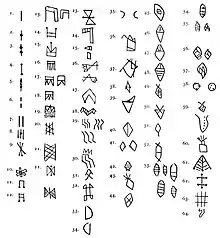 List of known Linear Elamite characters.[1] | |
| Script type | Undeciphered
|
Time period | 3rd millennium BC |
| Status | Extinct |
| Direction | left-to-right  |
| Languages | Elamite |
| Related scripts | |
Parent systems | Proto-writing
|
Overview
It was in use for a brief period of time during the last quarter of the 3rd millennium BC. It is often claimed that Linear Elamite is a syllabic writing system derived from the older Proto-Elamite writing system, although this has not been proven. Linear Elamite has not been deciphered.[2]
There have been multiple attempts to decipher the script. Early efforts by Carl Frank (1912) and Ferdinand Bork (1924) made limited progress.[3] Later work by Walther Hinz and Piero Meriggi furthered the work.[4][5][6][7] In November 2020, François Desset announced that he has deciphered the script.[8] The article describing his discovery is to be published in 2021.
Demise
It is thought that the use of Linear Elamite ended circa 2100 BC with the death of King Kutik-Inshushinak, last ruler of the Awan Dynasty in Susa. After his death the linear script fell into disuse, and Susa was overrun by the Third dynasty of Ur, while Elam fell under control of the Shimashki dynasty (also Elamite of origin).[9]
Influences
Scholars have been comparing the Indus valley script with Linear Elamite, as the two languages were contemporary to each other. One of the best sources of knowledge regarding the Elamite language is a bilingual monument called the "Table of the Lion" currently in the Louvre museum. The monument is written in both Akkadian, which is a known language, and in Linear Elamite. On comparing this ancient language to the Indus script, a number of similar symbols have been found.[10]
Discovered texts
There are only 22 known documents in Linear Elamite; they are identified by letters A-V (Hinz, 1969, pp. 11–44; Andre‚ and Salvini, 1989, pp. 58–61); of these, 19 are on stone and clay objects excavated in the acropolis at Susa (now kept in the Louvre in Paris). Other objects are held at the National Museum of Iran.

The most important longer texts, partly bilingual, appear in monumental contexts. They are engraved on large stone sculptures, including a statue of the goddess Narunte (I), the "Table au Lion" (A), and large votive boulders (B, D), as well as on a series of steps (F, G, H, U) from a monumental stone stairway, where they alternated with steps bearing texts with Akkadian titles of Puzur-Inšušinak. A unique find is item Q, a silver vase with a single line of perfectly executed text, kept in the Tehran Museum. There are also a few texts on baked-clay cones (J, K, L), a clay disk (M), and clay tablets (N, O, R). Some objects (A, I, C) include both Linear Elamite and Akkadian cuneiform inscriptions. The bilingual and biographic inscriptions of the monumental stairway as a whole, and the votive boulder B have inspired the first attempts at decipherment of Linear Elamite (Bork, 1905, 1924; Frank, 1912). Nine texts have also been found on silver beakers (X, Y, Z, F', H', I', J', K' and L').[11] Note that some of the extant Linear Elamite inscriptions are suspected of being forgeries.
In 2016, 10 additional Linear Elamite inscriptions were discovered, some containing nearly 200 signs. [12]
Examples
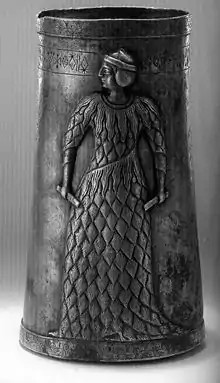
 Perforated stone, with Linear Elamite text. Louvre Museum Sb6 Sb177
.jpg.webp) Perforated stone proposed reading (1912).
Perforated stone proposed reading (1912).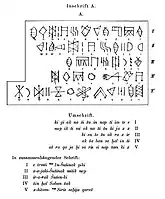 Table au Lion, a proposed reading of the Linear Elamite (1912).
_in_Linear_Elamite.jpg.webp)
The Elamite name of Puzur-Inshushinak: 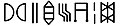
Pu-zu-r Šu-ši-na-k
in Linear Elamite script.[14]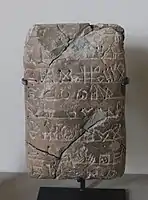 Clay tablet with Linear Elamite text. Louvre Museum Sb 9382.
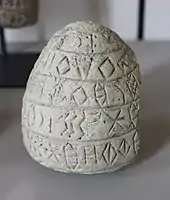 Clay cone with Linear Elamite text. Louvre Museum Sb 17830. Reign of Puzur-Inshushinak.[15]
Decipherment
A very large Elamite language vocabulary is known from the trilingual Behistun inscription and numerous other bilingual or trilingual inscriptions of the Achaemenid Empire, in which Elamite was written using Elamite cuneiform (circa 400 BCE), which is fully deciphered. An important dictionary of the Elamite language, the Elamisches Wörterbuch was published in 1987 by W. Hinz and H. Koch.[16][17] The Linear Elamite script however, one of the scripts used to transcribe the Elamite language circa 2000 BCE, has remained elusive.[18]
First readings (1905–1912)
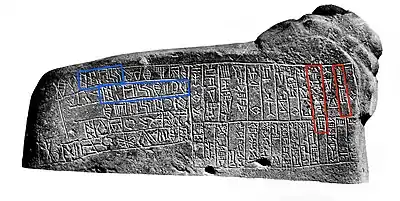
The first readings were determined by the analysis of the bilingual Cuneiform Akkadian-Linear Elamite Table au Lion (Louvre Museum), by Bork (1905) and Frank (1912). Two words with similar endings were identified in the beginning of the inscription in the known Akkadian Cuneiform (the words "Inshushinak" 𒀭𒈹𒂞 dinšušinak and "Puzur-Inshushinak" 𒅤𒊭𒀭𒈹𒂞 puzur4-dinšušinak), and correspondingly similar sets of signs with identical endings were found in the beginning of the Elamite part (.jpg.webp) and ), suggesting a match.[18] This permitted a fairly certain determination of about ten signs of Linear Elamite:[18]
and ), suggesting a match.[18] This permitted a fairly certain determination of about ten signs of Linear Elamite:[18]
- Pu-zu-r shu-shi-na-k, King Puzur-Inshushinak.[14]
- I-n-shu-shi-na-k, God Inshushinak.[14]
Further efforts were made, but without significant success.[18]
Additional readings (2018)
Additional readings were proposed by CNRS researcher François Desset in 2018, based on the analysis of the recently discovered Gunagi vessels (2004). Desset identified repetitive sign sequences in the beginning of the Gunagi inscriptions, and guessed they were names of kings, in a manner somewhat similar to Grotefend's decipherment of Old Persian cuneiform in 1802–1815.[19] Using the small set of letters identified in 1905–1912, the number of symbols in each sequence taken as syllables, and in one instance the repetition of a symbol, Desset was able to identify the only two contemporary historical rulers that matched these conditions: Shilhaha and Ebarat, the two earliest kings of the Sukkalmah Dynasty.[20] Another set of signs matched the well-known God of the period: Napirisha. This permitted the determination of several additional signs:[20][21]
.jpg.webp) Shi-l-ha-ha, Shilhaha, second king of the Sukkalmah Dynasty.[20][21]
Shi-l-ha-ha, Shilhaha, second king of the Sukkalmah Dynasty.[20][21].jpg.webp) E-b-r-t, Ebarat II, founder of the Sukkalmah Dynasty.[20][21]
E-b-r-t, Ebarat II, founder of the Sukkalmah Dynasty.[20][21] Na-pi-r-ri-sha, God Napirisha.[20][21]
As of 2020, Desset announced that he had completed the decipherment of all known inscriptions in Linear Elamite, through deductive work based on the confrontation of known Elamite vocabulary and the recently determined additional letters, and through the analysis of the standard contents of known Elamite texts in Cuneiform.[21][8]
New readings include:

Desset also suggests that Linear Elamite is an evolution of Proto-Elamite, and that Proto-Elamite evolved in parallel with Sumerian cuneiform, from a common substrate of simple signs and numerals used in accounting tokens and numeral tablets.[21][22]
References
- Frank (1912), pp. 52–56
- Desset (2018a)
- Hinz, Walther (1975). "Problems of Linear Elamite". Journal of the Royal Asiatic Society of Great Britain and Ireland. 2: 106–115. JSTOR 25203649.
- Meriggi, Piero (1971). La scritura proto-elamica, Parte Ia: La scritura e il contenuto dei testi (in Italian). Roma: Accademia Nazionale dei Lincei.
- Meriggi, Piero (1974). La scritura proto-elamica, Parte IIa: Catalogo dei segni (in Italian). Roma: Accademia Nazionale dei Lincei.
- Meriggi, Piero (1974). La scritura proto-elamica, Parte IIIa: Testi (in Italian). Roma: Accademia Nazionale dei Lincei.
- Hinz, Walther (1969). Altiranische Funde und Forschungen (in German). Berlin: De Gruyter.
- Arnaud, Bernadette (7 December 2020). "Un Français "craque" une écriture non déchiffrée de plus de 4000 ans, remettant en cause la seule invention de l'écriture en Mésopotamie". Sciences et Avenir (in French). Retrieved 7 December 2020.
- "Elam I: The History of Elam". Encyclopaedia Iranica.
- Possehl, Gregory L. (2002). The Indus Civilization: A Contemporary Perspective. Walnut Creek: Altamira Press. p. 131. ISBN 0-7591-0171-X.
- Desset (2018b)
- Mäder, Michael (2017). "Some New Linear Elamite Inscriptions". BAF-Online: Proceedings of the Berner Altorientalisches Forum. 1. doi:10.22012/baf.2016.18.
- Item Q in Desset (2018a)
- Frank (1912)
- Harper, Prudence O.; Aruz, Joan; Tallon, Françoise, eds. (1992). The Royal City of Susa: Ancient Near Eastern Treasures in the Louvre. New York: Metropolitan Museum of Art. p. 264. ISBN 0-87099-651-7.
- Hinz, Walter; Koch, Heidemarie (1987). Elamisches Wörterbuch (in German). 1. Berlin: Dietrich Reimer.
- Hinz, Walter; Koch, Heidemarie (1987). Elamisches Wörterbuch (in German). 2. Berlin: Dietrich Reimer.
- Desset (2018a), pp. 405–406
- Desset (2018b), p. 140
- Desset (2018b)
- Desset (2020a)
- Desset, François (2020b). A New History of Writing on The Iranian Plateau – via YouTube.
Sources
- André, B.; Salvini, M. (1989). "Réflexions sur Puzur-Inšušinak". Iranica Antiqua (in French). 24: 53–72.
- Bork, F. (1905). "Zur protoelamischen Schrift". Orientalistische Literaturzeitung (in German). 8: 323–330.
- Bork, Ferdinand (1924). Die Strichinschriften von Susa (in German). Königsberg in Preußen.
- Frank, Carl (1912). Zur Entzifferung der altelamischen Inschriften (in German). Berlin: Verlag der Königl. Akademie der Wissenschaften.
- Desset, François (2018a). "Linear Elamite Writing". In Álvarez-Mon, Javier; Basello, Gian Pietro; Wicks, Yasmina (eds.). The Elamite World. Abingdon, Oxon: Routledge. pp. 397–415. ISBN 978-1-315-65803-2.
- Desset, François (2018b). "Nine Linear Elamite Texts Inscribed on Silver "Gunagi" Vessels (X, Y, Z, F', H', I', J', K' and L'): New Data on Linear Elamite Writing and the History of the Sukkalmaḫ Dynasty". Iran. 56 (2): 105–143. doi:10.1080/05786967.2018.1471861.
- Desset, François (2020a). "Breaking the Code: The Decipherment of Linear Elamite, a Forgotten Writing System of Ancient Iran (3rd Millenium BC)". Canal-U.
- Englund, Robert K. (1996). "The Proto-Elamite Script" (PDF). In Daniels, Peter T.; Bright, William (eds.). The World's Writing Systems. New York: Oxford University Press. pp. 160–164. ISBN 0-19-507993-0.
- Hinz, W. (1962). "Zur Entzifferung der elamischen Strichinschrift". Iranica Antiqua (in German). 2: 1–21.
External links
- Linear-Elamite on CDLI Wiki
- Linear Elamite Text Images at CDLI
- Online Corpus of Linear Elamite Inscriptions OCLEI
- Desset, François (2020). "A New History of Writing on the Iranina Plateau".
- "Breaking the Code, The Decipherment of Linear Elamite Writing" University of Tehran 26 January 2021