List of formulae involving π
The following is a list of significant formulae involving the mathematical constant π. Many of these formulae can be found in the article Pi, or the article Approximations of π.
| Part of a series of articles on the |
| mathematical constant π |
|---|
| 3.1415926535897932384626433... |
| Uses |
| Properties |
| Value |
| People |
| History |
| In culture |
| Related topics |
Euclidean geometry

where C is the circumference of a circle, d is the diameter. More generally,

where s and w are, respectively, the perimeter and the width of any curve of constant width.

where A is the area of a circle and r is the radius.

where V is the volume of a sphere and r is the radius.

where SA is the surface area of a sphere and r is the radius.

where H is the hypervolume of a 3-sphere and r is the radius.

where SV is the surface volume of a 3-sphere and r is the radius.
Physics

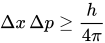

- Coulomb's law for the electric force in vacuum:


- Period of a simple pendulum with small amplitude:


- The buckling formula:

Formulae yielding π
Integrals
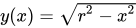
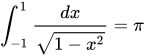
- (integrating two halves to obtain the area of a circle of radius )
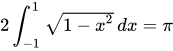

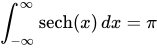

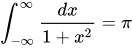
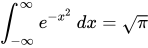
- (see Gaussian integral).
- (when the path of integration winds once counterclockwise around 0. See also Cauchy's integral formula).

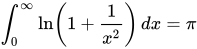
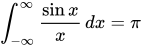
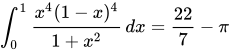
- (see also Proof that 22/7 exceeds π).
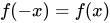
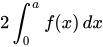
Note that with symmetric integrands , formulas of the form can also be translated to formulas .

Efficient infinite series
- (see also Double factorial)

- (see Chudnovsky algorithm)


The following are efficient for calculating arbitrary binary digits of π:



Plouffe's series for calculating arbitrary decimal digits of π:[3]
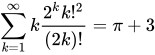
Other infinite series
- (see also Basel problem and Riemann zeta function)


- , where B2n is a Bernoulli number.

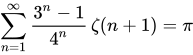
- (see Leibniz formula for pi)











- (see Gregory coefficients)

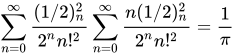
- (where is the rising factorial)[5]

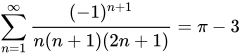
- (Nilakantha series)
- (where is the n-th Fibonacci number)
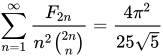



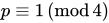

Some formulas relating π and harmonic numbers are given here.









Infinite series
Some infinite series involving π are:[7]

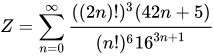


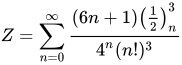



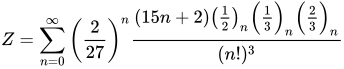







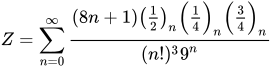

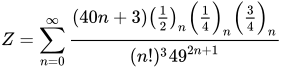

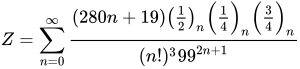

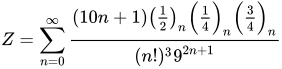

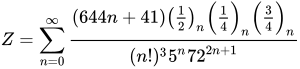

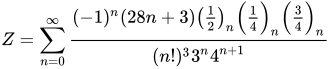
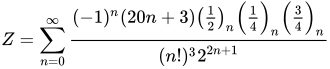

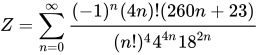


where is the Pochhammer symbol for the rising factorial. See also Ramanujan–Sato series.
Infinite products
- (Euler)
- where the numerators are the odd primes; each denominator is the multiple of four nearest to the numerator.


- (see also Wallis product)

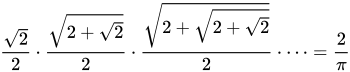
A double infinite product formula involving the Thue-Morse sequence:
- where and is the Thue-Morse sequence (Tóth 2020).



Arctangent formulas

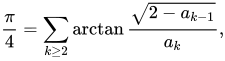
where such that .


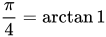
whenever and , , are positive real numbers (see List of trigonometric identities). A special case is




Continued fractions
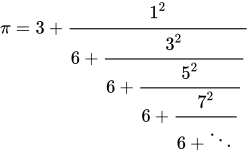
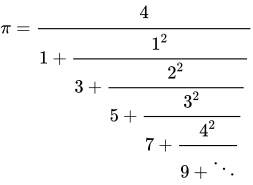
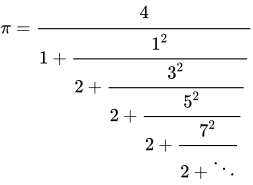
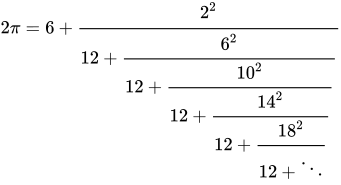
For more on the third identity, see Euler's continued fraction formula.
(See also Continued fraction and Generalized continued fraction.)
Iterative algorithms

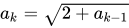
- (closely related to Viète's formula)
- (where is the h+1-th entry of m-bit Gray code, )[8]
- (cubic convergence)[9]





- (Archimedes' algorithm, see also harmonic mean and geometric mean)

For more iterative algorithms, see the Gauss–Legendre algorithm and Borwein's algorithm.
Miscellaneous
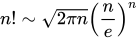

- (see Euler's totient function)
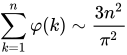
- (see Euler's totient function)
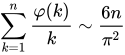
- (see also Beta function and Gamma function)

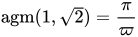
- (where agm is the arithmetic–geometric mean)

- (where and are the Jacobi theta functions[10])



- (where and is the complete elliptic integral of the first kind with modulus ; reflecting the nome-modulus inversion problem)[11]
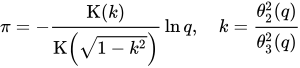


- (where )[11]

- (due to Gauss,[12] is the lemniscate constant)

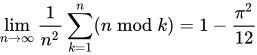
- (where is the remainder upon division of n by k)

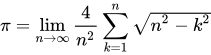
- (summing a circle's area)

- (Riemann sum to evaluate the area of the unit circle)

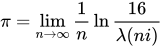
- (the numbers are real and algebraic for every ; is the modular lambda function)[13]


See also
- List of mathematical identities – Wikipedia list article
- Lists of mathematics topics – Wikipedia list article
- List of trigonometric identities – Equalities that involve trigonometric functions
- List of topics related to π – Wikipedia list article
- List of representations of e
References
- A000796 - OEIS
- Arndt, Jörg; Haenel, Christoph (2001). π Unleashed. Springer-Verlag Berlin Heidelberg. ISBN 978-3-540-66572-4. page 126
- Gourdon, Xavier. "Computation of the n-th decimal digit of π with low memory" (PDF). Numbers, constants and computation. p. 1.
- Weisstein, Eric W. "Pi Formulas", MathWorld
- Cooper, Shaun (2017). Ramanujan's Theta Functions (First ed.). Springer. ISBN 978-3-319-56171-4. (page 647)
- Carl B. Boyer, A History of Mathematics, Chapter 21., pp. 488–489
- Simon Plouffe / David Bailey. "The world of Pi". Pi314.net. Retrieved 2011-01-29.
"Collection of series for π". Numbers.computation.free.fr. Retrieved 2011-01-29. - Vellucci, Pierluigi; Bersani, Alberto Maria (2019-12-01). "$$\pi $$-Formulas and Gray code". Ricerche di Matematica. 68 (2): 551–569. doi:10.1007/s11587-018-0426-4. ISSN 1827-3491.
- Arndt, Jörg; Haenel, Christoph (2001). π Unleashed. Springer-Verlag Berlin Heidelberg. ISBN 978-3-540-66572-4. page 49
- Borwein, Jonathan M.; Borwein, Peter B. (1987). Pi and the AGM: A Study in Analytic Number Theory and Computational Complexity (First ed.). Wiley-Interscience. ISBN 0-471-83138-7. page 225
- Borwein, Jonathan M.; Borwein, Peter B. (1987). Pi and the AGM: A Study in Analytic Number Theory and Computational Complexity (First ed.). Wiley-Interscience. ISBN 0-471-83138-7. page 41
- Gilmore, Tomack. "The Arithmetic-Geometric Mean of Gauss" (PDF). Universität Wien. p. 13.
- Borwein, J.; Borwein, P. "Ramanujan and Pi". Springer Link.
- Tóth, László (2020), "Transcendental Infinite Products Associated with the +-1 Thue-Morse Sequence" (PDF), Journal of Integer Sequences, 23: 20.8.2, arXiv:2009.02025.
Further reading
- Peter Borwein, The Amazing Number Pi
- Kazuya Kato, Nobushige Kurokawa, Saito Takeshi: Number Theory 1: Fermat's Dream. American Mathematical Society, Providence 1993, ISBN 0-8218-0863-X.