Los Angeles Police Department resources
This is a list of resources of the Los Angeles Police Department.
Police stations
The department's deployment of officers has reflected the growth and changes of the City of Los Angeles since the late 19th century. The earliest police station (or "division" as the early ones were known – this term was originally meant to mean the Patrol Division but over time this term became commingled and substituted for what today we would refer to as the actual brick and mortar police building the divisions were housed within) was Central Division, located in what today would be known as downtown Los Angeles on the southeast corner of 1st and Hill Streets. This station opened in 1896 and was the department's first dedicated police station (another had been located at 2nd/Spring Streets, but was possibly a leased or rented storefront type of set-up). The Central Jail was located directly south of it. "Old Central" as it came to be known, housed not only Central Division but also many of the Department's headquarters units until its closure in about 1955 in favor of Parker Center. The following is a listing of other Los Angeles Police stations through the years, along with their original division numbers:
- 01 Central Police Station.
- 02 Lincoln Heights, Los Angeles, California Rampart Police Station. 1401 West 6th Street 90017
- 03 Southwest Police Station. 1546 West Martlin Luther King Boulevard 90062
- 04 Hollenbeck Police Station. 2111 East 1st St 90033
- 05 San Pedro Police Station. 2175 John S Gibson Boulevard 90731
- 06 Hollywood Police Station. 1358 North Wilcox Avenue 90028
- 07 Wilshire Police Station. 4861 West Venice Boulevard 90019
- 08 West Los Angeles Police Station. 1663 South Butler Avenue 90025
- 09 Van Nuys Police Station. 6240 Sylmar Avenue 91401
- 10 West Valley Substation. 19020 West Vanowen Street 91335
- 11 Northeast Police Station. 3353 North San Fernando Road 90065
- 12 77th Street Police Station. 7600 South Broadway 90003
- 13 Newton Street Police Station.3400 South Central Ave 90011
- 14 Pacific Police Station. 12312 West Culver Boulevard 90066
- 15 North Hollywood Police Station. 11640 South Burbank Boulevard 91601
- 16 Foothill Police Station. 12760 West Osborne Street 91331
- 17 Devonshire Police Station. 10250 North Etiwanda Avenue 91324
- 18 Southeast Police Station. 145 West 108th Street 90061
- 19 Mission Police Station. 11121 North Sepulveda Boulevard 91345
- 20 Olympic Police Station 1130 South Vermont Avenue 90006
- 21 Topanga Police Station 21501 West Schoenborn Street 91304
The city's largest growth period was from approximately the late 19th century through the 1930s when the city grew at a geometric rate. Approximately 100 smaller portions were added to the original five square mile Pueblo. Of these, about 90 were formerly unincorporated county lands. The remaining ten portions had been their own incorporated cities. These included the cities of: Watts, Venice (originally Ocean Park), Hollywood, San Pedro, Wilmington, Barnes, Hyde Park, Eagle Rock, Sawtelle and Tujunga. Generally when the city consolidated another existing city, its police officers became LAPD officers with corresponding ranks and titles at the LAPD, per the city charter. LAPD would create a new Division, named after the city that had been consolidated and would continue using the prior city's police station, usually replacing these facilities with larger police stations within a few years.
Mobility
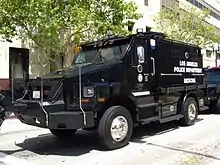
To patrol the 469 square miles (1,210 km2) of the city of Los Angeles, the police department utilizes a number of different types of vehicles:
Sedans
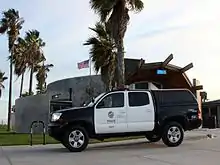
The Ford Crown Victoria Police Interceptor is one of three sedans for patrol in the department fleet, the others being the Dodge Charger Pursuit, and the Ford Police Interceptor Sedan. Only sedans are permitted to engage in a vehicle pursuit, pursuant to department policy. Like most police agencies throughout southern California, Los Angeles Police Department vehicles are ordered painted in black clearcoat with the roof, doors, and pillars painted white from the factory. The Department has used this black-and-white paint scheme since approximately 1940 with minimal modifications. Options available from Ford ordered by the Department today include dual pillar-mounted Unity spotlights, 16-inch heavy duty steel wheels with chrome center caps, and ballistic panels within the two front doors.
Most police vehicles bear at least two rear bumper stickers: one reading "There's NO Excuse - For Domestic Violence" and another for "Watch The Road - Operation Traffix". On the rear side panel is a black and white sticker that reads "EMERGENCY DIAL 9-1-1 Fire Police Medical." The front doors bear the seal of the city of Los Angeles, the department slogan "to protect and to serve" as well as the citywide five-digit "shop number" and city department name (POLICE). The last three numbers of the shop number (used to identify all vehicles operated by the city) are reprinted on the roof to help air units visually identify cars. On the trunk is a number that identifies which division the unit belongs to (e.g., a 25 would be "South Traffic Division" or a 3 would be "Southwest Area").
These cars appeared on the NBC television drama Adam-12:
- 1967, 1968 and 1969 Plymouth Belvedere
- 1971 Plymouth Satellite
- 1972 AMC Matador
On September 11, 2015, the Mayor announced a plan to lease 160 battery electric vehicles and 128 plug-in hybrids. The LA police have borrowed a Tesla Model S and a BMW i3 for testing.[2][3]
SUV
Due to the Ford Crown Victoria being discontinued in 2011, and the Ford Taurus being discontinued in 2019, the LAPD has been purchasing many more Ford Police Interceptor Utilities. The LAPD also uses a small number of Chevrolet Tahoes, but are starting to transition away, due to their poor gas mileage.
Unmarked Vehicles
The LAPD has many unmarked vehicles, mainly for gang units, SWAT, Metro, detectives, special investigations, vice, etc. They are usually assigned Dodge Chargers, Ford Explorers, Chevrolet Impalas (2010-2014 era), and sometimes Chevrolet Tahoes . The LAPD SWAT have a fleet of unmarked Chevrolet Suburbans, Chevrolet Tahoes, and the vehicles listed from above. Certain units like detectives, vice, special investigations, homicide units, may be assigned different vehicles that are not normally used for police work, such as the Chevrolet Malibu, Chevrolet Equinox, Chevrolet Traverse, Chevrolet Trailblazer(2019 era), Chevrolet Colorado, Ford Fusion, Ford Mustang, Ford Escape, Ford Edge, Ford Explorer (civilian version), Ford Expedition, Ford F-150, Dodge Durango, Dodge Caravan, RAM 1500, Jeep Grand Cherokee, Jeep Cherokee, Chrysler 300, GMC Acadia, GMC Terrain, GMC Yukon, Toyota Corolla, Toyota Camry, Toyota Avalon, Toyota RAV-4, Toyota Highlander, Toyota 4Runner, Toyota Sienna, Toyota Tacoma, Honda Civic, Honda Accord, Honda CR-V, Honda Pilot, Honda Odyssey, Nissan Altima, Nissan Maxima, Hyundai Sonata, Kia Sorento, Volkswagen Jetta, and other kinds of vehicles assigned to the unit. These vehicles are civilian models and are typically higher trim levels. Most feature leather seats, chrome wheels, and other features that would make them look like anything but a police vehicle.[4]
Motorcycles
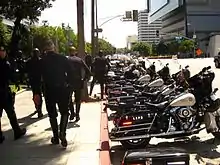
Kawasaki Police Motorcycles have represented the majority of the motorcycle vehicles in the motor pool with some Harley-Davidson motorcycles and increasingly, BMW motorcycles. Motorcycles are also painted black and white. These motorcycles carry a radio, code-3 equipment, a shotgun and documentation used by a police officer. During rain, motors are garaged, and traffic units patrol the city in sedans. LAPD also operates 3 electric motorcycles and 23 electric scooters.[3]
Air Support Division
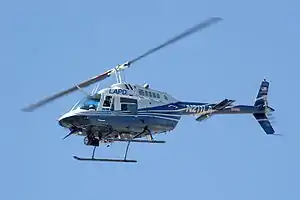
The LAPD maintains the second largest non-military airforce in the world. It maintains 21 helicopters and 1 fixed-wing aircraft.[5] The helicopters are painted silver and blue. The LAPD Air Support Division is slowly trading in their older Eurocopters for newer Eurocopter 125 models. The new models, however, are entering service with the more traditional black-and-white paint schemes similar to their department patrol cars. The letters LAPD appear on the top side of the aircraft in blue, capital letters.[6] LAPD air units include 14 Eurocopter AS-350B2 AStars, 4 Bell 206B-IIIs and 1 Bell 412. The aircraft come with a wide variety of electronics and equipment that include a 30 million candlepower "Nightsun" spotlight, optical FLIR cameras and electronically stabilized binoculars, a LoJack signal receiver, police radios in addition to the built-in aviation radios.
Two officers with at least three years of patrol car service fly in each air unit; they are armed and able to land and make arrests in areas not accessible by other means. They depart from the Hooper Heliport in downtown Los Angeles, and the Van Nuys airport.
Air units provide information with regards to barricaded suspects, suspects fleeing on foot or in a vehicle, violent incidents involving large numbers of individuals, and then some. Air units are automatically requested when initiating a traffic stop on a "code 5" vehicle, or suspect with known wants or warrants that are a felony in order to limit the potential for a vehicle pursuit.
Air units do not fly during poor weather (particularly dense fog) due to aviation safety.
Bicycles
Occasionally, "cycle" units go on patrol (usually in large numbers), especially during special events to provide fast and easy access to police assistance. Bicycle units may go on patrols lasting between 10–25 miles during any given beat. Bicycle units train rigorously (mainly in the hills of Elysian Park near Academy Road and Dodgers Stadium). The bicycles used by the Los Angeles Police Department are manufactured by Giant.
Horses
Metro Division, known for its famous Special Weapons and Tactics (SWAT) unit, also has a Mounted Unit that consists of approximately 40 police horses. Normally deployed during riots. Specially trained officers also wear their uniform along with boots and a Stetson hat with the same Police shield as the one worn on the brim of the traditional police hat. Equestrian units normally appear in the city only on special occasions. Metro Division is also responsible for the K-9 units, making Metro Division responsible for not only police horses, but also for police dogs (which also wear ballistic vests). Narcotics and Bomb K-9 units belong to different divisions. The reason the police force still uses Mounted Police is the added height and visibility that the horses give their riders allows officers to observe a wider area, but it also allows people in the wider area to see the officers, which helps deter crime and helps people find officers when they need them.
Radio
Inspired by a contest in 1924, Police Chief R. Lee Heath ordered his staff to investigate the use of radio to "more quickly dispatch officers to where they are needed." It was not until Police Chief Roy E. Steckel, however, that the department was assigned its first Federal Communications Commission license. On May 1, 1931, KGPL began broadcasting at 1712 kHz, just above the commercial radio broadcasting frequencies. Later, this was changed to 1730 kHz. Any citizen could monitor outgoing police radio traffic on their home sets. The system was "one way" until the mid-1930s when mobile transmitters were installed in patrol units.
Today, telephone calls into the department for police service are handled by the Communications Division. First, an Emergency Board Operator answers calls placed to 9-1-1 (with a lower number of operators assigned to the non-emergency 1-877-ASK-LAPD). A call for service results in an incident number, which resets to the number 1—citywide—at midnight each night. Upon receiving the incident, the Radio Telephone Operator (RTO) will go on the air to broadcast to the division (with the option to simulcast on bureau-wide, geographically-adjacent or citywide frequencies). Today, RTOs provide the following information in what is known as a crime broadcast:
- to whom this message is intended (a particular unit, a certain division's units, or, "all units"),
- the type of crime that just occurred (usually by California Penal Code but sometimes an abbreviation, established by the Communications Division),
- how long ago the crime occurred,
- where,
- a quantity of suspects (if more than one),
- a description of the suspect or suspects, their clothing and/or other uniquely identifiable attributes, if available, with what they might be armed.
- Additional details may include information about the "PR" (person reporting) or simply instructions to "monitor comments for further" (a direction to responding officers to read about the incident on their in-car Mobile Data Terminals).
- The broadcast always concludes with a code (such as Code 3 or Code 2 for immediate response but without siren with red and blue lights), the incident number and the "RD" or reporting district (a numbered area within the division).
There may also be a request by the RTO for the responding unit handling to identify.
A fictitious example of a radio call might begin with tones (to alert patrol units that a broadcast will follow), "Any central unit, a 211 just occurred at 714 south Broadway Street at the Footlocker. Suspect was a male, white, six-foot seven, approximately 280 pounds; shaved head, black eyes, goatee, white T-shirt, dark baggy pants. Weapon used was a revolver. Monitor comments for additional. Code 2. Incident number 555 in RD 193."
"Control" (the radio name for Communications division) as well as units in the area also use a wide variety of codes, common ones include:
- Code 1: answer your radio
- Code 2: respond immediately to location, no lights or siren, obey all traffic laws
- Code 3: respond immediately with lights and siren to location, exemption from traffic laws permitted with lights and siren
- Code 4: no further units need respond, return to patrol
- Code 4-Adam: no further units need respond, suspect not in custody, units en route to the scene position or patrol in strategic areas near the scene
- Code 5: Stakeout, marked police cars must avoid location
- Code 6: unit has arrived to location, officers investigating
- Code 6-Adam: unit has arrived, may need further assistance from nearby units
- Code 6-Charles: Dangerous suspect (usually felony want or warrant reported); one-officer units stand-by for assistance
- Code 7: meal break request( this code is no longer used)
- Code 8: fire reported in area of high fire hazard or threat to firefighting personnel
- Code 8-Adam: units requested to scene of fire for traffic and crowd control
- Code 10: request to clear frequency for broadcast of want/warrant information
- Code 12: False Alarm
- Code 20: Notify Media or Often Used To Advise Others That media Is On Scene
- Code 30: Burglar Alarm (can be Code 30-Silent)
- Code 37: Vehicle is Reported Stolen (Code 6-Charles is given if vehicle license check produces dangerous suspect or felony want or warrant information)
- Code 100: units in position to intercept fleeing suspect
- Code Robert: Request for deployment of Urban Police Rifle
- Code Sam: Request for deployment of shotgun slug ammunition to location
- Code Tom: Request for deployment of taser to location
NOTE: A unit that responds Code-3 must state their starting location (e.g. intersection or street address), after which the RTO broadcasts a Code 3 notification, announcing the unit number is responding Code-3 from that starting location to the location of the distress call.
Typical radio traffic (usually not simulcast citywide) includes the activity generated from traffic stops. A patrol unit may radio control that they are "code 6" on a traffic stop, to which control will give the "Roger" acknowledgement. Additional broadcasts will be requests for information on "cal IDs", or CalOps (the numbers that appear at the top of California Department of Motor Vehicle driver licenses) or on vehicle license plates. The result of which provides all of the expected details about the subject plus important details such as whether or not the licensee has any wants or warrants, FTAs (failure to appear in court) or FTPs (failure to pay a fine), etc. In the case of a vehicle, whether or not it is Code 37. Off the air and via MDT, officers can also see to whom the vehicle is registered.
In the event a Code 6 Charles is broadcast, the unit in question must verify their location, advise if they are Code 4 and the nature of the Code 4 (e.g. Suspect in custody, Common Name, Information Only or Wrong suspect.)
A noticeable characteristic of police broadcasts is the expedited nature of crime broadcasts; due to the number of broadcasts that need to be made at any given moment of the day, each transmission is necessarily as brief as possible. As a standard of police professionalism, RTOs are trained to use a tone that is strictly business-like.
Digital frequencies
After the parade in Los Angeles celebrating the Los Angeles Lakers 2001 NBA championship title, the police department switched from analog frequencies to digital frequencies. This ended a long-lasting era of the public having easy listening access to police broadcasts that started when the department had initially set up agreements with a local, commercial AM radio station to interrupt regularly scheduled programming for a crime broadcast. Officers were tuned to a specific radio station. However, as the amount of broadcasting needed increased, the department established its first transmission tower in Elysian Park and eventually began broadcasting over dozens of frequencies in the 400 MHz and 500 MHz ("T-band") ranges. These digital transmissions can be monitored on a proper Uniden Bearcat or Radio Shack digital scanner.
Radio cars
From the perspective of control, each unit is represented by an LAPD-specific callsign. Typically, a callsign is made up of three elements: the division number, the unit type and the "beat" number. For example, division 1 is Central Division (or, now, "Central Area"), an "A" is patrol unit with two officers and their patrol area number can be a number like 12. Such a unit would identify themselves as 1-A-12 (or 1-Adam-12, using the LAPD phonetic alphabet). There are several patrol types:
- A: Two officer patrol unit ("Adam")
- D: SWAT ("David")
- E: Ticket writing car
- L: One officer patrol unit. ("Lincoln"); ( "X" or "T" units shall use the letter "L" following the regular service letter when applicable.):traffic supervisor, TL units usually carry the rank of Sergeant
- M: Motorcycle unit ("Mary"); (MQ: motorcycle on special assignment, MQ: DUI enforcement)
- C or "cycle": Bicycle unit
- CP: Command Post
- FB: Foot Beat (Foot Patrol)
- T: Traffic investigator ("Tom")
- TL: Traffic single officer car or field supervisor (a Sergeant in a Traffic Division)
- G: Gang enforcement unit ("George")
- H: Detective ("Henry")
- J: Juvenile Investigator
- N: Narcotics
- R: Metro Unit
- W: Detective ("William")
- U: Report-taking Unit ("Union")
- V: Vice ("Victor")
- OP: Observation Post (normally, a small bus operating as a mobile command unit for major incidents)
- Q: Special detail (Not to be assigned radio calls. Works on a specific crime mission)
- X: Extra patrol ("X-ray")
- Z: Special detail ("Zebra"); (Not to be assigned radio calls. Works on a specific crime mission)
The immediate supervisor of any patrol officer is called a Field Supervisor, which typically have beats that end in zero beginning from 2 through 7 (for example, 7-L-60 for a Wilshire Area supervisor). The watch commander is a usually a lieutenant I at a geographic division. Their radio code always ends in L-10 (e.g., the watch commander at division 6 or Hollywood Area station is always 6-L-10). The Watch commander is responsible for the geographic area (e.g. "Southwest Area") and reports to the area patrol captain I.
Radio equipment
Officers out of their cars are able to communicate over the air using portable Motorola radios nicknamed ROVERs ("Remote Out of Vehicle Emergency Radios"). These hand-held radios are currently a mix of the new Motorola APX-8000 and older XTS-5000 Models With Some Motorola Astro digital SABRE models still being used by very few officers and some still inside older police vehicles. Originally, Motorola MX-series analog handheld units were used when the transition from VHF to UHF "T-band" dispatch/tactical frequencies was made in the early 1980s. Prior to that time, portable 2-way radios (known in LAPD jargon then as "CC units") were either VHF or UHF, mainly Motorola HT-200s and HT-220s, stocked in small quantities, and used mainly by specialized units such as Metropolitan division, SWAT (Special Weapons & Tactics), SIS (Special Investigations Section) and Narcotics divisions as stakeout tools. Another use was for foot beats "FB" units, mainly in Central division, in the late 1970s and early 1980s. ROVERs are normally gun belt-mounted. For convenience, smaller, corded, hand-held speaker-microphones can be plugged into these radios and then clipped to parts of the uniform shirt such as a front pocket or shoulder loop.
Ranks of the LAPD
| Rank | Insignia | Notes[7][8] |
|---|---|---|
| Chief of Police |  |
Appointment made by the mayor of Los Angeles, with majority approval of the Police Commission. Should have a college degree and at least 12 years of progressively responsible law enforcement experience. Since 1876, there have been 57 appointed chiefs of the Los Angeles Police Department. William Parker was the longest serving police chief in Los Angeles Police Department history, serving for 16 years as the chief of the LAPD.[9] |
| Deputy Chief II |  |
Commanding officer of an office |
| Deputy Chief I |  | |
| Commander (assistant commanding officer of a bureau) |  |
Eligibility for rank promotion achieved after completion of required probationary periods. |
| Police Captain | 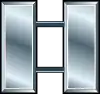 | |
| Police Lieutenant |  | |
| Insignia are worn as metal pins on the collars of a shirt and as shoulder marks on a jacket. | ||
| Rank | Insignia | Notes[7] | ||
|---|---|---|---|---|
| Sergeant II |  |
At least two years service as Sergeant II or Detective III before eligibility for promotion to Lieutenant I. | ||
| Detective III |  | |||
| Sergeant I |  |
Promotion based on panel interview/departmental assessment. | ||
| Detective II |  | |||
| Detective I |  | |||
| Senior Lead Officer ‡ |  |
Certain Police Officer III in special or hazard pay situations are denoted by a Police Officer III insignia and star. These roles can include traffic follow-up investigators, canine training officers, SWAT platoon element leaders, and Senior Lead Officers who coordinate geographical areas.[10] | ||
| Police Officer III ‡ |  |
At least four years service as a Police Officer before becoming eligible for promotion to Sergeant I or Detective I (which requires an additional examination and interview). | ||
| Police Officer II | No insignia | At least three years service as a Police Officer before eligibility for promotion to Police Officer III | ||
| Police Officer I | Automatic promotion to Police Officer II upon satisfactory completion of an 18-month probationary assignment (6 months at the academy plus a 12-month field assessment). | |||
| Insignia are worn as embroidered chevrons on the upper sleeves of a shirt or jacket. | ||||
- Specialized unit insignia are worn at the top of the sleeve beneath the shoulder for officers assigned to the traffic divisions. Officers assigned to area patrol divisions have historically not worn any departmental shoulder patch on their uniforms.
- Service stripes are worn above the left cuff on a long-sleeved shirt. Each silver stripe represents five years of service in the LAPD.
Supervisory terminology
The following names are used to describe supervision levels within the LAPD:[11]
| Position | Description |
|---|---|
| Staff Officer | Any rank above captain |
| Commanding Officer | Any officer in charge of a bureau, a group, a geographical area, or a division |
| Director | An officer commanding an office of the LAPD |
| Incident Commander | Any officer who takes command at an emergency situation or who is in command at a planned special event |
| Watch Commander | An officer in charge of a specific watch within a division or geographical area |
| Supervisor | An officer engaged in field supervision or in general supervision of a section or unit |
| Officer in Charge ‡ | An officer in charge of a section, incident or unit |
‡ As detectives are considered specialists within the LAPD, they are normally considered to be separate from the uniformed line of command. The senior-most detective is therefore permitted to take charge of an incident when it is necessary for investigative purposes, superseding the chain of command of other higher-ranking officers in attendance.[11]: 125
Predictive Policing
Predictive Policing is a relatively new approach to policing that uses algorithms to predict when future crimes are most likely to occur. Through artificial intelligence data is gathered and used to identify suspicious patterns, locations, activity, and individuals. The technology is based on network models and risk models. Network models predict specific types of crime using information based on time and location to predict when and where to look for crimes. The prediction model utilizes geo-spatiality [12] to provide information on crimes.[13] In 2008, William Bartton, the then chief of the LAPD began working with federal agencies to assess the use of a more predictive approach to policing. Currently, certain cities such as Santa Cruz, New Orleans, and Oakland have banned predictive policing. However, in the LAPD, predictive policing is expanding rapidly within the department.[14]
Technology
Los Angeles' Strategic Extraction and Restoration Program
The Los Angeles’ Strategic Extraction and Restoration Program began in 2011 and is a strategy that includes place based and offender based models. It began in 2011 and was funded by the Smart Policing Initiative.[15] This program uses a point based system where people get a LASER score which is later used to evaluate the risk of an individual. This system was created with the intention of targeting individuals who are most likely to commit a crime based on data around crime history. Points are designed based on gang membership, violent crime committed, and “quality” interaction with the police. Through this system, when individuals scored a high enough LASER score, they were put on an “chronic offenders bulletin” which was exposed to officers in the LAPD. After a report in 2018, they found that 84% of the 233 people with high enough LASER scores to be labeled a ‘chronic offender’ were Latinos and African Americans. Due to these outstanding statistics, The LAPD shut down LASER.[16]
PredPol
The LAPD started using PredPol, a predictive policing software, in 2012. PredPol uses an algorithm to analyse data from LAPD record management systems and predict future crimes. It uses the near repeat model, which suggests that once there is a crime in a location, the surrounding area is immediately at increased risk for more crimes. Three aspects of offender behavior are incorporated into the algorithm that is informed by a decade of research on criminal patterns:
- Repeat victimization: if a crime is committed one day, the risk of it happening again goes up. This is based on the understanding that if an offender is successful in one area, they will come back because it is now less risky.
- Near-repeat victimization: if a crime is committed next door, neighboring homes are now at higher risk because of the close proximity.
- Local search: Crimes tend to cluster together, because criminals are not likely to travel far from their key activity points such as home, work, and play.[17]
Palantir
Palantir is a platform where the LAPD uses data to send out reports to officers.[15] The platform works by merging data from crime and arrest reports, automated license plate reader (ALPR), rap sheets and other sources.[14] This platform uses “tagging,” which allows officers to tag people, vehicles, addresses, phone numbers, documents, indicents, citations, calls for service, ALRP, and field interview cards of interest. Through having Palantir on their cell phones, officers are automatically notified of warrants or events that involve the tagged entities.
References
- "Toyota Tacoma", Wikipedia, July 5, 2021, retrieved July 6, 2021
- "LAPD Blog: Mayor Garcetti And City Departments Commit To Largest City-Owned Fleet Of Pure Battery EV Vehicles In America". Lapdblog.typepad.com. September 11, 2015. Retrieved April 29, 2016.
- Brandom, Russell. "The LAPD has a Tesla now". The Verge. Retrieved April 29, 2016.
- "Request 20-3440 - NextRequest - Modern FOIA & Public Records Request Software". recordsrequest.lacity.org. Retrieved June 30, 2020.
- "Archived copy". Archived from the original on May 4, 2007. Retrieved May 3, 2007.CS1 maint: archived copy as title (link)
- "LAPD Air Support — Police Helicopter Pilot". Policehelicopterpilot.com. Retrieved April 29, 2016.
- "The LAPD Career Ladder". Join LAPD. Archived from the original on August 23, 2011. Retrieved August 18, 2011.
- "LAPD Sworn Police Officer Class Titles". LAPD. Retrieved September 28, 2020.
- "Brief biography". Los Angeles Police Department. Retrieved August 11, 2008.
- "Quality of Life Issues". Los Angeles Police Department. Retrieved August 18, 2011.
- "Supervision". Los Angeles Police Department. Retrieved November 21, 2012.
- Janowicz, Krzysztof; Gao, Song; McKenzie, Grant; Hu, Yingjie; Bhaduri, Budhendra (April 2, 2020). "GeoAI: spatially explicit artificial intelligence techniques for geographic knowledge discovery and beyond". International Journal of Geographical Information Science. 34 (4): 625–636. doi:10.1080/13658816.2019.1684500. ISSN 1365-8816.
- Walczak, Steven (2021). "Predicting Crime and Other Uses of Neural Networks in Police Decision Making". Frontiers in Psychology. 12: 4110. doi:10.3389/fpsyg.2021.587943. ISSN 1664-1078.
- Hvistendahl, Mara (January 30, 2021). "How the LAPD and Palantir Use Data to Justify Racist Policing". The Intercept. Retrieved November 17, 2021.
- Brayne, Sarah (August 29, 2017). "Big Data Surveillance: The Case of Policing". American Sociological Review. 82 (5): 977–1008. doi:10.1177/0003122417725865. ISSN 0003-1224.
- "LAPD not giving up on data-driven policing, even after scrapping controversial program". www.cbsnews.com. Retrieved November 17, 2021.
- "Predictive Policing Technology". PredPol. Retrieved November 17, 2021.
| Facilities |  | |
|---|---|---|
| Divisions | ||
| Units | ||
| Medals | ||
| Events (LAPD history) | ||
| Corruption/ misconduct | ||
| Organizations | ||
| Related |
| |