Luigi Russolo
Luigi Carlo Filippo Russolo (30 April 1885 – 6 February 1947) was an Italian Futurist painter, composer, builder of experimental musical instruments, and the author of the manifesto The Art of Noises (1913).[1] He is often regarded as one of the first noise music experimental composers with his performances of noise music concerts in 1913–14 and then again after World War I, notably in Paris in 1921.[2] He designed and constructed a number of noise-generating devices called Intonarumori.
Luigi Russolo | |
|---|---|
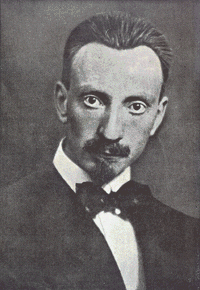 Luigi Russolo ca. 1916 | |
| Background information | |
| Birth name | Luigi Russolo |
| Born | 30 April 1885 Portogruaro, Italy |
| Died | 4 February 1947 (aged 61) Laveno Mombello, Italy |
| Genres | Futurism, experimental, avant-garde, noise |
| Occupation(s) | Composer, painter, custom instrument builder |
| Years active | 1901–1947 |
Biography
%252C_oil_on_canvas%252C_99_x_99_cm%252C_private_collection.jpg.webp)
Luigi Russolo was perhaps the first noise artist.[3][4] His 1913 manifesto, L'Arte dei Rumori (The Art of Noises), stated that the industrial revolution had given modern men a greater capacity to appreciate more complex sounds. Russolo found traditional melodic music confining, and he envisioned noise music as its future replacement.
Russolo designed and constructed a number of noise-generating devices called Intonarumori, and assembled a noise orchestra to perform with them. A performance of his Gran Concerto Futuristico (1917) was met with strong disapproval and violence from the audience, as Russolo himself had predicted. None of his intoning devices have survived, though recently some have been reconstructed and used in performances. Although Russolo's works bear little resemblance to modern noise music, his pioneering creations cannot be overlooked as an essential stage in the evolution of the several genres in this category.[5][6] Many artists are now familiar with Russolo's manifesto.
%252C_oil_on_canvas%252C_86_x_65_cm%252C_Mus%C3%A9e_de_Grenoble.jpg.webp)
Antonio Russolo, another Italian Futurist composer and Luigi's brother, produced a recording of two works featuring the original Intonarumori. The phonograph recording, made in 1921, included works entitled Corale and Serenata, which combined conventional orchestral music set against the sound of the noise machines. It is the only surviving contemporaneous sound recording of Luigi Russolo's noise music.[7]
Russolo and Filippo Tommaso Marinetti gave the first concert of Futurist music, complete with intonarumori, in April 1914, causing a riot.[8] The program comprised four "networks of noises".
Some of Russolo's instruments were destroyed in World War II; others have been lost.[9] Replicas of the instruments have since been built.
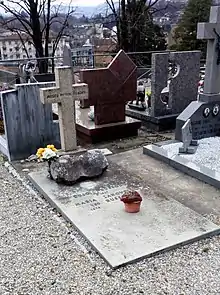
Gallery
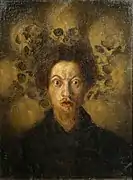 Self-portrait with Skulls, 1909 painting
.jpg.webp) Profumo (meaning "scent", "fragrance", 1910)
Profumo (meaning "scent", "fragrance", 1910) La Rivolta (The Revolt), 1911 oil on canvas
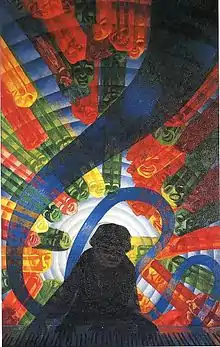 La Musica (a pianist playing for his audience), 1911–12 oil on canvas
 Solidity of Fog, 1912 oil on canvas
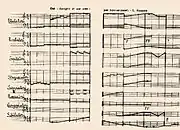 1913 score of en-harmonic notation, for Intonarumori
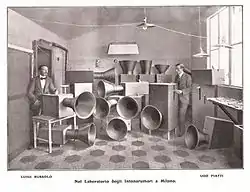 Intonarumori, 1913, instruments built for music-piece Bruitism, partly operating on electricity
%252C_1913.jpg.webp) Russolo and his assistant Ugo Piatti in their Milan studio in 1913 with the Intonarumori (noise machines)
Russolo and his assistant Ugo Piatti in their Milan studio in 1913 with the Intonarumori (noise machines)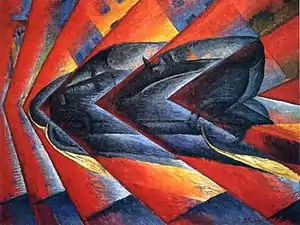 Dynamism of a Car, 1913 oil painting
 Soap-dish, 1929 oil painting
 Landscape with trees, c. 1940s painting
Notes
- Chilvers & Glaves-Smith, p. 619.
- Chilvers & Glaves-Smith, p. 620.
- In Futurism and Musical Notes, Daniele Lombardi discusses the French composer [Louis] Carol-Bérard (1881–1942); a pupil of Isaac Albéniz, Carol-Bérard is said to have composed a Symphony of Mechanical Forces in 1910 – but little evidence as emerged thus far to establish this assertion.
- Luigi Russolo, "The Art of Noises"
- Paul Hegarty, Noise/Music: A History (London: Continuum International Publishing Group, 2007), pp. 13–14
- László Moholy-Nagy in 1923 recognized the unprecedented efforts of the Italian Futurists to broaden our perception of sound using noise. In an article in Der Sturm #7, he outlined the fundamentals of his own experimentation: "I have suggested to change the gramophone from a reproductive instrument to a productive one, so that on a record without prior acoustic information, the acoustic information, the acoustic phenomenon itself originates by engraving the necessary Ritzschriftreihen [etched grooves]." He presents detailed descriptions for manipulating discs, creating "real sound forms" to train people to be "true music receivers and creators" (" A Brief history of Anti-Records and Conceptual Records" by Ron Rice via UbuWeb, from Unfiled: Music Under New Technology, Chris Cutler (ed.) 1994
- Albright, Daniel (ed.) Modernism and Music: An Anthology of Source. Chicago: University of Chicago Press, 2004. p. 174
- Larry Sitsky (2002). Music of the Twentieth-century Avant-garde: A Biocritical Sourcebook. Westport and London: Greenwood Publishing Group. p. 415. ISBN 978-0-313-29689-5.
- Barclay Brown, "The Noise Instruments of Luigi Russolo", Perspectives of New Music 20, nos. 1 & 2 (Fall–Winter 1981, Spring–Summer 1982): 31–48; citation on 36
References
- Chilvers, Ian; Glaves-Smith, John. A Dictionary of Modern and Contemporary Art. Oxford and New York: Oxford University Press.
Further reading
- Chessa, Luciano: Luigi Russolo, Futurist: Noise, Visual Arts, and the Occult. University of California Press, 2012.
External links
 |
Wikimedia Commons has media related to Luigi Russolo. |
 |
Wikiquote has quotations related to: Luigi Russolo |
- Russolo, Luigi Carlo Filippo. Dizionario Biografico degli Italiani (2017). (in Italian)
- Media Art Net | Russolo, Luigi: Intonarumori (at medienkunstnetz.de)
- Archive Russolo recordings at LTM
- Peggy Guggenheim Collection: Luigi Russolo
- Bob Osborn's Futurism: Luigi Russolo
- Prof. Russolo & His Noise Intoners
- Audio
- MP3 audio files of music of Luigi Russolo on UbuWeb
- Three audio clips by Luigi Russolo: Serenata, Corale and Risveglio di una città
- Video
Futurism and noise music | ||
|---|---|---|
| People |  | |
| Techniques | ||
| Compositions | ||
| Other | ||
Authority control  | |
|---|---|
| General | |
| National libraries | |
| Art research institutes | |
| Other | |