MV Derbyshire
MV Derbyshire was a British ore-bulk-oil combination carrier built in 1976 by Swan Hunter, as the last in the series of the Bridge-class sextet. She was registered at Liverpool and owned by Bibby Line.[2]
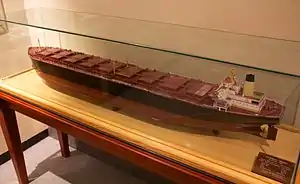 Model of Derbyshire's sister ship, English Bridge | |
| History | |
|---|---|
| Name |
|
| Owner | Bibby Line |
| Port of registry |  Liverpool Liverpool |
| Builder | Swan Hunter |
| Yard number | 57[1] |
| Launched | 5 December 1975[1] |
| Completed | June 1976[1] |
| Identification | IMO number: 7343805 Call sign: GULK |
| Fate | Lost with all hands on 9 September 1980 during Typhoon Orchid. |
| Notes | Largest British ship ever lost at sea |
| General characteristics | |
| Class and type | Bridge-class combination carrier |
| Tonnage | |
| Length | 294.2 m (965 ft 3 in) |
| Beam | 44.3 m (145 ft 4 in) |
| Draft | 18.44 m (60 ft 6 in) |
| Ice class | A1 |
| Installed power | B&W 8K98FF |
| Propulsion | 1 x propeller |
| Speed | 15.5 knots (28.7 km/h; 17.8 mph) |
| Capacity | c. 160,000 tonnes of cargo |
| Crew | 42 |
Derbyshire was lost on 9 September 1980 during Typhoon Orchid, south of Japan. All 42 crew members and two of their wives were killed in the sinking. At 91,655 gross register tons, she is the largest British ship ever to have been lost at sea.[3]
History
MV Derbyshire was launched in late 1975 and entered service in June 1976, as the last ship of the Bridge-class combination carrier, originally named Liverpool Bridge. She and English Bridge (later Worcestershire and Kowloon Bridge) were built by Seabridge for Bibby Line. The ship was laid up for two of its four years of service life.[4]
In 1978, Liverpool Bridge was renamed Derbyshire, the fourth ship to carry the name in the company's fleet. On 11 July 1980, on what turned out to be the ship's final voyage, Derbyshire left Sept-Îles, Quebec, Canada, her destination being Kawasaki, Kanagawa Prefecture, Japan, though she foundered near Okinawa (southern Japan). Derbyshire was carrying a cargo of 157,446 tonnes of iron ore.[5]
On 9 September 1980, Derbyshire hove-to in Typhoon Orchid some 230 miles (370 km) from Okinawa, and was overwhelmed by the tropical storm killing all aboard. She never issued a mayday distress message.[5] The ship had been following weather routing advice by Ocean Routes, a commercial weather routing company.[6]
The search for Derbyshire began on 15 September 1980 and was called off six days later when no trace of the vessel was found, and it was declared lost. Six weeks after Derbyshire sank, one of the vessel's lifeboats was sighted by a Japanese tanker.[7]
Derbyshire's sister ship Kowloon Bridge was lost off the coast of Ireland in 1986 following incidences of deck cracking that were first discovered after an Atlantic crossing.[8] In the wake of this second disaster, Nautilus International, the National Union of Rail, Maritime and Transport Workers and International Transport Workers' Federation funded a new investigation sought by relatives of the Derbyshire victims.[9]
In 1994, a deep water search began. In June 1994, the wreck of Derbyshire was found at a depth of 4 kilometres (2.5 mi), spread over 1.3 kilometres (0.81 mi).[10] An additional expedition spent over forty days photographing and examining the debris field looking for evidence of what sank the ship. Ultimately it was determined that waves crashing over the front of the ship had sheared off the covers of small ventilation pipes near the bow. Over the next two days, seawater had entered through the exposed pipes into the forward section of the ship, causing the bow to slowly ride lower and lower in the water. Eventually, the bow was completely exposed to the full force of the rough waves, which caused the massive hatch on the first cargo hold to buckle inward, allowing hundreds of tons of water to enter in moments. As the ship started to sink, the second, then third hatches also failed, dragging the ship underwater. As the ship sank, the water pressure caused the ship to be twisted and torn apart by implosion/explosion, a property of double-hulled ships where the compression of air between the hulls causes a secondary explosive decompression.
Memorials

A bronze plaque was placed on the wreckage as a memorial to those who were lost.[7]
On 21 September 1980, the Bibby Line vessel Cambridgeshire held a memorial service for Derbyshire in the area the vessel was lost.
The 20th anniversary of the vessel's loss was marked by a memorial service in Liverpool, England, which was attended by Deputy Prime Minister John Prescott, himself a former merchant seaman.[11] Ten years later a memorial service was held in the vessel's home port of Liverpool on the 30th anniversary of Derbyshire's loss.[12]
A permanent monument was dedicated on 15 September 2018 in the garden of the Church of Our Lady and Saint Nicholas, Liverpool.[13]
See also
- List of ship launches in 1976
- List of shipwrecks in 1980
- List of maritime disasters
- Edmund Fitzgerald, an American bulk carrier lost in 1975 under similar circumstances
References
- "7343085". Miramar Ship Index. Retrieved 18 December 2009.
- "MV Derbyshire - HC Deb 03 July 1996 vol 280 cc883-904". www.hansard.millbanksystems.com. Hansard / House of Commons proceedings. Retrieved 18 July 2017.
- "List of websites and links of the enquiries of Derbyshire sinking". www.c4tx.org. Retrieved 27 July 2017.
- "What really happened to the Derbyshire". Archived from the original on 17 September 2011. Retrieved 17 February 2012.
- "The final voyage of MV Derbyshire". Liverpool Museums. Archived from the original on 11 November 2013. Retrieved 27 July 2017.
- Marston, Paul (9 November 2000). "Crew cleared over sinking of Derbyshire". The Daily Telegraph. Retrieved 27 July 2017.
- Mearns, David. "Searching for the Derbyshire". Archived from the original on 13 August 2001. Retrieved 17 February 2012.
- Cowton, Rodney (13 December 1986). "Public inquiry into Derbyshire sinking ordered by minister". The Times (62640). p. 3. ISSN 0140-0460.
- "RMT mourns loss of crew and safety rights on 40th anniversary of MV Derbyshire tragedy". RMT. 9 September 2020. Retrieved 14 October 2020.
- "Conclusions". Archived from the original on 8 April 2000. Retrieved 17 February 2012.
- "Prescott remembers Derbyshire victims". BBC News. 9 September 2000.
- Stewart, Gary. "Memorial service to remember loss of MV Derbyshire". Liverpool Daily Post. Trinity Mirror. Archived from the original on 6 September 2012. Retrieved 17 February 2012.
- "RMT supports MV Derbyshire Families Association". RMT. 13 September 2018. Retrieved 14 October 2020.
External links
 |
Wikimedia Commons has media related to IMO 7343805. |
- "Prescott remembers Derbyshire victims". BBC News. 9 September 2000.
- Tarman, Daniel; Heitmann, Edgar. "Case Study II, Derbyshire, Loss of a Bulk Carrier". Ship Structure Committee. Archived from the original on 2 April 2008. (dead link, archived)
- Gadfly (7 December 2019). "Means, Ends and Dirty Hands". – essay criticising the 2000 formal investigation
- "Public Information regarding the Inquiry into the MV-Derbyshire". The National Archives. Archived from the original on 13 October 2010. – archived version of official inquiry website
Shipwrecks and maritime incidents in 1980 | |
|---|---|
| Shipwrecks |
|
| Other incidents |
|
1979   1981 1981 | |