Mangur (tribe)
Mangur is one of the largest Kurdish tribes of western Iran. They are native to a basin on the little Zab river called “Mangurayeti”[1] in Mukriyan[2][3] and also inhabit the districts and cities of Sardasht, Piranshahr, Mahabad, Pshdar District.[4]
Mangur was one of the Kurdish tribes in the Bolbas Federation.[5] The others were: Mâmash, Pirân, Zerzâ, Herki and Shekâk.[6]
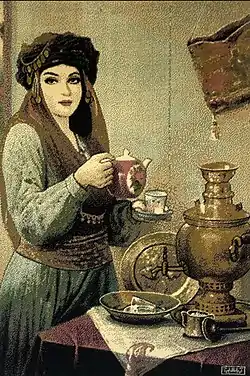
Mangurs pass down their lineage Matrilineally, referring to their ancestral grandmother as their family name. Since the introduction of surnames in Iran, Mangurs adopted using surnames, however still using their maternal family sub groups identities amongst themselves. Some Mangur Families are run by women and can be considered as Matriarchal, Though typically most Mangur Families were run by men and therefore considered Patriarchal however were still Matrilineal and had better status of women compared to other surrounding peoples. In cases of Patriarchal-Matrilineal Mangur families the succession typically goes from man to maternal nephew so that the domain will stay in the family name, occasionally the domains will lay in the hands of a shrewd women and thus the succession will just go from mother to child (usually son).[7]
History
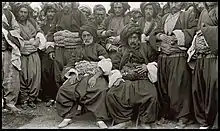
In the winter of 1928-29 the Mangur, the Mâmash and other tribes rebelled against Reza Shah and occupied Sardasht though they lacked the forces to extend the revolt more widely.[8][9] The Mangur were among the tribes to initially back the Soviet-backed Republic of Mahabad in 1946. However support for the republic soon fell after the withdrawal of Russia. The Mangur Tribe, and other surrounding tribes withdrew their support.[10]
Mangurs practice matrilineality. This was demonstrated through a legend that the Mangur Tribal chief had six wives, he gave his children surnames named after their mother. The name of these wives were Amān, Šamʿ, Zīn, Zarrīn, Ḵeder, and Morowwat.[11] There is a different legend that states that those six women were actually the chiefs daughters, who had no sons, and to preserve the family he continued his kinship line through them. All Mangurs can trace their ancestral grandmother back to one of these six women. By far the largest clan is the Morowwat clan in Mahabad, though the other clans collectively live in Piranshahr and Sardasht.[12] Today Mangurs officially use surnames, however they still identify as being descendants belonging to one of these six families. Historically, these six maternal clans were often amongst war with each other and remained disunited as six different clans.[13] Marriages were often political, and it was common to marry outside of their tribe with other local tribes. This tradition of Matrilineality has also been adopted by many non-Mangur Kurdish tribes who were subjects to the Mangurs throughout the years though it is currently only actively practiced by Mangurs and other smaller clans, however other non-Mangur Kurdish tribes and families in Mukriyan remain being named after a female ancestor.[14]
The Zahediyeh Sufi order traces its origins back to Zarrīn, one of the six Mangur ancestral grandmothers.[15]
References
- Naval Intelligence Division (3 September 2014). Iraq & The Persian Gulf. Taylor & Francis. p. 377.
- Ates, Sabri (October 21, 2013). Ottoman-Iranian Borderlands. Cambridge University Press. p. 235.
- Mangurayeti http://www.mangurayeti.com. Missing or empty
|title=(help) - "KURDISH TRIBES – Encyclopaedia Iranica". www.iranicaonline.org. Retrieved 2019-10-20.
- Minorsky, V. (1957). "Mongol Place-Names in Mukri Kurdistan". Mongolica. 19 (1): 75. JSTOR 609632.
- "Welcome to Encyclopaedia Iranica". Iranica Online.
- Abdurrahman Sharafkandi. Çêştî Micêvir.
- David McDowall (2004-05-14). A Modern History of the Kurds. I.B.Tauris. ISBN 978-1-85043-416-0.
- Stephanie Cronin (2007-01-24). Tribal Politics in Iran: Rural Conflict and the New State, 1921-1941. Routledge. pp. 116–. ISBN 978-1-134-13801-2.
- E. O'Ballance (1995-12-18). The Kurdish Struggle, 1920-94. Palgrave Macmillan UK. pp. 29–. ISBN 978-0-230-37742-4.
- "Welcome to Encyclopaedia Iranica". Iranica Online.
- "KURDISH TRIBES – Encyclopaedia Iranica". www.iranicaonline.org. Retrieved 2019-10-20.
- Harris, Walter (1896). From Batum to Baghdad. Harvard University: W. Blackwood and sons. p. 196.
- Minorsky, V. (1957). "Mongol Place-Names in Mukri Kurdistan". Mongolica. 19 (1): 75. JSTOR 609632.
- "Geni".
| Iraq | |
|---|---|
| Iran | |
| Azerbaijan | |
| Turkey | |
| Syria | |
| Historical tribes | |
| Related topics | |