Mars in fiction
Fictional representations of Mars have been popular for over a century.[1] Interest in Mars has been stimulated by the planet's dramatic red color, by early scientific speculations that its surface conditions might be capable of supporting life, and by the possibility that Mars could be colonized by humans in the future. Almost as popular as stories about Mars are stories about Martians engaging in activity (frequently invasions) away from their home planet.
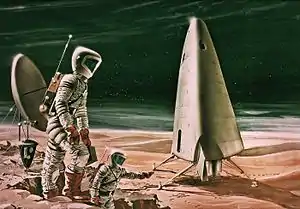
In the 20th century, actual spaceflights to the planet Mars, including seminal events such as the first artificial object to impact the surface of Mars in 1971, and then later the first landing of "the first mechanized device to successfully operate on Mars" in 1976 (in the Viking program by the United States), inspired a great deal of interest in Mars-related fiction. Exploration of the planet has continued in the 21st century on to the present day.
Mars has been seen as the perfect distance away from Earth to create the idea of a different life, as this allowed for early works to fuel the minds of what Mars could hold. The ideas of Mars as science fiction would first start with Giovanni Schiaparelli in 1877.[2] The ideas of Mars will grow and change with new information changing the way Mars would be seen in the science fiction world. Several early modern writers, including Athanasius Kircher (1602–1680) and Emanuel Swedenborg (1688–1772), hypothesized contact with Mars. Early science fiction about Mars often involved the first voyages to the planet, sometimes as an invasion force, more often for the purposes of exploration. By the 1930s, stories about reaching Mars had become somewhat trite and the focus shifted to Mars as an alien landscape. In the following stories, human contact and basic exploration had taken place sometime in the past; Mars is a setting rather than a goal.

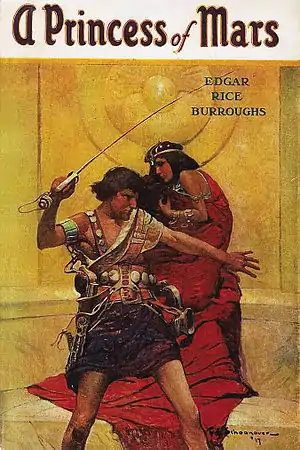
Mariner 4 in July 1965 found that Mars—contrary to expectations—is heavily cratered, with a very thin atmosphere. No canals were found; while scientists did not believe that Mars was a moist planet, the lack of surface water surprised them.[3] Science fiction had so influenced real explorations of the planet, however—Carl Sagan was among the many fans who became scientists—that after Mariner 9 in 1971–1972, craters were named after Wells, Burroughs, and other authors.[4] The Mariner and Viking space probes confirmed that the Martian environment is extremely hostile to life. By the 1970s, the ideas of canals and ancient civilizations had to be abandoned.
Authors soon began writing stories based on the new Mars (frequently treating it as a desert planet). Most of these works feature humans struggling to tame the planet, and some of them refer to terraforming (using technology to transform a planet's environment to be Earthlike).
A common theme, particularly among American writers, is that of a Martian colony fighting for independence from Earth. It appeared already in Heinlein's Red Planet and is a major plot element in Greg Bear's Moving Mars and Kim Stanley Robinson's Mars trilogy. It is also part of the plot of the movie Total Recall and the television series Babylon 5. Many video games also use this concept, such as the Red Faction and Zone of the Enders series, and Call of Duty: Infinite Warfare. A historical rebellion of Mars against Earth is also mentioned in the Star Trek series of novels, which are not considered canon.
In the decades following Mariner and Apollo, the once-popular subgenre of realistic stories about a first expedition to Mars fell out of fashion, possibly due to the failure of the Apollo Program to continue on to Mars. The early 1990s saw a revival and re-envisioning of realistic novels about Mars expeditions. Early novels in this renaissance were Jack Williamson's novel Beachhead and Ben Bova's novel Mars (both 1992), which envisioned large-scale expeditions to Mars according to the thinking of the 1990s. These were followed by Gregory Benford's The Martian Race (1999), Geoffrey A. Landis's Mars Crossing (2000), and Robert Zubrin's First Landing (2002), which took as their starting points the smaller and more focused expedition strategies evolved in the late 1990s, mostly building on the concepts of Mars Direct.
Several post-Mariner works are homages to the older phase of Mars fiction, circumventing the scientific picture of a dry and lifeless Mars with an unbreathable atmosphere through such science fiction generic staples as positing its future terraforming, or creating alternate history versions of Mars, where Burroughs' Barsoom, Bradbury's Martian Chronicles or The War of the Worlds are literal truth.
Martians in fiction
The Martian is a favorite character of classical science fiction; he was frequently found away from his home planet, often invading Earth, but sometimes simply a lonely character representing alienness from his surroundings. Martians, other than human beings transplanted to Mars, became rare in fiction after Mariner, except in exercises of deliberate nostalgia – more frequently in some genres, such as comics and animation, than in written literature.
See also
References
- "SFE: Mars". sf-encyclopedia.com. Retrieved 17 December 2021.
- Hendrix, Howard V et al. Visions of Mars: Essays on the Red Plant in Fiction and Science. McFarland & Co./2011.pg17
- Ley, Willy (April 1966). "The Re-Designed Solar System". For Your Information. Galaxy Science Fiction. pp. 126–136.
- Sagan, Carl (28 May 1978). "Growing up with Science Fiction". The New York Times. p. SM7. ISSN 0362-4331. Retrieved 12 December 2018.
External links
| Solar System |
|  | ||||
|---|---|---|---|---|---|---|
| Other systems | ||||||
| Other astronomical objects | ||||||
| Inhabitants | ||||||
| Geography | |||||||||||
|---|---|---|---|---|---|---|---|---|---|---|---|
| Astronomy |
| ||||||||||
| Exploration |
| ||||||||||
| Related | |||||||||||
| |||||||||||