Mercury in fiction
Fictional depictions of Mercury, the innermost planet of the Solar System, have gone through three distinct phases. Before much was known about the planet, it received scant attention. Later, when it was incorrectly believed that it was tidally locked with the Sun creating a permanent dayside and nightside, stories mainly focused on the conditions of the two sides and the narrow region of permanent twilight between. Finally, since that misconception was dispelled in 1965, the planet has received less attention from fiction writers again and stories have largely concentrated on the harsh environmental conditions that come from the planet's proximity to the Sun.[1]
Early depictions
Mercury has appeared as a setting in fiction since at least the 1750 novel Relation du Monde de Mercure (English title: The World of Mercury) by Chevalier de Béthune.[2][3] In W. S. Lach-Szyrma's 1883 novel Aleriel, or A Voyage to Other Worlds, Mercurians are depicted as living in the planet's atmosphere.[1][3] John Munro's 1897 novel A Trip to Venus portrays a brief visit to Mercury as well as Venus.[2][4] The first English-language work of fiction set primarily on Mercury was William Wallace Cook's 1905 novel Adrift in the Unknown, or Adventures in a Queer Realm, a satire on United States capitalism.[2][5] Homer Eon Flint's 1919 short story "The Lord of Death" depicts the ruins of a previous civilization now extinct on Mercury.[1][3]
Tidal locking
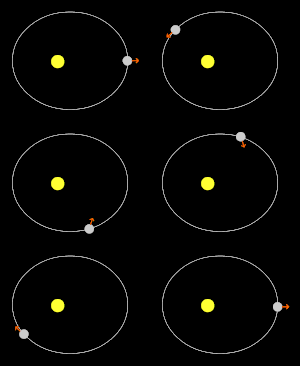
From 1893 to 1965, it was believed that Mercury was 1:1 tidally locked with the Sun such that one side of Mercury was always in sunlight and the opposite side always in darkness, with a thin band of perpetual twilight in between. Numerous works of fiction written in this period portray Mercury in this way.[1][3][6] Examples include Ray Cummings' 1930 novel Tama of the Light Country where the inhabitants of Mercury live their lives under an unmoving Sun,[2] Clark Ashton Smith's 1932 short story "The Immortals of Mercury" where there are two different hostile species on the planet,[1][3][7] Isaac Asimov's 1942 short story "Runaround" (later included in the 1950 collection I, Robot) where a robot is sent to retrieve critical supplies from the inhospitable dayside and malfunctions,[1][6] Asimov's 1956 short story "The Dying Night" where a character who has spent a long time on Mercury is used to there being areas in permanent darkness,[6] Alan E. Nourse's 1956 short story "Brightside Crossing" which depicts an attempt to cross the illuminated side of the planet "because it's there" as a feat similar to the then-recent first successful ascent of Mount Everest in 1953,[1][3] and Poul Anderson's 1957 short story "Life Cycle" where there is a species that changes from female to male when it goes from the nightside to the dayside and vice versa.[6] Larry Niven's 1964 short story "The Coldest Place" depicts the nightside of Mercury and may have been the last story of a tidally locked Mercury before it was discovered that the planet actually has a 3:2 spin–orbit resonance such that all sides regularly see daylight.[1][3][6]
Modern depictions
Even after it was discovered that Mercury is not tidally locked with the Sun, some stories continued to use the juxtaposition of the hot daytime side facing the Sun and the cold nighttime side facing away as a plot device; the 1982 short story "The Tortoise and O'Hare" by Grant Callin portrays an astronaut who struggles to stay on the night side of the terminator line in order to avoid dying from the heat of the dayside,[6] and the 2008 novel Saturn's Children by Charles Stross depicts cities that move to stay in the sunrise area where it is neither too hot nor too cold.[1][2] In general, however, most post-1965 stories focus on the generally harsh conditions of the planet.[1]
Other purposes for Mercury in modern science fiction literature include as a base for studying the Sun, as in the 1980 novel Sundiver by David Brin where humans attempt to determine whether there is extraterrestrial life inside the Sun.[2][3][8] It is occasionally mined for minerals, as in the 1994 short story "Cilia-of-Gold" by Stephen Baxter which also features life below the ice in a permanently shadowed region near one of the planet's poles.[3][6] Several stories portray struggles against bureaucratic forces, as in the 1976 short story "Render unto Caesar" by Eric Vinicoff and Marcia Martin where a Mercurian colony resists United Nations influence in order to stay independent.[1][6] A terraformed Mercury enclosed in an enormous man-made structure is depicted in the 2000 short story "Romance in Extended Time" by Tom Purdom.[3] In the 2005 short story "Kath and Quicksilver" by Larry Niven and Brenda Cooper, Mercury is threatened by the expansion of the Sun.[3]
Vulcan
Anomalies in Mercury's orbit around the Sun led Urbain Le Verrier to propose the existence of an unseen planet with an orbit interior to Mercury's exerting gravitational influence in 1859, similar to how irregularities in Uranus' orbit had led to his discovery of Neptune in 1846. This hypothesized planet was dubbed "Vulcan", and featured in several works of fiction including the 1932 short story "The Hell Planet" by Leslie F. Stone where it is mined for resources, the 1936 short story "At the Center of Gravity" by Ross Rocklynne where its hollow interior is visited, and the 1941 short story "Child of the Sun" by Leigh Brackett where it is inhabited by intelligent life. Mercury's orbital anomalies are now understood to be caused by the effects of general relativity.[1][6][9]
See also
References
- Westfahl, Gary (19 July 2021). "Mercury". Science Fiction Literature through History: An Encyclopedia [2 volumes]. ABC-CLIO. pp. 442–444. ISBN 978-1-4408-6617-3. Archived from the original on 28 November 2021. Retrieved 28 November 2021.
- Clute, John; Langford, David; Sleight, Graham (eds.). "Mercury". The Encyclopedia of Science Fiction (4th ed.). Archived from the original on 26 November 2021. Retrieved 25 November 2021.
- Stableford, Brian M. (2006). "Mercury". Science Fact and Science Fiction: An Encyclopedia. Taylor & Francis. pp. 298–299. ISBN 978-0-415-97460-8. Archived from the original on 26 November 2021. Retrieved 26 November 2021.
- Clute, John; Langford, David; Sleight, Graham (eds.). "Munro, John". The Encyclopedia of Science Fiction (4th ed.). Archived from the original on 26 November 2021. Retrieved 26 November 2021.
- Clute, John; Langford, David; Sleight, Graham (eds.). "Cook, William Wallace". The Encyclopedia of Science Fiction (4th ed.). Archived from the original on 26 November 2021. Retrieved 26 November 2021.
- Gillett, Stephen L. (2005). "Mercury". In Westfahl, Gary (ed.). The Greenwood Encyclopedia of Science Fiction and Fantasy: Themes, Works, and Wonders. Greenwood Publishing Group. pp. 513–515. ISBN 978-0-313-32952-4. Archived from the original on 26 November 2021. Retrieved 26 November 2021.
- Clute, John; Langford, David; Sleight, Graham (eds.). "Smith, Clark Ashton". The Encyclopedia of Science Fiction (4th ed.). Archived from the original on 4 December 2021. Retrieved 3 December 2021.
- Stableford, Brian (1999). "David Brin". In Bleiler, Richard (ed.). Science Fiction Writers: Critical Studies of the Major Authors from the Early Nineteenth Century to the Present Day (2nd ed.). New York: Charles Scribner's Sons. pp. 107–108. ISBN 0-684-80593-6. OCLC 40460120. Archived from the original on 4 December 2021. Retrieved 4 December 2021.
- Clute, John; Langford, David; Sleight, Graham (eds.). "Vulcan". The Encyclopedia of Science Fiction (4th ed.). Archived from the original on 27 November 2021. Retrieved 27 November 2021.


| Solar System |
|  | ||||
|---|---|---|---|---|---|---|
| Other systems | ||||||
| Other astronomical objects | ||||||
| Inhabitants | ||||||