Marxist historiography
Marxist historiography, or historical materialist historiography, is an influential school of historiography influenced by Marxism. The chief tenets of Marxist historiography include the centrality of social class, social relations of production in class-divided societies that struggle against each other, and economic constraints in determining historical outcomes (historical materialism). Marxist historians follow the tenets of the contradictory development of class-divided societies, especially modern capitalist ones.
| Part of a series on |
| Marxism |
|---|
 |
|



Yet, the way Marxist historiography has developed in different regional and political contexts has varied, in full adherence to Marxism. On one side there are the general identities and on the other the particular differences. As to reject bourgeois reductionism, idealism, and determinism. In particular, Marxist historiography has had unique trajectories of development in the West, in the Soviet Union, and in India, as well as in the Pan-Africanist and African American traditions, adapting to these specific regional and political conditions in different ways. Marxist historiography has made contributions to the history of the exploited and oppressed working class, oppressed nationalities, and the methodology of a scientific history that went down as history from below.[1][2][3] The chief problematic aspect of Marxist historiography has been an argument on the nature of history as determined or dialectical; this can also be stated as the relative importance of subjective and objective factors in creating outcomes. Marxist historians have also made this critique, particularly social historians who emphasize the need for a more humanist, historically contingent, Marxism.
Marxist history is sometimes criticised as teleological or deterministic,[4][5][6] in that it posits a direction of history, towards an end state of history as classless human society. Marxist historiography, that is, the writing of Marxist history in line with the given historiographical principles, is generally seen as a tool. Its aim is to bring those oppressed by history to self-consciousness, and to arm them with tactics and strategies from history: it is both a historical and a liberatory project.
Historians who use Marxist methodology, but disagree with the mainstream of Marxism or wish to avoid a personality cult of Marx, often describe themselves as "marxist" historians (with a lowercase M). Methods from Marxist historiography, such as class analysis, can be divorced from the liberatory intent of Marxist historiography; practitioners often refer to their techniques as "marxian". Marxist historians are generally Progressives in politics.[7]
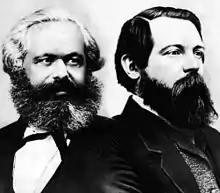
Marx & Engels
Friedrich Engels' (1820-1895) most important historical contribution to the development of Marxist historiography was Der Deutsche Bauernkrieg (The German Peasants' War, 1850), which analysed social warfare in early Protestant Germany in terms of emerging capitalist classes. Although The German Peasants' War was overdetermined lacked a rigorous engagement with archival sources, it exemplifies an early Marxists' interest in history from below and in class analysis, it also attempts a dialectical analysis.
Karl Marx's (1818-1883) most important works on social and political history include The Eighteenth Brumaire of Louis Napoleon (1852), The Communist Manifesto (1848), The German Ideology (written in 1845, published in 1932), and those chapters of Das Kapital (1867-1894) dealing with the historical emergence of capitalists and proletarians from pre-industrial English society.
Engels' short treatise The Condition of the Working Class in England in 1844 (German: Die Lage der arbeitenden Klasse in England, 1845; English-language translation published in 1887) was salient in giving a socialist impetus to British politics from then on, e.g. the Fabian Society. Modern European democratic socialism finds its roots here.
Marx & labor
The key to understanding Marxist historiography is his view of labor. For Marx "historical reality is none other than objectified labor, and all conditions of labor given by nature, including the organic bodies of people, are merely preconditions and 'disappearing moments' of the labor process."[8] This emphasis on the physical as the determining factor in history represents a break from virtually all previous historians. Until Marx developed his theory of historical materialism, the overarching determining factor in the direction of history was some sort of divine agency. In Marx's view of history "God became a mere projection of human imagination" and more importantly "a tool of oppression".[9] There was no more sense of divine direction to be seen. History moved by the sheer force of human labor, and all theories of divine nature were a concoction of the ruling powers to keep the working people in check. For Marx, "The first historical act is... the production of material life itself."[10] As one might expect, Marxist history not only begins with labor, it ends in production: "history does not end by being resolved into "self-consciousness" as "spirit of the spirit," but that in it at each stage there is found a material result: a sum of productive forces, a historically created relation of individuals to nature and to one another, which is handed down to each generation from its predecessor..."[11] For further, and much more comprehensive, information on this topic, see historical materialism.
"Western" historiography
Karl Marx and Friedrich Engels worked in relative isolation together outside the larger mainstream. However, by the turn of the twentieth century, Marxist thought was perhaps the most prominent opposition to the idealist traditions. [12]
R. H. Tawney (1880-1962) was an early historian working in this tradition. The Agrarian Problem in the Sixteenth Century (1912)[13] and Religion and the Rise of Capitalism (1926), reflected his ethical concerns and preoccupations in economic history. He was profoundly interested in the issue of the enclosure of land in the English countryside in the sixteenth and seventeenth centuries and Max Weber's thesis on the connection between the appearance of Protestantism and the rise of capitalism. His belief in the rise of the gentry in the century before the outbreak of the Civil War in England provoked the 'Storm over the Gentry' in which his methods were subjected to severe criticisms by Hugh Trevor-Roper and John Cooper.
A circle of historians inside the Communist Party of Great Britain (CPGB) was formed in 1946. It became a highly influential cluster of British Marxist historians, who shared a common interest in and contributed to history from below and class structure in early capitalist society. While some members of the group (most notably Christopher Hill (1912-2003) and E. P. Thompson (1924-1993)) left the CPGB after the 1956 Hungarian Revolution, the common points of British Marxist historiography continued in their works. They placed a great emphasis on the subjective determination of history. E. P. Thompson famously engaged Althusser in The Poverty of Theory, arguing that Althusser's theory overdetermined history, and left no space for historical revolt by the oppressed.
Christopher Hill's studies on 17th-century English history were widely acknowledged and recognised as representative of Marxist historians and Marxist historiography in general.[14] His books include Puritanism and Revolution (1958), Intellectual Origins of the English Revolution (1965 and revised in 1996), The Century of Revolution (1961), AntiChrist in 17th-century England (1971), The World Turned Upside Down (1972) and many others.
E. P. Thompson pioneered the study of history from below in his work, The Making of the English Working Class, published in 1963. It focused on the forgotten history of the first working-class political left in the world in the late-18th and early-19th centuries. In his preface to this book, Thompson set out his approach to writing history from below:
I am seeking to rescue the poor stockinger, the Luddite cropper, the "obsolete" hand-loom weaver, the "Utopian" artisan, and even the deluded follower of Joanna Southcott, from the enormous condescension of posterity. Their crafts and traditions may have been dying. Their hostility to the new industrialism may have been backward-looking. Their communitarian ideals may have been fantasies. Their insurrectionary conspiracies may have been foolhardy. But they lived through these times of acute social disturbance, and we did not. Their aspirations were valid in terms of their own experience; and, if they were casualties of history, they remain, condemned in their own lives, as casualties.
Thompson's work was also significant because of the way he defined "class". He argued that class was not a structure, but a relationship that changed over time. Thompson's work is commonly considered the most influential work of history in the twentieth century and a crucial catalyst for social history and from social history to gender history and other studies of marginalized peoples.[15] His essay, "Time, Work, Discipline, and Industrial Capitalism" is also hugely influential and argues that industrial capitalism fundamentally altered (and accelerated) humans' relationship to time. He opened the gates for a generation of labor historians, such as David Montgomery (1927-2011) and Herbert Gutman (1928–1985), who made similar studies of the American working classes.
Perhaps the most famous of the Communist Historians was E.B. Hobsbawm (1917–2012), who might be the most famous and widely read historian of the 20th century. Hobsbawm is credited for establishing many of the basic historical arguments of current historiography and synthesizing huge amounts of modern historical data across time and space – most famously in his trilogy: The Age of Revolutions, The Age of Empires, and The Age of Extremes.[16] Eric Hobsbawm's Bandits is another example of this group's work.
C. L. R. James (1901–1989) was also a great pioneer of the 'history from below' approach. Living in Britain when he wrote his most notable work The Black Jacobins (1938), he was an anti-Stalinist Marxist and so outside of the CPGB. The Black Jacobins was the first professional historical account of the greatest and only successful slave revolt in colonial American history, the Haitian Revolution. James's history is still touted as a remarkable work of history nearly a century after publication, an immense work of historical investigation, story-telling, and creativity.[17]
Other important British Marxist historians included Raphael Samuel (1934–1996), A. L. Morton (1903–1987), and Brian Pearce (1915–2008).
In the United States, Marxist historiography greatly influenced the history of slavery and labor history. Marxist historiography also greatly influenced French historians, including France's most famous and enduring historian Fernand Braudel (1902–1985), as well as Italian historians, most famously the Autonomous Marxist and micro-history fields.
In the Soviet Union
Soviet historiography (the way in which history was and is written by scholars of the Soviet Union[18]) was significantly influenced by the strict control by the authorities aimed at propaganda and Soviet power. Marxist historiography suffered in the Soviet Union, as the government requested overdetermined historical writing. Soviet historians tended to avoid contemporary history (history after 1905) where possible, and effort was predominantly directed at premodern history. As history was considered to be a politicised academic discipline, historians limited their creative output to avoid prosecution.
The Soviet interpretation of Marxism predetermined much of the research done by historians. Research by scholars in the USSR was limited to a large extent due to this predetermination. Some Soviet historians could not offer non-Marxist theoretical explanations for their interpretation of sources. This was true even when alternate theories had greater explanatory power concerning a historian's reading of source material.[19][20]
The Marxist theory of historical materialism identified means of production as chief determinants of the historical process. They led to the creation of social classes, and class struggle was the motor of history. The sociocultural evolution of societies was considered to progress inevitably from slavery, through feudalism and capitalism to socialism and finally communism. In addition, Leninism argued that a vanguard party was required to lead the working class in the revolution that would overthrow capitalism and replace it with socialism. Soviet historiography interpreted this theory to mean that the creation of the Soviet Union was the most important turning event in human history since the USSR was considered to be the first socialist society. Furthermore, the Communist Party—considered to be the vanguard of the working class – was given the role of the permanent leading force in society, rather than a temporary revolutionary organization. As such, it became the protagonist of history, which could not be wrong. Hence the unlimited powers of the Communist Party leaders were claimed to be as infallible and inevitable as history itself.[21] It also followed that a worldwide victory of communist countries is inevitable. All research had to be based on those assumptions and could not diverge in its findings.[22] In 1956, Soviet academician Anna Pankratova said that "the problems of Soviet historiography are the problems of our Communist ideology."[23]
Since the late 1930s, Soviet historiography treated the party line and reality as one and the same.[24] As such, if it was a science, it was a science in service of a specific political and ideological agenda, commonly employing historical negationist methods.[25] In the 1930s, historic archives were closed and original research was severely restricted. Historians were required to pepper their works with references – appropriate or not – to Stalin and other "Marxist-Leninist classics", and to pass judgment – as prescribed by the Party – on pre-revolution historic Russian figures.[26]
Many works of Western historians were forbidden or censored, many areas of history were also forbidden for research as, officially, they never happened.[27] Translations of foreign historiography were often produced in a truncated form, accompanied with extensive censorship and corrective footnotes. For example, in the Russian 1976 translation of Basil Liddell Hart's History of the Second World War pre-war purges of Red Army officers, the secret protocol to the Molotov–Ribbentrop Pact, many details of the Winter War, the occupation of the Baltic states, the Soviet occupation of Bessarabia and Northern Bukovina, Western Allied assistance to the Soviet Union during the war, many other Western Allies' efforts, the Soviet leadership's mistakes and failures, criticism of the Soviet Union and other content were censored out.[28]
The Katyn massacre was formally assigned to Nazi Germany but the subject was frequently concealed. Soviet famines were taboo.
Soviet historians have also been criticized for a Marxist bias in the interpretation of other historical events, unrelated to the Soviet Union. Thus, for example, they assigned to the rebellions in the Roman Empire the characteristics of the social revolution.[29]
Often, the Marxist bias and propaganda demands came into conflict: hence the peasant rebellions against the early Soviet rule, such as the Tambov Rebellion of 1920–21, were simply ignored as inconvenient politically and contradicting the official interpretation of the Marxist theories.[30]
Notable histories include the Short Course History of the Communist Party of the Soviet Union (Bolshevik), published in 1938, which was written to justify the nature of Bolshevik party life under Joseph Stalin.[31][32]
In China
Most Chinese history that is published in the People's Republic of China is based on a Marxist interpretation of history. These theories were first applied in the 1920s by Chinese scholars such as Guo Moruo, and became orthodoxy in academic study after 1949. The Marxist view of history is that history is governed by universal laws and that according to these laws, a society moves through a series of stages, with the transition between stages being driven by class struggle.[33] These stages are:
- Slave society
- Feudal society
- Capitalist society
- Socialist society
- The world communist society
The official historical view within the People's Republic of China associates each of these stages with a particular era in Chinese history.
- Slave society – Xia to Shang
- Feudal society (decentralized) – Zhou to Sui
- Feudal society (bureaucratic) – Tang to the First Opium War
- Feudal society (semi-colonial) – First Opium War to end of Qing dynasty
- Capitalist society – Republican era
- Socialist society – PRC 1949 to present
Because of the strength of the Chinese Communist Party and the importance of the Marxist interpretation of history in legitimizing its rule, it was for many years difficult for historians within the PRC to actively argue in favor of non-Marxist and anti-Marxist interpretations of history. However, this political restriction is less confining than it may first appear in that the Marxist historical framework is surprisingly flexible, and it is a rather simple matter to modify an alternative historical theory to use language that at least does not challenge the Marxist interpretation of history.[34]
Partly because of the interest of Mao Zedong, historians in the 1950s took a special interest in the role of peasant rebellions in Chinese history and compiled documentary histories to examine them.[35]
There are several problems associated with imposing Marx's European-based framework on Chinese history. First, slavery existed throughout China's history but never as the primary form of labor. While the Zhou and earlier dynasties may be labeled as feudal, later dynasties were much more centralized than how Marx analyzed their European counterparts as being. To account for the discrepancy, Chinese Marxists invented the term "bureaucratic feudalism". The placement of the Tang as the beginning of the bureaucratic phase rests largely on the replacement of patronage networks with the imperial examination. Some world-systems analysts, such as Janet Abu-Lughod, claim that analysis of Kondratiev waves shows that capitalism first arose in Song dynasty China, although widespread trade was subsequently disrupted and then curtailed.
The Japanese scholar Tanigawa Michio, writing in the 1970s and 1980s, set out to revise the generally Marxist views of China prevalent in post-war Japan. Tanigawa writes that historians in Japan fell into two schools. One held that China followed the set European pattern which Marxists thought to be universal; that is, from ancient slavery to medieval feudalism to modern capitalism; while another group argued that "Chinese society was extraordinarily saturated with stagnancy, as compared to the West" and assumed that China existed in a "qualitatively different historical world from Western society". That is, there is an argument between those who see "unilinear, monistic world history" and those who conceive of a "two-tracked or multi-tracked world history". Tanigawa reviewed the applications of these theories in Japanese writings about Chinese history and then tested them by analyzing the Six Dynasties 220–589 CE period, which Marxist historians saw as feudal. His conclusion was that China did not have feudalism in the sense that Marxists use, that Chinese military governments did not lead to a European-style military aristocracy. The period established social and political patterns which shaped China's history from that point on.[36]
There was a gradual relaxation of Marxist interpretation after the death of Mao in 1976,[37] which was accelerated after the Tian'anmen Square protest and other revolutions in 1989, which damaged Marxism's ideological legitimacy in the eyes of Chinese academics.
In India
In India, B. N. Datta, and D. D. Kosambi are considered the founding fathers of Marxist historiography. D. D. Kosambi was apologetic of the Marxist revolution of Mao and thought of Indian Prime Minister Jawaharlal Nehru's policies as Pro Capitalist. Kosambi, a polymath, viewed Indian History from a Marxist viewpoint. The other Indian scholars of Marxist historiography are R. S. Sharma, Irfan Habib, D. N. Jha, and K. N. Panikkar.[38] Other historians such as Satish Chandra, Romila Thapar, Bipan Chandra, and Arjun Dev, are sometimes referred to as "left-leaning" or "influenced by the Marxist approach to history."[39]
Marxist historiography of India has focused on studies of economic development, land ownership, and class conflict in precolonial India and deindustrialisation during the colonial period. Marxist historians portrayed Gandhi's movement as a device of the bourgeois elite to harness popular, potentially revolutionary forces for its ends.[40]
One debate in Indian history that relates to a historical materialist schema is on the nature of feudalism in India. D. D. Kosambi in the 1960s outlined the idea of "feudalism from below" and "feudalism from above". Element of his feudalism thesis was rejected by R.S. Sharma in his monograph Indian Feudalism (2005) and various other books,[41][42][43][44] on the basis that feudalism began with the land grants besides fiscal, administrative and judicial rights given to Brahmins, temples and monasteries; There took place around the middle of the first millennium CE a decline in commodity, production, urban centres and foreign trade resulting in the growth of self sufficient economy in which metallic currency became relatively scarce and hence all payments had to be made through assignment of land or of revenues therefrom.[45] However R. S. Sharma also largely agrees with Kosambi in his various other books.[46][47][48][49] Most Indian Marxists argue that the economic origins of communalism are feudal remnants and the economic insecurities caused by slow development under a "world capitalist system."[50]
The Marxist school of Indian historiography is accused of being too ideologically influenced, and also elitist.[51] B. R. Ambedkar criticized Marxists, as he deemed them to be unaware or ignorant of the specifics of caste issues.[52][53] Some historians have also debated Marxist historians and critically examined their analysis of the history of India. Many have alleged that Marxist historians used negationist tactics to whitewash some of the atrocities committed by Muslim rulers in the Indian Subcontinent.[54][55][56][57] Since the late 1990s, Hindu nationalist scholars especially have polemicized against the Marxist tradition in India for neglecting the country's 'illustrious past.' Marxists are held responsible for aiding or defending Muslims, who figure in Hindu nationalist discourse as the enemy.[58] An example of such a critique is Arun Shourie's Eminent Historians (1998).[59]
Marxist historiography remains popular in India, many are drawn to it due to an abiding concern for the downtrodden, and causes of social justice prevalent within the Leftist movement and ideology. Marxist historians are generally known to have a strong stance against both Hindutva and Muslim communalists.[60][61] Even non academic and lay men contributions to Marxist Historiography exist in India. The book Coffee Housinte Katha or The Story of Coffee House, written in Malayalam, a regional language of Kerala, by one of the leaders of the Indian Coffee House Movement, Nadakkal Parameswaran Pillai, is an example of this.
Some other Indian Marxist historians are Gangadhar Adhikari, N. E. Balaram, K. Damodaran, Amalendu De, Barun De, Akshay Ramanlal Desai, Amalendu Guha, Ranajit Guha, Mohammad Habib, Saiyid Nurul Hasan, Meera Kosambi, Mohammad Mujeeb, Mridula Mukherjee, Ramkrishna Mukherjee, Harbans Mukhia, Utsa Patnaik, Vijay Prashad, Sumit Sarkar, and Susobhan Sarkar. Historians from the Aligarh Muslim University (AMU), Jawaharlal Nehru University (JNU), Jamia Milia Islamia, and Delhi University such as K.M. Shrimali, K. M. Panikkar, Gyanendra Pandey, Mushirul Hasan have also been called Marxist historians by others.
The effects of Marxist historiography
Marxist historiography has had an enormous influence on historiography, and compares with empiricist historiography as one of the basic and foundational historiographic methodologies. Most non-Marxist historians make use of tools developed within Marxist historiography, like dialectical analysis of social formations, class analysis, or the project of broadening the scope of history into social history. Marxist historiography provided the first sustained efforts at social history, and is still highly influential within this area. The contribution of class analysis has also led to the development of gender and race as other analytical tools.
Marxism was one of the key influences on the Annales school tradition of French historiography.[62]
See also
References
- Ben Fine; Alfredo Saad-Filho; Marco Boffo (January 2012). The Elgar Companion to Marxist Economics. Edward Elgar Publishing. p. 212. ISBN 9781781001226.
- O'Rourke, J.J. (6 December 2012). The Problem of Freedom in Marxist Thought. Springer Science & Business Media. p. 5. ISBN 9789401021203.
- Stunkel, Kenneth (23 May 2012). Fifty Key Works of History and Historiography. Routledge. p. 247. ISBN 9781136723667.
- Ben Fine; Alfredo Saad-Filho; Marco Boffo. The Elgar Companion to Marxist Economics. Edward Elgar Publishing. p. 212.
- O'Rourke, J.J. Springer Science & Business Media. p. 5 https://books.google.com/books?id=A2WSBgAAQBAJ&pg=PA5&dq=marxist+history+deterministic&hl=en&sa=X&ved=0ahUKEwiRsLn61NfXAhUJK48KHXprAcg4ChDoAQgyMAI#v=onepage&q=marxist%20history%20deterministic&f=false.
- Stunkel, Kenneth. Routledge. p. 247 https://books.google.com/books?id=9pem7Ip_WUgC&pg=PA247.
- "Historiography - Marxist historiography".
- Andrey Maidansky. "The Logic of Marx's History," Russian Studies in Philosophy, vol. 51, no. 2 (Fall 2012): 45.
- Ernst Breisach. Historiography: Ancient, Medieval, and Modern, 3rd Ed. (Chicago, Il: University of Chicago Press, 2007), p. 320.
- Fritz Stern. The Varieties of History: From Voltaire to the Present. Vintage Books Edition (New York: Random House: 1973), 150.
- Fritz Stern. The Varieties of History: From Voltaire to the Present. Vintage Books Edition (New York: Random House: 1973), 156–57.
- "Historiography - Marxist historiography".
- William Rose Benét (1988) p. 961
- "Hill, (John Edward) Christopher (1912–2003)". Oxford Dictionary of National Biography (online ed.). Oxford University Press. January 2007. doi:10.1093/ref:odnb/89437. Retrieved 29 June 2012. (Subscription or UK public library membership required.)
- Scott,Joan. Gender and the Politics of History. New York: Columbia University Press, 1988; Revised edition, 1999
- Robin, Corey. "Eric Hobsbawm, The Communist Who Explained History" The New Yorker, May 9, 2019.
- Dubois, Laurent. The Avengers of the New World: The Story of the Haitian Revolution. Cambridge: Harvard University Press, 2005.
- It is not the history of the Soviet Union. See definitions of historiography for more details.
- Gwidon Zalejko, Soviet historiography as "normal science", in Historiography Between Modernism and Postmodernism, Jerzy Topolski (ed.), Rodopi, 1994, ISBN 90-5183-721-6, Google Print, pp. 179–191.
- Ferro, Marc (2003). The Use and Abuse of History: Or How the Past Is Taught to Children. London; New York: Routledge. ISBN 978-0-415-28592-6. See Chapters 8 Aspects and variations of Soviet history and 10 History in profile: Poland.
- David Satter. Age of Delirium: The Decline and Fall of the Soviet Union, Yale University Press, 2001, ISBN 0-300-08705-5
- Ferro, Marc (2003). The Use and Abuse of History: Or How the Past Is Taught to Children. London; New York: Routledge. ISBN 978-0-415-28592-6. See Chapters 8 Aspects and variations of Soviet history and 10 History in profile: Poland.
- Roger D. Markwick, Donald J. Raleigh, Rewriting History in Soviet Russia: The Politics of Revisionist Historiography, Palgrave Macmillan, 2001, ISBN 0-333-79209-2, Google Print, pp. 4–5
- Taisia Osipova, Peasant rebellions: Origin, Scope, Design and Consequences, in Vladimir N. Brovkin (ed.), The Bolsheviks in Russian Society: The Revolution and the Civil Wars, Yale University Press, 1997, ISBN 0-300-06706-2. Google Print, pp. 154–76
- Roger D. Markwick, Donald J. Raleigh, Rewriting History in Soviet Russia: The Politics of Revisionist Historiography, Palgrave Macmillan, 2001, ISBN 0-333-79209-2, Google Print, pp. 4–5
- John L. H. Keep: A History of the Soviet Union 1945–1991: Last of the Empires, pap. 30–31
- Ferro, Marc (2003). The Use and Abuse of History: Or How the Past Is Taught to Children. London; New York: Routledge. ISBN 978-0-415-28592-6. See Chapters 8 Aspects and variations of Soviet history and 10 History in profile: Poland.
- Lewis, B. E. (1977). "Soviet Taboo: Vtoraya Mirovaya Voina, History of the Second World War by B. Liddel Gart, B. Liddell Hart". Soviet Studies. Taylor & Francis. 29 (4): 603–6. doi:10.1080/09668137708411159. ISSN 0038-5859. JSTOR 150540.
- Ferro, Marc (2003). The Use and Abuse of History: Or How the Past Is Taught to Children. London; New York: Routledge. ISBN 978-0-415-28592-6. See Chapters 8 Aspects and variations of Soviet history and 10 History in profile: Poland.
- Taisia Osipova, Peasant rebellions: Origin, Scope, Design and Consequences, in Vladimir N. Brovkin (ed.), The Bolsheviks in Russian Society: The Revolution and the Civil Wars, Yale University Press, 1997, ISBN 0-300-06706-2. Google Print, pp. 154–176
- Rappaport, Helen (1999). Joseph Stalin: A Biographical Companion. ABC-CLIO. ISBN 978-1576070840. p. 130.
- Torchinov, Valeri ; Leontiuk, Alexei (2000). Vokrug Stalina: Istoriko-Biograficheskii Spravochnik. Filologicheskii Fakultet Sankt-Peterburgskogo Universitet. ISBN 5-8465-0005-6. p. 255.
- Arif Dirlik, "The Universalization of a Concept: From 'Feudalism' to Feudalism in Chinese Marxist Historiography," Journal of Peasant Studies 12.2–3 (January/April 1985): 197–227.
- Albert Feuerwerker, "China's History in Marxian Dress," The American Historical Review 66.2 (1961): 323–353. https://www.jstor.org/stable/1844030
- James P. Harrison. The Communists and Chinese Peasant Rebellions; a Study in the Rewriting of Chinese History. New York: Atheneum, 1969.
- Tanigawa (1985), p. 3.
- Liu, Kwang-Ching (February 1981). "World View and Peasant Rebellion: Reflections on Post-Mao Historiography". The Journal of Asian Studies. 40 (2): 295–326. doi:10.2307/2054866. JSTOR 2054866.
- Bottomore, T. B. 1983. A Dictionary of Marxist thought. Cambridge, Massachusetts: Harvard University Press.
- Guichard, Sylvie (2010), The Construction of History and Nationalism in India, Routledge, p. 87, ISBN 978-1136949319
- Bagchi, Amiya Kumar (January 1993). "Writing Indian History in the Marxist Mode in a Post-Soviet World". Indian Historical Review. 20 (1/2): 229–244.
- Purohit, Vinayak. 1988. Arts of transitional India twentieth century. Bombay: Popular Prakashan.
- R S Sharma, Indian Feudalism (book), 2005
- R S Sharma, Early Medieval Indian Society: A Study in Feudalisation, Orient Longman, Kolkata, 2001, pp. 177-85
- R S Sharma, India's Ancient Past, Oxford University Press, New Delhi, 2005
- D N Jha, The Feudal Order: State Society and Ideology in Early Medieval India, Manohar Publishers, New Delhi, 2002
- R S Sharma, Indian Feudalism (book), 2005
- R S Sharma, Early Medieval Indian Society: A Study in Feudalisation, Orient Longman, Kolkata, 2001, pp. 177–85
- R S Sharma, India's Ancient Past, Oxford University Press, New Delhi, 2005
- D N Jha, The Feudal Order: State Society and Ideology in Early Medieval India, Manohar Publishers, New Delhi, 2002
- Jogdand, Prahlad (1995). Dalit women in India: issues and perspective. p. 138.
- Bagchi, Amiya Kumar (January 1993). "Writing Indian History in the Marxist Mode in a Post-Soviet World". Indian Historical Review. 20 (1/2): 229–244.
- Padovani, Florence. Development-Induced Displacement in India and China: A Comparative Look at the Burdens of Growth. Rowman & Littlefield. Bhimrao Ambedkar himself, who criticized Indian Marxists
- Jadhav, Narendra (1991). "Neglected Economic Thought of Babasaheb Ambedkar". Economic and Political Weekly. 26 (15): 980–982. ISSN 0012-9976. JSTOR 4397927.
- Lal, Kishori Saran. The Legacy of Muslim Rule in India. Aditya Prakashan. p. 67.
Marxists who always try to cover up the black spots of Muslim rule with thick coats of whitewash
- Seshadri, K. Indian Politics, Then and Now: Essays in Historical Perspective. Pragatee Prakashan. p. 5.
certain attempts made by some ultra-Marxist historians to justify and even whitewash tyrannical emperors of the medieval India
- Gupta, KR (2006). Studies in World Affairs, Volume 1. Atlantic Publisher. p. 249. ISBN 9788126904952.
- Wink, André (1991). Al-Hind the Making of the Indo-Islamic World: The Slave Kings and the Islamic Conquest : 11th–13th Centuries. Brill. p. 309.
apologists for Islam, as well as some marxist scholars in India have sometimes attempted to reduce Islamic iconoclasm..
- Guichard, Sylvie (2010). The Construction of History and Nationalism in India: Textbooks, Controversies and Politics. ISBN 9781136949319.
- Bryant, E. E. (2014). Quest for the Origins of Vedic Culture: The Indo-Aryan Migration Debate. Cary, US: Oxford University Press
- Jha, D.N. (1996). Society and Ideology in India: Essays in Honour of Prof. R.S. Sharma. New Delhi, India: Munshiram Manoharlal Publishers Pvt. Ltd. ISBN 978-8121506397.
- Historian: Prof Irfan Habib outlookindia.com. Magazine | 23 April 2007. Retrieved 15 January 2013
- Olivia Harris, "Braudel: Historical Time and the Horror of Discontinuity." History Workshop Journal (2004) (57): 161–174. ISSN 1363-3554 Fulltext: OUP. Only Ariès was a true conservative—indeed a royalist.
- Perry Anderson, In the tracks of Historical Materialism
- Paul Blackledge, Reflections on the Marxist Theory of History (2006)
- "Deciphering the past" International Socialism 112 (2006)