Maurice Duplessis
Maurice Le Noblet Duplessis QC (French pronunciation: [dyplɛsi]) was a French Canadian lawyer and a politician who served as the 16th premier of Quebec. A conservative, nationalist, anti-Communist, anti-unionist and fervent Catholic, he and his party, the Union Nationale, dominated provincial politics from 1930s to 1950s.
Maurice Duplessis | |
|---|---|
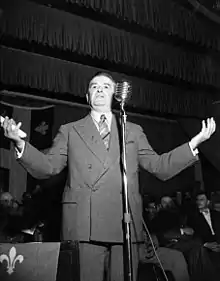 Duplessis campaigning in the 1952 election | |
| 16th Premier of Quebec | |
| In office August 30, 1944 – September 7, 1959 | |
| Monarch | George VI Elizabeth II |
| Lieutenant Governor | Eugène Fiset Gaspard Fauteux Onésime Gagnon |
| Preceded by | Adélard Godbout |
| Succeeded by | Paul Sauvé |
| In office August 26, 1936 – November 8, 1939 | |
| Monarch | Edward VIII George VI |
| Lieutenant Governor | Ésioff-Léon Patenaude |
| Preceded by | Adélard Godbout |
| Succeeded by | Adélard Godbout |
| Attorney General of Quebec | |
| In office August 30, 1944 – September 7, 1959 | |
| Preceded by | Léon Casgrain |
| Succeeded by | Antoine Rivard |
| In office August 26, 1936 – November 8, 1939 | |
| Preceded by | Charles-Auguste Bertrand |
| Succeeded by | Wilfrid Girouard |
| Minister of Roads of Quebec | |
| In office July 7, 1938 – November 30, 1938 | |
| Preceded by | François Leduc |
| Succeeded by | Anatole Carignan |
| Minister of Lands and Forests of Quebec | |
| In office February 23, 1937 – July 27, 1938 | |
| Preceded by | Oscar Drouin |
| Succeeded by | John Samuel Bourque |
| Member of the Legislative Assembly of Quebec for Trois-Rivières | |
| In office May 16, 1927 – September 7, 1959 | |
| Preceded by | Louis-Philippe Mercier |
| Succeeded by | Yves Gabias |
| Leader of the Official Opposition of Quebec | |
| In office November 8, 1939 – August 30, 1944 | |
| Preceded by | Télesphore-Damien Bouchard |
| Succeeded by | Adélard Godbout |
| In office November 7, 1932 – August 26, 1936 | |
| Preceded by | Charles Ernest Gault |
| Succeeded by | Télesphore-Damien Bouchard |
| 70th President of the Bar of Quebec, Bar of Trois-Rivières | |
| In office 1937–1938 | |
| Preceded by | Lucien Moraud |
| Succeeded by | Paul Lacoste |
| Personal details | |
| Born | Maurice Le Noblet Duplessis (baptized Joseph Maurice Stanislas Le Noblet Duplessis) April 20, 1890 Trois-Rivières, Quebec, Canada |
| Died | September 7, 1959 (aged 69) Schefferville, Quebec, Canada |
| Resting place | Saint-Louis Cemetery, Trois-Rivières |
| Political party | Union Nationale |
| Other political affiliations | Conservative Party of Quebec (pre 1936) |
| Spouse(s) | None |
| Children | None |
| Alma mater | Université Laval de Montréal |
| Profession | Lawyer |
| Signature | 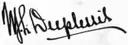 |
| Nickname(s) | "Le Chef"[lower-alpha 1] (The Boss) |
| This article is part of a series on |
| Conservatism in Canada |
|---|
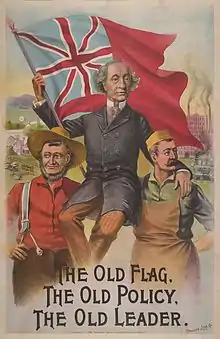 |
.svg.png.webp) Canada portal Canada portal  Conservatism portal Conservatism portal |
| Part of a series on |
| Conservatism |
|---|
 |
|

| Part of a series on |
| Christian democracy |
|---|
 |
 Christianity portal Christianity portal |
Son of Nérée Duplessis, a lawyer who was serving at the time as a Conservative member of the Legislative Assembly (MLA), Maurice went on to study law in Montreal and became a member of the Bar of Quebec in 1913. He then returned to his home town to practice law, where he founded a successful consultancy. Duplessis ran as a Conservative candidate in the 1923 elections, but only managed to get the Trois-Rivières seat four years later, which he retained until his death. His rhetorical skills helped him become the leader of the Official Opposition in the Legislative Assembly in 1933 in the place of Camillien Houde.
As Leader of the Official Opposition, he agreed to a coalition with Paul Gouin's Action libérale nationale (ALN), a breakaway faction of former Liberal MLAs, of which he quickly became the most prominent member. The first attempt, in 1935, to oust Louis-Alexandre Taschereau, then solidly in power for 15 years, failed. Duplessis, however, won in a landslide the following year, when the ALN merged with the Conservatives to form the Union Nationale, which Duplessis would lead until his death.[1] The 1936 election broke the dominance of the Quebec Liberal Party it held uninterruptedly for almost 40 years.
The first government of Maurice Duplessis lasted for just over three years. It was then that Duplessis became the president of the Bar of Quebec (bâtonnier), becoming the only person in Quebec to be Attorney General, Premier and President of the Bar at the same time. He was defeated by Liberal Adélard Godbout in the 1939 election, when his bid to underline Quebec's opposition to World War II failed, but the same opposition, as expressed in the 1942 Canadian conscription plebiscite and the Conscription Crisis that followed, returned him to power following the 1944 election. His second stint as premier lasted for fifteen years and spanned four legislatures. He is the longest-serving premier of Quebec since Confederation and the last one to have consecutively served more than ten years. His leadership was only interrupted by his death in September 1959 due to intracranial bleeding.
Duplessis was a proponent of economic liberalism, obstructing the efforts of the federal government to conduct Keynesian policies, and viewed the welfare state unfavourably, resisting calls to expand social programmes. In his second period of premiership, he presided over a period of strong economic growth, notably due to the development of the Côte-Nord and rural areas. Duplessis implemented pro-business policies, which his opponents say led to wild capitalism and a clientelist relationship with business interests. The leader of Union Nationale also opposed the increasingly powerful trade unions and fought against communism by adopting laws such as the Padlock Law. Duplessis, while not being a sovereigntist, repeatedly asserted provincial autonomism. He also strongly protected the role of the Catholic Church it traditionally held in Quebec's society, notably in healthcare and education, engaged in persecution of Jehovah's Witnesses, and resisted non-conservative tendencies in the society. This, coupled with his authoritarian grip of the province and what was widely seen to be an anachronistic model of society Duplessis was promoting, led his critics to label the period as the Grande Noirceur (Great Darkness). While this opinion is still present, some narratives are challenging the perception, providing more nuance to the portrait of the Duplessism, whose social and economical legacy was largely undone in the 1960s with the Quiet Revolution.
Biography
Family
Maurice Le Noblet Duplessis was born on April 20, 1890 in Trois-Rivières to a religious family of modest upbringing. He was the second child and only son of Nérée Le Noblet Duplessis, a lawyer for the Diocese of Trois-Rivières, who at the time was a member of the Legislative Assembly of Quebec for Trois-Rivières and who would later become a judge of the Superior Court of Quebec and the mayor of Trois-Rivières. Maurice's father was a kind but busy man and spent little time with the family, which was, however, expected at the time.[2] Nérée came from a family of peasants from nearby Yamachiche, in what is today Mauricie. Maurice's mother was Berthe Genest,[lower-alpha 2][3][4] a daughter of Laurent-Ubald Genest, a greffier (clerk) of Trois-Rivières, and of Emma MacCallum[lower-alpha 3] of Montreal, who had Scottish and Irish origins.[4] These Anglo-Saxon roots made the future premier well-disposed to Anglophones; Duplessis would even joke that he was "one of them".[4]
At the end of the 19th century, the Duplessis family of Trois-Rivières was active in the political and religious life of the region, and the members of the family could often be found among conservative and ultramontanist sympathisers. Meetings would regularly happen in their houses, where the current political events were debated. Some of the influential figures of the time, including Louis-Olivier Taillon, Edmund James Flynn, Joseph-Mathias Tellier, Louis-Philippe Pelletier and Thomas Chapais, could be found there. In addition to that, Maurice's father, a deeply pious person, maintained close relations with Louis-François Richer Laflèche, the bishop of the Diocese of Trois-Rivières, where he worked as legal counsel.[4] The bishop supported his electoral bid for the Saint-Maurice seat in 1886, which Nérée won.[2] Maurice was born during his father's reelection campaign, who chose to name his son for the electoral district he was the MLA for.[2] The newborn boy was then baptized by Laflèche himself.
- Family of Maurice Duplessis
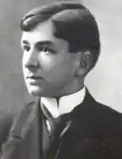 Maurice Duplessis in 1907
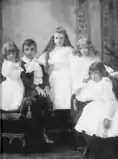 Maurice Duplessis with his sisters, Marguerite, Jeanne, Étiennette and Joséphine-Gabrielle, 1897
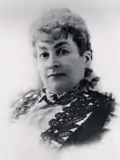 Berthe Genest, Maurice Duplessis's mother
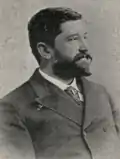 Nérée Le Noblet Duplessis, Conservative MLA for Saint-Maurice (1886-1900), mayor of Trois-Rivières (1904-05) and judge of the Superior Court of Quebec, father of Maurice Duplessis
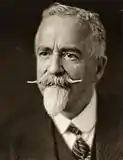 Samuel Genest, president of the Association canadienne-française d’éducation de l’Ontario (1932-33), a Franco-Ontarian advocacy organization. Uncle of Maurice Duplessis.
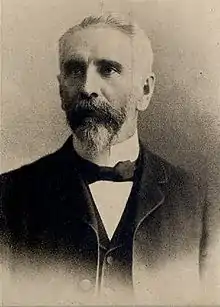 Richard-Stanislas Cooke, mayor of Trois-Rivières (1896-98), Liberal MLA for Trois-Rivières, uncle of Maurice Duplessis.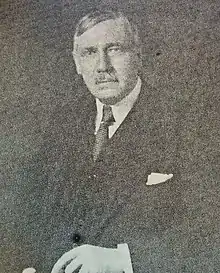
Studies
In 1898, Maurice left his home city to study at the Collège Notre-Dame in Montreal, which at the time was run by the Congregation of Holy Cross. There he met André Bessette (or Brother André, as he is better known), then porter of the college, who came to like young Duplessis and handed him over the task of finding students willing to talk with the rector.[5][lower-alpha 4] The relationship was so close that it was then that Duplessis developed the cult of Saint Joseph, which he carried for the rest of his life, and which sometimes influenced his political choices. The future premier was a bright student, excelling in French, history, Latin and philosophy; at the same time, he was known to be playful and sometimes mischievous. He would often play tricks to his school friends and also to their sisters, hiding their clothes and pillows, readjusting the beds so that they would fall when someone lay down on them and throwing water buckets, small pastries, buns and other projectiles.[6][7]
In 1902, Duplessis moved to the Séminaire de Trois-Rivières in order to pursue his study in a classical college. Maurice continued to excel in other subjects, including history, theology, Latin and Greek, which helped him become the best student in his year, but in particular sharpened his rhetorical skills while attending the debate club at the college's Saint Thomas Aquinas Society.[8] Maurice would make what Conrad Black described as "long apologetic speeches about the founders of French Canada that were as extravagant as they were unconvincing",[8] where he would show his attachment to and admiration of his roots and the Catholic faith. He was especially fond of Louis Hébert, one of the first colonizers of the New France and a pioneer of farming in the area,[lower-alpha 5] which Black suggests was a sign that he already had a deep affection for the rural lifestyle at this stage, particularly given that he spent the summer with his grandfather in Yamachiche.[lower-alpha 6] When it came to sports, however, Duplessis was hardly interested in them, and has not practised any in his life, except for croquet.[9]
Duplessis' interest for politics appeared at a very young age. Maurice would memorize the circumstances and dates of important events in the politics of Canada and of Quebec, as well as the regional differences in voting patterns in the province. As early as at the age of ten, Maurice was already engaging in political meetings and was speaking with the voters, and he would also follow his father during his electoral campaigns and meetings across the electoral region, thus showing more interest in the practical aspects of politics than in its theory.[8] Later, in his adolescence, the future premier was preparing for public life by working in a political organisation of Joseph-Arthur Barrette, a Conservative MP for Berthier.[9]
When finishing school, Maurice Duplessis felt attracted to the public life, while at the same time, he was equally devoted to the Catholic Church due to the influence of Brother André. However, Maurice felt that being a religious minister bore too many constraints. He confided to his secretary a few years later: "the priesthood is too much for me."[10] He was not interested to pursue business affairs, either, because, as Black suggested, "he knew the English were greatly advantaged".[9] In the meantime, a wave of increased interest in politics engulfed Quebec at the beginning of 20th century, with the popularity of figures like Henri Bourassa and Wilfrid Laurier being felt across the province, which did not bypass Trois-Rivières or Duplessis. Strongly influenced by the family and by the uptick in engagement in political matters, he decided to go in his father's footsteps. Thus in autumn of 1910, he enrolled in the faculty of law at the Université Laval in Montreal, which is now a separate university called Université de Montréal. Pursuing a law degree was then a standard way to get into politics. Conrad Black described Duplessis thus:[9]
His social life was going according to the vocation he had chosen. His books, many more in number than he would wish to admit while speaking to the workers and farmers, were more about educating him about the public life rather than distracting therefrom. He had no hobbies and, outside politics, the only distractions of the youth were professional baseball (he liked to memorize the statistics almost as much as those relating to the politics), and, from time to time, opera.

While studying, he was noted for his liveliness, sharp responses and socializing.[11][12] Duplessis, sitting in the opposition, was a local star within the model parliament organized by the university.[10] The future premier of Quebec, before practising law, trained in the offices of Rodolphe Monty et Alfred Duranleau, two nationalist conservatives and friends of Duplessis' family, where Maurice was referred to by his father, Nérée.[13]
Entry into politics
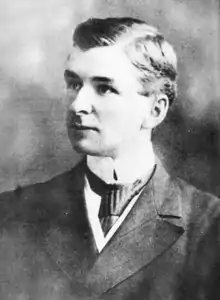
Law practice
After three years of studies, Duplessis was admitted to the Bar of Quebec on September 4, 1913.[14] Maurice returned to his home town to practice law at the Bar of Trois-Rivières, whose member he would stay until his death.[15] He first worked for a short time together with his father, before Nérée Duplessis was nominated as judge of the Superior Court of Quebec on June 15, 1914. The future Premier then opened his own consultancy, Duplessis, Langlois & Lamothe, Avocats et Procureurs, on Hart Street, behind his parents' house, together with Édouard Langlois, an old friend of his from the Séminaire who became husband of Duplessis' sister, Gabrielle,[16] and another lawyer from Trois-Rivières, Léon Lamothe.[14][17] The partnership of these lawyers lasted at least until early 1930s.[17]
Practising civil law more than criminal law, Duplessis developed his large client base among the ordinary people, who were attracted due to his arguments in court that often proved persuasive. He was quickly recognized as a sociable and competent lawyer who approached his cases carefully, and thus became a popular figure in the town.[18] The young lawyer engaged in the activities of his area, notably taking care of a local baseball team, and became a fixture in high-end taverns of his town. His professional success let him buy a personal Winton on a loan (to great dismay of his father), but it was briefly interrupted by the death of his mother, Berthe, in 1921.[19]
First electoral successes
Despite a promising career start in his legal profession, Duplessis did not lose sight from his political ambitions. He made his first attempt to get to the Legislative Assembly of Quebec in 1923, when he became a Conservative candidate for the riding of Trois-Rivières, seeking to oust the incumbent Liberal MLA, Louis-Philippe Mercier.[20] The campaigning has been heated. Mercier benefited from a well-organised political structure in the area, directed by his mentor, Jacques Bureau, who at the time served as an Member of Parliament for Three Rivers and St. Maurice and the federal minister of customs and excise.[20][lower-alpha 7] Maurice counted on his father's acquaintances' support (notably Louis-Olivier Taillon), some of whom came over to make speeches in Duplessis' favour, solidarity of his fellow lawyers and the admiration of his clients.[20] His campaign based on the what he alleged was "contempt towards provincial autonomy" and towards municipal rights that the then premier Louis-Alexandre Taschereau exhibited and on the criticism of the Liberals' management of the judiciary.[21][22] Despite a rather close race, Maurice lost to the incumbent, with 1,328 votes for Duplessis and 1,612 for Mercier. Duplessis at the time did not expect to win the riding anyway, but instead hoped that his good showing would make him a good candidate of the opposition leader in the region.[20]
Duplessis attempted a second run to the Legislative Assembly, trying to get as much support from working- and middle-class families as he could, including by paying personal visits to them and tracking his opponent's moves during Mercier's another four years in office;[21] his resolve to get to the provincial parliament increased even further after his father died in 1926.[23] Despite a dismal showing of the Conservatives in the 1927 election, where they only managed to capture 9 out of 85 seats, Duplessis eked out a victory of 2,622 to 2,496 votes in a rematch against Mercier and flipped the Trois-Rivières seat, previously considered a Liberal stronghold, for the first time in 27 years.[24] In his victory speech, he prophetically declared that "you have in front of you the future premier of Quebec".[25]
At the time when Duplessis was elected, the Legislative Assembly was only in session for two months in a year, which allowed Duplessis to spend more time in his electoral district. However, when the parliament was first convened on January 10, 1928, Duplessis immediately became active. In a speech from January 19, the Legislative Assembly freshman made a speech where he decried the overemphasis on industrial development, as opposed to rural and small-business interests, called to stop increasing taxes and to respect the religious nature of Sundays, and proposed to make an inventory of the forest industry (it was suspected at the time that the resources were being overexploited) and to reorganize the provincial police.[21][26] The first speech left Premier Taschereau impressed, who supposedly remarked that "this young man [...] will go far".[21] His rhetorical skills and the knowledge of the law on the books made him a rising star in the opposition. When Arthur Sauvé left the leadership of the Conservatives, it was even supposed that Duplessis could take the steers of the battered party, but Duplessis was not ready yet at the time.[27] Camillien Houde, Mayor of Montreal, was nominated instead, but he often had to leave the parliament sessions because of his other demanding job, so that Duplessis, whom the Conservative caucus already saw as a safe alternative to Houde should his policies fail,[28] was able to informally lead the caucus in the leader's absence.[29]
Arthur Sauvé, in his resignation speech, asked his successor "to reestablish order in our ravaged ranks". Even though the new leader liked Duplessis , the future premier did not particularly trust his organizational capabilities, finding him "an impetuous and verbose braggart".[30] He also said to his party colleague, Antonio Barrette, who would serve briefly as Premier in 1960: "You will see Houde climb to the top of the hill, only for him to go down on the other slope". Conrad Black characterized his relationship with Houde, together with his political views, in the following way:[31]
Maurice Duplessis was surely of a fundamentally conservative point of view; he distrusted anything that seemed to be a flash-in-the-pan event and doubted anything that seemed improbable to him. The family was important for him. He also liked it when a person was able to respect the procedure. For him, Camillien Houde was a disorganised person who went bankrupt several times, who did not belong to any group of people, who neither had a family nor a job and who, except for his silver tongue, was inexperienced in anything, chaotic and superficial. He was sure that Houde, an overweight and unwieldy man, would be no match to Taschereau's ruse, air of authority and meticulousness.
Later events seemed to confirm Duplessis' intuition. In the 1931 election, the Conservatives were again resoundingly defeated, with only 11 seats out of 90 in the party's hands despite the fact that the Conservatives got a markedly larger share of votes provincially. Houde lost his own riding, while Duplessis got barely reelected with a razor-thin margin of 41 votes (3,812 for Duplessis, versus 3,771 for Louis-Philippe Bigué, his Liberal challenger).[32] Upon learning the results, Taschereau declared that "this outcome means the end of Houdism".[33]
- Quebec politics of 1920s and 1930s
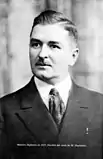 Maurice Duplessis in 1927, the year of his first successful election
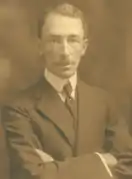 Louis-Alexandre Taschereau, MLA for Montmorency, leader of the Quebec Liberal Party and Premier of Quebec in 1920-1936
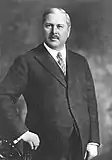 Arthur Sauvé, MLA for Deux-Montagnes, leader of the Conservative Party of Quebec in 1916-1929 and father of Paul Sauvé, who would replace Duplessis as Premier of Quebec after his death in 1959.
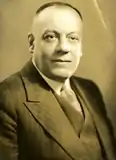 Camillien Houde, the penultimate leader of the Conservative Party of Quebec in 1929-1931, MLA for Montréal–Sainte-Marie and Mayor of Montreal
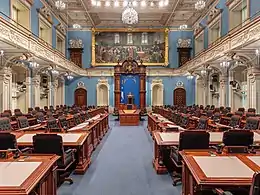 A contemporary photo of the the Blue Room of the Parliament Building of Quebec, where the Legislative Assembly had its sessions. Trois-Rivières, where Duplessis was elected from, is the oldest continuous provincial riding in Quebec.[34]
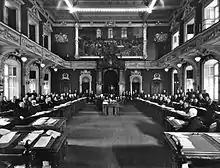 A Legislative Assembly session on April 5, 1933. Duplessis is seated in the third position from the background in the first row, directly opposite Taschereau.
Leader of the Official Opposition
The 1931 election has seen the Conservatives internal strife, already present in Sauvé years, intensify.[35] The party members could not even agree to a common strategy of dealing with the results of the election. Houde opted for a recount in 63 ridings won by Liberals, alleging widespread electoral fraud; Duplessis, however, was among a group of dissident MLAs who refused to endorse Houde's idea, with Duplessis particularly being afraid that his narrow victory would be overturned.[36][37] The plan was frustrated by the governing Liberals, who passed legislation requiring that $1,000 (equivalent to $18,200 in 2021) be paid for each contested riding.[21] In an effort to appease the Anglophone community, Houde designated an ageing Charles Ernest Gault, a Houde ally and long-time MLA from Montréal–Saint-Georges, as a new leader of the parliamentary caucus.[38] The choice enraged Duplessis, who was a rising star in his party. Houde also nominated Gault as leader of the Conservatives after he lost his mayorship and resigned from the leadership of the party on 19 September 1932, but the Conservative caucus overrode that decision on November 7 and put Duplessis in charge.[21]
The decision was formally confirmed during a party congress in Sherbrooke on October 4-5, 1933, when Duplessis was confirmed in his position, getting 332 votes against 214 cast for Onésime Gagnon, an MLA from Dorchester who favoured closer ties with the federal Conservatives.[39] Duplessis received support from seven out of 10 MLAs from his party as well as all federal ministers from Quebec with the exception of Maurice Dupré, who was a law partner of Gagnon.[40] While Duplessis got less support from the Anglophones due to him being perceived as too nationalist,[38] Richard Jones argues that it was the superior organisation and not the nationalist rhetoric that secured Maurice's victory.[35] Despite the victory, the tensions within the Conservative caucus did not subside.[41]
The news of the election of the new leader was received well in Trois-Rivières and Quebec City. Duplessis met with Cardinal Jean-Marie-Rodrigue Villeneuve, Anglican bishop Williams, Henry George Carroll, the Lieutenant Governor of Quebec, as well as the mayor of Quebec City, Henri-Edgar Lavigueur.[42] On the other hand, Camillien Houde was angered by the choice of his party's caucus. He bitterly declared that "either I will perish or they [Duplessis supporters] will" and said that he was "free to associate myself with any serious movement that will try to get us rid of two political parties in Quebec that perpetuate the idea that the power trumps the law".[42] Houde would only reconcile with Duplessis in 1944.[21]
Duplessis immediately engaged in his new job. In his response to Taschereau's speech from the throne, Duplessis harshly criticized the management of the province, in particular pointing to the overcapitalization of companies, chaos in the province's industry and resource exploitation, and what he saw as unjust treatment of the municipalities, unnecessary confrontations with the federal government, the lack of respect for traditions and pandering too much to big business interests instead of developing rural areas.[43][41] Unlike some of his other colleagues in the party centered around Aimé Guertin, however, he opposed trust-busting in order to increase the clout of French-Canadian businesses and saw unfavourably the advocacy of some of his party colleagues to overhaul the social welfare system.[41]
Despite the differences within the opposition, the governing Liberals had even more problems. Quebec was in the midst of the Great Depression, which left Canada's economy declining. The Liberal party, in power for more than 35 years at the time, was suffering from internal tensions, too, but also from the laissez-faire economic policies that proved inadequate for the crisis,[44] and what Conrad Black described as inflexibility and population's weariness of the government that has been in power for too long.[43] As a result, some of the Liberal MLAs became disillusioned with Taschereau and created a new party, the Action libérale nationale (ALN).
Coalition with the Action libérale nationale
The new party, which in particular despised the big business's interests in the province, consisted of nationalist and progressive MLAs led by Paul Gouin and included some other figures, such as Philippe Hamel, Joseph-Ernest Grégoire and Oscar Drouin. The members of the new political force drew heavily from the Programme de restauration sociale, a social policy document drafted by the Catholic clergy in 1933 that advocated corporatism as an alternative for capitalism and communism[45] and and sought to improve the position of French Canadians in the province by embracing, expanding the social welfare net, breaking (and, if needed, nationalizing) trusts and revitalizing rural areas.[46][47][48][49] In particular, the party was critical of the energy trusts and sought to bring the hydroelectricity companies under state control.[45] The New Deal policies adopted south of the Canadian border had also some impact on ALN's ideology.[50]
Initially, Maurice Duplessis was skeptical of the third political force, saying that "two [parties] are enough: the good one and the bad one".[51] He was then preparing for the upcoming 1935 election, starting a tour across the province more than a year before the voters were to go to the ballots. On 17 June 1934, Duplessis visited the Antonio Élie, a fellow deputy from Yamaska and an award-winning breeder of foxes,[51] where he delivered a speech underlining his attachment to the traditions and distrust of the modern and urban life.[lower-alpha 8] He also attacked the presence of foreign economic interests in the province, accusing Taschereau of supporting supermarkets with tax credits while leaving independent shop owners vulnerable to bankruptcy and by leaving the extraction of natural resources in the hands of foreign capital, which he argued let them be used against Quebeckers.[52] These arguments echoed those made by the ALN, whose strength was amplified by Duplessis's incessant attacks on the government, even if Duplessis tried to assure that "honest" capital would remain untouched in the province and that they were less extreme than the maverick Liberals.[53]
Maurice remained distrustful of the ALN members, seeing them as unreliable men who would join the Liberals after the election and ruin his dream of heading the government himself, and warned his fellow party colleagues to stay away from ALN advances, even when publicly he encouraged "all sincere Liberals" to join forces.[54] Despite several circumstances that nudged the Conservatives towards an alliance with the ALN, such as Oscar Drouin's call to Duplessis to unite in their quest to overturn Taschereau's government in July 1935, the federal Conservatives' crushing defeat in the 1935 federal election in October, a prospect of three-headed race in the first-past-the-post system that would cause vote splitting issues, and finally, Taschereau's decision to call a snap election on November 25, 1935 in a bid to capitalize on an electoral success of the federal Liberals in Quebec, Duplessis remained opposed to any agreement with the breakaway Liberals.[55] However, faced with overwhelming support of a coalition within his party, donors' and organizers' threats to withhold resources if the Conservatives did not sign a coalition agreement and local reports suggesting that ALN might hold balance of power if no deal was reached, forced Duplessis to sign one on November 7, 1935. According to the agreement, a so-called Union Nationale coalition was formed; each riding had only one candidate from the opposition, but two-thirds of ridings were signed off to the ALN members and all opposition candidates ran on ALN's platform, which was declared to be identical to the Conservatives';[56] if the Union Nationale won, Duplessis, given his experience, would become Premier but Gouin would choose the majority of his cabinet.[50]
The coalition failed to displace the Liberals from power, who got elected in 48 out of 90 seats, just enough for the majority but 31 fewer than in 1931 and 20 fewer than just before the election.[57] As for the opposition, the Conservatives managed to win 16 ridings, the best result since 1923, while the ALN got 26 MLAs. Duplessis got reelected with a safe margin of 1,202 out of 8,544 votes.[57] The charisma and ardor of Duplessis, in contrast to the temperate behaviour of Paul Gouin, would strongly influence the MLAs from the Action libérale nationale, and a lot of them would co-create the new merged party of the same name as the coalition.[58]
Ascendancy of the Union Nationale
Maurice Duplessis continued his offensive when the new parliamentary session opened. In spring 1936, Duplessis managed to call the parliamentary public accounts committee to start an inquiry into the management of public funds by the Taschereau government, in which Duplessis would place himself as prosecutor.[50][61] Numerous irregularities were uncovered, where various Liberal government officials acknowledged having used the public money inappropriately.[62] For example, Antoine Taschereau, brother of the Premier and the accountant of the Quebec Legislature, was forced to resign when he admitted having pocketed interest from public bank deposits. Duplessis even capitalized on the seemingly trivial infractions, such as when Irénée Vautrin, ex-minister of colonization, confessed to have bought trousers on his ministry's money, only to promptly denounce this as a symbol of the corruption of the Taschereau government.[63] The fact that the newspapers reported on all the smallest details of the inquiry made the committee job a political goldmine for Duplessis.[62] As a result of such revelations, Taschereau resigned on June 11, 1936, and handed over the premiership to Adélard Godbout,[64] who was forced to call an election on August 17 that year.
The political situation during that year changed dramatically. Even though Duplessis entered the election as a junior coalition partner, his charisma, rhetorical skills and his grilling of the Liberal officials has earned him support from most of ALN deputies; Gouin, on the other hand, proved not to be a good leader of the opposition and even handed over most of coalition matters to Duplessis because of the latter's expertise in politics.[50][65] On an organizational level, the Conservatives succeeded in capturing the Union Nationale brand for them.[65] Moreover, the corruption inquiry severely weakened the governing party, which gave Duplessis a chance to single-handedly win the premiership. Therefore, on 17 June, Duplessis announced that he refused to renew the coalition agreement even though the election writs were issued.[21] Though the leader of the Conservatives was quickly able to force an increase of the proportion of Conservative ridings in the coalition from one-third to two-thirds, Gouin decided to break with Duplessis the next day and started campaigning independently against the other two parties.[66] However, on 20 June, 35 out of 42 Union Nationale coalition MLAs who came to a caucus meeting in Sherbrooke backed Duplessis's takeover of the coalition, and most of ALN's members joined Duplessis and the newly created Union Nationale party.[50] Eventually, Gouin said he would not field any candidates in any ridings due to his "temporary" retirement from politics, which confirmed Duplessis's leadership.[67]
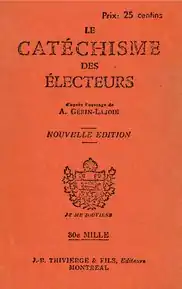
The Union Nationale made an electoral campaign along similar lines to the 1935 election, formalizing that in a pamphlet called Le Catéchisme des électeurs, designed in a question-and-answer format to address the contemporary political and economical issues, while also adding attacks on corruption.[68] Duplessis successfully tied Godbout to the deeply unpopular Taschereau and rallied massive support for his political appearances.[69] When the voters came to the polls, they delivered a landslide victory for the Duplessis's party, handing 76 out of 90 seats and ending the Liberal rule over Quebec that lasted for 39 years.[69]
Political career
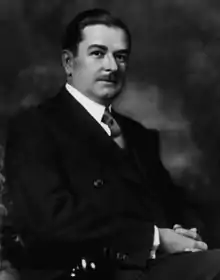
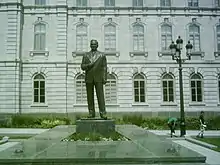

Duplessis' first government was defeated in the 1939 election, a snap election called by the premier in hopes of exploiting the issue of Canadian participation in World War II.
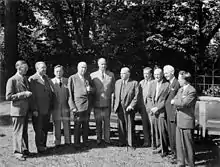
Duplessis returned as premier in the 1944 election, and held power without serious opposition for the next fifteen years, until his death, winning elections in 1948, 1952 and 1956. He became known simply as le Chef ("the boss").
He was elected to five terms of office in all, the last four of them consecutive. Duplessis remains the last Quebec premier to have won three or more consecutive majority governments. After him, no political party in Quebec elections at the provincial level had won more than two terms of office in a row until the December 2008 victory of Jean Charest's Liberal party, its third consecutive win.
Policies
Duplessis favoured rural areas over city development and introduced various agricultural credits during his first term. He was also noted for meagre investment in social services except education (budget was multiplied by six between 1946-1956[71]) in Catholic schools. Duplessis also opposed military conscription and Canadian involvement in World War II. The Union Nationale often had the active support of the Roman Catholic Church in its political campaigns and employed the slogan Le ciel est bleu; l'enfer est rouge: Heaven is blue (UN); Hell is red (Liberal). In 1936 Duplessis hung the Crucifix in the National Assembly's Blue Room, where it hung until July 2019.[72]
Jehovah's Witnesses and Roncarelli v. Duplessis
Duplessis actively opposed Jehovah's Witnesses, causing The Globe and Mail to comment, "The persecution of the religious sect known as Jehovah’s Witnesses, now going on in Quebec Province with enthusiastic official and judicial sanction, has taken a turn which suggests that the Inquisition has returned to French Canada."[73] In 1943 the Witnesses of the Canadian province of Quebec were continuously arrested up to twice the same day.[74]
Duplessis once used his influence to revoke a liquor licence from one of their members' businesses. In Roncarelli v. Duplessis, the decision of the lower court was upheld by the Supreme Court of Canada, and damages to Roncarelli were increased. Duplessis was ordered to pay $33,123.53 in damages. In his comments, Justice Abbott wrote, "The cancellation of the licence was made solely because of the plaintiff's association with the Witnesses of Jehovah and with the object and purpose of preventing him from continuing to furnish bail for members of that sect." In a 6-3 decision, Duplessis influencing the liquor commission to cancel the license was deemed an improper use of his power.[75]
Death and legacy

Duplessis died in office after a series of strokes he suffered while visiting the Iron Ore Company of Canada in Schefferville in the presence of seven government and company officials on September 7, 1959. Following his death and the subsequent election of a Liberal government under Jean Lesage in 1960, Quebec entered a period later termed the Quiet Revolution (Révolution tranquille), a decisive movement away from the conservative policies of Duplessis and toward a secular social democracy.
Duplessis has not been without his defenders. Conrad Black's 1977 encomium, Duplessis, painted a sympathetic portrait of the man as a transitional figure towards modernism, and the victim of partisan attack and personal malady.[76]
Nevertheless, Duplessis' legacy has been the subject of repeated criticism in the decades since his death. Quebec nationalists dislike his anti-separatist stance, liberals denounce his social conservatism. His critics hold that Duplessis' inherently corrupt patronage politics, his reactionary conservatism, his emphasis on traditional family and religious values, his anachronistic anti-union stance, rural focus and his preservation and promotion of Catholic Church institutions over the development of a secular social infrastructure akin to that underway in most of the postwar West, stunted Quebec's social and economic development by at least a decade.
In response, it has been argued that the notion of the Duplessis "black years" is a myth propagated by all subsequent major political actors in Quebec due to a fundamental aversion to Catholic church-oriented traditionalist patterns of development, with dominant intellectual movements combining various elements of this dislike. However, the counter-argument, that this is an over-simplification which fails to capture the complexities of Quebec politics, society and its economy, has consistently prevailed in public and academic discourse for some time.
Aside from occasional defenders of his anti-communist and socially conservative views,[77][78] defence of the Duplessis government today comes primarily from traditionalist conservatives (paleoconservatives in North American definition) who view his regime as an essential reaffirmation of traditional values, and as an assertion by democratic means of the basics of church and family life with low social spending and suppression of labour unions.
Richard Jones, an historian specialising in the political and cultural history of Canada and Quebec, summed up Duplessis:
- "The Duplessis regime may well have endured for too long, the Union Nationale leader's traditionalist policies may well have been anachronistic when compared with the relatively modern society that, in many respects, the Quebec of the 1950s had already become."[79]
He was a lifelong bachelor.[21]
See also
- Charbonneau et le Chef
Notes
- Also often rendered as "Le Cheuf" so as to reflect the particularities of Quebec French pronunciation
- Her full name was Marie Catherine Camille Berthe Genest.
- Her full name was Marie Esther Charlotte Emma MacCallum
- In the 1950s, when Duplessis was premier of Quebec, he was among the foremost people lobbying for the canonisation of Brother André
- Black gives an example of such speech: "How beautiful and laudable was the deed whose purpose was to establish Catholicism on the unexplored lands among the barbaric peoples deep in the dark forests of idolatry! Oh! The seas, ladies and gentlemen, have not always been these vast scathes of clear waters in which rays from the bright sun are being reflected; the waves have not always been calm and symmetrical, on which old and fragile vessels steered with sweet tranquility. How much courage was needed to set adventure in these pelagic immensities in such a light caravel... In light of his glorious actions, I dare anyone to say that Louis Hébert was not a great Christian, that he did not love the fleurdelisé with devotion and passion."
- Duplessis argued: "Louis Hébert has understood that with honesty and the good luck of having a healthy soul and body, the life in the fields would bring true happiness [...] Unfortunately, today [...] the countryside is being neglected by the legions of strong and able-bodied young men who leave it in order to flock in the offices of large cities."
- Étiennette Duplessis, sister of Maurice, would marry Édouard Bureau, Jacques's son, in the April following the election
- As Conrad Black notes in his biography of Duplessis, "[he] accused Taschereau of all crimes related to the disorganized industrialization. Hydroelectric projects were assigned a higher priority than those of the rural areas. The colonisation of new lands was almost tossed away in favour of urbanization. The farmers were abandoned all while foreign and corrupt industrialists were accorded more and more privileges, no assistance was offered to the breeders of foxes (like Élie; the market of fox skins virtually ground to a halt in the early 1930s), and neither were loans for agriculturers or rural electrification programmes enacted, while the assistance offered to the old parishes, which constituted the moral and social backbone of Quebec, was far from sufficient. The earth, the Church and the culture - all that was patriotic, divine and traditional - was thrown away to give way for urbanization, speculation and dehumanizing materialism. And among the swarming masses of the cities, patience, religious practice and faith, all that was honest and dignified was replaces by frivolousness, licentiousness, disorder, alcoholism and the lack of respect towards God and the state."
References
- Black, Conrad M. (2011). "Duplessis, Maurice Le Noblet". The Canadian Encyclopedia, Historica Foundation, Toronto. Retrieved January 31, 2011.
- Rumilly 1973, p. 14-15.
- "Nérée Le Noblet Duplessis". National Assembly of Quebec (in French). March 2009. Retrieved November 28, 2021.
- Black 1977, p. 15.
- Black 1977, p. 17.
- Rumilly 1973, p. 21.
- Black 1977, p. 23.
- Black 1977, p. 21.
- Black 1977, p. 25.
- Black 1977, p. 27.
- Rumilly 1973, p. 26.
- Black 1977, p. 30.
- Black 1977, p. 29.
- "Biography". Dictionnaire des parlementaires du Québec de 1792 à nos jours (in French). National Assembly of Quebec.
- "Duplessis, Maurice". Quebec Cultural Heritage Directory (in French). Retrieved November 28, 2021.
- Rumilly 1973, p. 29.
- "Expositions du Service des archives du Séminaire St-Joseph de Trois-Rivières | Ces terres qui portent fruits. | 0757-A-5-a-45". archives.ssj.qc.ca. Retrieved December 5, 2021.
- Black 1977, p. 30-32.
- Black 1977, p. 45.
- Black 1977, p. 36.
- Sarra-Bournet 2009.
- Black 1977, p. 38.
- Black 1977, p. 46.
- Rumilly 1973, p. 57.
- Black 1977, p. 48.
- Black 1977, p. 52.
- Black 1977, p. 53.
- Dirks 1991, p. 23.
- Black 1977, p. 63.
- Black 1977, p. 55-56.
- Black 1977, p. 56.
- Rumilly 1973, p. 96.
- Saint-Aubin 1979, p. 58.
- Desjardins, Joseph (1902). "Guide parlementaire historique de la province de Québec, 1792 à 1902". Canadiana Online. Retrieved December 5, 2021.
- Jones 2000, p. 3.
- Bélanger, Réal; Jones, Richard; Vallières, Marc (1994). Les grands débats parlementaires, 1792-1992 (in French). Quebec: Presses Université Laval. p. 88. ISBN 978-2-7637-7357-5.
- Paulin 2005, p. 42-44.
- Stevenson, Garth (1999). Community besieged : the anglophone minority and the politics of Quebec. Montreal: McGill-Queen's University Press. p. 48. ISBN 978-0-7735-6775-7. OCLC 180704153.
- Saint-Aubin 1979, p. 60,65.
- Saint-Aubin 1979, p. 60.
- Dirks 1991, p. 38.
- Saint-Aubin 1979, p. 65.
- Black 1977, p. 105.
- Dirks 1991, p. 26-28.
- "Action libérale nationale". University of Sherbrooke. Archived from the original on April 26, 2021. Retrieved December 14, 2021.
- Bouchard, Marie J; Lévesque, Benoît (2010). "Économie sociale et innovation. L'approche de la régulation, au coeur de la construction québécoise de l'économie sociale". doi:10.13140/2.1.4869.7120. Cite journal requires
|journal=(help) - Arès, Richard (1982). "Le Père Joseph-Papin Archambault, S.J. et l'École Sociale Populaire : témoignage" (PDF). Revue d'histoire de l'Amérique française (in French). 35 (4): 563–587. doi:10.7202/304012ar. ISSN 0035-2357.
- Blais, Christian. "Introduction historique - 18e législature, 2e session (10 janvier 1933 au 13 avril 1933)". National Assembly of Quebec (in French). Retrieved December 14, 2021.
- Dirks 1991, p. 35-36.
- Sarra-Bournet, Michel (Spring 2003). "Maurice Duplessis entre en scène" (PDF). Cap-aux-Diamants : La revue d'histoire du Québec.
- Black 1977, p. 126.
- Saint-Aubin 1979, p. 88.
- Dirks 1991, p. 61, 71-73.
- Dirks 1991, p. 73-74.
- Dirks 1991, p. 74-79.
- Dirks 2009, p. 79-80.
- Saint-Aubin 1979, p. 105.
- Saint-Aubin 1979, p. 109.
- Guay, Jean-Herman. "Parution de l'ouvrage « Le catéchisme des électeurs »". Bilan du siècle (in French). Université de Sherbrooke. Retrieved April 9, 2021.
- Bélanger, Jacques (1992). "Le catéchisme des électeurs" (PDF). Cap-aux-Diamants : La revue d'histoire du Québec – via erudit.org.
- Saint-Aubin 1979, p. 110.
- Saint-Aubin 1979, p. 111.
- Saint-Aubin 1979, p. 112.
- Saint-Aubin 1979, p. 113.
- Dirks 1991, p. 93-94.
- Saint-Aubin 1979, p. 115.
- Saint-Aubin 1979, p. 119.
- Saint-Aubin 1979, p. 117.
- Saint-Aubin 1979, p. 120.
- "Maison Maurice-Duplessis". Quebec Cultural Heritage Directory. Retrieved December 5, 2021.
- Bédard, Eric (May 30, 2013). History of Quebec For Dummies. John Wiley & Sons. ISBN 9781118439746.
- "Crucifix removed from National Assembly's Blue Room". CBC News. July 9, 2019. Retrieved July 14, 2019.
- Toronto Globe & Mail, December 19, 1946.
- min. 26:36 https://tv.jw.org/#es/mediaitems/VODMoviesDocumentary/pub-ivfa2_x_VIDEO// min. 26:36 Check
|url=value (help). Missing or empty|title=(help) - Roncarelli v. Duplessis, January 27, 1959, retrieved June 19, 2017
- Black 1977.
- Côté, Pauline (2004). "Public Management of Religious Diversity in Canada". In Richardson, James T. (ed.). Regulating religion: case studies from around the globe legacy. Springer. p. 425. ISBN 9780306478864.
- Frost, Catherine (2006). Morality and nationalism. Taylor & Francis. p. 157. ISBN 9780203086179.
- Richard Jones, "Duplessis and the Union National Administration" (Ottawa: Canadian Historical Association, 1983), p. 17. Reproduced on-line by Library and Archives Canada: Canadian Historical Association Booklets.
In English
- Laporte, Pierre (1960). The True Face of Duplessis. Montreal: Harvest House Limited.
- Roberts, Leslie (1963). The Chief: A Political Biography of Maurice Duplessis. Clarke, Irwin.
- Quinn, Herbert F. (1963). The Union Nationale: A Study in Quebec Nationalism. University of Toronto Press. ISBN 978-0-8020-6040-2.
- Black, Conrad (1973). Career of Maurice L. Duplessis as viewed through his correspondence, 1927-1939. Montreal: McGill University.
- Black, Conrad (1977). Duplessis. Toronto: McClelland and Stewart. ISBN 0-7710-1530-5. OCLC 3033534.
- Quinn, Herbert F. (1979). The Union Nationale: Quebec Nationalism from Duplessis to Levesque (2 ed.). Toronto: University of Toronto Press. ISBN 0-8020-2318-5.
- Dirks, Patricia G. (1991). Failure of L'Action Libérale Nationale. Montreal: McGill-Queen's Press. ISBN 978-0-7735-0831-6.
- Jones, Richard (2000). Duplessis and the Union Nationale Administration (PDF). Ottawa: Canadian Historical Association. ISBN 0-88798-087-2.
- Paulin, Marguerite (2005). Maurice Duplessis: Powerbroker, Politician. Montreal: XYZ Publishing. ISBN 1-894852-17-6.
- Geloso, Vincent (2017). Rethinking Canadian economic growth and development since 1900 : the Quebec case. Conrad Black. Cham, Switzerland: Palgrave Macmillan. ISBN 978-3-319-49950-5. OCLC 993526903.
In French
- Maurice Duplessis, grand canadien. Biographie du premier ministre de la province de Québec (in French). Montreal: Benallack Press. 1948. OCLC 977341564.
- Jean, Des Trois Rives (1960). Maurice Duplessis. Editions du Château. OCLC 63002020.
- Rumilly, Robert (1973). Maurice Duplessis et son temps. 1–2. Montreal: Fides. ISBN 0-7755-0708-3. OCLC 5838209. (vol. 1: 1890-1944, vol. 2: 1944-1959)
- Paradis, Raymond (1977). Nous avons connu Duplessis. Montreal: Editions Marie-France. OCLC 798850056.
- Saint-Aubin, Bernard (1979). Duplessis et son époque. Montreal: La Presse. ISBN 2-89043-019-7. OCLC 6304966.
- Boismenu, Gérard (1981). Le duplessisme: politique économique et rapports de force, 1944–1960. Montreal: Presses de l'Universite de Montreal. ISBN 2760605116.
- Benoît, André (1983). Maurice Duplessis et le duplessisme : bilan historiographique, 1959-1980. Montreal: Université de Montréal.
- Linteau, Paul-André; Durocher, René; Robert, Jean-Claude (1989). Histoire du Québec contemporain. Montreal: Boréal. ISBN 2-89052-297-0. OCLC 20357831.
- Gagnon, Alain-G.; Sarra-Bournet, Michel, eds. (1997). Duplessis : entre la grande noirceur et la société libérale (PDF). Montréal: Éditions Québec Amérique. ISBN 2-89037-935-3. OCLC 78036516.
- Jasmin, Claude (1999). Le patriarche bleu : Duplessis : biografiction. Outremont, Quebec: Lanctôt Editeur. ISBN 2-89485-100-6. OCLC 43468801.
- Marcotte, Gilles (1999). La mort de Maurice Duplessis et autres récits. Montreal: Boréal. ISBN 2-89052-949-5. OCLC 40735579.
- Hébert, Jacques (2000). Duplessis, non merci!. Montréal: Boréal. ISBN 2-7646-0048-8. OCLC 43847172.
- Fournier, Louis (2001). Histoire du mouvement ouvrier au Québec : 150 ans de luttes. Quebec: Confédération des syndicats nationaux/Centrale des syndicats du Québec. ISBN 2-89061-084-5. OCLC 300704036.
- Rouillard, Jacques (2004). Le syndicalisme québécois. Deux siècles d'histoire. Montreal: Éditions Boréal. ISBN 9782764603079.
- Luc, Bertrand (2005). Célébrités - Maurice Duplessis. Saint-Jean-sur-Richelieu: Lidec. Retrieved November 28, 2021.
- Vanasse, Claudie (2008). Maurice Duplessis. Montreal: Les Malins. ISBN 9782896570102.
- Pelletier, Martin; Lévesque, Michel (2009). L'Union nationale : bibliographie. Quebec: Library of the National Assembly of Quebec. Retrieved November 28, 2021.
- Gélinas, Xavier; Ferretti, Lucia; Bédard, Éric (2010). Duplessis : son milieu, son époque. Québec: Septentrion. ISBN 978-2-89448-625-2. OCLC 705507561.
- Lavigne, Alain (2012). Duplessis : pièce manquante d'une légende : l'invention du marketing politique. Quebec: Septentrion. ISBN 978-2-89448-688-7. OCLC 800754717.
- Berthelot, Pierre (September 29, 2014). Maurice Duplessis : mises en récit d'un personnage historique, 1959-1980 (PDF). Montreal: Université de Montréal.
- Lemay, Martin (2016). À la défense de Maurice Duplessis. Montreal: Éditions Québec Amérique. ISBN 978-2-7644-3069-9. OCLC 932844546.
- Livernois, Jonathan (2018). La révolution dans l'ordre : une histoire du duplessisme. Montreal: Éditions Boréal. ISBN 978-2-7646-2547-7. OCLC 1060593276.
- Berthelot, Pierre B. (2021). Duplessis est encore en vie. Quebec City: Septentrion. ISBN 978-2-89791-224-6. OCLC 1240728083.
Audiovisual materials
- The Royal Visit (documentary), National Film Board of Canada, 1939, retrieved November 28, 2021
- Union Nationale advertisement, 1948
- A speech on provincial autonomy, made in 1956, in Canadian Broadcasting Corporation archives (in English)
- Royal River (documentary), National Film Board of Canada, 1959, retrieved November 28, 2021 - the visit of the Royal Family connected with the opening of the Saint Lawrence Seaway
- Arcand, Denys (1972), Québec : Duplessis et après... (in French), National Film Board of Canada, retrieved November 28, 2021
- Duplessis, a seven-episode series by Denys Arcand (1978)
- Two series from the documentary Épopée en Amérique (1997), in French:
- Les Bâtisseurs d'eau (1997), a documentary about the origins of Hydro-Québec from Radio-Canada, with first two series covering Duplessis's era, in French
- Three episodes from the documentary Les 30 journées qui ont fait le Québec [30 days that have shaped Quebec], 2000, in French:
- The Duplessis Orphans (2003), a documentary by Marc Petitjean, in French
- The Premiers, a documentary on provincial leaders, with an episode on Duplessis: part 1, 2, 3
Short biographical entries
- "Biography". Dictionnaire des parlementaires du Québec de 1792 à nos jours (in French). National Assembly of Quebec.
- Sarra-Bournet, Michel (2009). "Duplessis, Maurice le Noblet". Dictionary of Canadian Biography. XVIII (1951-1960). Retrieved November 28, 2021.
- "Duplessis, Maurice". Quebec Cultural Heritage Directory (in French). Retrieved November 28, 2021.
- Black, Conrad (December 17, 2020). "Maurice Duplessis". The Canadian Encyclopedia. Retrieved December 1, 2021.
External links
- Authier, Philip (May 22, 1999). "Duplessis, warts and all". The Gazette. Archived from the original on October 22, 2017. Retrieved November 28, 2021.
- Duplessis's Speeches from the Throne
 |
Wikiquote has quotations related to: Maurice Duplessis |
*The Union Nationale was founded as an alliance in 1935 with Duplessis as leader. In 1936 the UN formally became a unitary political party with the Quebec Conservative Party dissolving into it.



Authority control  | |
|---|---|
| General | |
| National libraries | |
| Other | |