Mavrochori
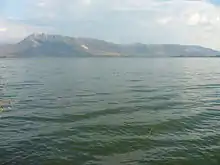
Mavrochori (Greek: Μαυροχώρι(οv) meaning "black village"; formerly Mavrovon, Μαύροβον[1]) is a village in Greece near Kastoria on the shores of Kastoria lake which was in existence at least from 1380[2] and is denoted, under the name Mavrovo, in the British Baldwin & Craddock Map of Greece which was published on 1 January 1830 (printed by a printer at 47 Paternoster Row, London).[3]
The name Mavros, together with the name Krepeni, is found in a title deed executed by Serbian nobleman Nikola Bagaš.[4]
History
In the end of the 18th century the patriarch of the Mavrovitis family moved his people from the nearby Krepeni village to Mavrochori in order to avoid a plague pandemic, and it is believed that people were frequently moving between Krepeni and Mavrovo.[2]
The Monastery of Mavriotissa, originally named Mesonisiotissa (meaning "in the middle of the island"), was built near the village.[2]
Mavrovo had a historical relationship with both the Mavriotissa monastery as well as with the nearby village of Krepeni.[2]
References
- Pandektis: Name Changes of Settlements in Greece, Retrieved on October 2, 2012, compiled by the Institute for Neohellenic Research
- "Jason C. Mavrovitis, Out of the Balkans, Pt.1, Ch.2, p.29". www.pahh.com. Retrieved 2021-07-04.
- "Map of the Balkan Peninsula".
- Nicholas K. Moutsopoulos, Kastoria, the Virgin of Mavriotissa (Athens: Friends of Byzantine and Ancient Monuments of Kastoria, 1967), 85. Cited in http://www.pahh.com/mavrovitis/ch2/chapter2b.html