Metaxytherium
Metaxytherium is an extinct genus of dugong that lived from the Miocene until the end of the Pliocene. Fossil remains have been found in Africa, Asia, Europe, North America (Güines and Lagunitas Formations, Cuba, Florida, California, Virginia, Maryland and South Carolina, United States), and South America (Paraná Formation, Argentina, Pirabas Formation, Brazil and Montera Formation, Peru).[2][3][4]
| Metaxytherium | |
|---|---|
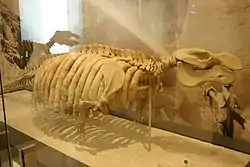 | |
| M. floridanum fossil | |
| Scientific classification | |
| Kingdom: | |
| Phylum: | |
| Class: | |
| Order: | |
| Family: | |
| Genus: | Metaxytherium De Christol 1840 |
| Species | |
Taxonomy
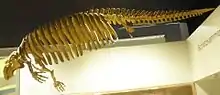
There are eight species of Metaxytherium recognized as valid: M. albifontanum, M. arctodites, M. crataegense, M. floridanum, M. krahuletzi, M. medium, M. serresii, and M. subapenninum.
The genus Thalattosiren Sickenberg 1928 was once thought to be distinct from Metaxytherium, but is now considered a junior synonym of M. medium.[5]
Evolution
The relict species M. subapenninum represents the last stage of evolution of Metaxytherium, showing an increase in body size and in tusk size and a rostral reinforcement responding to a long-term climatic cooling.[6][7] These aquatic herbivores lived in warm coastal waters and inland waterways, feeding on seagrass.[8][9] Metaxytherium subapenninum, which has the distinct for being the youngest species, as well as being the last known species, of Metaxytherium in the fossil record, lived in the early and late Pliocene of Italy and Spain (age range: 3.6 to 2.588 million years ago).[8] It is the only species of sirenians that lived in the northwestern coasts of the Mediterranean Sea in the Pliocene. It disappeared from the Mediterranean around 3 million years ago because of the progressive climate cooling. Fossils of these dugongs have been found, from the second half of the nineteenth century, in Piedmont, Emilia-Romagna, Liguria and Tuscany.[10][11][12][13][14] It most likely went extinct due to climate change and changes in its ecosystem.[15][16]
Paleobiology
Metaxytherium lived in coastal waters and inland waterways, and there is evidence that they were preyed on by sharks, specifically tiger sharks, Hemipristis serra, and Megalodon.[17][18][19][20][21] According to the University of Florida, Metaxytherium floridanum was one of the most common mammals found in Florida during the Neogene.[22][9][23] Remains of M. floridanum can usually be found in the phosphate mines of Central Florida.[24][9][25]
Diet
Much like the modern day manatees and dugongs, Metaxytherium ate sea grass.[26]
References
- Jorge Vélez-Juarbe and Daryl P. Domning (2014). "Fossil Sirenia of the West Atlantic and Caribbean region. Ix. Metaxytherium albifontanum, sp. nov.". Journal of Vertebrate Paleontology 34 (2): 444–464. doi:10.1080/02724634.2013.799072.
- Hay, Oliver Perry (1922). "Description of a new fossil sea cow from Florida, Metaxytherium floridanum". Proceedings of the United States National Museum. 61 (2438): 1–4. doi:10.5479/si.00963801.61-2438.1. ISSN 0096-3801.
- Sorbi, Silvia; Domning, Daryl P.; Vaiani, Stefano Claudio; Bianucci, Giovanni (May 2012). "Metaxytherium subapenninum(Bruno, 1839) (Mammalia, Dugongidae), the latest sirenian of the Mediterranean Basin". Journal of Vertebrate Paleontology. 32 (3): 686–707. doi:10.1080/02724634.2012.659100. ISSN 0272-4634. S2CID 84318304.
- Domning, Daryl P. (1988). "Fossil Sirenia of the West Atlantic and Caribbean Region. I. Metaxytherium floridanum Hay, 1922". Journal of Vertebrate Paleontology. 8 (4): 395–426. doi:10.1080/02724634.1988.10011728. ISSN 0272-4634. JSTOR 4523227.
- D. P. Domning and P. Pervesler. 2012. The sirenian Metaxytherium (Mammalia: Dugongidae) in the Badenian (Middle Miocene) of Central Europe. Austrian Journal of Earth Sciences 105(3):125-160
- Sorbi, Silvia; Domning, Daryl P.; Vaiani, Stefano Claudio; Bianucci, Giovanni (2012). "Metaxytherium subapenninum(Bruno, 1839) (Mammalia, Dugongidae), the latest sirenian of the Mediterranean Basin". Journal of Vertebrate Paleontology. 32 (3): 686–707. doi:10.1080/02724634.2012.659100. S2CID 84318304.
- Velez-Juarbe, Jorge; Domning, Daryl P.; Pyenson, Nicholas D. (2012-02-03). "Iterative Evolution of Sympatric Seacow (Dugongidae, Sirenia) Assemblages during the Past ∼26 Million Years". PLOS ONE. 7 (2): e31294. Bibcode:2012PLoSO...731294V. doi:10.1371/journal.pone.0031294. ISSN 1932-6203. PMC 3272043. PMID 22319622.
- Paleobiology Database
- MacFadden, Bruce J.; Higgins, Pennilyn; Clementz, Mark T.; Jones, Douglas S. (June 2004). <0297:dhpand>2.0.co;2 "Diets, habitat preferences, and niche differentiation of Cenozoic sirenians from Florida: evidence from stable isotopes". Paleobiology. 30 (2): 297–324. doi:10.1666/0094-8373(2004)030<0297:dhpand>2.0.co;2. ISSN 0094-8373.
- GAMPS La sirena Plioenica
- Paleontologia: trovato fossile sirenio di 5 milioni anni fa
- La Nazione - Ha 5 milioni di anni il fossile trovato nel grossetano
- Quando inMaremma nuotavano le mucche di mare
- Il Tirreno - Scoperto lo scheletro di una "sirena" di cinque milioni di anni fa
- Dornbos, Stephen Q.; Wilson, Mark A. Wilson (1999-07-12). "Paleoecology of a Pliocene coral reef in Cyprus: Recovery of a marine community from the Messinian Salinity Crisis". Neues Jahrbuch für Geologie und Paläontologie - Abhandlungen. 213 (1): 103–118. doi:10.1127/njgpa/213/1999/103. ISSN 0077-7749.
- SORBI, SILVIA; DOMNING, DARYL P.; VALANI, STEFANO CLAUDIO; BIANUCCI, GIOVANNI (2012). "Metaxytherium Subapenninum (Bruno, 1839) (Mammalia, Dugongidae), the Latest Sirenian of the Mediterranean Basin". Journal of Vertebrate Paleontology. 32 (3): 686–707. doi:10.1080/02724634.2012.659100. ISSN 0272-4634. JSTOR 41515288. S2CID 84318304.
- "METAXYTHERIUM TUSK FOSSILS". Paleo Direct, Inc. Archived from the original on 6 June 2013. Retrieved 26 June 2013.
- "14.5 million-year-old shark-attack on manatee documents oldest predator-prey interaction". idw - Informationsdienst Wissenschaft e.V. (in German). 2021-04-06. Retrieved 2021-06-15.
- "Clarendonian North American Land Mammal Age". Florida Museum. 2017-03-28. Retrieved 2021-06-15.
- "Region 1 National Capital Area Natural History Collections, National Park Service". www.nps.gov. Retrieved 2021-06-15.
- "Dugongs and Megalodon Sharks in the National Capital Area (U.S. National Park Service)". www.nps.gov. Retrieved 2021-06-15.
- Rojas, Alexis; Hulbert Jr., Richard C.; Valdes, Natali (March 2, 2015). "Metaxytherium floridanum". Florida Museum. Florida Museum of Natural History Gainesville, FL 32611: University of Florida. Retrieved 19 April 2021.CS1 maint: location (link)
- Allen, Glover M. (1923). "Additional Remains of the Fossil Dugong of Florida". Journal of Mammalogy. 4 (4): 231–239. doi:10.2307/1373704. ISSN 0022-2372. JSTOR 1373704.
- www.fossilexpeditions.com http://www.fossilexpeditions.com/findsdug.htm. Retrieved 2021-06-15. Missing or empty
|title=(help) - "Palmetto Fauna". Florida Museum. 2017-03-27. Retrieved 2021-06-15.
- MacFadden, Bruce J.; Higgins, Pennilyn; Clementz, Mark T.; Jones, Douglas S. (2004). "Diets, Habitat Preferences, and Niche Differentiation of Cenozoic Sirenians from Florida: Evidence from Stable Isotopes". Paleobiology. 30 (2): 297–324. doi:10.1666/0094-8373(2004)030<0297:DHPAND>2.0.CO;2. ISSN 0094-8373. JSTOR 4096848.
Further reading
- Manatees and Dugongs of the World by Jeff Ripple
- Discovering Fossils: How to Find and Identify Remains of the Prehistoric Past (Fossils & Dinosaurs) by Frank A. Garcia, Donald S. Miller, and Jasper Burns
- Encyclopedia of Marine Mammals by William F. Perrin, Bernd Wursig, and J. G.M. Thewissen
- Marine Mammals: Evolutionary Biology by Annalisa Berta, James L. Sumich, and Kit M. Kovacs
- Marine Mammal Biology: An Evolutionary Approach by A. Rus Hoelzel
- Neptune's Ark: From Ichthyosaurs to Orcas by David Rains Wallace
- Classification of Mammals by Malcolm C. McKenna and Susan K. Bell
External links
Sirenian genera | ||||||||||||||||||||||
|---|---|---|---|---|---|---|---|---|---|---|---|---|---|---|---|---|---|---|---|---|---|---|
| ||||||||||||||||||||||
|  | |||||||||||||||||||||