Mihrimah Sultan Mosque, Edirnekapı
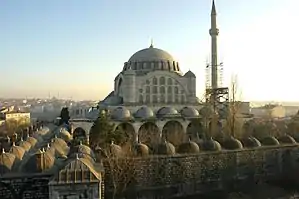
The Mihrimah Sultan Mosque is a 16th-century Ottoman mosque located in the Edirnekapı neighborhood near the Byzantine land walls of Istanbul, Turkey. It was commissioned by Mihrimah Sultan, the daughter of Suleiman the Magnificent and designed by the chief imperial architect Mimar Sinan. Sited on the peak of the Sixth Hill near the highest point of the city, the mosque is a prominent landmark in Istanbul.
| Mihrimah Sultan Mosque, Edirnekapı | |
|---|---|
 | |
| Architecture | |
| Architect(s) | Mimar Sinan |
| Type | Mosque |
| Groundbreaking | c. 1563 |
| Completed | c. 1570 |
| Specifications | |
| Dome height (outer) | 37 meters (121 ft) |
| Dome dia. (outer) | 20 meters (66 ft) |
| Minaret(s) | 1 |
| Materials | granite, marble |
History
The Mihrimah Sultan Mosque in Edirnekapı is the second and larger of two mosques named and commissioned by Mihrimah Sultan, the very loved only daughter of Suleiman the Magnificent. Her name and name of the mosque means sun and moon which is important in muslim religion. It was designed by Mimar Sinan. There is no foundation inscription on the mosque but the evidence from surviving manuscripts suggests that the building work started in 1563 and was completed by 1570.[1] On several occasions the mosque has been damaged by earthquakes. In 1719 some of the stairs in the minaret were destroyed; in 1766, the earthquake of that year let collapse the minaret and the main dome of the mosque;[2] in the severe 1894 earthquake the minaret collapsed again and came crashing down on the north west corner of the mosque.[3][lower-alpha 1] Although efforts were made to restore the mosque itself, its attendant buildings received less attention. The dome was further damaged during 1999 İzmit earthquake. In the first phase of the restoration undertaken between 2007 and 2010 the mosque and the upper part of the minaret were repaired.[5][6] The second phase involved paving the courtyard, restoring the central fountain and rebuilding an outer portico. The mosque originally had a double portico but only the inner part had survived.[7]
Architecture
Exterior
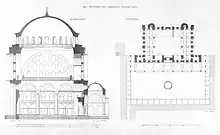
The mosque was built on a terrace overlooking the main street. A large courtyard (avlu) whose interior portico is divided into individual cells forming a madrasah surrounds the mosque. In the center of the courtyard is a large ablution fountain (sadirvan). Entry to the mosque is through an imposing porch of seven domed bays with marble and granite columns.[8] The mosque itself is a cube topped by a half-sphere, with symmetrical multi-windowed tympana on each of the four sides. The dome is supported by four towers, one in each corner; its base is pierced by windows. The single minaret is tall and slender; during the 1894 earthquake it crashed through the roof of the mosque. After the crash it was fully restored.
There's heavy usage of domes this shows they are seen as being of great importance, they also make it a point to have domes encircling the mosque's courtyard, with seven of them located there. [9]The frame of the arches are thick with walls between them, though they have low capability to hold the weight of the building. [10]
Last restored in 1956 and 1957.
Interior
_Interior.jpg.webp)
The dome is 20 metres (66 feet) in diameter and 37 metres (121 feet) high.[11] On the north and south sides, triple arcades supported by granite columns open onto side aisles with galleries above, each with three domed bays. A vast amount of surface area is covered by windows, making the mosque one of the brightest lit of any of Sinan's works and easily allows light to really be magnified throughout the building. [12]Some of the windows contain stained glass.
The interior stencil decorations are all modern. However, the mimbar in carved white marble is from the original construction.
Complex
As built, the Mihrimah Sultan Mosque had a külliye which included (besides madrasah) a double hammam, türbe and a low row of shops under the terrace upon which the mosque was built, whose rents were intended to financially support the mosque complex.
The complex does not include the grave of Mihrimah Sultana herself (which is located at the Süleymaniye Mosque, but a ruined türbe (which is also a work of Sinan) behind the mosque houses the graves of her son-in-law, Grand Vizier Semiz Ali Pasha, daughter Ayşe Hümaşah Sultan, grandsons Mehmed Bey, Şehid Mustafa Pasha and Osman Bey as well as many other members of her family.
Gallery
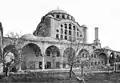 Damage after the 1894 earthquake, Gurlitt 1912
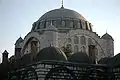 Dome
Dome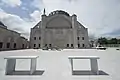 Edirne Gate aka Mihrimah Sultan Mosque from east side
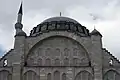 Edirne Gate aka Mihrimah Sultan Mosque dome
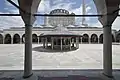 Edirne Gate aka Mihrimah Sultan Mosque courtyard
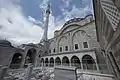 Edirne Gate aka Mihrimah Sultan Mosque south side with graveyard
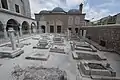 Edirne Gate aka Mihrimah Sultan Mosque graveyard
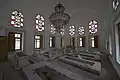 Edirne Gate aka Mihrimah Sultan Mosque interior mausoleum
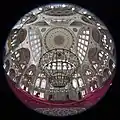 Edirne Gate aka Mihrimah Sultan Mosque interior
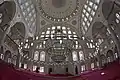 Edirne Gate aka Mihrimah Sultan Mosque interior
 Edirne Gate aka Mihrimah Sultan Mosque panorama
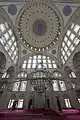 Edirne Gate aka Mihrimah Sultan Mosque prayer area and mosque
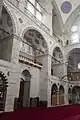 Edirne Gate aka Mihrimah Sultan Mosque entrance from courtyard
 Edirne Gate aka Mihrimah Sultan Mosque view from nearby square
Notes
- The German art historian Cornelius Gurlitt includes a photograph showing the damaged mosque and the collapsed minaret in his 1912 book Die Baukunst Konstantinopels.[4]
References
- Necipoğlu 2005, pp. 306–307.
- Müller-Wiener 1977, p. 441.
- Goodwin 2003, p. 253.
- Gurlitt 1912, Fig. 20a.
- Sav & Kuşüzümü 2010.
- Sav & Kuşüzümü 2014.
- Kuşseven 2014.
- Freely, Blue Guide Istanbul
- "The Mihrimah Sultan Mosque, Edirnekapi". ExploreTurkey.com. Retrieved 2021-12-07.
- "Archnet". www.archnet.org. Retrieved 2021-12-07.
- Goodwin 2003, p. 255.
- "The Mihrimah Sultan Mosque, Edirnekapi". ExploreTurkey.com. Retrieved 2021-12-07.
Sources
- Goodwin, Godfrey (2003) [1971]. A History of Ottoman Architecture. London: Thames & Hudson. ISBN 978-0-500-27429-3.
- Gurlitt, Cornelius (1912). Die Baukunst Konstantinopels. Volume 2. Berlin: E. Wasmuth.
|volume=has extra text (help) - Kuşseven, Gamze (2014). "Edirnekapı Mihrimah Sultan Külliyesi'ne Bağlı Yapıların Son Restorasyonlarına Ait Uygulamalar" [The latest restoration works of buildings of the Minrimah Sultan Complex in Edirnekapı]. Restorasyon Yıllığı Dergisi (in Turkish). 9: 80–88. hdl:11352/2133.
- Müller-Wiener, Wolfgang (1977). Bildlexikon Zur Topographie Istanbuls: Byzantion, Konstantinupolis, Istanbul Bis Zum Beginn D. 17 Jh (in German). Tübingen: Wasmuth. ISBN 978-3-8030-1022-3.
- Necipoğlu, Gülru (2005). The Age of Sinan: Architectural Culture in the Ottoman Empire. London: Reaktion Books. ISBN 978-1-86189-253-9.
- Sav, Murat; Kuşüzümü, Kıvanç H. (2010). "Restorasyon Çalışmaları Çerçevesinde Mihrimah Sultan Camii". Restorasyon Yıllığı Dergisi (in Turkish). 1: 46–55. hdl:11352/237.
- Sav, Murat; Kuşüzümü, Kıvanç H. (2014). "Mihrimah Sultan Camii'ndeki Son Restorasyon Çalışmalarının Değerlendirmesi" [Remarks on the latest restoration works of the Mihrimah Sultan Mosque]. Restorasyon Yıllığı Dergisi (in Turkish). 9: 52–63. hdl:11352/2130.
Further reading
- Köse, Fatih (2014). "Arşiv Belgelerine Göre Edirnekapı Mihrimah Sultan Camii Tamirleri ve Onarımları" [Repair and renovation of Edirnekapi Mihrimah Sultan Mosque with reference to archive documents]. Restorasyon Yıllığı Dergisi (in Turkish). 9: 24–33. hdl:11352/2128.
External links
- Mihrimah Sultan Complex at Edirnekapi, Archnet.
- Photographs of the Mihrimah Sultan Mosque in Edirnekapı by Dick Osseman
| Neighbourhoods |
|
|---|---|
| Quarters |
|
| Landmarks | |
| Transport | |
| Education | |
| |



.svg.png.webp)
Authority control  | |
|---|---|
| General | |
| National libraries | |