Mihrimah Sultan Mosque, Üsküdar
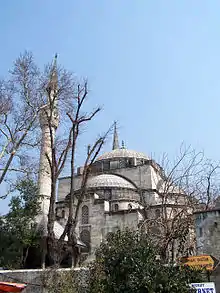
The Mihrimah Sultan Mosque (Iskele Mosque, Jetty Mosque, Üsküdar Quay Mosque, Turkish: Mihrimah Sultan Camii, İskele Camii) is a 16th century Ottoman mosque located in the historic center of the Üsküdar district of Istanbul, Turkey. The Mihrimah Sultan Mosque is one of Üsküdar's best-known landmarks and takes its nicknames from the ferry landing near which it stands.
| Mihrimah Sultan Mosque | |
|---|---|
 | |
| Religion | |
| Affiliation | Sunni Islam |
| Location | |
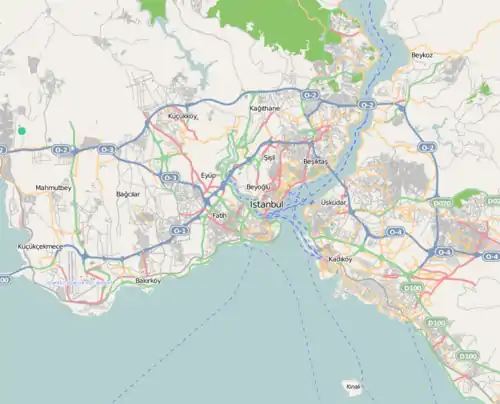
| Location | Istanbul, Turkey |
  Shown within Istanbul | |
| Geographic coordinates | 41°01′36″N 29°00′58″E |
| Architecture | |
| Architect(s) | Mimar Sinan |
| Type | Mosque |
| Groundbreaking | c. 1543-44 |
| Completed | 1548 |
| Specifications | |
| Dome height (outer) | 24.2 m (79 ft) |
| Dome dia. (outer) | 11.4 m (37 ft) |
| Minaret(s) | 2 |
| Materials | ashlar |
History
The Mihrimah Sultan Mosque in Üsküdar has the smaller dome and is the earlier of the two Friday mosques in Istanbul commissioned by Mihrimah Sultan, daughter of Sultan Suleiman the Magnificent and wife of Grand Vizier Rüstem Pasha. It was designed by the imperial architect Mimar Sinan and built between 1543-44 and 1548.[1]
Architecture
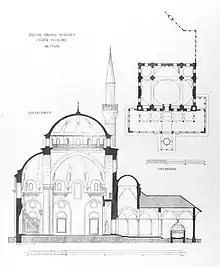
It is a massive structure on a raised platform and already shows several hallmarks of Sinan's mature style: a spacious, high-vaulted basement, slender minarets, a single-domed baldacchino flanked by three semi-domes ending in three exedrae and a broad double portico.
Mimar Sinan
Mimar Sinan was the chief imperial architect to multiple sultans, the construction of this mosque set the aesthetic techniques for his later developments. The half domes and attention to small ornamental design became his signature style, making the architect easily recognizable. The housing of two very slender minarets, minbar, and ablution fountain makes it directly correlate to Islamic Architecture.
Dome
Sinan constructed numerous unique structures and experimented throughout his designs. One notable feature that remained the same was the central dome, purposefully done to be the primary focus next to the suspended curved arches and piers. [2] Additionally, the use of pendentives were deployed in the building to help in the construction of the dome, as it does not sit on the walls. [3] The open interior of this Ottoman mosque is nondirectional much similar to that of byzantine Churches and early domed buildings of the Romans.[4]
Women as Architectural Patrons
Social and cultural aspects restricted royal sultan women from public nature; with the ability to inherit property, architecture became prominent in showcasing royal status to their subjects.[5]
Materials Used
The Mihrimah Sultan Mosque exterior is composed of ashlar, a thin dressed stone of gray to cream color. While its interior houses imported craved marble that surrounds its walls and minbar.[6]
_(19).jpg.webp)
_(31).jpg.webp)
_(12).jpg.webp)
_(32).jpg.webp)
Gallery
 Üsküdar Mihrimah Sultan İskele Mosque
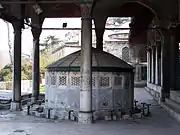 Ablution fountain
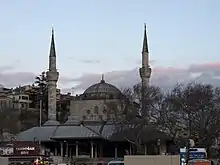 The frontal view
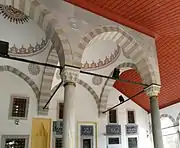 Mosque detail
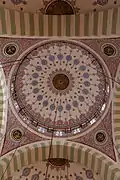 Interior view of the dome
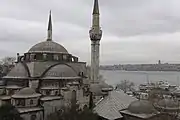 Mihrimah Sultan Mosque Uskudar from hill behind
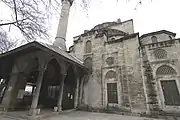 Mihrimah Sultan Mosque Uskudar from the west
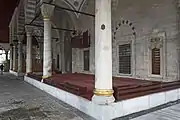 Mihrimah Sultan Mosque Uskudar son cemaat area
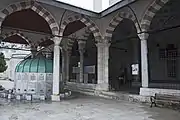 Mihrimah Sultan Mosque Uskudar with ablutions fountain
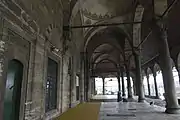 Mihrimah Sultan Mosque Uskudar son cemaat part
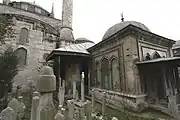 Mihrimah Sultan Mosque Uskudar from graveyard
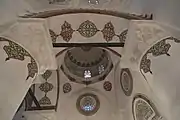 Mihrimah Sultan Mosque Uskudar dome
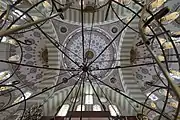 Mihrimah Sultan Mosque Uskudar domes
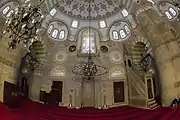 Mihrimah Sultan Mosque Uskudar minber and mihrab
 Mihrimah Sultan Mosque Uskudar window
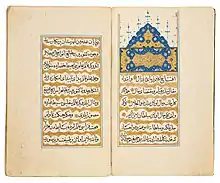 Endowment Deed of Mihrimah Sultan. This document concerns the endowment of properties in Anatolia and Rumelia, from which revenues were to be used to meet the expenses of the Mihrimah Sultan Mosque. April-March 1550. Sadberk Hanım Museum

References
- Necipoğlu 2005, p. 301.
- Erarslan, Alev. "An essay on Byzantine architectural influence on the spatial organization of the Architect Sinan's square baldachin single-domed mosques" (PDF): 167. Cite journal requires
|journal=(help) - Kuran, Aptullah. The Mosques In Early Ottoman Architecture. The University of Chicago Press, Chicago and London. p. 60.
- Gebhard, D. "The problem of space in the ottoman mosque". ProQuest 1296200159. Cite journal requires
|journal=(help) - Thys-Senocak, Lucienne. Ottoman Women Builders. Koc University, Turkey. p. 55.
- Rogers, J. M. (1982). "The State and the Arts in Ottoman Turkey Part 1. The Stones of Suleymaniye". International Journal of Middle East Studies. 14 (1): 71–86. doi:10.1017/S0020743800026593. JSTOR 163335.
Sources
- Necipoğlu, Gülru (2005). The Age of Sinan: Architectural Culture in the Ottoman Empire. London: Reaktion Books. ISBN 978-1-86189-253-9.
External links
 |
Wikimedia Commons has media related to Mihrimah Sultan Mosque (Üsküdar). |
- Photographs of the Mihrimah Sultan Mosque by Dick Osseman
- Mihrimah Sultan Külliyesi at Üsküdar, Archnet


.svg.png.webp)