Moero! Nekketsu Rhythm Damashii Osu! Tatakae! Ouendan 2
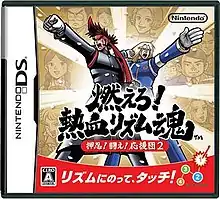
Moero! Nekketsu Rhythm Damashii: Osu! Tatakae! Ouendan 2[lower-alpha 1] is a rhythm video game developed by iNiS and published by Nintendo for the Nintendo DS handheld video game console.[1] It is the third of three rhythm games developed by iNiS for the DS, and is the sequel to Osu! Tatakae! Ouendan while incorporating many of the improvements in gameplay made in its international counterpart, Elite Beat Agents. The game has 4-player wireless play,[2] supports the Nintendo DS Rumble Pak accessory, and was released in Japan on May 17, 2007.[3]
| Moero! Nekketsu Rhythm Damashii: Osu! Tatakae! Ouendan 2 | |
|---|---|
 | |
| Developer(s) | iNiS |
| Publisher(s) | Nintendo |
| Designer(s) | Keiichi Yano |
| Series | |
| Engine | Osu! Tatakae! Ouendan engine |
| Platform(s) | Nintendo DS |
| Release |
|
| Genre(s) | Rhythm |
| Mode(s) | Single-player, multiplayer |

Storyline
Moero! Nekketsu Rhythm Damashii follows more or less the storyline from the original Osu! Tatakae! Ouendan, and is set roughly six years after the original game based on the game manual and the age differences of returning characters. Players act as the leader of a three-person cheerleading squad. Whenever someone is stressed out or backed into a corner, all they need to do is shout "Ouendan!" (Japanese for "Cheer Squad"). Then, the Ouendan appear (usually out of a place like a closet or waiting there while eating ramen) and use cheering and dance to help that someone through their troubles. The map of the territory that the Ouendan patrol within Moero! Nekketsu Rhythm Damashii is the same as that found in the original game, although it has been turned ninety degrees and is now rendered using 3D graphics.
The original Ouendan from the Yuuhi Town (signified by wearing their long Gakuran jackets and for the Cheergirls, signified by wearing their blue cheer outfits) are still present in this game, cheering people on. However, a new rival Ouendan from the Asahi Town appear that challenge the original Ouendan in skill and cheering (the "new" Ouendan are signified by their blue military-style outfits and for the Cheer Maidens, signified by wearing their modest red cheer outfits.) The individual stories are all unrelated, but characters featured in one stage may appear as background or supporting characters in another. One can also see characters from the first Ouendan game as lead, supporting or background characters, such as the pottery maker from the first game that appears as a guest at a hot springs, and gifts the hot springs family with new pottery work should the player be successful in the stage. In the final stage, broken into two parts like that of Agents, all of the characters in the game unite when the two Ouendan join together and once again lead the entire world in a cheer to save Earth when the sun's activity stops, plunging Earth into another ice age.
Gameplay
As in the original game, this sequel is played almost entirely via touch screen (the only actual button used is the Start button for pausing the game). The player acts as the Ouendan, who cheer on the people that are in turmoil and shout out for them (the original "Black" Ouendan control the west side of that world, Yūhi Town, and the new "Blue" Ouendan control the east side, Asahi Town.) The gameplay plays out identically to that found in the first Ouendan; the player must tap colored circles in precise time with the music in order to cheer the character through his or her problems. There are three types of marker:
- Hit Markers: These need to be tapped to the beat.
- Phrase Markers: When this is tapped, the stylus must be held down and follow a ball sliding along a track. If an arrow appears at the end of the track, the player must run the stylus back in the opposite direction.
- Spin Markers: At certain points, a large wheel appears. Players must spin the wheel by making circular motions on the screen (either direction will do.) Once the required amount of spin has been cleared, further spinning will earn bonus points.
The top screen displays the stage's protagonist overcoming his or her dilemma. If the player's cheering is good, then the meter at the top of the touch screen stays in the yellow, and the character is seen triumphing over whatever it is holding him or her back. If the player's cheering is bad, then the meter on the top of the screen falls to the red and the character struggles. If the player's performance is particularly poor, the meter will hit the bottom and the mission will end in failure. Then, the player can either try again, quit to do something else, or review the last five seconds of gameplay up to where he or she lost.
At intervals in the song, the story progresses on the top screen. If the meter remains in the yellow, then the story will progress positively (scoring an "O") and if the meter is in the red, it will progress negatively (scoring an "X"). The number of Os and Xs given will determine the story's outcome from one of three possibilities: a good ending, which results in a special illustration, an average ending, or a bad ending. The final two levels do not adhere to this pattern.
Moero! Nekketsu Rhythm Damashii contains multiple enhancements over the original game, many of which were first featured in Elite Beat Agents. These features include the ability to save stage replay data and use it later in a "ghost versus" mode, 4-player wireless play, Rumble Pak compatibility, multiple stage endings depending on the player's performance, and the ability to skip intro and epilogue sections of each stage. Also, as the player earns new ranks by achieving cumulative high score totals across all stages and difficulties, three additional bonus stages are unlocked when specific ranks are earned.
Brand-new features introduced to the series for the first time in Moero! Nekketsu Rhythm Damashii include improvements to replay management, namely the removal of Elite Beat Agents' one replay per mission restriction, an increase of the replay storage limit from 19 to 20 and the inclusion of the option to delete individual replays (which can otherwise only be done with a drastic factory reset that erases all the others in Agents). Moreover, on the easiest difficulty, the player can continue a failed stage from the point the failure occurred, beginning with half of the life bar. It is also possible to unlock a mode in which the game's timer circles/markers are disabled, forcing the player to hit the markers with only the rhythm of the music as a guide. On the Kigaru ni Ōen mode, only the timer circles are missing. On all other difficulty levels, the whole marker disappears, and as the player moves up the difficulty levels, the markers disappear faster. The game also includes an unlockable gallery featuring pictures of the various cheer teams unlocked each time a specific player rank is reached, the "end of stage" images, and the Story mode scenes. The multiplayer mode has also been upgraded, as players are now allowed to use the male cheerleaders on Karei ni Ōen mode. They retain their male animations, except their dancing corresponds to the positioning of the Very Hard markers. Likewise, the player is allowed to use a Cheer Girl on the easier difficulties, retaining the female moves, but the dances correspond to the male markers. As well as being able to skip song intros, players can now skip the ending sequence of songs they have previously completed.
Elite Beat Agents mode
Between June 28 and July 11, 2007, players could use a Japanese DS Download Station to unlock downloadable content based on Elite Beat Agents, which can also be achieved with a cheat device, such as Action Replay. It consists of skins of the Elite Beat Agents and Elite Beat Divas for the 3-D models of dancing Ouendan on the touch screen, as well as two new multiplayer characters, Agent J and the Ramen Shop Cat in the first Ouendan game,[4] the former which is used in the campaign and is toggled on or off when selecting its difficulty level. In the campaign's final mission, which is performed simultaneously by the leaders of both Ouendan, the Yuhi Town Ouendan leader is replaced with their equivalent Elite Beat Agents leader, while the Asahi Town Ouendan leader is replaced by the Ramen Shop Cat, who sports their hairstyle. The Elite Beat Agents skins have the same animation as the Ouendan they replace, but the Agents keep their right hands closed to hold their signature microphones.
Canceled sequel
Years after the release of Ouendan 2, iNiS approached Nintendo to discuss the possibility of making a third Ouendan game for the Nintendo 3DS, but Nintendo declined to green-light it for business reasons,[5] including the poor sales of the two Ouendan games and Agents.
Notes
References
- "『押忍!闘え!応援団2』発売決定! 任天堂発売スケジュール更新". Dengeki Online. MediaWorks. 2007-02-21. Retrieved 2007-02-21.
- Joystiq - Elite Beat Agents sequel is on (oh yes)
- Ouendan 2 Coming Next Month
- Kohler, Chris (21 June 2007). "Unlock Elite Beat Agents in Ouendan 2". WIRED. Retrieved 3 September 2021.
- https://gamingreinvented.com/news/new-video-shows-history-of-ouendan-and-elite-beat-agents/