Moor macaque
The moor macaque (Macaca maura) is a macaque with brown/black body fur with a pale rump patch and pink bare skin on the rump. It is about 50–58.5 cm long, and eats figs, bamboo seeds, buds, sprouts, invertebrates and cereals in tropical rainforests. It is sometimes called "dog-ape" because of its dog-like muzzle, although it is no more closely related to apes than any other Old World monkey is. It is endemic to the island of Sulawesi in Indonesia.
| Moor macaque[1] | |
|---|---|
.jpg.webp) | |
Scientific classification  | |
| Kingdom: | Animalia |
| Phylum: | Chordata |
| Class: | Mammalia |
| Order: | Primates |
| Suborder: | Haplorhini |
| Infraorder: | Simiiformes |
| Family: | Cercopithecidae |
| Genus: | Macaca |
| Species: | M. maura |
| Binomial name | |
| Macaca maura (H.R. Schinz, 1825) | |
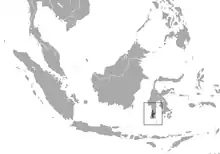 | |
| Moor macaque range | |

The moor macaque is threatened mostly due to habitat loss from an expanding human population and deforestation to increase agricultural land area. The population is estimated to have decreased from 56,000 in 1983 to under 10,000 in 1994.[3] In 1992, Supriatna et al. 1992 conducted an extensive survey and found 6.3–63.2 individuals/km².[2][4]
References
- Groves, C. P. (2005). Wilson, D. E.; Reeder, D. M. (eds.). Mammal Species of the World: A Taxonomic and Geographic Reference (3rd ed.). Baltimore: Johns Hopkins University Press. pp. 162–163. ISBN 0-801-88221-4. OCLC 62265494.
- Supriatna, J.; Shekelle, M. & Burton, J. (2008). "Macaca maura". The IUCN Red List of Threatened Species. IUCN. 2008: e.T12553A3356200. doi:10.2305/IUCN.UK.2008.RLTS.T12553A3356200.en.
- Evans, B. J.; Supriatna, J.; Melnick, D. J. (2001). "Hybridization and population genetics of two macaque species in Sulawesi, Indonesia". Evolution. The Society for the Study of Evolution. 55 (8): 1688. doi:10.1111/j.0014-3820.2001.tb00688.x. PMID 11580028.
- Supriatna, Jatna; Froehlich, Jeffrey W.; Erwin, Joseph M.; Southwick, Charles H. (1992). "Population, habitat and conservation status of Macaca maurus, Macaca tonkeana and their putative hybrids". Tropical Biodiversity. 1 (1): 31–48.
