Morong, Bataan
Morong, officially the Municipality of Morong (Tagalog: Bayan ng Morong; Kapampangan: Balen ning Morong), is a 3rd class municipality in the province of Bataan, Philippines. According to the 2020 census, it has a population of 35,394 people. [3]
Morong | |
|---|---|
| Municipality of Morong | |
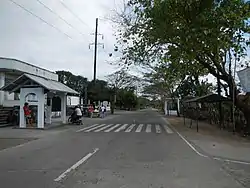 Downtown area | |
 Seal | |
| Nickname(s): Bataan's Wild West | |
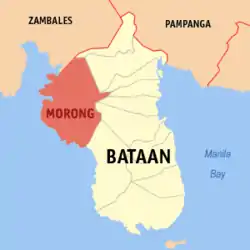 Map of Bataan with Morong highlighted | |
OpenStreetMap 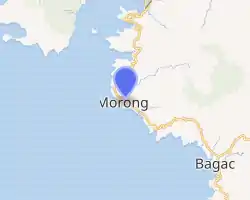
| |
.svg.png.webp)  Morong Location within the Philippines | |
| Coordinates: 14°40′48″N 120°16′06″E | |
| Country | Philippines |
| Region | Central Luzon |
| Province | Bataan |
| District | 3rd district |
| Barangays | 5 (see Barangays) |
| Government | |
| • Type | Sangguniang Bayan |
| • Mayor | Cynthia L. Estanislao |
| • Vice Mayor | Jose T. Calma Jr. |
| • Representative | Geraldine B. Roman |
| • Municipal Council | Members |
| • Electorate | 21,107 voters (2019) |
| Area | |
| • Total | 219.20 km2 (84.63 sq mi) |
| Elevation | 24 m (79 ft) |
| Highest elevation | 208 m (682 ft) |
| Lowest elevation | 0 m (0 ft) |
| Population | |
| • Total | 35,394 |
| • Density | 160/km2 (420/sq mi) |
| • Households | 6,828 |
| Economy | |
| • Income class | 3rd municipal income class |
| • Poverty incidence | 15.01% (2015)[4] |
| • Revenue | ₱223,076,257.90 (2020) |
| • Assets | ₱496,915,506.41 (2020) |
| • Expenditure | ₱192,052,314.77 (2020) |
| Service provider | |
| • Electricity | Peninsula Electric Cooperative (PENELCO) |
| Time zone | UTC+8 (PST) |
| ZIP code | 2108 |
| PSGC | |
| IDD : area code | +63 (0)47 |
| Native languages | Mariveleño Tagalog |
The municipality is home to the Subic Bay International Airport, the Bataan Nuclear Power Plant, and the former Philippine Refugee Processing Center. Morong was formerly known as Moron.[5] It is accessible via the Bataan Provincial Expressway, off Exit 65.
History

Morong, originally called Bayandati, was a small settlement located in Barrio Nagbalayong.[6] Due to the scarcity of land available for cultivation, the early inhabitants migrated to adjacent areas where wider lands can be discovered. They found Poblacion, the present site where the Spaniards met the natives of Moron.
Folkloric tradition alludes the etymology of the name Moron to the Spaniards' mishearing of the phrase "mga Moro umurong" when they asked the local people the name of their village. While there are many records of Muslim led slave-raiding expeditions in the 18th and 19th Century, there is no record of slave raiding incidents in that area. The problem of slave raiding did however influence the architecture of the Morong Church, which was build as a church-fortress.
The most probable etymology comes from the Spanish word morón which refers to a hill which can be seen from the sea. Several towns in Spain and in Spanish colonies are also named Morón, namely Morón in Cuba; Morón de la Fronterra in Sevilla, Spain; and Morón in Buenos Aires, Argentina. These place all have hilly topographies and are nearby the ocean.
Establishment of the Town by the Augustinian Order of Recollects
The Augustinian Order of Recollects (AOR) arrived in the Philippines in 1606 and a year later, in 1607, they have began mission work in Zambales. By 1612, the AOR claimed and organized 12 communities in the surrounding area into towns each with small churches and convents. It is said that in 1607, Morong was officially founded as an ecclesiastical parish by the Augustinian Recollects[7] as well as being founded by Fr. Rodrigo de San Miguel who placed it under the protection of the Our Lady of the Pillar.[8]
The Our Lady of the Pillar Parish of Morong, erected in 1607 and is now one of the oldest seats of Catholic faith in the Philippines;[9]. It is unknown when the AOR built fortress-church made with local stony corals (Porites species) but is believed to be a contemporary of another Augustinian Recollect built church, the Sta. Monica Church of Botolan, Zambales, also built with stony corals and is believed to have been built in the 1700s.
On June 10, 1955, Moron was renamed Morong by virtue of Republic Act No. 1249.[10]
Conscription of Morong Residents
During the onset of the war, able-bodied men from Morong were conscripted for service in the army. With their families in the path of the attacking Japanese, these conscripts had to abandon their fatherly duties to their vulnerable families to take up arms to protect their nation. Later after the fall of Bataan up until the Liberation, boonie guerilla groups sought to fight and sabotage the Japanese occupying forces.
The Seven Day Battle of Mauban
For the defense of Bataan, the main and first battle position established by the USAFFE was the Mabatang (Abucay)–Mauban (Morong) Line. General Wainwright was in command of the Mauban side of the defense. With the First Defense Line in Mauban, the entire town of Morong was left unprotected from the attacking Japanese which ransacked and burned the town.
On 16 January 1942, Imperial Japanese Army and an Allied coalition of Filipino-American forces both raced to capture Morong. Although both had arrived at approximately the same time, the allies were the first to notice the other party (the Japanese). To therefore commit a surprise attack, Lieutenant Edwin P. Ramsey of the 26th Cavalry Regiment ordered his troops to charge; the 27 heavily outnumbered Filipino and American cavalrymen charged and scattered the surprised Japanese. It was the last charge of American cavalry[11]
Issues of the Forgotten Heroes of Morong, Bataan
All over the country and the world, the heroism of WWII veterans who fought in Bataan are commemorated. Towns and cities, such as Marikina, have erected monuments to honor their citizens who have fought or fallen in defense of Bataan. In the whole of Bataan, Morong is the lone town where no memorial markers have been erected by the government despite the historical significance and sacrifice of the town and its residents during the war. A town left sacrificed and undefended during the war, now a home of heroes forsaken and unrecognized.
Geography
According to the Philippine Statistics Authority, the municipality has a land area of 219.20 square kilometres (84.63 sq mi) [12] constituting 15.97% of the 1,372.98-square-kilometre- (530.11 sq mi) total area of Bataan.
Morong is bounded by Dinalupihan to the northeast, Hermosa and Orani to the east, and province of the Zambales to the north. Olongapo City is located directly north of Morong, accessible via SBMA–Olongapo Access Road through Rizal Highway to Aguinado Road or Security Road to East 14th Street.
Environmental protection
The Pawikan Conservation Center is a community-based effort to protect turtles in Morong with a focus on protecting the Olive Ridley species.[13]
Climate
Morong has a tropical monsoon climate (Af) with little to no rainfall from December to April and heavy to extremely heavy rainfall from May to November.
| Climate data for Morong | |||||||||||||
|---|---|---|---|---|---|---|---|---|---|---|---|---|---|
| Month | Jan | Feb | Mar | Apr | May | Jun | Jul | Aug | Sep | Oct | Nov | Dec | Year |
| Average high °C (°F) | 30.8 (87.4) |
31.7 (89.1) |
33.1 (91.6) |
34.4 (93.9) |
33.6 (92.5) |
31.8 (89.2) |
30.8 (87.4) |
30.1 (86.2) |
30.7 (87.3) |
31.5 (88.7) |
31.4 (88.5) |
31.0 (87.8) |
31.7 (89.1) |
| Daily mean °C (°F) | 26.3 (79.3) |
26.8 (80.2) |
28.0 (82.4) |
29.3 (84.7) |
29.3 (84.7) |
28.1 (82.6) |
27.4 (81.3) |
27.0 (80.6) |
27.3 (81.1) |
27.6 (81.7) |
27.4 (81.3) |
26.8 (80.2) |
27.6 (81.7) |
| Average low °C (°F) | 21.9 (71.4) |
21.9 (71.4) |
22.9 (73.2) |
24.3 (75.7) |
25.0 (77.0) |
24.5 (76.1) |
24.1 (75.4) |
24.0 (75.2) |
23.9 (75.0) |
23.8 (74.8) |
23.4 (74.1) |
22.6 (72.7) |
23.5 (74.3) |
| Average rainfall mm (inches) | 5 (0.2) |
4 (0.2) |
4 (0.2) |
17 (0.7) |
211 (8.3) |
509 (20.0) |
711 (28.0) |
1,036 (40.8) |
523 (20.6) |
234 (9.2) |
82 (3.2) |
21 (0.8) |
3,357 (132.2) |
| Source: Climate-Data.org[14] | |||||||||||||
Barangays
Morong is politically subdivided into 5 barangays.[15]
| PSGC | Barangay | Population | ±% p.a. | |||
|---|---|---|---|---|---|---|
| 2020 [3] | 2010 [16] | |||||
| 030808001 | Binaritan | 16.9% | 5,966 | 5,273 | 1.17% | |
| 030808002 | Mabayo | 13.5% | 4,771 | 4,275 | 1.04% | |
| 030808003 | Nagbalayong | 17.5% | 6,207 | 5,680 | 0.84% | |
| 030808004 | Poblacion | 15.6% | 5,511 | 5,105 | 0.72% | |
| 030808005 | Sabang | 21.0% | 7,446 | 5,838 | 2.32% | |
| Total | 35,394 | 26,171 | 2.89% | |||
Demographics
| Year | Pop. | ±% p.a. |
|---|---|---|
| 1903 | 1,906 | — |
| 1918 | 2,576 | +2.03% |
| 1939 | 3,301 | +1.19% |
| 1948 | 3,336 | +0.12% |
| 1960 | 5,734 | +4.62% |
| 1970 | 6,738 | +1.62% |
| 1975 | 7,793 | +2.96% |
| 1980 | 10,637 | +6.42% |
| 1990 | 17,155 | +4.90% |
| 1995 | 18,731 | +1.66% |
| 2000 | 21,273 | +2.77% |
| 2007 | 27,119 | +3.41% |
| 2010 | 26,171 | −1.29% |
| 2015 | 29,901 | +2.57% |
| 2020 | 35,394 | +3.37% |
| Source: Philippine Statistics Authority [17] [16] [18][19] | ||
In the 2020 census, Morong had a population of 35,394. [3] The population density was 160 inhabitants per square kilometre (410/sq mi).
Economy
| Poverty Incidence of Morong | |
| Source: Philippine Statistics Authority[20][21][22][23][24][25] | |
Existing industries in Morong include mango/cashew production as well as vinegar making from nipa palm nuts and the production of basketry using jungle vines.[6]
There is some variety of developments intended for Morong. Industries targeted for development are the manufacturing of component parts or assembly operations. In addition, there are plans to establish convention centers, exhibit halls, golf course and clubs, entertainment and leisure and sports centers, hotels, beach resorts and meditation centers.[6]
Mining
Morong has also had some activity in mining. In 1972 it had mining activity from Long Beach Mining Corporation producing magnetite concentrate from beach sands[26] and in 2017 there was headway into opening 709.6 hectares of land to Gandara minerals and development corporation in order to mine basalt and other associated minerals.[27]
Economic Zone Developments
The Bataan Technology Park (informally called the "Technopark") is the main zone of the Morong Special Economic Zone (MSEZ), established in March 1997[28] after a previous ecozone which was established under the 1992 Bases Conversion and Development Act.[29] The park's investors can claim the following benefits:
- A 5% levy on Gross Income Earned (in lieu of all national and local taxes and duties)
- Tax and duty-free importation of raw materials and capital equipment
- Management of the zone as a separate customs territory, ensuring the free flow of movement of goods and capital equipment within, imported and exported out of the zone
- The Atmanda Ecopark also has potential as a retirement haven and a corporate training center
Popular culture
- Some scenes of the 2009–2010 ABS-CBN religious-themed teleserye May Bukas Pa were taped within the municipality, such as on a scene in its final episode where there are many children playing together, including Santino (Zaijian Jaranilla), Rico (Timothy Chan), Alfred (Miguelito de Guzman), Joy (Phoebe Khae Arbotante), and Grace (Erin Panlilio). Said scene was taped at Ilanin Forest West in Subic Bay Freeport Zone, Morong.
Gallery
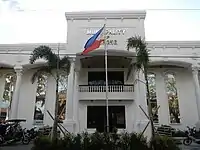 Municipal hall
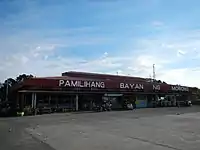 Public market
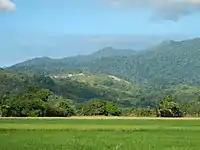 Morong landscape
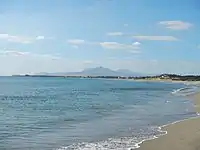 Seascape
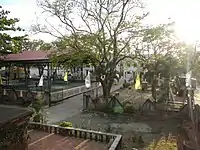 Park and covered court
References
- Municipality of Morong | (DILG)
- "2015 Census of Population, Report No. 3 – Population, Land Area, and Population Density" (PDF). Philippine Statistics Authority. Quezon City, Philippines. August 2016. ISSN 0117-1453. Archived (PDF) from the original on May 25, 2021. Retrieved July 16, 2021.
- Census of Population (2020). "Region III (Central Luzon)". Total Population by Province, City, Municipality and Barangay. PSA. Retrieved 8 July 2021.
- https://psa.gov.ph/sites/default/files/City%20and%20Municipal-level%20Small%20Area%20Poverty%20Estimates_%202009%2C%202012%20and%202015_0.xlsx; publication date: 10 July 2019; publisher: Philippine Statistics Authority.
- "Republic Act No. 1249; An Act Changing the Name of the Municipality of Moron, Province of Bataan, to Morong". LawPH.com. Archived from the original on 3 May 2012. Retrieved 19 January 2021.
- "Morong – bataan.gov.ph". Retrieved 2020-03-28.
- "7 bishops, more than 60 priests expected in Morong Canonical Coronation". 1Bataan. 2018-10-10. Retrieved 2020-03-28.
- "About Morong". www.morong.gov.ph. Retrieved 2020-03-28.
- "Our Lady of the Pillar image crowned in Bataan". CBCPNews. 2018-10-10. Retrieved 2020-03-28.
- "Republic Act No. 1249". The LawPhil Project. Retrieved 2020-03-28.
- Steve Shaw (4 September 2008). "The Last U.S. Cavalry Charge". Parting Shot. Western Shooting Horse Magazine. Retrieved 22 October 2009.
- "Province: Bataan". PSGC Interactive. Quezon City, Philippines: Philippine Statistics Authority. Retrieved 12 November 2016.
- MORELLA, CECIL (29 February 2016). "Turtles' vulnerable start to life on Bataan coast". GMA News. Retrieved 29 March 2020.
- "Climate: Morong". Climate-Data.org. Retrieved 27 October 2020.
- "Municipal: Morong, Bataan". PSGC Interactive. Quezon City, Philippines: Philippine Statistics Authority. Retrieved 8 January 2016.
- Census of Population and Housing (2010). "Region III (Central Luzon)". Total Population by Province, City, Municipality and Barangay. NSO. Retrieved 29 June 2016.
- Census of Population (2015). "Region III (Central Luzon)". Total Population by Province, City, Municipality and Barangay. PSA. Retrieved 20 June 2016.
- Censuses of Population (1903–2007). "Region III (Central Luzon)". Table 1. Population Enumerated in Various Censuses by Province/Highly Urbanized City: 1903 to 2007. NSO.
- "Province of Bataan". Municipality Population Data. Local Water Utilities Administration Research Division. Retrieved 17 December 2016.
- "Poverty incidence (PI):". Philippine Statistics Authority. Retrieved 28 December 2020.
- https://psa.gov.ph/sites/default/files/NSCB_LocalPovertyPhilippines_0.pdf; publication date: 29 November 2005; publisher: Philippine Statistics Authority.
- https://psa.gov.ph/sites/default/files/2003%20SAE%20of%20poverty%20%28Full%20Report%29_1.pdf; publication date: 23 March 2009; publisher: Philippine Statistics Authority.
- https://psa.gov.ph/sites/default/files/2006%20and%202009%20City%20and%20Municipal%20Level%20Poverty%20Estimates_0_1.pdf; publication date: 3 August 2012; publisher: Philippine Statistics Authority.
- https://psa.gov.ph/sites/default/files/2012%20Municipal%20and%20City%20Level%20Poverty%20Estima7tes%20Publication%20%281%29.pdf; publication date: 31 May 2016; publisher: Philippine Statistics Authority.
- https://psa.gov.ph/sites/default/files/City%20and%20Municipal-level%20Small%20Area%20Poverty%20Estimates_%202009%2C%202012%20and%202015_0.xlsx; publication date: 10 July 2019; publisher: Philippine Statistics Authority.
- Morton, Rogers; Falkie, Thomas (1972). Minerals Yearbook, Volume 3. Washington D.C: UNITED STATES DEPARTMENT OF THE INTERIOR. p. 660.
- http://region3.mgb.gov.ph/mgb_roIII_files/pdf/Mining_Permits_and_Contracts/December_2017/Exploration-Permit.pdf (See Entry 29)
- "Bataan Technological Park, Inc. (BTPI) – Invest in Bataan". Retrieved 2020-03-28.
- Philippines, Doing Business, Investing in Philippines Guide. Printed: United States of America. International Business Publications. 2018. p. 56. ISBN 978-1-387-56731-7.CS1 maint: others (link)
External links
 Media related to Morong, Bataan at Wikimedia Commons
- Morong Profile at PhilAtlas.com
- Philippine Standard Geographic Code
Places adjacent to Morong, Bataan | |
|---|---|