Mossi language
The Mossi language (known in the language as Mooré; also Mòoré, Mõõré, Moré, Moshi, Moore, More) is a Gur language of the Oti–Volta branch and one of two official regional languages of Burkina Faso, closely related to the Frafra language spoken just across the border in the northern half of Ghana and less-closely to Dagbani and Mampruli farther south. It is the language of the Mossi people, spoken by approximately 5 million people in Burkina Faso, plus another 60,000+ in Mali and Togo.
| Mossi | |
|---|---|
| Mooré | |
| Native to | Burkina Faso, Benin, Ivory Coast, Ghana, Mali, Togo |
| Ethnicity | Mossi |
Native speakers | 7.83 million (2009–2013)[1] |
| Latin (Mossi alphabet) | |
| Official status | |
Recognised minority language in | |
| Language codes | |
| ISO 639-2 | mos |
| ISO 639-3 | mos |
| Glottolog | moss1236 |
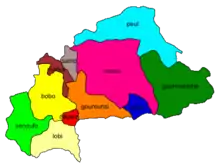 Majority areas of Mossi speakers, in pink, on a map of Burkina Faso | |
%252C_Nord%252C_Burkina_Faso%252C_1981_-_Moor%C3%A9_Mossi_language_text.tif.jpg.webp)
A Mooré text on a blackboard in the open at a meeting of farmers and extension workers, Ziga, Burkina Faso, 1981. The text reads:
"talaat Octobre kiug daar 6 soaba 1981 / moor tarongo roogo la wooto / ed fãa tom ne taaba d bayira manegre yinga / ned ka être n le n encore yẽ seka un meng ye ned fãarata / ato sôngre, ta vum yi a noogo / Ziiga"
(Tuesday, month of Octobre, 6th day, 1981 / This is a Mossi tarongo(?) house / We all work together for the repair of our home (village, homeland) / Nobody can say .. / With help it gets good. / Ziiga)[2]
"talaat Octobre kiug daar 6 soaba 1981 / moor tarongo roogo la wooto / ed fãa tom ne taaba d bayira manegre yinga / ned ka être n le n encore yẽ seka un meng ye ned fãarata / ato sôngre, ta vum yi a noogo / Ziiga"
(Tuesday, month of Octobre, 6th day, 1981 / This is a Mossi tarongo(?) house / We all work together for the repair of our home (village, homeland) / Nobody can say .. / With help it gets good. / Ziiga)[2]
| Person | Moaaga |
|---|---|
| People | Moose |
| Language | Mòoré |
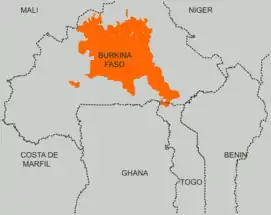
The distribution of Mossi
Phonology
The Mossi language consists of the following sounds:[3]
Consonants
| Labial | Alveolar | Postalveolar / palatal |
Velar | Glottal | ||
|---|---|---|---|---|---|---|
| Nasal | m | n | ɲ | |||
| Stop | voiceless | p | t | k | ʔ | |
| voiced | b | d | ɡ | |||
| Fricative | voiceless | f | s | h | ||
| voiced | v | z | ||||
| Liquid | r, l | |||||
| Approximant | j | w | ||||
Remark:
Vowels
| Front | Central | Back | ||
|---|---|---|---|---|
| Close | close | i | u | |
| near-close | ɪ | ʊ | ||
| Close-mid | e | o | ||
| Open | a | |||
Notes:
- All vowels (other than /e/ and /o/) are pronounced like their nasal counterparts.
- All vowels (oral and nasal) are pronounced like their lengthened counterparts.
- Other linguists include the vowels /ɛ/ and /ɔ/; here, they are analysed as diphthongs, (/ɛ/ is considered to be ea and /ɔ/ is considered to be oa).
Orthography
In Burkina Faso, the Mossi alphabet uses the letters specified in the national Burkinabé alphabet.
| Burkinabé Mossi alphabet | |||||||||||||||||||||||||
|---|---|---|---|---|---|---|---|---|---|---|---|---|---|---|---|---|---|---|---|---|---|---|---|---|---|
| A | ʼ | B | D | E | Ɛ | F | G | H | I | Ɩ | K | L | M | N | O | P | R | S | T | U | Ʋ | V | W | Y | Z |
| a | ʼ | b | d | e | ɛ | f | g | h | i | ɩ | k | l | m | n | o | p | r | s | t | u | ʋ | v | w | y | z |
| Phonetic values | |||||||||||||||||||||||||
| a | ʔ | b | d | e | ɛ | f | ɡ | h | i | ɪ | k | l | m | n | o | p | r | s | t | u | ʊ | v | w | j | z |
See also
References
- "Mòoré". Ethnologue. Retrieved 2018-12-06.
- Kind translation by Afrika-Studiecentrum Leiden/African Studies Centre Leiden, 2021.
- Cf. Kabore (1985) : (p.44) for the consonants, (p.85-86) for the vowels.
External links
Learning materials
 |
Wikivoyage has a phrasebook for Mooré. |
- Protestant Mission, Assemblies of God. More (Language of the Mossi Tribe) Phrase Book. Ouagadougou, Upper Volta: World Digital Library.
Authority control  | |
|---|---|
| National libraries | |
| Other | |
This article is issued from Wikipedia. The text is licensed under Creative Commons - Attribution - Sharealike. Additional terms may apply for the media files.