NASA Railroad
The NASA Railroad (reporting mark NLAX) is a Class III industrial short-line railroad at the Kennedy Space Center in Cape Canaveral, Florida. The railroad consists of 38 miles (61 km) of track connecting the mainline of the Florida East Coast Railway and trackage at the Cape Canaveral Space Force Station.[1] NASA uses the railroad to deliver large or bulk materials to support its operations, particularly solid rocket boosters and chemicals such as helium and oxygen for rocket fuel.
 | |
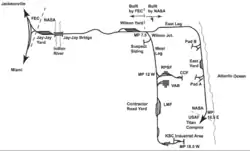 NASA Railroad and connector to Florida East Coast Railway | |
| Overview | |
|---|---|
| Headquarters | Cape Canaveral, Florida |
| Reporting mark | NLAX |
| Locale | Kennedy Space Center |
| Dates of operation | 1963–present |
| Technical | |
| Track gauge | 4 ft 8+1⁄2 in (1,435 mm) standard gauge |
| Electrification | No |
| Length | 38 mi (61 km) |
History
NASA uses the railroad to transport equipment which could not be transported over the road to and from other NASA locations. Rail transportation also offers cost savings over transporting bulky and heavy cargo via barge or aircraft. Prior to its shutdown, much of the rail traffic was devoted to sending segments of the reusable solid rocket boosters (SRB) from the Thiokol plant in Utah back again for refurbishment after Space Shuttle launches and recovery. A total of 24 cars were devoted to transporting the SRBs.[1]
With the end of the Shuttle program in 2011, the railroad's future became uncertain and went under review by the government. One possibility that was being considered was the delivery of equipment for private space launches at Cape Canaveral.[2] In 2012, the program's helium tank cars, a liquid oxygen tank car, and a liquid hydrogen tank car were transferred for delivery to the SpaceX engine test complex outside McGregor, Texas, where they were re-purposed to support their engine tests. Originally, the tank cars belonged to the U.S. Bureau of Mines. Eight other cars were shipped to California and are currently on lease to SpaceX to support Falcon 9 rocket launches from Space Launch Complex-4 at Vandenberg Air Force Base. SpaceX already uses three helium tank cars at Space Launch Complex-40 on Cape Canaveral Space Force Station in Florida, which were previously used for the shuttle program.[3]
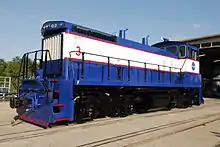
In 2014, NASA donated locomotive #2 to the Gold Coast Railroad Museum in Miami where it remains on static display. In the spring of 2015, it was announced that the NASA railroad would formally cease operations. The remaining two locomotives, #1 & #3, were pulled from service and delivered via the Florida East Coast Railway to their respective new homes. Locomotive #1 was sold to the Natchitoches Parish Port in Natchitoches, Louisiana, while locomotive #3 was sold to the Madison Railroad in Madison, Indiana, where it is used for regular freight service and passenger excursion train service.[4] As of 2016, much of the trackage along the East Leg as well as in the KSC Industrial Area had been pulled up and was presumably scrapped, although the majority of trackage along the West Leg remained out of service.
In 2020, NASA reopened the railroad to support the new Space Launch System (SLS) vehicle.[5]
The railroad took delivery of a train loaded segments of the two shuttle-derived solid fuel rocket boosters that will be used on the initial flights of the SLS. Each booster will provide 3.6 million pounds of thrust by adding one additional solid fuel propellant segment to the modified shuttle boosters (5 sections for the SLS vs. 4 for the STS). This SLS booster will be the largest, most powerful solid propellant boosters ever built. The boosters will once again be manufactured by Orbital ATK in Utah and shipped cross country by rail.
Equipment
The NASA Railroad formerly operated three SW1500 switcher locomotives, each former Toledo, Peoria and Western Railway units, as well as 75 railroad cars.[6] The fleet is maintained by the NASA Railroad shop, which also maintains locomotives and cars for the Cape Canaveral Space Force Station.[1][7] Upon the railroad's reopening in 2020, the SW1500s were replaced by railcar movers.[8]
Locomotives
| Model | Built | Acquired | Number | Disposition |
|---|---|---|---|---|
| EMD SW1500 | 1968 | 1983 | 1 | Natchitoches Parish Port, April 2015 |
| EMD SW1500 | 1970 | 1983 | 2 | Gold Coast Railroad Museum, March 2014 |
| EMD SW1500 | 1970 | 1983 | 3 | Madison Railroad, April 2015 |
Rolling stock
| Type | Built | count |
|---|---|---|
| Flat car – Spacer – 70-ton | 1952 | 2 |
| Flat car – Aft SRB skirt – 70-ton | 1985 | 2 |
| Flat car – 90-ft | 1961-1969 | 8 |
| Flat car –60-ft; 100-ton | 1968 | 3 |
| Flat car –Pig -70-ton | 1968 | 2 |
| Flat car – 100-ton | 1952 | 14 |
| Flat car –65-ft; 90-ton | 1965 | 1 |
| Helium Car | 1961 | 13 |
| Nitrogen Car | 2 | |
| Hopper car 100-ton | 1968-1979 | 11 |
| Tank car – 70-ton | 1982 | 2 |
| Tank car – 100-ton | 1962, 1975 | 4 |
| Gondola car – 60-ft | 1966, 1960 | 2 |
| Gondola car – 74-ft; 100-ton | 1976 | 2 |
| Cover car | 1960 | 2 |
| Boxcar – 70-ton | 1970 | 1 |
| Total | 75 |
See also
 |
Wikimedia Commons has media related to NASA Railroad. |
References
- "NASA Facts: The NASA Railroad" (PDF). NASA.gov. October 2007. Retrieved December 26, 2010.
- "Rail Insider-Short lines: NASA Railroad's future in question. Information for Rail Career Professionals from Progressive Railroading Magazine".
- Grossmann, Jim (2012-05-23). "Media Detail National Aeronautics and Space Administration John F. Kennedy Space Center Kennedy Space Center, Florida 32899 FOR RELEASE: 05/23/2012". NASA Kennedy Media Gallery. NASA. Archived from the original on February 16, 2015. Retrieved February 16, 2015quotes public domain text from NASACS1 maint: postscript (link)
- Dean, James (2015-05-24). "NASA Railroad reaches the end of its line". usatoday.com. USA Today. Retrieved May 6, 2016.
- Leman, Jennifer (2020-06-17). "NASA's Famous Rocket Railroad Is Back in Business". Popularmechanics.com. Popular Mechanics. Retrieved June 18, 2020.
- Archaeological Consultants, Inc. HISTORICAL SURVEY AND EVALUATION OF THE JAY JAY BRIDGE, RAILROAD SYSTEM, AND LOCOMOTIVES, JOHN F. KENNEDY SPACE CENTER, BREVARD COUNTY, FLORIDA (PDF). pp. 3–8. Archived from the original (PDF) on 2013-02-17.
- "NASA Railroad rides into sunset". Florida Today.
- Potter, Sean (2020-06-16). "Rocket Motors for First NASA Artemis Moon Mission Arrive at Spaceport". NASA. Retrieved 2021-09-11.
External links
- Rockets and Rails: The NASA Railroad at YouTube.com