Nanjing Normal University
Nanjing Normal University (NNU or NJNU; simplified Chinese: 南京师范大学; traditional Chinese: 南京師範大學; pinyin: Nánjīng Shīfàn Dàxué) is a public research university in Nanjing, China. Founded in 1902 as Sanjiang Normal School, it is one of the oldest and most prestigious higher normal schools in China, and has become a research-intensive comprehensive university co-funded by the Ministry of Education of China and Jiangsu Provincial Government since its separation from Nanjing University in 1952. NNU is a leading National Key University designated by China's Project 211, Plan 111, and Double First Class University Plan.[3]
| Nanjing Normal University | |||||||||||||
|---|---|---|---|---|---|---|---|---|---|---|---|---|---|
| Simplified Chinese | 南京师范大学 | ||||||||||||
| Traditional Chinese | 南京師範大學 | ||||||||||||
| |||||||||||||
南京师范大学 | |
 | |
Former names | Sanjiang Normal College (Faculty of Education),
National Nanjing Higher Normal School (Faculty of Education), College of Education, National Southeastern University, College of Education, Dyisyi Chungshan University, College of Education, National Central University, Teacher's College, National Central University, Teacher's College, Nanjing University, Nanjing Normal College (1952-1984) |
|---|---|
| Motto | 正德厚生,笃学敏行 |
| Type | Public |
| Established | Originated in 1902 and established as an independent school in 1952 |
| President | Minqiang Hu[1] |
Academic staff | 1,898 |
| Students | 30,933[2] |
| Undergraduates | 18,369 |
| Postgraduates | 12,564 |
| 1,525 | |
Other students | 5,216 (continuing education) |
| Location | Nanjing , Jiangsu , China 32°03′22″N 118°45′52″E |
| Campus | Urban and suburban |
| Colours | |
| Website | www |
 | |
As of 2021, Nanjing Normal University has three campuses in Nanjing, namely Xianlin, Suiyuan, and Zijin, among which Suiyuan is renowned as "the most beautiful campus of the Orient". It consists of 28 colleges and schools with an enrollment of 18,369 undergraduates and 12,564 graduate students, including 1,525 doctoral candidates. It is ranked among the top 50 universities comprehensively and top 20 for humanities and social sciences in China by several influential university rankings. NNU is a relatively selevtive university in China, which only accepts students who score top 5% (95th percentile) in the National College Entrance Examination.
The 2021 Academic Ranking of World Universities ranked NNU 401st-500th among world universities, comparable to such schools as Boston College (US), University of York (UK) and Kobe University (Japan) within the same rank interval.[4] It has 10 disciplines listed among the world's top 1% in ESI, including mathematics, chemistry, engineering, computer science, social sciences, etc.
History
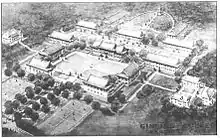
The history of Nanjing Normal University can be traced to 1902 with the establishment of Sanjiang Normal School (三江师范学堂), one of the cradles of China's teacher education. Sanjiang refers to a historical province in Qing Dynasty that roughly covers three provinces in contemporary China, including Jiangsu, Jiangxi, and Anhui. The college chronologically evolved into Liangjiang Advanced Normal College, National Nanjing Higher Normal School, National Southeastern University, National Dyisyi Chungshan University, National Jiangsu University, National Central University, and Nanjing University in the following decades.
The other origin of Nanjing Normal University is the University of Nanking (金陵大学) which was established in 1888 as Nanking Academy and developed into Private University of Nanking in 1910. It was the first institution in China officially named "university" in English and was registered with the New York State Education Department. In 1951, Private University of Nanking and Private Ginling College (金陵女子大学), were integrated into the National University of Nanking.
In 1952, as the result of the nationwide reorganization of higher education, some schools and departments of Nanjing University and University of Nanking were separated and merged to establish Nanjing Normal College (南京师范学院), which was set up on the former site of Ginling College. The college then exchanged several academic faculties and departments with Soochow University (Suzhou), another leading university in Jiangsu Province, establishing a more robust discipline system for both institutions. In 1984, Nanjing Normal College was renamed Nanjing Normal University. In 1996, it became one of the first bunch of universities designated by the Ministry of Education of China in the list of Project 211 for National Key Universities. In 2000, Nanjing Polytechnic of Power Engineering, a national polytechnic institute governed by the Ministry of Chemical Industry at the time, was incorporated into the university.
Campus
Nanjing Normal University has three campuses based in Nanjing, China. Nanjing, one of the world's largest megacities, was named among the best student cities in the world for studying abroad by Quacquarelli Symonds in 2019.[5] It is one of the Four Great Ancient Capitals of China and the current capital of Jiangsu Province, one of the most developed regions in China. With 2 universities included in the nation's Project 985 for leading research universities, 8 included in the Project 211, and 12 included in the Double First Class University Plan, the city possesses abundunt higher education resources that are easily accessible for local students.
Suiyuan Campus
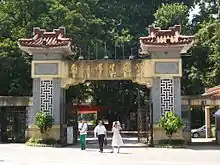
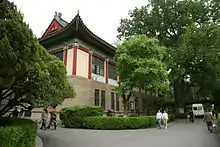
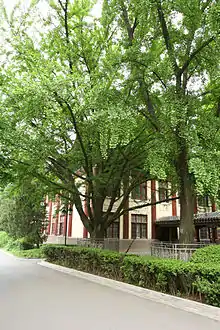
Suiyuan Campus (随园校区) (122 Ninghai Rd, Gulou District) is the historical site of the former Ginling College and has been designated as a "Major Historical and Cultural Site Protected at the National Level" of China. It owns a number of classical Chinese buildings and is often regarded as "the most beautiful campus of the Orient".
Zijin Campus
Zijin Campus (紫金校区) (78 Bancang St, Xuanwu District) is the site of the former Nanjing Polytechnic of Power Engineering, which merged into Nanjing Normal University in 2000. It was the home of NNU's School of Electrical and Automation Engineering and School of Energy and Mechanical Engineering, which have been moved to the Xianlin Campus in 2019.
Xianlin Campus
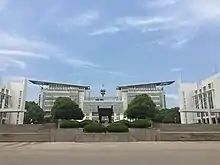
Xianlin Campus (仙林校区) (1 Wenyuan Rd, Qixia District), located in Xianlin University City, is the main campus of Nanjing Normal University. Established in 2001, it is the newest and largest campus with modern buildings and facilities. It occupies an area of 346.7 hectares and is divided into four parts, east, west, north and south, having the majority of undergraduate students study here. The main library in the center of the campus, subsidized by Zhu Jingwen, is the largest single building library in Jiangsu Province.[6]
Academics
Overview
Today, Nanjing Normal University has become a leading research university for arts and sciences in China with a bunch of top-ranked subjects. It has 6 national key disciplines, 3 national key cultivated disciplines, 14 provincial priority disciplines, 13 provincial first-level and national key cultivated disciplines, and 23 provincial first-level key disciplines.[7] According to the official academic subjects evaluation held by the Ministry of Education of China in 2012, NNU ranked 3rd in China for pedagogy, 6th for geography, 6th for Marxism studies, 7th for foreign languages and literatures, 9th for psychology, 9th for fine arts, 13th for law, etc.[8]
Nanjing Normal University is one of the first universities in China to grant bachelor's, master's, and doctoral degrees. It has involved undergraduate and graduate students all over the world as well as a bunch of foreign researchers and instructors.
Colleges and schools
As of 2020, there are 28 colleges and schools, including:
- Ginling College
- Honors College
- School of Teacher Education
- International College for Chinese Studies
- School of Public Administration
- School of Business
- School of Law
- School of Marxism
- School of Education Science
- School of Psychology
- School of Sports Science and Physical Education
- School of Chinese Language and Literature
- School of Foreign Languages and Cultures
- School of Journalism and Communication
- School of Social Development
- School of Mathematical Sciences
- School of Physics and Technology
- School of Chemistry and Materials Science
- School of Geography
- School of Life Sciences
- School of Energy and Mechanical Engineering
- School of Electrical Engineering and Automation
- School of Computer Science and Electronic Information/School of Artificial Intelligence
- School of Environment
- School of Marine Science and Engineering
- School of Food and Pharmaceutical Engineering
- School of Music
- School of Fine Art
Majors and programs
By 2020, Nanjing Normal University offers undergraduate degree programs in 74 majors, research master's degree programs in 41 disciplines, professional master's degree programs in 25 disciplines, and doctoral degree programs in 26 disciplines. It has also established 22 post-doctoral research centers.
As of 2020, NNU has 29 undergraduate programs that are officially designated by the Ministry of Education of China as "National First-class Undergraduate Programs", including:
| School | Undergraduate Program |
|---|---|
| School of Public Administration | Philosophy |
| Public Administration | |
| School of Business | Business Administration |
| School of Law | Law |
| School of Marxism | Ideological and Political Education |
| School of Education Science | Early Child Education |
| Elementary Education | |
| Educational Technology | |
| School of Psychology | Applied Psychology |
| School of Sports Science and Physical Education | Physical Education |
| Sports Management | |
| School of Chinese Language and Literature | Chinese Language and Literature |
| School of Foreign Languages and Cultures | English |
| Russian | |
| School of Journalism and Communication | Journalism |
| Broadcast and Television Directing | |
| School of Mathematical Sciences | Mathematics and Applied Mathematics |
| Statistics | |
| School of Physics and Technology | Physics |
| School of Chemistry and Materials Science | Chemistry |
| School of Geography | Geographic Information Science |
| Physical Geography and Environmental Resources | |
| Tourism Management | |
| School of Life Sciences | Biology |
| School of Electrical Engineering and Automation | Electrical Engineering and Automation |
| School of Computer Science | Computer Science and Engineering |
| School of Music | Musicology |
| School of Fine Art | Fine Art |
| Chinese Painting |
Research
In recent years, NNU has achieved 32 Major Projects from the National Social Science Fund, 7 Key Projects of Philosophy and Social Sciences Research from the Ministry of Education, 2 Support Projects of National Science and Technology, 4 Major Projects of National Sciences Research, 1 project funded by “Program 863”, 28 Key Projects from the National Natural Science Fund. In addition, it has 5 research papers published in the Journal of Science and the Journal of Nature with NNU faculty members as the first authors, and won a Second Prize of National Natural Science Award (ranked first). It also has won 11 First Prizes of Humanities and Social Sciences and 4 First Prizes of Natural Sciences in College Outstanding Research Achievement Awards from the Ministry of Education (ranked first), with 13 monographs selected into the Achievements Library of the National Social Sciences Fund. Supported by its priority disciplines and major research institutes, NNU has established a number of platforms for fruitful production-study-research cooperation, promoting the transformation of scientific and technological achievements and the development of cultural innovation industries. A number of featured fields of production-study-research cooperation have been built to encourage teachers to do research on application strategies and play the role of a brain trust.
Rankings
The 2021 Academic Ranking of World Universities (ARWU) ranked Nanjing Normal University within the range of 401–500 globally. Universities in the same range are ranked in no particular order. Western universities ranked between 401-500 include Boston College, Brigham Young University, Rensselaer Polytechnic Institute, Wake Forest University, Queen's University Belfast, University of Essex, University of Strathclyde, University of York, etc.
| University rankings | |
|---|---|
| Global – Overall | |
| ARWU World[9] | 401-500 (2021) |
| CWUR World[10] | 646 (2021-22) |
| CWTS World[11] | 498 (2021) |
| THE World[12] | 801–1000 (2021) |
| National – Overall | |
| BCUR National[13] | 47 (2021) |
| CUAA National[14] | 41 (2021) |
| Wu Shulian National[15] | 56 (2021) |
The 2021 Chinese University Ranking (CUAA) ranked the university 41st comprehensively and 20th for humanities and social sciences, right behind such schools as Shanghai Jiao Tong University (18th) and China University of Political Science and Law (19th) and ahead of such schools as Zhongnan University of Economics and Law (21st), Jinan University (23rd) and Xi'an Jiaotong University (26th).[16]
The 2022 U.S. News & World Report Best Global University Rankings by subject ranked the university:
- #128 in Physical Chemistry
- #133 in Nanoscience and Nanotechnology
- #246 in Mathematics
- #262 in Materials Science
- #270 in Geosciences
- #281 in Electrical and Electronic Engineering
International Cooperation
Nanjing Normal University is one of the first bunch of universities to "open up to the outside world" in China, boasting a model base authorized by the Ministry of Education for educating international students and teaching Chinese to foreigners. It is one of the first bases for Chinese language education and prep schools for students from China's Hong Kong, Macau and Taiwan regions. In addition, it has several international research and teaching organizations like UNESCO International Research and Training Centre for Rural Education (INRULED) Nanjing Base, French Culture Research Center and Alliance française de Nanjing, and Italian Culture Research Center. NNU has established 3 Confucius Institutes respectively with North Carolina State University (US), Pace University (US), and the Regional Council of Alsace (France). It has developed joint degree programs with 16 overseas universities and launched study abroad programs with 49 overseas universities, as well as intercollegiate exchange relationships with 192 universities from 33 countries and regions around the world. NNU employs more than 400 foreign experts, 56 of whom with long-term employment, and receives more than 1,600 international students annually from 133 countries and regions.[17]
Joint Programs (Selected)
- Dual Bachelor's Program in Accounting/Finance with Macquarie University (Australia)[18]
- Dual Bachelor's Program in Computer Science with the University of Queensland (Australia)[18]
- Dual Bachelor's Program in Education with Tohoku University (Japan)
- Dual Bachelor's Program in Education with the University of Strathclyde (UK)
- Dual Bachelor's Program in Electrical Engineering with Northumbria University (UK)
- Dual Bachelor's Program in Law with Hokkaido University (Japan)
- Dual Bachelor's Program in Public Administration with George Mason University (US)
- Dual Master's Program in Criminal Justice with the University of Maryland, College Park (US)[19]
- Dual Master's Program in Geographic Information Science with the University of Maryland, College Park (US)[20]
- Fifth Year Master of Laws (L.L.M.) Program with the University of California, Riverside (US)
- Fifth Year Master of Laws (L.L.M.) Program with Swansea University (UK)
Partner Universities (Selected)
| Country/Region | Institutions |
|---|---|
| United States |
|
| United Kingdom | |
| Canada | |
| Australia | |
| France | |
| Germany | |
| Japan | |
| South Korea | |
| Hong Kong, China | |
| Taiwan, China |
Student Life
Organizations
180 recognized student organizations and clubs on campus make it easy for NNU students to meet people who share common interests with them and explore something new. Furthermore, students can create new organizations to satisfy their own interests and look for fellows as well. With the consent from related departments and the approval of the NNU Party Committee, students are also allowed to establish organizations which off-campus students can get involved. Staff members in the Youth League Committee are available to help students find ways to engage. They will connect students with existing recognized student organizations and give advices to start new ones.
Registered student organizations (selected)
Astronomy Club: a university-level academic club which has been awarded as one of the three five-star clubs from nearly 200 clubs all over the university. The astronomy club was founded in September, 2009. Since then, the club has been constantly improving its observation equipments, increasing the number of club members, encouraging participation in various activities, and widening its social influence. The club owns 5 astronomical telescopes, including a reflective astronomical telescope,a refractive and reflective astronomical telescope, and three refractive astronomical telescopes. The astronomy club is dedicated to provide a communication platform where students can enjoy the magnificence of the universe and pursuit the truth of astronomy.
G-Mix Dancing Club: In October 1999, a group of girls in NNU who love dance founded a school dancing association named G-Mix. The club aims at improving college students' artistic accomplishment. No matter whether students have learned dancing or not, they can join the club as long as they have enough passion for it. Members dance together at least three times a week. G-Mix also invites professional teachers to give lessons every semester.
Guangyu Chinese Opera Club: Guangyu Chinese Opera Club was founded in September 2003. It is a club of various kinds of Chinese operas, such as Beijing Opera, Kun Opera, Yue Opera, Huangmei Opera, Yu Opera. The club holds regular activities every week. Students practice singing on weekdays, train performing on Saturdays, and watch different types of operas on Sundays. There are lectures on Chinese opera every semester as well. The club aims at inheriting and carrying forward the culture of Chinese opera and meanwhile adding varieties to campus activities.
HOLA Ballroom Dance Club: HOLA Ballroom Dance Club is a prize-winning NNU student group focused on social dancing. Founded in 2015 by a group of enthusiastic dance lovers, the club not only teaches novice and veteran dancers a variety of Latin dances and Ballroom, but also takes part in dance events, performances and competitions. The club mainly offers lessons on the International Latin (Cha-Cha, Rumba, Samba, Paso Doble, Jive). Classes are divided into two levels: Beginner and Intermediate, therefore no former experience is required. Team members train weekly to prepare for competitions and performances held in the university and across Nanjing.
Athletics
.jpg.webp)
Equipped with many complete sets of advanced facilities for exercising, the Xianlin Sports Center covers an area of 23,000 square meters falling in a convenient range for people to reach with six public bus driving directly to the destination and Metro Line 2 a few miles ahead. The Sports Center consists of two gyms, which are designed as the competition venue A with Yoga room, dancing room, VIP fitness center and shower room, and the comprehensive training gym B with warm-watered natatorium, badminton stadium, basketball arena, volleyball arena, table tennis training hall, exercising instrument room for masculine building, room for martial arts training, gymnastic hall, indoor plastic racetrack and two outdoor swimming pools. Many national-leveled and international-leveled sports competitions and artistic performance have been held in the center. In respond to the National Fitness Program, all the exercising rooms are now available to the citizens in Nanjing after the successful holding of the Tenth National Games. Except for the moment of physical teaching and training period, everyone is welcomed to the center to enjoy the shared resources for exercising.
It is not rare to see all-aged sports amateurs exercising in the Suiyuan sports center after class and on holidays. To meet with the public demand for fitness training and physical recreation, School of Sports Science and Physical Education in NNU has established many beloved training programs open to the public to enhance the social interaction and ease the contradictions caused by the unbalanced distribution of the training zones in the gym. Providing the access to the Sports Center in Suiyuan campus, Nanjing Normal University has acted as an ideal place for public exercising and arena for sports competition. There are three gyms now available to the public: the badminton hall, table tennis arena and basketball arena.[5]
Notable alumni
- Tao Xingzhi (陶行知), one of the most celebrated educators in Chinese history
- Zhang Daqian (张大千), one of the most famous Chinese artists of the 20th century
- Wu Yi-fang (吴贻芳), a prominent Chinese diplomat in the United States and one of only four women to sign the UN Charter in 1945
- Zheng Xiaoying (郑小瑛), the first woman conductor in China and the chief conductor of the China National Opera House
- Chen Heqin (陈鹤琴), famous child educator, child psychologist, professor, the founder of China's modern early childhood education
- Qian Ji (钱骥), a profound physicist and aerospace engineer awarded the Two Bombs, One Satellite Meritorious Medal for his contribution in the development of China's first satellite
- Hong Yinxing (洪银兴), a prominent economist who served as the Chancellor of Nanjing University and the Vice-Chair of the Social Science Commission of the Ministry of Education
- Li Jiange (李剑阁), president of China International Capital Corporation and former deputy director of the Economics Restructuring Office of the State Council
- Liu Mingkang (刘明康), former chairman of China Banking Regulatory Commission, former president of the Bank of China and China Everbright Group
- Cai Mingzhao (蔡名照), president of Xinhua News Agency, director of the State Council Information Office, member of the 19th Central Committee of the Communist Party of China,
- Huang Ming (黄明), minister of the Ministry of Emergency Management and former deputy minister of the Ministry of Public Security (China)
- Le Yucheng (乐玉成), executive vice minister of the Ministry of Foreign Affairs, alternate member of the 19th Central Committee of the Communist Party of China
- Zhu Chengshan (朱成山), curator of the Memorial Hall of the Victims in Nanjing Massacre by Japanese Invaders, a prominent scholar of Chinese history and peace-building
- Yang Jinlong (杨金龙), chemist, Academician of the Chinese Academy of Sciences (CAS), vice president of the University of Science and Technology of China
- Zhang Jindong (张近东), a Chinese billionaire entrepreneur, founder and the current largest shareholder of Suning
- Fan Hongwei (范红卫), a Chinese billionaire entrepreneur, CEO of the chemical fiber company Hengli Petrochemical Co., Ltd.
- Wu Weishan (吴为山), curator of the National Art Museum of China and president of the Chinese Academy of Sculpture
- Meng Fei (孟非), a household name in China that serves as a host for several nationwide TV programs
- Hui Ruoqi (惠若琪), the Outside Hitter and the fifteenth Captain of China Women's National Volleyball Team which won the gold medal at the 2016 Summer Olympics
- Zhang Changning (张常宁), the Outside Hitter of China Women's National Volleyball Team and won the gold medal at the 2016 Summer Olympics
- Michael Anti (赵静), a Chinese journalist and political blogger, recognized for his posts about freedom of the press in China
References
- "University Leadership | Nanjing Normal University". en.njnu.edu.cn.
- "学校简介——南京师范大学". www.njnu.edu.cn. Archived from the original on 15 December 2018. Retrieved 7 April 2018.
- "教育部 财政部 国家发展改革委关于公布世界一流大学和一流学科建设高校及建设学科名单的通知 - 中华人民共和国教育部政府门户网站". www.moe.gov.cn.
- "Nanjing Normal University". Shanghai Ranking. Retrieved 2021-11-20.
- "2019 Best Student Cities". Top Universities. Retrieved 2021-11-23.
- "南京师范大学图书馆". Lib.njnu.edu.cn. 2005-07-26. Retrieved 2011-10-29.
- "Archived copy". Archived from the original on 2013-06-27. Retrieved 2020-04-13.CS1 maint: archived copy as title (link)
- "教育部学位中心2012学科评估结果公布". www.cdgdc.edu.cn.
- "2021 Academic Ranking of World Universities". hanghairanking.com/m. Retrieved 3 September 2021.
- "CWUR - World University Rankings - Nanjing Normal University 2021-2022 Ranking". Center for World University Rankingsg. Retrieved 3 September 2021.
- "CWTS Leiden Ranking 2021 - PP top 10%". CWTS Leiden Ranking. Retrieved 3 September 2021.
- "World University Rankings - Nanjing Normal University". timeshighereducation.com. Retrieved 3 September 2021.
- http://www.shanghairanking.com/Chinese_Universities_Rankings/Overall-Ranking-2019.html
- "CUAA Chinese University Rankings 2021". Retrieved 24 November 2021.
- "Wushulian Chinese University Rankings 2021". Retrieved 24 November 2021.
- "2021校友会中国大学文科实力排名,中国人民大学全国第二_高校". www.sohu.com. Retrieved 2021-11-30.
- "About Nanjing Normal University - Nanjing Normal University". en.njnu.edu.cn. Retrieved 7 April 2018.
- "南京师范本科招生网". bkzs.njnu.edu.cn. Retrieved 2021-12-12.
- "Joint CJ Program with Nanjing Normal University". UMD Office of lnternational and Executive Programs. Retrieved 2021-11-18.
- "Joint GIS Program with Nanjing Normal University". UMD Office of lnternational and Executive Programs. Retrieved 2021-11-18.
External links
 |
Wikimedia Commons has media related to Nanjing Normal University. |
- Suqian College basic dept. sponsored by
- Official website (in Chinese)
- 3D map of NJNU (in Chinese)
- Nanjing Normal University (in English)
- the introduction of YangFan Forum (in Chinese)
- Map of Xianlin campus
- Map of Zijin campus
- Map of Suiyuan campus



Authority control  | |
|---|---|
| General | |
| National libraries | |
| Other | |