New Mexican Spanish
New Mexican Spanish (Spanish: español neomexicano, novomexicano) is a variety of Spanish spoken in the United States, primarily in Northern New Mexico and the southern part of the state of Colorado by the Hispanos of New Mexico. Despite a continual influence from the Spanish spoken in Mexico to the south by contact with Mexican migrants who fled to the US from the Mexican Revolution, New Mexico's unique political history and relative geographical and political isolation from the time of the annexation to the US have caused New Mexican Spanish to differ notably from the Spanish spoken in other parts of Hispanic America, with the exception of certain rural areas of southern Colorado, Northern Mexico, and Texas.[1]
| New Mexican Spanish | |
|---|---|
| español neomexicano, novomexicano | |
Early forms | |
| Latin (Spanish alphabet) | |
| Language codes | |
| ISO 639-3 | – |
| Glottolog | None |
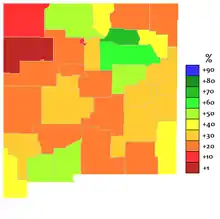 Spanish language distribution in New Mexico by county | |
| Part of a series on |
| Hispanic and Latino Americans |
|---|
|

Many speakers of traditional New Mexican Spanish are descendants of colonists from Spain and the New World who arrived in New Mexico in the 16th to the 18th centuries.
After the Mexican–American War, New Mexico and all its inhabitants came under the governance of the English-speaking United States, and for the next 100 years, English-speakers increased in number.
Those reasons caused these main differences between New Mexican Spanish and other forms of Hispanic American Spanish: the preservation of forms and vocabulary from colonial-era Spanish no longer present in the standard (such as, in some places, haiga instead of haya or Yo seigo, instead of Yo soy),[2] the borrowing of words from Puebloan languages for some indigenous vocabulary[3] (in addition to the Nahuatl additions that the colonists had brought),[4] independent lexical and morphological innovations,[5] and a large proportion of English loanwords, particularly for technology (such as bos, troca, and telefón).[6]
In recent years, speakers have developed a modern New Mexican Spanish, called Renovador, which contains more modern vocabulary because of the increasing popularity of Spanish-language broadcast media in the US and intermarriage between New Mexicans and Mexican settlers. The modernized dialect contains Mexican Spanish slang (mexicanismos).[1]
History
Spanish first arrived in New Mexico with Juan de Oñate's colonization, bringing 600-700 settlers. Almost half of the early settlers were from Spain, many from New Spain, the rest from "various parts of Latin America, the Canary Islands, Portugal, and so forth." Following the Pueblo Revolt, New Mexico was resettled again, primarily by refugees from the Pueblo Revolt and others born in northern New Spain. The Spanish-speaking areas with which New Mexico had the greatest contact were Chihuahua and Sonora.[7] Colonial New Mexico was very isolated and had widespread illiteracy, resulting in most New Mexicans having little to no exposure to "standard" Spanish.[8] This linguistic isolation facilitated New Mexican Spanish's preservation of older vocabulary[2] as well as its own innovations.[5]
During that time, contact with the rest of Spanish America was limited because of the Comancheria, and New Mexican Spanish developed closer trading links to the Comanche than to the rest of New Spain. In the meantime, some Spanish colonists co-existed with and intermarried with Puebloan peoples and Navajos, also enemies of the Comanche.[9]
New Mexico's 1848 annexation by the US led to a greater exposure to English. Nevertheless, the late-19th-century development of a culture of print media allowed New Mexican Spanish to resist assimilation toward American English for many decades.[10] The 1911 Encyclopædia Britannica, for instance, noted, "About one-tenth of the Spanish-American and Indian population [of New Mexico] habitually use the English language."[11] At the beginning of the 20th century, there was an attempt by both Anglos and Hispanos to link New Mexico's history and language to Spain, rather than Mexico. This led to the occasional use of vosotros rather than ustedes in some newspaper ads, with the same meaning.[12]
After 1917, Spanish usage in the public sphere began to decline and it was banned in schools. Newspapers published in Spanish switched to English or went out of business.[13] From then on, Spanish became a language of home and community. The advance of English-language broadcast media accelerated the decline. Since then, New Mexican Spanish has been undergoing a language shift, with Hispanos gradually shifting towards English.[14] In addition, New Mexican Spanish faces pressure from Standard and Mexican Spanish. Younger generations tend to use more Anglicisms and Mexican and standard Spanish forms. This is in part due to language attrition. The decline in Spanish exposure in the home creates a vacuum, into which "English and Mexican Spanish flow easily."[15]
Morphology
Besides a great deal of phonological variation, there are various differences between Traditional New Mexican Spanish morphology and standard Spanish morphology, usually in verb conjugations or endings. Use of non-standard forms isn't universal, and usually correlates negatively with education.[16] Many, though not all, are more commonly found among older speakers:[17]
- Change from -mos to -nos in the first-person plural (nosotros) endings with antepenultimate stress, as in the past subjunctive, imperfect, and conditional tenses, ie: nos bañábamos to nos bañábanos, nos bañáramos to nos bañáranos, nos bañaríamos to nos bañaríanos, under the influence of the clitic nos. This also occurs in the present subjunctive, with a shift of stress, as in nos báñenos.[1][5]
- In stem-changing verbs where the stressed stem vowel diphthongizes, this results in the usual diphthongization, ie. duérmanos for durmamos, piérdanos for perdamos.[18]
- The second person preterite endings can be -astes, -istes or -ates, -ites instead of the standard -aste, -iste.[1]
- Retention of Latin -b- in some imperfect conjugations of -er and -ir verbs, with the preceding -i- diphthongized into the previous vowel, as in: caiban vs. caían, traiba vs. traía, creiban vs creían.[2]
- Use of older preterite forms such as:
- Widespread use of vide, vido for vi, vio. This usage doesn't show any regional patterning, being found in both Border Spanish and Traditional New Mexican Spanish. Instead, it correlates negatively with exposure to standard Spanish and with age.[2][17]
- Widespread use of the regularized -jieron ending instead of -jeron, as in trajieron for trajeron, 'they brought'.[2]
- Less widespread use of the older truj- stem of traer, 'to bring' in the preterite, resulting in trujieron.[2]
- Nosotros ending -emos for present and -imos for past in -er/-ir verbs.[1][19]
- Extension of vowel raising in those stem-changing verbs which already have it. They have the raised stem vowel -i- or -u- in any unstressed position, including the infinitive. Diphthongization in stressed positions is preserved. Examples:
- Durmir instead of dormir, 'to sleep'. Duermo, 'I sleep', the standard first person present with diphthongization, is used in Traditional New Mexican Spanish.
- Dicir instead of decir, 'to say'.[20]
- Non-standard -g- in many verb roots, such as creiga, juigo, vaiga.[21][22] Also, epenthetic -g- in aire and related words.[21]
- Subjunctive present of haber is haiga, instead of haya.[1] This is common in non-standard Spanish varieties.
- Use of los instead of nos.[5]
- Regularization of the following irregular verb conjugations:
- Generalization of the ha- root to the first person in forms of haber as an auxiliary verb, instead of he-: "nosotros hamos comido," instead of "nosotros hemos comido," "yo ha comido" instead of "yo he comido."[1] This appears to be a more recent development, as younger and less-educated speakers are more likely to use it.[5]
- The plural forms of words which end in a stressed vowel, such as papá and café, are often formed with the suffix -ses instead of the standard -s. This is widespread in colloquial Spanish.[23]
Phonology
- New Mexican Spanish has seseo (orthographic ⟨c⟩ before /e/ and /i/ as well as ⟨z⟩ represent a single phoneme, /s/, normally pronounced [s]). That is, casa ("house") and caza ("hunt") are homophones. Seseo is prevalent in nearly all of Spanish America, in the Canary Islands, and some of southern Spain, where the linguistic feature originates.
- New Mexican Spanish, like nearly all Spanish dialects, is yeísta. The sound represented by ⟨ll⟩, /ʎ/, has merged with that represented by ⟨y⟩, /ʝ/.
The following tendencies are common in Traditional New Mexican Spanish, though are not universal:
| Feature | Example | Phonemic | Standard | N.M. Spanish |
|---|---|---|---|---|
| Phrase-final epenthetical [e] or [i][24][25] after an alveolar consonant[5] |
voy a cantar | /ˈboi a kanˈtaɾ/ | [ˈboi̯.a.kanˈtar] | [ˈboi̯.a.kanˈta.ɾe] |
| dame el papel | /ˈdame el paˈpel/ | [ˈda.mel.paˈpel] | [ˈda.mel.paˈpe.li] | |
| Uvularization of /x/[26] | mujeres | /muˈxeɾes/ | [muˈxe.ɾes] | [muˈχe.ɾes] |
| Conditional elision of intervocalic /ʝ/.[lower-alpha 1][27][25] | ella | /ˈeʎa/ | [ˈe.ʝa], | [ˈe.a] |
| estrellita | /estɾeˈʎita/ | [es.tɾeˈʝi.ta] | [es.tɾeˈi.ta] | |
| Realization of /ɾ/ or /r/ as an alveolar approximant [ɹ][lower-alpha 2][25][28][29] |
carne | /ˈkaɾne/ | [kaɾ.ne] | [karne] |
| "Softening" (deaffrication) of /t͡ʃ/ to /ʃ/ [lower-alpha 3][25][28] | muchachos | /muˈt͡ʃat͡ʃos/ | [muˈt͡ʃa.t͡ʃos] | [muˈʃa.ʃos] |
| Elision of intervocalic /d/, especially in -ado[lower-alpha 4][25] |
ocupado | /okuˈpado/ | [o.ku.ˈpa.ðo] | [o.kuˈpa.o] |
| [o.kuˈpau] | ||||
| todo | /ˈtodo/ | [ˈto.ðo] | [ˈto.o] ~ [ˈto] | |
| Aspiration or elision (rare) of /f/[lower-alpha 5][26][30] | me fui | /me ˈfui/ | [me ˈfwi] | [meˈhwi] |
| [meˈwi] | ||||
| [me'xwi] | ||||
| Velarization of prevelar consonant voiced bilabial approximant[31] |
abuelo | /aˈbuelo/ | [a.ˈβ̞we.lo] | [aˈɣʷwe.lo] |
| Syllable-initial, syllable-final, or total aspiration or elision of /s/[lower-alpha 6][25][30] |
somos así | /ˈsomos aˈsi/ | [ˈso.mos.aˈsi] | [ˈho.mos.aˈhi] |
| [ˈo.mos.aˈi] | ||||
| [ˈso.moh.aˈsi] | ||||
| [ˈso.mo.aˈsi] | ||||
| [ˈho.moh.aˈhi] | ||||
| [ˈo.mo.aˈi] | ||||
| Word-initial h aspiration in some words, as [h], [x], or [χ][26][30] | humo | /umo/ | [umo] | [humo] |
| [xumo] | ||||
| [χumo] |
Traditional New Mexican Spanish has a number of syllabic consonants.[32][33] A syllabic [m̩] can arise as the result of mi or un before a bilabial consonant, as in un beso 'a kiss' [m̩ˈbeso] or mi papá 'my dad' [m̩paˈpa].
Vocabulary
One of the most notable characteristics of Traditional New Mexican Spanish is its vocabulary. New Mexican Spanish has retained a lot of older vocabulary, or common vocabulary with older meanings, that has been lost in other Spanish varieties.[2] This is one of the reasons it's often called "archaic". It's also developed a lot of vocabulary of its own,[5] inherited many Nahuatl loanwords from Mexican Spanish,[4] and taken in more loanwords from neighboring indigenous languages and from English.[6]
New Mexican retains many older variants of common words no longer current in standard Spanish, such as asina for así, 'like this/that', cuasi for casi, 'almost', muncho for mucho, 'a lot of; many', naide or nadien for nadie and onde for donde, 'where'.[34][35] Many of these terms are found in the colloquial speech of other regions as well.[36]
Language contact
New Mexican Spanish has been in contact with several indigenous American languages, most prominently those of the Pueblo and Navajo peoples with whom the Spaniards and Mexicans coexisted in colonial times.[3] For centuries, Hispanics had hostile relations with the Navajo and other nomadic peoples, such as the Apache. As a result, New Mexican Spanish has borrowed few terms from their languages. Cobos (2003) gives only two examples of loans from Navajo: chihuil 'small valley' and josquere, as in the phrase andar en el josquere 'to be sowing one's wild oats'.[37] The term gileño, referring to the Gila Apache, is cited as a loan from an Apache language. In the opposite direction, Navajo, which typically doesn't adopt many loanwords, has borrowed some terms from Spanish as well. For example, the Navajo terms for "money" (béeso) and "Anglo" (bilagáana) are borrowings from Spanish peso and americano respectively.[38]
Hispanic contact with the Puebloans was much closer, though linguistic contact was somewhat uneven. Most of the bilinguals who mediated between Hispanics and Puebloans were themselves Puebloans since few Hispanics spoke a Pueblo language. As a result, Puebloan languages borrowed many words from Spanish, while New Mexican Spanish borrowed fewer words from Pueblo languages.[39] For an example of loanword phonological borrowing in Taos, see Taos loanword phonology.
Most Puebloan loanwords in New Mexican Spanish have to do with people and place names, cultural artifacts, foods, and plants and herbs.[40] One such loan is the term cunque, which comes from either a Zuni word for "bits of ground corn or cornmeal used for ceremonial purposes" or a Rio Grande Tewa term for grains of corn. It's most commonly used to mean "coffee grounds". This usage is also attested in northern Chihuahua. It's also used to mean "crumbs" by speakers from south-western New Mexico, although speakers elsewhere prefer the standard migajas.
New Mexico came into contact with the French language in the early 18th century due to interactions with French Fur trappers and traders. These interactions increased after Mexican independence.[23] Some family names, such as Archibeque, Gurulé, and Tixier, are attributable to French influence. New Mexican Spanish has otherwise borrowed few words from French, though two prominent ones are puela,[23] meaning "skillet", and chamuz,[41] meaning "slipper". The only other Spanish variety where puela is used is the Brule variety of Isleño Spanish, which has been greatly influenced by French. The term pantufla is also used in New Mexico for "slipper", but it's associated with the border region, and is widely used across Latin America and Spain.[42]
New Mexican Spanish has also been in substantial contact with American English. The contact with American English began before the Mexican–American War, when New Mexico did trade with the US,[13] and increased after New Mexico's annexation by the US. One effect of this is semantic extension, using Spanish words with the meaning of their English cognates, such as using realizar to mean "to realize."[13] Contact with English has also led to a general adoption of many loanwords, as well as a language shift towards English with abandonment of Spanish.[14]
Legal status
New Mexico law accommodates the use of Spanish. For instance, constitutional amendments must be approved by referendum and must be printed on the ballot in both English and Spanish.[43] Certain legal notices must be published in English and Spanish, and the state maintains a list of newspapers for Spanish publication.[44] Spanish was not used officially in the legislature after 1935.[45]
Though the New Mexico Constitution (1912) provided that laws would be published in both languages for 20 years and that practice was renewed several times, it ceased in 1949.[45][46] Accordingly, some describe New Mexico as officially bilingual.[47][48] Others disagree and say that New Mexico's laws were designed to facilitate a transition from Spanish to English, not to protect Spanish or give it any official status.[49]
See also
Notes
- Occurs between /i/ and another vowel, or after /e/ and before another vowel. /ʝ/ in general is very weak in Traditional New Mexican Spanish, pronounced as a semivocalic [j] at most.
- Most often before alveolar consonants. Other cases are likely due to English influence
- This is also a feature of the Spanish spoken in the northern Mexican states of Chihuahua and Sonora, other northwestern states of Mexico, and western Andalusia.
- This is a feature of many Spanish dialects, both in the Americas and in northern and southern Spain.
- This is related to the change of Latin /f/- to Spanish /h/-, in which /f/ was pronounced as a labiodental [f], bilabial [ɸ], or glottal fricative [h], which was later deleted from pronunciation.
- Aspiration is much more common than deletion syllable-initially.
References
- Cobos (2003), "Introduction"
- Bills & Vigil (2008), pp. 51–74, Ch.5 "Retentions"
- Bills & Vigil (2008), pp. 153–164, Ch.9 "Uneasy Alliances"
- Bills & Vigil (2008), pp. 93–120, Ch.7 "Nahuatlisms"
- Bills & Vigil (2008), pp. 123–151, Ch.8 "El Nuevo México"
- Bills & Vigil (2008), pp. 165–190, Ch.10 "Anglicisms"
- Lipski (2008), pp. 193–200.
- Lipski (2008), pp. 200–202.
- Hämäläinen, Pekka (2008). The Comanche Empire. Yale University Press. ISBN 978-0-300-12654-9.
- Great Cotton, Eleanor and John M. Sharp. Spanish in the Americas. Georgetown University Press, p. 278.
- Chisholm, Hugh, ed. (1911). . Encyclopædia Britannica. 19 (11th ed.). Cambridge University Press.
- Gubitosi, Patricia; Lifszyc, Irina (September 2020). "El uso de vosotros como símbolo de identidad en La Bandera Americana, Nuevo México" (PDF). Glosas (in Spanish). 9. ISSN 2327-7181.
- Gubitosi, Patricia (2010). "El español de Nuevo México y su uso como lengua pública: 1850-1950" (PDF). Camino Real. Estudios de las Hispanidades Norteamericanas. (in Spanish).
- Bills & Vigil (2008), pp. 241–260, Ch.13 "The Long Goodbye"
- Bills & Vigil (2008), pp. 258–260, 343
- Bills & Vigil (2008), pp. 261–282, Ch.14 "Expanding Horizons"
- Bills & Vigil (2008), pp. 215–240, Ch.12 "The Permanent Certainty"
- Hills (1906), p. 730.
- Hills (1906), p. 729–730.
- Hills (1906), pp. 733, 738.
- Espinosa (1909), p. 91.
- Sanz, Israel; Villa, Daniel J. (2011). "The Genesis of Traditional New Mexican Spanish: The Emergence of a Unique Dialect in the Americas". Studies in Hispanic and Lusophone Linguistics. 4 (2): 417–442. doi:10.1515/shll-2011-1107. S2CID 163620325. Retrieved 13 April 2021.
- Bills & Vigil (2008), p. 160.
- Mackenzie, Ian. "Spanish in the USA". The Linguistics of Spanish. Retrieved 4 April 2021.
- Lipski (2008), pp. 204–206
- Vigil, Donny (2018). "WORD-INITIAL H ASPIRATION AND THE PRESENCE OF THE POST-VELAR FRICATIVE [χ] IN NEW MEXICO SPANISH" (PDF). Estudios de Fonética Experimental.
- Ross (1980).
- Bills, Garland D. (1997). "New Mexican Spanish: Demise of the Earliest European Variety in the United States". American Speech. 72 (2): 154–171. doi:10.2307/455787. JSTOR 455787.
- Bills & Vigil (2008), p. 151.
- Zepeda Torres, Miguel Ángel (2018). Debuccalization of /s/ and Historic /f/ Variation in Traditional New Mexican Spanish: an Optimality Theory Approach (Doctor of Philosophy in Hispanic Linguistics thesis). University of California, Davis.
- Espinosa (1909), p. 60.
- Lipski (2008), p. 205.
- Lipski, John M. (1993). "Syllabic consonants in New Mexico Spanish: the geometry of syllabification" (PDF). Southwest Journal of Linguistics. 12: 109–127. OCLC 9368210.
- Hills (1906), pp. 740–753.
- Vergara Wilson, Damián (June 2015). "A Panorama of Traditional New Mexican Spanish". Informes del Observatorio / Observatorio Reports. doi:10.15427/OR012-06/2015EN.
- Bills & Vigil (2008), p. 15
- Cobos (2003), cited in Bills & Vigil (2008), p. 154
- Young & Morgan (1987), p. 7 cited in Bills & Vigil (2008), p. 154
- Bills & Vigil (2008), p. 154
- Bills & Vigil (2008), p. 155
- Bills & Vigil (2008), p. 162.
- Bills & Vigil (2008), p. 164.
- New Mexico Code 1-16-7 (1981).
- New Mexico Code 14-11-13 (2011).
- Cobarrubias, Juan; Fishman, Joshua A. (1983). Progress in Language Planning: International Perspectives. Walter de Gruyter. p. 195. ISBN 90-279-3358-8. Retrieved 2011-12-27.
- Garcia, Ofelia (2011). Bilingual Education in the 21st Century: A Global Perspective. John Wiley & Sons. p. 167. ISBN 978-1-4443-5978-7. Retrieved 2011-12-27.
- The U.S. Commission on Civil Rights. "Language Rights and New Mexico Statehood". New Mexico Public Education Department. Retrieved July 12, 2011.
- "NMTCE New Mexico Teachers of English". New Mexico Council of Teachers of English. Retrieved July 12, 2011.
- Bills & Vigil (2008), p. 17.
Sources
- Bills, Garland D. (1997). "New Mexican Spanish: Demise of the Earliest European Variety in the United States". American Speech. 72 (2): 154–171. doi:10.2307/455787. ISSN 0003-1283. JSTOR 455787.
- Bills, Garland D.; Vigil, Neddy A. (16 December 2008). The Spanish Language of New Mexico and Southern Colorado : A Linguistic Atlas. University of New Mexico Press. ISBN 9780826345516.
- Cobos, Rubén (2003). A Dictionary of New Mexico & Southern Colorado Spanish (2nd ed.). Museum of New Mexico Press. ISBN 0-89013-452-9.
- Espinosa, Aurelio Macedonio (1909). Studies in New-Mexican Spanish: Phonology. Retrieved 13 April 2021.
- Hills, E. C. (1906). "New-Mexican Spanish". PMLA. Modern Language Association. 21 (3): 706–753. doi:10.2307/456770. JSTOR 456770.
- Lipski, John M. (2008). Varieties of Spanish in the United States. Georgetown University Press. ISBN 9781589016514. Retrieved 4 April 2021.
- Miller, Wick R. (1959). "Spanish Loanwords in Acoma: I". International Journal of American Linguistics. The University of Chicago Press. 25 (3): 147–153. doi:10.1086/464521. JSTOR 1263789. S2CID 222527399.
- Miller, Wick R. (1960). "Spanish Loanwords in Acoma: II". International Journal of American Linguistics. The University of Chicago Press. 26 (1): 41–49. doi:10.1086/464552. JSTOR 1263730. S2CID 224808846.
- Ross, L. Ronald (1980). "La Supresion de /y/ en el Español Chicano". Hispania (in Spanish). 63 (3): 552–554. doi:10.2307/341016. JSTOR 341016.
- Sánchez, Rosaura (1982). "Our linguistic and social context". In Amastae, Jon; Elías-Olivares, Lucía (eds.). Spanish in the United States: Sociolinguistic Aspects. Cambridge University Press. pp. 9–46.
- Silva-Corvalán, Carmen; Enrique-Arias, Andrés (2001). "Lengua, variación y dialectos". Sociolingüística y pragmática del español (in Spanish). Georgetown University Press. pp. 1–37. ISBN 9781626163966.
- Spencer, Robert F. (1947). "Spanish Loanwords in Keresan". Southwestern Journal of Anthropology. The University of Chicago Press. 3 (2): 130–146. doi:10.1086/soutjanth.3.2.3628729. JSTOR 3628729. S2CID 164169397.
- Young, Robert W.; Morgan, William, Sr. (1987). The Navajo Language: A grammar and colloquial dictionary (Revised ed.). Albuquerque: University of New Mexico Press. ISBN 9780826310149.
