List of political parties in South Korea
This article lists political parties in South Korea. South Korea has a weakly institutionalized multi-party system,[1][2] characterized by frequent changes in party arrangements. Political parties have a chance of gaining power alone.
 |
|---|
 South Korea portal South Korea portal |


Current parties
Main parties
| Party | Assembly seats |
Party leader | Floor leader | Position | ||
|---|---|---|---|---|---|---|
| Parliamentary group | Democratic Party 더불어민주당 |
169 | Song Young-gil | Yun Ho-jung | Centre[3] to centre-left[4] | |
| People Power Party 국민의힘 |
103 | Lee Jun-seok | Kim Gi-hyeon | Right-wing[5] | ||
| Non-Parliamentary group | Justice Party 정의당 |
6 | Yeo Yeong-gug | Kang Eun-mi | Centre-left[6] | |
| People Party 국민의당 |
3 | Ahn Cheol-soo | Kwon Eun-hee | Centre to centre-right | ||
| Open Democratic Party 열린민주당 |
3 | Choi Kang-wook | Kang Min-jung | Centre to centre-left | ||
| Basic Income Party 기본소득당 |
1 | Shin Ji-Hae | Yong Hae-In | Universal Basic Income (Single issue) | ||
| Transition Korea 시대전환 |
1 | Cho Jung-hun | Cho Jung-hun | Centre[7] | ||
Conservative parties
- Revolution Party (혁명21당)
- Liberty Party (자유당)
- Inter-Korean Unification Party (남북통일당)
- Republican Party (공화당)
- Pro-Park Coalition (친박연대)
- Pro-Park New Party (친박신당)
- Our Republican Party (우리공화당)
- National Revolutionary Party (South Korea, 2021) (국민혁명당), formerly Christian Liberal Unification Party (기독자유통일당)
- Dawn of Liberty (자유의새벽당)
- Saenuri Party (2017) (새누리당)
- New National Participation Party (국민참여신당)
- Let's Go! Korea (가자코리아)
- The Christian Party (기독당)
- Dokdo is Korea Party (독도한국당)
- Korean Wave Alliance Party (한류연합당)
- Liberty Democratic Party (자유민주당)
- New Liberal Democratic Union (신자유민주연합), formerly known as Chungcheong's Future Party
- Future Korean Peninsula Union (한반도미래연합)
- New Korean Peninsula Party (신한반도당)
Centrist parties
- Hongik Party (홍익당)
- Republic of Korea Party (대한민국당)
- Let's Go! Peace and Human Rights Party (가자!평화인권당)
- Let's Go! Environmental Party (가자환경당)
- Party for People's Livelihoods (민생당)
- Kim Dong-yeon's New Wave - Squid Party (새로운물결 - 오징어당)[8]
Liberal parties
- Awakened Civic Solidarity Party (깨어있는시민연대당)
- Republic of Korea Party (대한국민당) [9]
Progressive parties
- Labor Party (노동당)
- Green Party (녹색당)
- Our Future (미래당)
- Progressive Party (진보당), known as the Minjung Party until June 21, 2020
Single-issue parties
- Women's Party (여성의당)
- People's Democratic Party (민중민주당)
- Small and Medium-sized Businesses and Self-employed Peoples' Party (중소자영업당)
Unknown stances, third way, or syncretic parties
- National Revolutionary Dividends Party (국가혁명배당금당)
- Socialist Revolutionary Workers' Party, an unregistered left-wing to far-left political party. It is unable to register due to a ban on openly socialist or communist parties under the National Security Act.
- The Beggar's Party (거지당), they would go to England to return the portrait of famous Buddhist Monk Jinpyo in the British Museum. They also claim that Queen Elizabeth is Queen Seondeok of Silla in her past life.
- Gagaryedo People's Union (가가례도인연합), ethnic nationalism.[10]
- United Korean People's Party (통일한국당), Samgyun-ist party, where republican and nationalist political thought merge.[11]
Parties in formation
These parties are not legal acting political parties yet, but are in the process of gathering petition signatures to become formal political parties.
| Party Name | Registration Date | Party Leader | Petitioning Deadline | Notes |
|---|---|---|---|---|
| All Together with Liberty Party (다함께자유당) | April 12, 2021 | Choi Seong-deok | November 12, 2021 | |
| Cyber Democratic Party (사이버민주당) | June 28, 2021 | Yang Yun-yeong | December 28, 2021 | |
| Liberty Vision Alliance (자유비전연대) | July 19, 2021 | Hong Mun-jong | January 19, 2022 | |
| National Co-Operatives Economics Party (국민공동소유기업경제당) | September 23, 2021 | Kim Jeong-seo | February 23, 2022 | |
| Culture Party (문화당) | August 31, 2021 | Choi Yeongmin | February 28, 2022 | Failed to meet petition deadline. Resubmitted application paperwork a second time. |
| The Feminism Party (페미니즘당) | February 14, 2020 | Lee Ga-hyun | Founding Congress still in session. Has not filed paperwork, but runs candidates as independents. |
Defunct parties
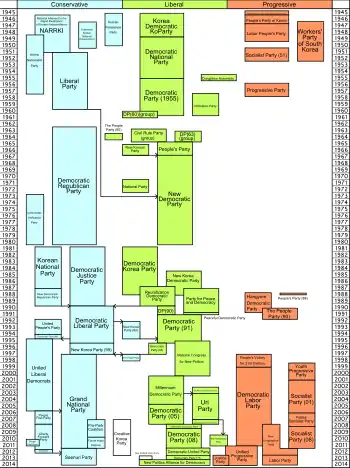
Timeline of all mainstream political parties
Conservative parties
Mainstream parties
- National Alliance for the Rapid Realization of Korean Independence (1946-1951)
- Liberal Party (1951–1960)
- Democratic Republican Party (1963–1980)
- Democratic Justice Party (1981–1990)
- Democratic Liberal Party → New Korea Party (1990–1997)
- Hannara Party → Saenuri Party → Liberty Korea Party (1997–2020)
Minor parties
- Korean Resistance Party (1945–1950)
- Federation Korean National Independence (1947–1951)
- Korea National Party (1947–1958)
- Democratic Unification Party (1973–1980)
- Korean National Party → New Democratic Republican Party (1981–1990)
- United People's Party → Democratic Party (1992–1995)
- United Liberal Democrats (1995–2006)
- People First Party (2005–2008)
- Liberty Forward Party → Advancement Unification Party (2008–2012)
- Pro-Park Coalition → Future Hope Alliance (2008–2012)
- Hannara Party (2012)
- Evergreen Korea Party (2017–2018)
- Grand National United Party (2017–2018)
- Bareun Party (2017–2018)
- Bareunmirae Party (2018~2020)
- New Conservative Party (2020)
- Uri Party (2021)
- Free Korea 21 (2016-2021), formerly Korea Economic Party, merged with Liberty Democratic Party.
Liberal parties
Mainstream parties
- Korea Democratic Party → Democratic National Party (1945–1955)
- Democratic Party (1955–1961)
- Civil Rule Party (1963–1965)
- People's Party → New Democratic Party (1965–1980)
- Democratic Korea Party (1981–1988)
- New Korea and Democratic Party (1984–1988)
- Reunification Democratic Party (1987–1990)
- Peace Democratic Party (1987–1991)
- Democratic Party (1991–1995)
- National Congress for New Politics (1995–2000)
- Millennium Democratic Party → Democratic Party (2000–2008)
- The People's Party for Freedom → Uri Party (2002–2007)
- Grand Unified Democratic New Party (2007–2008)
- United Democratic Party → Democratic Party (2008–2011)
- Democratic United Party → Democratic Party (2011–2014)
Minor parties
- Democratic Party (1963–1965)
- Democratic Party (1990–1991)
- Democratic Party (1995–1997)
- The Participation Party (2010–2011)
- New Political Vision Party (2014)
- Democratic Party (2014–2016)
- People's Party (2016–2018)
- Bareunmirae Party (2018~2020)
- Party for Democracy and Peace (2018~2020)
- New Alternatives (2019-2020)
- Future Democratic Party (2020)
Progressive parties
- Preparatory Committee for National Construction → People's Party of Korea → People's Labor Party (1945–1950)
- Workers' Party of South Korea (1946–1953)
- Socialist Party (1951–1953)
- Progressive Party (1956–1958)
- United Socialist Party of Korea (1961–1967)
- Hankyoreh Democratic Party (1988–1991)
- People's Party (1988)
- Popular Party (1990–1992)
- People's Victory 21 → Democratic Labor Party (1997–2011)
- Youth Progressive Party → Socialist Party → Korea Socialist Party → Socialist Party (1998–2012)
- New Progressive Party (2008–2012)
- People's United Party (2016–2017)
- New People's Party (2017)
Green parties
- Korea Greens (2004–2008)
Banned parties
See also
References
- Wong, Joseph (2015). "South Korea's Weakly Institutionalized Party System". Party System Institutionalization in Asia: Democracies, Autocracies, and the Shadows of the Past. Cambridge University Press. pp. 260–279.
- Wong, Joseph (2012). "Transitioning from a dominant party system to multi-party system: The case of South Korea". Friend or Foe? Dominant Party Systems in Southern Africa: Insights from the Developing World. United Nations University Press. pp. 68–84.
- The Democratic Party of Korea is described as a centrist party by numerous sources:
- "Democratic Party of Korea". Britannica.com.
Democratic Party of Korea (DP), Korean Daeburo Minjudang, centrist-liberal political party in South Korea.
- "Political Populism: Eroding Asia's Complex Interdependence? – Analysis". Eurasia Review. 1 November 2019.
The South Korean President Moon Jae-in’s centrist-liberal Democratic Party has also reflected and tactically deployed the considerable popular nationalist sentiment in South Korean society as he vowed in early August that in the escalating bilateral trade dispute the country would “never again lose to Japan”.
- "South Korea: Economic and Political Outline". Santander. July 2019. Retrieved 21 July 2019.
The Minjoo Party: centre, socially liberal main opposition party, result of a 2014 merger between the Democratic Party and the New Political Vision Party, first party in the Parliament since August 2017
- "The Justice Party and the South Korean Left: A movement with potential, but divided and struggling". Europe Elects. 14 November 2019.
With most of national politics dominated by the centrist Democratic Party and the right-wing Liberty Korea Party (자유한국당), successor to the former governing Saenuri Party, there is little space for the Justice Party to find an opening for electoral success.
- "Topic Brief - Academy Model United Nations" (PDF). ACADEMY MODEL UNITED NATIONS XXI.
- Ahn, JH (19 September 2016). "South Korea split over whether to aid "arch-nemesis" in flood relief". NK news.org.
Her party, Saenuri, has also remained silent on the issue, in sharp contrast to centrist Minjoo Party [sic], which on Monday urged Seoul to look beyond politics and help its neighbor.
- "Democratic Party of Korea". Britannica.com.
-
- "Moon Jae-in: South Korean liberal claims presidency". BBC. 9 May 2017. Retrieved 2 October 2019.
Mr Moon, of the centre-left Democratic Party, unsuccessfully ran against Ms Park in 2012 elections.
- "South Koreans set to continue backing President Moon's agenda in local elections". Foreign Brief. 13 June 2017. Retrieved 7 December 2019.
his centre-left Democratic Party of Korea is expected to make major political gains
- "Moon Jae-in: South Korean liberal claims presidency". BBC. 9 May 2017. Retrieved 2 October 2019.
- "Three minor parties merge ahead of April elections". Yonhap News Agency. 24 February 2020.
Last Monday, the main opposition Liberty Korea Party merged with the New Conservative Party and Forward for Future 4.0 to create the right-wing United Future Party (UFP).
- "Minor opposition party picks Rep. Shim Sang-jung as new chief". Yonhap News. 2015-07-18. Retrieved 2020-03-11.
- "시대전환 '비례연합정당' 참여하나… 16일 중 최종결정". Kyunghyang Shinmun. 16 March 2020. Retrieved 14 July 2019.
중도·실용주의 신생정당인 ‘시대전환’이 16일 더불어민주당이 주도하는 비례연합정당 참여를 최종 결정할 예정인 것으로 전해졌다.
- https://biz.chosun.com/policy/politics/2021/10/24/VNTWA4Y7YVE7RJD7P42ABZIT2M/
- "중앙당 등록공고(대한국민당)".
- "중앙당 등록공고(가가례도인연합)".
- "중앙당 등록공고(통일한국당)".
- Yonhap News Agency, December 19, 2014, , “...South Korea's Constitutional Court on Friday ordered the dissolution of a pro-North Korean minor opposition party...”
Bibliography
- The present state of registered political parties, National Election Commission of S. Korea.
- The present state of political parties registration, National Election Commission of S. Korea, May 29, 2008.
| Sovereign states |
|
|---|---|
| States with limited recognition | |
| Dependencies and other territories |
|
| |


This article is issued from Wikipedia. The text is licensed under Creative Commons - Attribution - Sharealike. Additional terms may apply for the media files.