Democratic Party of Korea
The Democratic Party of Korea[32] (Korean: 더불어민주당; Hanja: 더불어民主黨; RR: Deobureominjudang; lit. Together Democratic Party; short form 민주, 더민주 Minju, Deominju, known as "Minjudang" 민주당 in South Korean media since 2016),[33] formerly the New Politics Alliance for Democracy (NPAD),[34] is a political party in South Korea. It is English abbreviation is DPK.
Democratic Party of Korea 더불어민주당 | |
|---|---|
 | |
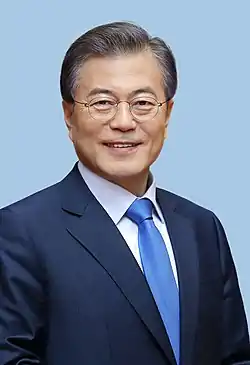
| President of South Korea | Moon Jae-in |
| Leader | Song Young-gil |
| Floor leader | Yun Ho-jung |
| Secretary-General | Youn Kwan-suk |
| Chair of the Policy Planning Committee | Park Wan-joo |
| Founded | 26 March 2014 (as New Politics Alliance for Democracy) 28 December 2015 (as Democratic Party) |
| Merger of | Minjoo Party Platform Party |
| Preceded by | Democratic Party New Politics Alliance |
| Headquarters | 7, Gukhoe-daero 68-gil, Yeongdeungpo District, Seoul |
| Think tank | The Institute for Democracy |
| Youth wing | Democratic Party of Youth |
| Membership (2019) | 4,065,408[1] |
| Ideology | Liberalism (South Korea)[A] Factions: Conservative liberalism[2][8] Social liberalism[9][10] Social conservatism[17][18] Left-wing populism[19][20][21] |
| Political position | Centre to centre-left (with centre-right factions)[A] |
| Colours | Blue (Democratic)[22] Blue (NPAD)[N 1][23] |
| Seats in the National Assembly | 169 / 300 |
| Metropolitan Mayors and Governors | 10 / 17 |
| Municipal Mayors | 151 / 226 |
| Seats within local government | 1,565 / 2,927 |
| Website | |
| theminjoo | |
^ A: DPK is recognized as a centre-left party because of its history of confrontation with major conservative forces in South Korea, including PPP, and media outlets sometimes call it "social-liberal",[27] but "social-liberal" is not an official or consistent ideology,[30] and some South Korean media and DPK politicians describe DPK's political line as "conservative-liberal", "conservative" or "centre-right".[31] | |
| Democratic Party of Korea | |
| Hangul | 더불어민주당 |
|---|---|
| Hanja | 더불어民主黨[N 2] |
| Revised Romanization | Deobureominjudang |
| McCune–Reischauer | Tŏburŏminjudang |
| New Politics Alliance for Democracy | |
| Hangul | 새정치민주연합 |
| Hanja | |
| Revised Romanization | Saejeongchi Minju Yeonhap |
| McCune–Reischauer | Saechŏngch'i Minju Yŏnhap |
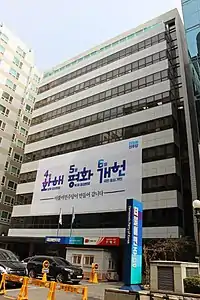
The party was founded on 26 March 2014 as a merger of the Democratic Party and the preparatory committee of the New Political Vision Party (NPVP). The former Democratic Party was legally absorbed into the NPAD after the latter's creation, while the preparatory committee of the NPVP was dissolved, with members who supported the merger joining the NPAD individually.
History
Formation and Ahn–Kim leadership (March–July 2014)

The Democratic Party was formed as the New Politics Alliance for Democracy (새정치민주연합; Saejeongchi Minju Yeonhap) on 26 March 2014 after the independent faction led by Ahn Cheol-soo, then in the process of forming a party called the New Political Vision Party, merged with the main opposition Democratic Party, led by Kim Han-gil. Ahn and Kim became joint leaders of the new party.[35] The party performed poorly in by-elections that July, however, and both leaders stepped down, having served for three months. Leadership of the party was assumed by an emergency committee.[36]
Ahn–Moon split (2015–16)
The next year, at a party convention on 7 February, Moon Jae-in was elected the new chairman of the party.[37] Moon, who had previously served as chief of staff for former president Roh Moo-hyun,[37] was the leader of the party's "pro-Roh" faction, which was opposed to Ahn and Kim. Moon came under fire for imposing a "pro-Roh hegemony" in the party, as Ahn and Kim were jeered and harassed at a memorial service for Roh held in May 2015.[38]
The party hemorrhaged support as the factional conflict intensified, falling from around 40 to 30 percent in opinion polls.[39] A survey conducted on 12–14 November showed that supporters of the party wanted Ahn and Seoul mayor Park Won-soon to assume the leadership alongside Moon.[40] On 29 November, Ahn rejected a proposal from Moon to establish a joint leadership,[41] and the next month he presented Moon with an ultimatum, demanding that he would call a convention to elect a new party leader. Moon rejected the demand,[42] and Ahn left the party.[43]
Ahn was followed by a number of supportive NPAD assembly members, including his former co-leader Kim Han-gil,[44] and the group began preparations to form a new party.[45] On 12 January, Kwon Rho-kap, a former aide of President Kim Dae-jung and a popular figure in the party's traditional stronghold of Honam, also exited the party, similarly citing Moon's "pro-Roh hegemony".[46] Meanwhile, Ahn and Kim merged their group with that of another defector from the NPAD, Chun Jung-bae, to form the People's Party.[47]
Following the defections, the NPAD was renamed the Democratic Party of Korea on 27 December 2015, and Moon resigned on 27 January 2016.[48] Moon handed power to Kim Chong-in, an academic and former assemblyman who had more recently served as economic advisor to conservative President Park Geun-hye.[49][50] Kim was seen as an unexpected choice, as he had previously worked for the right-wing Chun Doo-hwan and Roh Tae-woo administrations in the 1980s,[51] serving as an assembly member for the ruling Democratic Justice Party and as health and welfare minister under Roh.[52]
Under Kim Chong-in (January–August 2016)
Kim Chong-in viewed the pro–Roh Moo-hyun faction and what he considered the extremist wing of the party as responsible for the party's troubles, and pledged to diminish their influence.[53] In the lead-up to the 2016 parliamentary election he moved against key members of the pro-Roh faction in the nominations process, deselecting Lee Hae-chan, who had been Prime Minister under Roh and was now chairman of the Roh Moo-hyun Foundation.[54] Lee left the party in response.[53] Kim's moves proved controversial, and many of his nominations for the party's proportional representation list were rejected by the rest of the party leadership, while favored candidates of Moon were ranked near the top of the approved list. Kim offered to resign in March, but decided to stay on as leader after a personal visit from Moon.[55] Kim affirmed that he would continue to attempt to change the party's image, stating that the events had shown the party was "still unable to move on from its old ways".[49]
2016 legislative election victory
Though losing votes to the People's Party formed by Ahn, Chun and Kim Han-gil—particularly in Honam[39]—the party emerged as the overall winner of the election, garnering a plurality of seats (123 seats) in the National Assembly with a margin of one seat over the Saenuri Party. Lee Hae-chan returned to the Assembly as an independent representing Sejong City. Following its election victory, Kim Chong-in announced that the Minjoo Party would change its emphasis from welfare to economic growth and structural reform. Kim stated that the party would also change its position to support the establishment of for-profit hospitals, in contrast to the party's earlier opposition to the policy.[56]
Under Choo Mi-ae (August 2016–August 2018)
2017 presidential election victory
After the constitutional court impeached President Park Geun-hye over bribery, the Democratic Party's Moon Jae-in won the presidential election with a 41.1% plurality of the votes, with Hong Joon-pyo of Liberty Korea coming second with 24%.
2018 local elections victory
2020 legislative election victory
On April 15, 2020, Democratic party won far more votes than any other parties, and 176 candidates were elected. It took took 180 seats in the 300-member National Assembly with its allies. The main opposition United Future Party (UFP) won 103 seats.[57]
Under Lee Nak-yon (August 2020–March 2021)
On 9 March 2021, Lee Nak-yon resigned as the leader of the Democratic Party of Korea to run for 2022 South Korean presidential election.[58]
2021 by-elections
Following the major losses in the 2021 by-elections, party leadership was reorganized.[59] Do Jong-hwan became the interim party President.[59]
2022 presidential election
In October 2021, the Democratic Party nominated Lee Jae-myung as its nominee in the 2022 presidential election. Lee had beat other contenders such as former Democratic Party leaders Lee Nak-yon and Choo Mi-ae for the nomination.
Political position
| Part of a series on |
| Liberalism in South Korea |
|---|
|
Democratic Party does not have a official and consistent ideology, but is generally described as a liberal party because of its historical position led by the South Korean democratization movement forces that resisted the anti-communist conservative military dictatorship.[60][61] In general, the Democratic Party's political position is considered centrist[62][63][64] or centre-left.[65][66][67] This party is sometimes described as a progressive party in contrast to conservatives, but it is not such a universal view and is referred to as a position between South Korea's "progressive" and "conservative".[68][69] DPK's key figures describe DPK as "centre-right" and "conservative". Some South Korean media have also described NPAD or DPK as a "centre-right party" or "conservative party".[3][4][5][6][7]
Economic policies
DPK supports the expansion of fiscal expenditures to gradually increase welfare, but there is in part an element of economic liberal (fiscal conservative).[28][29] The Party supports the market economy, but it also values the need for state intervention in the market.[70] The Party pledged in 2020 to implement a version of the Green New Deal to move South Korea to carbon neutrality by 2050.[71]
Labour policies
The Party takes a favorable stance on government intervention in the market, while keeping some distance from labour politics and labour movements. For this reason, labour have evaluated it as a (with the intention of distinguishing it from "liberal," which means centre-left politics in some countries) "conservative-liberal" party.[2]
Social policies
DPK's social position is inconsistent. DPK is generally classified as a liberal political party, but it is also influenced by Christian forces, so it has a some social conservative character. The Party was opposed to legislation on homosexuality and same-sex marriage during the 2018 local elections.[72] In addition, some Democratic politicians have taken a very conservative stance on some social issues.[12][73][74][18] However, DPK opposes discrimination against homosexuals themselves in a narrow sense, (not same-sex marriage,) and argues that they should be recognized as citizens with dignity.[72][75]
Many DPK politicians are friendly to the etiquette and Confucian traditions of Korean culture.[76][77] The Hankyoreh and Hankook Ilbo, South Korean socially liberal journalists, strongly criticized DPK for holding a discussion on the pros and cons of the anti-discrimination law and giving anti-LGBT the right to speak.[78][79]
DPK's policy in perspective rooted in Christianity are also criticized by other religious circles. In December 2021, the Moon Jae-in government launched a campaign to promote carol music in stores such as restaurants and cafes, and invested 1.2 billion won (10,000,000 U.S. dollars. As of 2021). The Buddhist community strongly protested, calling it a policy that gives preferential treatment to a specific religion.[80]
However, DPK is not socially conservative in every way. DPK's socially conservative (in issues related to LGBT or feminism) is mainly based on Christianity,[12] so it shows a moderate to relative liberal position on agendas related to right-wing Confucian socially conservatism. DPK contributed to the complete abolition of the law in 2021 advocating parents' corporal punishment for their children's corporal punishment. DPK also supports strengthening punishment for domestic violence.[81][82]
DPK negatively views South Korea's dog meat intake culture and has criticized it from the perspective of liberalism. President Moon Jae-in said he was even considering a legal ban on dog meat in September 2021.[83] DPK also actively supports the rights of vegetarians and vegan citizens.[84] In addition, DPK supports liberal reform on student rights issues.[85]
DPK is taking an ambiguous position that neither supports nor opposes the abolition of the National Security Act.[86]
Reunification of North and South Korea
The Party strongly supports the denuclearization of the Korean Peninsula and aims for peaceful relations with North Korea. The party also officially advocates increasing exchanges and cooperation with the North to create a foundation for reunification.[87] Some conservative media outlets criticize the Democratic Party lawmakers for being overly conciliatory toward North Korea.[88]
List of leaders
Current leadership
| Office | Officer(s) |
|---|---|
| Leader of the Democratic Party | Song Young-gil |
| Floor leader in the National Assembly | Yun Ho-jung |
| Elected members | Kim Yong-min, Kang Byung-won, Back Hye-ryun, Kim Young-bae, Jun Hye-sook |
Leaders
- Note: ERC - as head of Emergency Response Committee
| No. | Name | Photo | Term of office | Election results | ||||
|---|---|---|---|---|---|---|---|---|
| Took office | Left office | |||||||
| 1 | Co-leadership
|
.jpg.webp) .jpg.webp) |
26 March 2014 | 31 July 2014 | no election | |||
| — | Park Young-sun (ERC) |
4 August 2014 | 18 September 2014 | appointed | ||||
| — | Moon Hee-sang (ERC) |
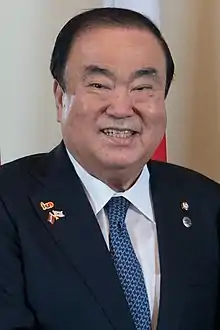 |
18 September 2014 | 9 February 2015 | appointed | |||
| 2 | Moon Jae-in (resigned) |
|
9 February 2015 | 27 January 2016 |
Moon Jae-in – 45.3% Park Jie-won – 41.8% Lee In-young – 12.9% | |||
| — | Kim Chong-in (ERC) |
.jpg.webp) |
27 January 2016 | 27 August 2016 | appointed | |||
| 3 | Choo Mi-ae | 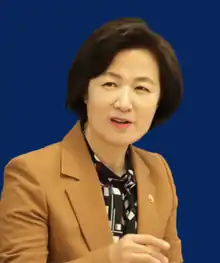 |
27 August 2016 | 25 August 2018 |
Choo Mi-ae – 54.03% Lee Jong-kul – 23.89% Kim Sang-gon – 22.08% | |||
| 4 | Lee Hae-chan | .jpg.webp) |
25 August 2018 | 29 August 2020 |
Lee Hae-chan – 42.88% Song Young-gil – 30.73% Kim Jin-pyo – 26.39% | |||
| 5 | Lee Nak-yon | _(cropped).jpg.webp) |
29 August 2020 | 9 March 2021 |
Lee Nak-yon – 60.77% Kim Boo-kyum – 21.37% Park Joo-min – 17.85% | |||
| — | Kim Tae-nyeon (acting) |
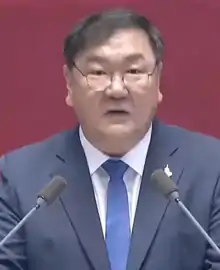 |
9 March 2021 | 8 April 2021 | succeeded | |||
| — | Do Jong-hwan (ERC) |
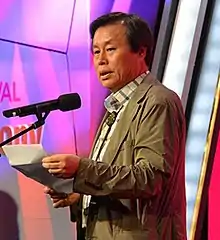 |
8 April 2021 | 16 April 2021 | appointed | |||
| — | Yun Ho-jung (ERC) |
16 April 2021 | 2 May 2021 | succeeded | ||||
| 6 | Song Young-gil |  |
2 May 2021 | incumbent | elected | |||
Floor leaders
| No. | Name | Term of office | |
|---|---|---|---|
| Took office | Left office | ||
| 1 | Jun Byung-hun | 26 March 2014 | 7 May 2014 |
| 2 | Park Young-sun | 7 May 2014 | 2 October 2014 |
| — | Kim Yung-rok (acting) |
2 October 2014 | 8 October 2014 |
| 3 | Woo Yoon-keun | 8 October 2014 | 6 May 2015 |
| 4 | Lee Jong-kul | 6 May 2015 | 4 May 2016 |
| 5 | Woo Sang-ho | 4 May 2016 | 16 May 2017 |
| 6 | Woo Won-shik | 16 May 2017 | 11 May 2018 |
| 7 | Hong Young-pyo | 11 May 2018 | 8 May 2019 |
| 8 | Lee In-young | 8 May 2019 | 7 May 2020 |
| 9 | Kim Tae-nyeon | 7 May 2020 | 8 April 2021 |
| 10 | Yun Ho-jung | 16 April 2021 | incumbent |
Secretary-General
| No. | Name | Term of office | |
|---|---|---|---|
| Took office | Left office | ||
| 1 | Ahn Gyu-back | 27 August 2016 | 16 May 2017 |
| 2 | Lee Choon-suak | 16 May 2017 | 3 September 2018 |
| 3 | Yun Ho-jung | 3 September 2018 | 31 August 2020 |
| 4 | Park Kwang-on | 31 August 2020 | 4 May 2021 |
| 5 | Youn Kwan-suk | 4 May 2021 | incumbent |
Election results
Presidential elections
| Election | Candidate | Total votes | Share of votes | Outcome |
|---|---|---|---|---|
| 2017 | Moon Jae-in | 13,423,800 | 41.1% | elected  |
General elections
| Election | Total seats won | Total votes | Share of votes | Outcome of election | Status | Election leader |
|---|---|---|---|---|---|---|
| 2016 | 123 / 300 |
6,069,744 | 25.5% |  4 seats; Plurality 4 seats; Plurality |
Opposition | Kim Chong-in |
| 2020 | 180 / 300 |
9,307,112 | 33.4% |  57 seats; Majority 57 seats; Majority |
Governing | Lee Hae-chan |
Local elections
| Election | Metropolitan mayor/Governor | Provincial legislature | Municipal mayor | Municipal legislature | Election leader |
|---|---|---|---|---|---|
| 2014 | 9 / 17 |
349 / 789 |
78 / 226 |
1,157 / 2,898 |
Kim Han-gil Ahn Cheol-soo |
| 2018 | 14 / 17 |
652 / 824 |
151 / 226 |
1,638 / 2,927 |
Choo Mi-ae |
By-elections
| Election | Metropolitan mayor/Governor | Municipal mayor | Provincial legislecture | Municipal legislature | Election leader |
|---|---|---|---|---|---|
| 2021 | 0 / 2 |
0 / 2 |
2 / 8 |
2 / 9 |
Kim Tae-nyeon |
See also
- Politics of South Korea
- Democratic Party (South Korea, 2000)
- Uri Party
- Democratic Party (South Korea, 2008)
- Democratic Party (South Korea, 2011)
- Gangnam liberal (factions)
- Liberal Party (Philippines) - This party is also called social liberal, but it has a partially conservative character and is similar to DPK in that it was influenced by Christianity.
Footnotes
References
- National Election Commission. "2019년도 정당의 활동개황 및 회계보고" (in Korean).
- "'더불어민주당 2중대'로서 정의당" [The Justice Party, which became the "second party of the Democratic Party of Korea".]. 매일노동뉴스. 4 November 2021. Retrieved 4 November 2021.
... 집값은 오르고 불로소득은 넘쳐 나고 빈부격차도 심해졌다. 노동 개혁도 엉망진창이다. 코로나19라는 악재가 있으나, 보수적 자유주의 정당인 더불어민주당의 성격을 고려할 때 정권 출범부터 예견됐던 일이다.
[... Housing prices rose, unearned income overflowed, and the gap between the rich and the poor widened. labour reform is also a mess. Although there is a negative factor called COVID-19, it has been predicted since the inauguration of the regime considering the nature of the conservative liberal party, the Democratic Party of Korea.] - "이해찬 "민주당 진보적인 당 아니다…중도 우파 정도"" [Lee Hae-chan said, "The Democratic Party is not a progressive party. It's centre-right party"]. JoongAng Ilbo. 21 September 2021. Retrieved 10 October 2021.
- "이재명 "보수 가치 제대로 서는 나라 만들고 싶어"" [Lee Jae-myung said "I want to create a country where conservative values are properly established".]. Yonhap News Agency. 21 September 2021. Retrieved 11 October 2021.
- "'중도보수' 표방 새정치연합, '세모녀 법'등 민생정치도 '흔들'" [People's livelihood politics such as the NPAD, which advocates 'moderate conservatism', and the "three-mother-daughter law" shake.]. 참세상. 31 March 2014.
- "실제 '중도 우파' 더불어민주당이 극좌파로 몰리는 대한민국 현실" [The reality of Korea, where the Democratic Party of Korea, which is actually "centre-right", is flocking to the extreme left.]. 뉴스프리존. 4 April 2019.
- "'"부동산 규제 풀자" "노동유연성 확대"… 여기 민주당 맞나요" ["Let's lift real estate regulations.", "Expanding labor flexibility." Is this the Democratic Party?]. 서울신문. 6 May 2020.
더불어민주당이 21대 총선에서 163석의 '슈퍼 여당'으로 몸집을 키우면서 내부에서는 보수적 색채가 점차 번져 가고 있다.
[As the Democratic Party of Korea has grown into a 163-seat "super ruling party" in the 21st general elections, conservative colors are gradually deepening inside.] - [3][4][5][6][7]
- "권인숙 "차별금지법은 절대 합의 사안 아니다"" [Kwon In-sook said, "The anti-discrimination law is never an agreement matter."]. 미디어스. 18 March 2021. Retrieved 13 December 2021.
... 권인숙 더불어민주당 인권위원장은 “차별금지법 제정은 국민적 합의가 필요한 사안이 절대 아니고 우리의 결단이 필요한 것”이라고 말했다.
[... Kwon In-sook, chairman of the Democratic Party of Korea's Human Rights Commission, said, "The enactment of the anti-discrimination law is not an issue that requires national consensus, but requires our decision."] - ""동성애 반대하죠" 文 발언 그후···차별금지법 딜레마 빠진 與" [After Moon Jae In said that he opposes homosexuality... The (liberal) ruling party in a dilemma in enacting the anti-discrimination law.]. JoongAng Ilbo. 30 June 2021. Retrieved 13 December 2021.
더불어민주당에서는 비례대표인 권인숙·이동주 의원이 공동 발의자로 나섰다. ... 하지만 민주당의 전체적인 기류는 여전히 소극적이다.
[In the Democratic Party of Korea, proportional representatives Kwon In-sook and Lee Dong-joo have co-proposed (the Anti-Discrimination Act). ... However, the overall atmosphere of the Democratic Party is still passive] - "How religion spurs homophobia in South Korean politics". Nikkei Asia. 26 March 2021.
- "South Korea After Park". Jacobin magazine. 18 May 2017. Retrieved 13 February 2021.
... At the same time, however, he belongs to the Catholic Church and holds some socially conservative views. When asked during a debate about the military’s persecution of gay soldiers, Moon responded that he opposed homosexuality in general.
- "The politics of homophobia in South Korea". East Asia Forum. 4 July 2016.
- Steger, Isabella. "Being a progressive politician in Korea doesn't stop you from being homophobic". Quartz. Retrieved 8 December 2019.
- ""중증장애인 삶은 늘 코로나 재난" 거리로 나온 장애인들 (Disabled people who have taken to the streets "Life with severe disabilities is always a disaster like COVID-19")" (in Korean). 이데일리. 4 April 2020. Retrieved 10 May 2020.
- "'성소수자 차별·낙태 금지' 수호자가 대한민국 총리라니요 (The Guardian of the Prohibition of Discrimination and Abortion in LGBT is the Prime Minister of the Republic of Korea?)" (in Korean). OhmyNews. 5 December 2019. Retrieved 22 April 2020.}}
- [11][12][13][14][15][16]
- ""광기 페미니즘" 글 공유한 이재명…이대남 잡고 페미 손절?" [Lee Jaemyeong, who shared a message saying "crazy feminism"... This antagonizing feminism in partnership with a man in 20s?]. JoongAng Ilbo. 11 November 2021. Retrieved 13 November 2021.
‘페미니즘과 거리를 둬야 한다’는 취지의 글을 이 후보가 공유한 건 이번이 처음이 아니다. 앞서 지난 8일에는 중앙선대위 회의 직후 참석자들에게 ‘2030 남자들이 펨코에 모여서 홍(홍준표)을 지지한 이유’라는 온라인 커뮤니티 글을 함께 읽어보자며 내용을 프린트해서 배포했다.
- "After Choi-gate". Jacobin magazine. 12 June 2016. Retrieved 16 November 2021.
This allows a populist figure like Lee Jae-myung, mayor of wealthy satellite city Seongnam, to be presented as a progressive presidential candidate, simply because he instituted a minor basic income program and has directly called for President Park’s imprisonment.
- Shin, Hyonhee (14 September 2021). "'S.Korea's Bernie Sanders' tops presidential polls with talk of universal basic income". Reuters. Retrieved 11 October 2021.
- "이재명 "청년 위해 필요하다면 기꺼이 포퓰리즘"" [Lee Jae-myung said "If necessary, I will be a populist for young people."]. 아시아투데이. 7 November 2021. Retrieved 13 November 2021.
- Democratic Party of Korea. "더불어민주당 로고(Logo of the Democratic Party of Korea)" (in Korean).
- Park, Cheoljoong (16 March 2014). 바다파랑 '새정치민주연합', 썩지 않는 바다처럼 (in Korean). News1. Retrieved 22 April 2014.
- JUNHYOUNG LEE; JORGE TAMAMES (25 March 2020). "Lecciones de Corea del Sur". politicaexterior.com (in Spanish).
El Partido de la Libertad de Corea (conservador) ha criticado al actual gobierno (del socio-liberal Partido Demócrata) por promover iniciativas en este ámbito.
- "South Korea ahead of legislative elections" (PDF). European Parliamentary Research Service. 7 April 2016.
The social-liberal Minjoo Party of Korea (MPK, Together Democratic Party) is the main opposition force.
- "An Identity Crisis for South Korea's Opposition". The Diplomat. 31 December 2015.
South Korea's main opposition social-liberal party is reeling (again) from intraparty factional struggle. Rebranded earlier this week "the Minjoo Party of Korea" (formerly New Politics Alliance for Democracy), the party is searching for a new identity and direction after high profile and popular assemblyperson Ahn Cheol-soo defected on December 13.
- [24][25][26]
- "'"부동산 규제 풀자" "노동유연성 확대"… 여기 민주당 맞나요" ["Let's lift real estate regulations.", "Expanding labor flexibility." Is this the Democratic Party?]. 서울신문. 6 May 2020.
더불어민주당이 21대 총선에서 163석의 '슈퍼 여당'으로 몸집을 키우면서 내부에서는 보수적 색채가 점차 번져 가고 있다. (As the Democratic Party of Korea has grown into a 163-seat "super ruling party" in the 21st general elections, conservative colors are gradually deepening inside.)
- "이재명 "관료적 규제 없애야...내가 친기업 1등"" [Lee Jae-myeong said, "We need to get rid of bureaucratic regulations ... I'm the number 1 pro-business".]. 머니투데이. 11 November 2021. Retrieved 29 November 2021.
이 후보는 이날 서울 중구 대한상공회의소에서 최태원 대한상의 회장과 만나 "창의와 혁신을 가로막는 관료적 규제는 축소하거나 없애야 하는 것"이라면서 "기업은 새로운 아이템 발굴이 자유롭게 이뤄질 수 있도록 해야한다"고 밝혔다.
[Candidate Lee met with Choi Tae-won, chairman of the Korea Chamber of Commerce and Industry, at the Korea Chamber of Commerce and Industry in Jung-gu, Seoul, and said "Bureaucratic regulations that hinder creativity and innovation should be reduced or removed", "Companies should be free to discover new items".] - [11][12][18][13][14][15][16][28][29]
- [2][3][4][5][6][7]
- Park, Seung-ju (19 October 2016). 더민주, 오늘 원외 민주당 통합...'민주당' 이름 되찾는다 (in Korean). News1. Retrieved 19 October 2016.".
- "Main Opposition To Be Called 'The Minjoo Party Of Korea'". tbs.seoul.kr. Traffic Broadcasting System. 30 December 2015. Retrieved 30 December 2015.
- Choi, He-suk (20 March 2014). 새정치민주연합 영문 당명 확정 (in Korean). The Korea Herald. Retrieved 22 April 2014.
- "Democratic Party, Ahn Cheol-soo agree to create new party". The Dong-A Ilbo. 3 March 2014. Retrieved 15 April 2016.
- "Co-chairmen quit amid election rubble". Korea JoongAng Daily. 1 August 2014. Retrieved 15 April 2016.
- "Main opposition party picks ex-Roh aide as new leader".
- "Roh son's speech creates stir". The Korea Times. 24 May 2015. Retrieved 17 April 2016.
- "In liberal stronghold, voters give main opposition party a lashing". The Hankyoreh. 14 April 2016. Retrieved 17 April 2016.
- "NPAD supporters wish for troika". Korea JoongAng Daily. 18 November 2015. Retrieved 17 April 2016.
- "Ahn rejects Moon's call for joint NPAD leadership". The Korea Herald. 29 November 2015. Retrieved 15 April 2016.
- "NPAD's Moon rejects Ahn demand". Korea JoongAng Daily. 9 December 2015. Retrieved 15 April 2016.
- "Ahn Cheol-soo calls it quits with NPAD". The Korea Times. 13 December 2015. Archived from the original on 25 April 2016. Retrieved 15 April 2016.
- "Kim departs party he co-founded". Korea JoongAng Daily. 4 January 2016. Retrieved 16 April 2016.
- "Ahn vows to move forward as 3rd political force". The Korea Herald. 4 January 2016. Retrieved 16 April 2016.
- "Former Kim DJ aide exits Minjoo Party". The Korea Herald. 12 January 2016. Retrieved 17 April 2016.
- "Ahn Cheol-Soo, Chun Jung-Bae To Create New Party". TBS eFM. 25 January 2016. Archived from the original on 25 April 2019. Retrieved 12 April 2016.
- "Moon Jae-in steps down as leader of The Minjoo Party of Korea". The Hankyoreh. 28 January 2016. Retrieved 17 April 2016.
- "Minjoo's identity must be changed: Kim Chong-in". Korea JoongAng Daily. 24 March 2016. Retrieved 17 April 2016.
- "South Koreans go to the polls in parliamentary election". Business Insider. 13 April 2016. Retrieved 17 April 2016.
- "Can a Right Wing Defector Save Korea's Liberal Opposition?". The Diplomat. 22 March 2016. Retrieved 18 April 2016.
- "South Korean president replaces minister, 6 Cabinet members". United Press International. 19 July 1989. Retrieved 18 April 2016.
- "Former P.M. quits Minjoo Party in nomination feud". The Korea Herald. 15 March 2016. Retrieved 17 April 2016.
- "Kim Jong-in Gets Rid of Pro-Roh Dominance and Replaces the Mainstream: Signs of Factional Conflict". The Kyunghyang Shinmun. 15 April 2016. Retrieved 17 April 2016.
- "Opposition chief quells dissenters". The Korea Herald. 23 March 2016. Retrieved 17 April 2016.
- "Opposition party shifting to growth". The Korea Times. 21 April 2016. Archived from the original on 22 April 2016. Retrieved 21 April 2016.
- "South Korea's governing party wins election by a landslide".
- "DP Chair Steps Down to Prepare for Presidential Election". KBS World. 9 March 2021. Retrieved 10 March 2021.
- "충격의 與, 지도부 전원 사퇴…비대위 체제 돌입". 8 April 2021. Retrieved 8 April 2021.
-
- Jesús Velasco (4 July 2019). American Presidential Elections in a Comparative Perspective: The World Is Watching. Rowman & Littlefield. p. 154. ISBN 978-1498557580.
- "South Korean President Moon Says Open to North Korea Visit". Voice of America. 10 April 2017. Retrieved 13 February 2021.
- "South Korea Is a Liberal Country Now". Foreign Policy. 16 April 2020. Retrieved 13 February 2021.
- "South Korea: Seoul Mayor Park Won-soon found dead in apparent suicide". Deutsche Welle. 10 July 2020. Retrieved 13 February 2021.
Park Won-soon was a member of President Moon Jae-in's liberal Democratic Party and had been touted for a run at becoming South Korea's president in the country's next national elections in 2022.
- The Democratic Party of Korea is described as a liberal party by numerous sources:
- S. NATHAN PARK (16 April 2020). "South Korea Is a Liberal Country Now". Foreign Policy.
To be sure, the Democrats, the main liberal party, were expecting a good result.
- "Democratic Party of Korea". Britannica.
Democratic Party of Korea (DP), Korean Daeburo Minjudang, centrist-liberal political party in South Korea.
- Steven Denney (13 March 2017). "South Koreans Can't Agree What Democracy Is". Foreign Policy.
It doesn’t help Hwang’s credibility that the main opposition Minjoo Party, the liberal party with the most seats in the legislature, declared at the end of February its intent to see Hwang impeached for his refusal to grant a special prosecutor the right to continue its probe into the corruption scandal.
- Steven Denney (12 August 2016). "Dong-A Ilbo Sees Minjoo Party at a Crossroads". sino NK.
Having been handily defeated in the last two presidential elections (2007 and 2012), some say that the main liberal party, the Minjoo Party (더불어 민주당) is in need of an identity change.
- Steven Borowiec (24 February 2016). "South Korean lawmakers try first filibuster since 1969 to block anti-terrorism bill". Los Angeles Times.
In recent years, the main liberal party, now the Minjoo Party, has changed its name, and had many high-profile members defect amid infighting and electoral defeats.
- S. NATHAN PARK (16 April 2020). "South Korea Is a Liberal Country Now". Foreign Policy.
- The Democratic Party of Korea is described as a centrist party by numerous sources:
- "Democratic Party of Korea". Britannica.
Democratic Party of Korea (DP), Korean Daeburo Minjudang, centrist-liberal political party in South Korea.
- Andrew Walter (31 October 2019). "Political Populism: Eroding Asia's Complex Interdependence?" (PDF). Nanyang Technological University. S. Rajaratnam School of International Studies.
The South Korean President Moon Jae-in’s centrist-liberal Democratic Party has also reflected and tactically deployed the considerable popular nationalist sentiment in South Korean society as he vowed in early August that in the escalating bilateral trade dispute the country would “never again lose to Japan”.
- "South Korea: Economic and Political Outline". Santander. July 2019. Retrieved 21 July 2019.
The Minjoo Party: centre, socially liberal main opposition party, result of a 2014 merger between the Democratic Party and the New Political Vision Party, first party in the Parliament since August 2017
- "The substance of a Korean Green New Deal is still being defined". Chinadialogue.net. 1 July 2020.
During South Korea's parliamentary election in mid-April, which was the world’s first national election amid the pandemic, the ruling centrist Democratic Party of Korea (DPK), the centre-right Party for People’s Livelihoods (PPL), the centre-left Justice Party (JP) and the left Green Party Korea (GPK) all made pledges around a “Green New Deal".
- "The Justice Party and the South Korean Left: A movement with potential, but divided and struggling". Europe Elects. 14 November 2019.
With most of national politics dominated by the centrist Democratic Party and the right-wing Liberty Korea Party (자유한국당), successor to the former governing Saenuri Party, there is little space for the Justice Party to find an opening for electoral success.
- Ahn, JH (19 September 2016). "South Korea split over whether to aid "arch-nemesis" in flood relief". NK news.org.
Her party, Saenuri, has also remained silent on the issue, in sharp contrast to centrist Minjoo Party [sic], which on Monday urged Seoul to look beyond politics and help its neighbor.
- "North Korean dissident Thae Yong-ho running for seat in South Korean parliament". AsiaNews. 11 February 2020. Retrieved 8 July 2020.
The conservative Liberty Korea Party (LKP), the main opposition to President Moon Jae-in and his centrist Democratic Party, made the announcement today
- "Democratic Party of Korea". Britannica.
- Sanghun Lee (9 July 2020). "The substance of a Korean Green New Deal is still being defined". Eco Business.
During South Korea’s parliamentary election in mid-April, which was the world’s first national election amid the pandemic, the ruling centrist Democratic Party of Korea (DPK), the centre-right Party for People’s Livelihoods (PPL), the centre-left Justice Party (JP) and the left Green Party Korea (GPK) all made pledges around a "Green New Deal"
- Soo Kim, ed. (2020). How to Live Korean. Quarto Publishing Group UK. p. 107. ISBN 9780711257092.
South Korea's two main political parties today include the Democratic Party of Korea (the centrist liberal group and latest ruling party of The National Assembly) and the Liberal Korea Party (the conservative, far right-wing party).
- "The Squid Game presidential battle: South Korean frontrunner aims to address inequalities highlighted in hit Netflix drama". The Telegraph. 16 October 2021. Retrieved 13 November 2021.
... clinched the presidential nomination for the ruling centre-left Democratic party, hoping to succeed Moon Jae-in, the current president,...
- "Moon Jae-in: South Korean liberal claims presidency". BBC. 9 May 2017. Retrieved 2 October 2019.
Mr Moon, of the centre-left Democratic Party, unsuccessfully ran against Ms Park in 2012 elections.
- "South Koreans set to continue backing President Moon's agenda in local elections". Foreign Brief. 13 June 2017. Retrieved 7 December 2019.
his centre-left Democratic Party of Korea is expected to make major political gains
- "[제20대 국회의원 선거] 정당(政黨) 이야기". The Chosun Ilbo. 23 March 2016. Retrieved 16 January 2021.
- "2022년 대선에 대처하는 정의당의 자세". The Hankyoreh. 21 September 2021. Retrieved 10 October 2021.
- "與 '큰 정부' 앞세워 시장개입...'공정경제'로 맞불". SIGNAL. 31 July 2018. Retrieved 14 December 2020.
- Farand, Chloé (16 April 2020). "South Korea to implement Green New Deal after ruling party election win". Climate Change News. Climate Home News Ltd. Retrieved 16 April 2020.
- "지방선거 앞둔 주요 정당들 "동성애·동성혼 반대"". 뉴스앤조이. 31 May 2018. Retrieved 14 December 2020.
- "민주당 "성소수자 문제 소모적" 발언에 민생·정의 "차별적 인식"". KBS NEWS. 7 March 2020. Retrieved 10 October 2021.
- "윤호중 "극우·극좌와는 연합 못해…이념·성소수자문제 소모적"". Yonhap News Agency. 17 March 2020. Retrieved 10 October 2021.
- "이재명 "동성애, 인정해야…성적 지향 차별 안돼"". 이데일리. 17 March 2020. Retrieved 30 November 2021.
- "경기도의회,배수문 의원, 학교 현장에 필요한 교육복지사 태부족 지적". 경인투데이뉴스. 10 November 2020. Retrieved 14 December 2020.
- "문경희 경기도의회 부의장, '나를 낮추고 상대를 높이는 다례교육' 참여". 서울신문. 21 October 2020. Retrieved 14 December 2020.
- "'성소수자 혐오' 판 깔아준 민주당". 한겨레. 25 November 2021. Retrieved 28 December 2020.
- "속 보이는 민주당 차별금지법 토론회". 한국일보. 26 November 2021. Retrieved 28 December 2020.
- "정부, 캐럴 활성화 캠페인에 12억 배정…불교계 반발". JTBC. 6 December 2021. Retrieved 6 December 2020.
- ""법으로 아이 체벌 금지"···신현영 의원, '여행가방' 아동학대 등 관련 개정안 발의". 경향신문. 11 June 2020. Retrieved 28 December 2020.
- "'자녀 체벌 못 한다'…민법 개정안 국무회의 통과". 중앙일보. 13 October 2020. Retrieved 28 December 2020.
- "동물단체들, 문 대통령 '개 식용 금지 검토'에 "더 없이 반가운 소식"". Hankook Ilbo. 13 August 2021. Retrieved 14 December 2021.
- ""채식도 기본권!"… 서울시 조례로 보호한다". Hankook Ilbo. 6 March 2021. Retrieved 14 December 2021.
- "문장길, 복장 규제 등 학생인권 침해 방지 조례 통과". 송파타임즈. 9 March 2021. Retrieved 14 December 2021.
- "152석 열린우리당 때 실패한 '국보법 폐지' 재부상… 與 일단 "논의안해"" [The issue of "abolishing the National Security Act", which failed during the 152-seat Uri Party, has resurfaced… The ruling party DPK said, "We will not discuss it."]. The Chosun Ilbo. 17 April 2020. Retrieved 16 December 2021.
- 강령·당헌·당규·윤리규범 (in Korean). Democratic Party of Korea. Retrieved 8 December 2019.
- ""북한은 잘못 없다" 민주당 의원들의 이상한 합창". 조선일보. 15 June 2020. Retrieved 14 December 2020.
- "더불어민주당 최고위원" [Supreme committee members]. theminjoo.kr (in Korean). Retrieved 29 May 2021.
External links
- Official website
 (in Korean)
| Leaders (acting) | |
|---|---|
| Presidential candidates Presidents | |
| Floor leaders |
|
| Preceding parties |
|
| Splinter parties |
|
| Satellite party | |
| Related articles | |
 Liberalism portal Liberalism portal | |
Authority control | |
|---|---|
| General | |
| National libraries | |