Nezak Tarkan
Nezak Tarkan was a nomadic ruler of Tokharistan who led a revolt against the Arab commander Qutayba bin Muslim around 709 CE.[1]
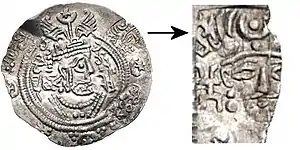
.gif) . Time of Nezak Tarkan, circa 700 CE.
. Time of Nezak Tarkan, circa 700 CE.Nezak Tarkan is first mentioned in 651 CE as the Hephthalite ruler of Badghis, when he allied with the marzban of Merv against the Sasanian ruler Yazdegerd III.[2] Yazdegerd III was defeated and barely escaped with his life, but he was murdered in the vicinity of Merv soon after, and the Arabs managed to capture the city of Merv the same year.[2]
In 659, Chinese chronicles still mentioned the "Hephtalite Tarkans" (悒達太汗 Yida Taihan, probably related to "Nezak Tarkan"), as some of the rulers in Tokharistan who remained theoretically subjects to the Chinese Empire, and whose main city was Huolu 活路 (modern Mazār-e Sherif, Afghanistan).[3][4]
Circa 689 CE, the Hephthalite ruler of Badghis and the Arab rebel Musa ibn Abd Allah ibn Khazim, son of the Zubayrid governor of Khurasan Abd Allah ibn Khazim al-Sulami, allied against the forces of the Ummayad Caliphate.[5] The Hepthalites and their allies captured Termez in 689, repelled the Arabs, and occupied the whole region of Khorasan for a brief period, with Termez as they capital, described by the Arabs as "the headquarters of the Hephthalites" (dār mamlakat al-Hayāṭela).[6][7] The Arabs of the Ummayad Caliphate under Yazid ibn al-Muhallab re-captured Termez in 704.[5][3]
Nezak Tarkan, the ruler of the Hephthalites of Badghis, led a new revolt in 709 with the support of other principalities as well as his nominal ruler, the Yabghu of Tokharistan.[6] In 710, the Umayyad general Qutaiba ibn Muslim was able to re-establish Muslim control over Tokharistan and captured Nizak Tarkan, who was executed on the orders of al-Hajjaj ibn Yusuf, despite promises of pardon, while the Yabghu was exiled to Damascus and kept there as a hostage.[8][9][10]
According to some authors, he may have been of Nezak descent.[1]
References
- ALRAM, MICHAEL (2014). "From the Sasanians to the Huns New Numismatic Evidence from the Hindu Kush". The Numismatic Chronicle. 174: 281. ISSN 0078-2696.
- Beckwith 2009, p. 123.
- Referencing Tangshu XLIII, B, pp. 6-9 and Chavannes, Documents, p. 69, n. 2 in Grenet, Frantz (2002). "NĒZAK". In Yarshater, Ehsan (ed.). Encyclopædia Iranica, Online Edition. New York: Encyclopædia Iranica Foundation.
- Theobald, Ulrich. "The Western Territories 西域". www.chinaknowledge.de.
- Beckwith 2009, p. 132.
- Bosworth, C.E. (1988). "BĀḎḠĪS". In Yarshater, Ehsan (ed.). Encyclopædia Iranica, Volume III/4: Bačča(-ye) Saqqā–Bahai Faith III. London and New York: Routledge & Kegan Paul. pp. 370–372. ISBN 978-0-71009-116-1.
- Kennedy 2007, pp. 243–254.
- Gibb 1923, pp. 36–38.
- Shaban 1970, pp. 66–67.
- Esin, E. (1977). "Tarkhan Nīzak or Tarkhan Tirek? An Enquiry concerning the Prince of Badhghīs Who in A. H. 91/A. D. 709-710 Opposed the 'Omayyad Conquest of Central Asia". Journal of the American Oriental Society. 97 (3): 330. doi:10.2307/600737. ISSN 0003-0279.
Sources
- Beckwith, Christopher (2009). Empires of the Silk Road. Princeton University Press. ISBN 978-0-691-13589-2.
- Gibb, H. A. R. (1923). The Arab Conquests in Central Asia. London: The Royal Asiatic Society. OCLC 499987512.
- Kennedy, Hugh (2007). The Great Arab Conquests: How the Spread of Islam Changed the World We Live In. Philadelphia, Pennsylvania: Da Capo Press. ISBN 978-0-306-81740-3.
- Shaban, M. A. (1970). The ʿAbbāsid Revolution. Cambridge: Cambridge University Press. ISBN 0-521-29534-3.