Nezak
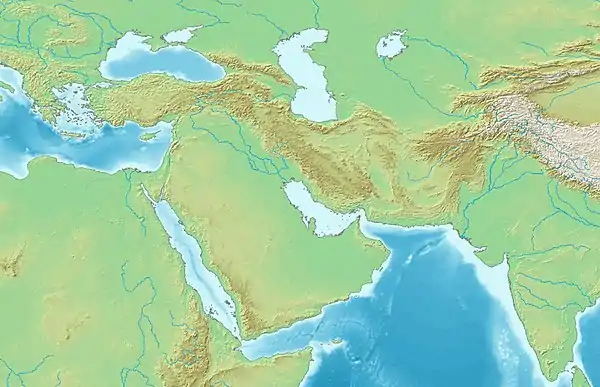
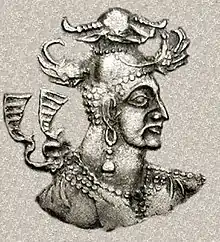
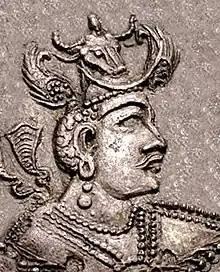
The Nezak Huns (Pahlavi: 𐭭𐭩𐭰𐭪𐭩 nycky),[2] also Nezak Shahs,[1] were one of the four groups of Huna people in the area of the Hindu Kush, active from circa 484 to 665 CE. The Nezak kings, with their characteristic gold bull's-head crown, ruled over Zabulistan (from Ghazni) and Kabulistan (from Kapisa). While their history is obscured, the Nezak's left significant coinage documenting their polity's prosperity. They were the last of the four major "Hunic" states known collectively as Xionites or "Hunas", their predecessors being, in chronological order, the Kidarites, the Hephthalites, and the Alchon.
Nezak Huns 𐭭𐭩𐭰𐭪𐭩 nycky | |||||||||||||
|---|---|---|---|---|---|---|---|---|---|---|---|---|---|
| 484–665 CE | |||||||||||||
 Royal Bull's-head crown of the Nezak kings
| |||||||||||||
| Capital | Ghazna Kapisa | ||||||||||||
| Common languages | Pahlavi script (written)[1] Middle Persian (common)[1] | ||||||||||||
| Religion | Buddhism Zoroastrianism | ||||||||||||
| Government | Nomadic empire | ||||||||||||
| Nezak Shah | |||||||||||||
• 6-7th century CE | Napki Malka | ||||||||||||
• 653 - 665 | Ghar-ilchi | ||||||||||||
| Historical era | Late Antiquity | ||||||||||||
• Established | 484 | ||||||||||||
• Disestablished | 665 CE | ||||||||||||
| Currency | Hunnic Drachm | ||||||||||||
| |||||||||||||
| Today part of | Afghanistan Pakistan | ||||||||||||



Etymology
_Vertical_layout.jpg.webp)
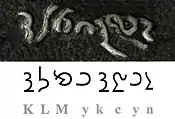
Although the Nezaks did not name individual rulers on their coinage, contrary to other groups such as the Alchons, they did inscribe the mention "King of Nezak" in Pahlavi on their coinage (𐭭𐭩𐭰𐭪𐭩𐭬𐭫𐭪 nycky MLK): the word "MLK" corresponds to the term Malik for "king", and the word "nycky" presumably corresponds to their ethnonym, hence the modern naming "Nezaks".[2][4][1] The use of Pahlavi on their coinage may reflect the importance of Middle Persian as the primary language of the regions of Zabulistan and Kabulistan at that time.[1]
Maria Magdolna Tatár compares Nezak to nizāk, a minor royal title, of non-Turkic provenance,[5] borrowed and borne by Turks north of the Oxus, to the Western Turkic title 泥孰 níshú, in reconstructed Middle Chinese *niei-źiuk, and to Manichaean Uighur nïğošak "auditor", Sogdian nwgš’k, and Parthian n(y)gwš’g, nywš’g.[6] According to Gerard Clauson, the Uyghur title nïğošak "auditor" is of Iranian origin and means "hearer."[7] Meanwhile, János Harmatta connected *niźük to unattested Saka *näjsuka- "fighter, warrior" from *näjs- "to fight".[8] Frantz Grenet sees a possible, yet not firmly established connection with Middle Persian nēzag spear.[9]
History
Establishment (484 CE)
The Nezak Huns established their realm in 484, after the defeat and death of the Sasanian King of Kings (shahanshah) Peroz I (r. 459–484) against the Hephthalites. The weakening of Sasanian authority in the east had for consequence that the Nezak Huns managed to take control of Zabulistan and started to mint their own coins.[10] According to Chinese sources, the founder of the dynasty was named "Khingal", who may or may not have been identical with the Khingila (430-495 CE) of the Alchon Huns, thereby pointing to a possible connection between the two groups.[4] The "Khingal dynasty" of the Nezal Huns ruled for twelve generations.[4]
The Nezaks started to mint their own coins on the Sasanian imperial coins, while also adopting aspects from the neighbouring Alkhan coins. They introduced the Pahlavi legend (𐭭𐭩𐭰𐭪𐭩𐭬𐭫𐭪 nycky MLK) "King of the Nezak" on their coinage (this legend was formerly misread as "Napki Malka").[1] They portrayed themselves with the winged crown of Peroz, on top of which they added their characteristic bull's head.[10] This remarkable bull's head was also mentioned in Chinese sources as an attribute of the so-called Nisai (phonetic for "Nezak") king of Kabul at that time.[11] The very adoption of the third crown of Peroz on their coinage indicates that they started to mint coins after 474 CE only.[10] The coin legend "nycky MLK" is either completed by an "ā" (Pahavi: 𐭠) or a "š" (Pahavi: 𐭮), which has led to suggestions that they might correspond to the mints of Ghazni and Kabul respectively, but this remains uncertain.[12]
From that point, the Nezaks consolidated their power in Zabulistan and in the 6th century expanded into Kabulistan, deposing the Alchon Huns from Kapisa.
Nezak coins with the bull's crown appear well into the 8th century, the design of their coinage continuing more or less unchanged for a period of about 150 years.[13][4] Coins however became more and more debased, as silver decreased in favour of alloys incorporating more and more copper.[4]
Early coins of the Nezak Huns have been discovered in the Buddhist monastery of Tepe Narenj.[14][15]
Confrontation with the Alchons retreating from India (circa 530 CE)
Around the middle of the 6th century CE, the Alchons, after having extensively invaded the heartland of India, had withdrawn from Kashmir, Punjab and Gandhara, and going back west across the Khyber pass they resettled in Kabulistan. It seems that there was a direct confrontation between the Alchon Toramana II and the Nezaks in Kabulistan, as he made overstrikes of Nezak coins, and at the same time adopted the Nezak bull's head in his own crown in some of his coins minted in Gandhara.[16]

The Nezaks also stopped minting coins in Ghazni around 560 CE.[4] This event may be linked to the resurgence of the Sasanian Empire under Khosrow I, as they allied to the Western Turks to defeat the Hepthalites and took control of Bactria.[16] The Sasanians may have taken control of Zabulistan on the same occasion, as suggested by the creation of Sasanian coin mints in the area of Kandahar during the reign of Ohrmazd IV (578-590 CE).[16]
Alchon-Nezak "Crossover coinage"

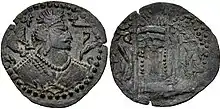
Having lost Ghazni and Kabul, the Nezak dynasty declined rapidly as indicated by the progressive elimination of Nezak symbols from the historical coin record. Their coinage suggests that they merged with the Alchon Huns, as "Alchon-Nezak Crossover" coins started to be minted. The new coins combined Nezak designs but abandonned the bull's head crown, which was replaced by a crown with three crescents enclosing a flower or a trident of the type worn by Toramana II on his coins.[17] Some coins also incoporate the Alchon tamgha symbol.[19][20] Later "Crossover" coins use a crown with a single crescent moon, with the king holding a flower in his hand.[17] The coin legends vaguely attempt to copy the original Pahlavi legend of Nezak coins, but becomes only decorative.[17][18] The double border adopted by some of these coins is a Sasanian innovation, which dates to 592/593 CE, and helps confirm Nezak dates.[17]
A confederacy probably emerged between the Nezaks and the Alchons, possibly against Turkic invaders.[21] They were able to take back Zabulistan from the Sasanians at the end of the 6th century CE.[17]
Last King: Ghar-ilchi (653-c.665 CE)
The last local king of Kapisi was the Nezak ruler known in the Chinese annals of 658 CE as "Hexiezhi" (Chinese: 曷撷支, reconstructed from Old Chinese: *γarγär-tśiě < *ghar-ilči), reconstructed as the Turkic "Ghar-ilchi" (*Qarγïlacï, 653-c.665 CE), 12th king of his dynasty from the founder "Xinnie" (馨孽, reconstructed from Old Chinese: *xäŋ-ŋär < *henger < Khingar/Khingal):[22][23][24]
In the third year of the Xianqing reign [658 CE], when [Tang envoys] investigated the customs of this state, people said: "From Xinnie, the founder of the royal house, up to the present [King] Hexiezi, the throne has been passed from father to son, [and by now] there have been twelve generations. In the same year, the city was established as Xiuxian Area Command
Ghar-ilchi had been formally installed as king of Jibin (罽宾国, former Kapisi/ Kabulistan) by the Chinese Tang Dynasty emperor in 653 CE, and was again confirmed as Governor of Jibin under the newly formed Chinese Anxi Protectorate, the "Protectorate of the Western Regions", in 661 CE.[25][27][28] Ghar-ilchi may have been the last member of a local "Khingal dynasty" possibly founded by Khingila.[28]
Replacement by the Turk Shahis (c.665 CE)
._After_679_in_the_style_of_the_Nezak_Huns.jpg.webp)
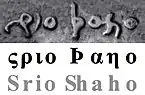
Eventually, the Nezak-Alchons were replaced by the Turk shahi dynasty,[21] first in Zabulistan and then in Kabulistan. The first known Turk Shahi ruler of Kapisi, named Barha Tegin, may have been initially a vassal in the service of Ghar-ilchi, but then revolted and usurped the throne.[28] He took control of the areas of Zabulistan, Kabulistan and Gandhara, and his name was recorded by the Arab historian Al-Biruni.[29] With the rise of the Turk Shahi, the coinage of the region started to incoporate a new legend, using the Indian honorific "Shri" ("Perfection") with the royal title "Shahi" in the Bactrian language (σριο Þανιο, Srio šauoi) and in Sanskrit (Śri Sāhi).[17]
The bull's head crown of the Nezaks remained popular in the coinage of the region well into the 8th century CE.[4] An 8th century ruler of Western Tokharistan was named Nezak Tarkan, and he played an important role in leading a revolt against the Arab commander Qutayba ibn Muslim circa 709/710 CE.[4] However, he may have been unrelated to the Nezak Huns, as his area of operation was quite remote from the original Nezak realm.[1]
Main rulers
Twelve mostly anonymous kings, forming a "Kingil dynasty". Only the first and last are known from Chinese sources: the last local king of Kapisi was the Nezak ruler known in the Chinese annals of 658 CE as "Hexiezhi" (Chinese: 曷撷支, reconstructed from Old Chinese: *γarγär-tśiě < *ghar-ilči), reconstructed as the Turkic "Ghar-ilchi" (*Qarγïlacï, 653-c.665 CE), 12th king of his dynasty from the founder "Xinnie" (馨孽, reconstructed from Old Chinese: *xäŋ-ŋär < *henger < Khingar/Khingal):[22][30][31]
- "Xinnie" (馨孽), reconstructed as Khingar/Khingal, possibly identical with Khingila (c.430-490).
- (Ten anonymous rulers)
- "Hexiezhi" (曷撷支), reconstructed as Ghar-ilchi (653-665 CE)
Napki Malka, previously understood as a Nezak king, was only hypothesized through a misreading of the standard Nezak coin inscription: the Pahlavi legend (𐭭𐭩𐭰𐭪𐭩𐭬𐭫𐭪 nycky MLK) "King of the Nezak".[1]
Coinage
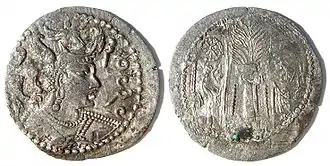
_circa_500-560.jpg.webp) Nezak Huns Anonymous ("Nezak Shah") circa 500–560.
Nezak Huns Anonymous ("Nezak Shah") circa 500–560.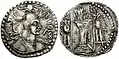 Coin minted in Ghazni
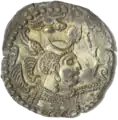 Billon drachm
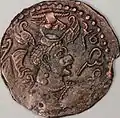 Bronze drachm
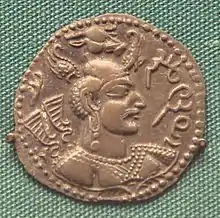 Nezak king Napki Malka
 Nezak Huns ruler Sahi Tigin (?) Early 8th century CE.
See also
 |
Wikimedia Commons has media related to Nezak Huns. |
| History of Afghanistan |
|---|
 |
| Timeline |
| Related historical names of the region |
| Related topics |
|

References
- Rezakhani 2017, p. 159.
- Alram, Michael (1 February 2021). Sasanian Iran in the Context of Late Antiquity: The Bahari Lecture Series at the University of Oxford. BRILL. p. 9. ISBN 978-90-04-46066-9.
- Alram, Michael (1 February 2021). Sasanian Iran in the Context of Late Antiquity: The Bahari Lecture Series at the University of Oxford. BRILL. p. 25. ISBN 978-90-04-46066-9.
- Alram 2014, p. 280-281.
- Inaba, M. "Nezak in Chinese Sources?" Coins, Art and Chronology II. Ed. M. Alram et.al. (2010) p. 191-202
- Tatár, M. M. (2005) "Some Central Asian Ethnonyms Among the Mongols" Bolor-un gerel. Crystal-splendor. Tanulmányok Kara György tiszteletére. I-II. Budapest. p. 3-4
- Clauson, G. An Etymological Dictionary of Pre-13th Century Turkish (1972). p. 774
- Inaba, M. "Nezak in Chinese Sources?" Coins, Art and Chronology II. Ed. M. Alram et.al. (2010) p. 191
- Grenet 2002, p. 159.
- Alram 2014, p. 280.
- Rezakhani 2017, p. 159-160.
- Rezakhani 2017, p. 160-162.
- Robert Göbl (1967). Dokumente zur Geschichte der iranischen Hunnen in Baktrien und Indien. Otto Harrassowitz Verlag. GGKEY:4TALPN86ZJB.
- ALRAM, MICHAEL (2014). "From the Sasanians to the Huns New Numismatic Evidence from the Hindu Kush". The Numismatic Chronicle (1966-). 174: 281. ISSN 0078-2696.
- Alram, Michael. "The Countenance of the Other. Showcase 11". Kunsthistorisches Museum Vienna.
- Alram 2014, p. 278.
- Alram 2014, p. 282.
- Rezakhani 2017, p. 162.
- Coin Cabinet of the Kunsthistorisches Museum Vienna
- Alram 2014, p. 278, 282.
- Klaus Vondrovec (2014). Coinage of the Iranian Huns and Their Successors from Bactria to Gandhara (4th to 8th Century CE). ISBN 978-3-7001-7695-4.
- Rezakhani 2017, p. 164.
- Petrie, Cameron A. (28 December 2020). Resistance at the Edge of Empires: The Archaeology and History of the Bannu basin from 1000 BC to AD 1200. Oxbow Books. p. 137. ISBN 978-1-78570-304-1.
- Journal asiatique (in French). Société asiatique. 1991. pp. 276–277.
- Balogh, Dániel (12 March 2020). Hunnic Peoples in Central and South Asia: Sources for their Origin and History. Barkhuis. p. 104. ISBN 978-94-93194-01-4.
-
 This article incorporates text from this source, which is in the public domain. Chinese original: 显庆三年,访其国俗,云“王始祖馨孽,至今曷撷支,父子传位,已十二代。”其年,改其城为修鲜都督府。龙朔初,授其王修鲜等十一州诸军事兼修鲜都督。"旧唐书/卷198 - 维基文库,自由的图书馆". zh.wikisource.org (in Chinese).
 - Alram, Michael; Filigenzi, Anna; Kinberger, Michaela; Nell, Daniel; Pfisterer, Matthias; Vondrovec, Klaus. "The Countenance of the other (The Coins of the Huns and Western Turks in Central Asia and India) 2012-2013 exhibit: 13. THE TURK SHAHIS IN KABULISTAN". Pro.geo.univie.ac.at. Kunsthistorisches Museum Vienna. Retrieved July 16, 2017.
- Rahman, Abdur; Bopearachchi (Ed.), Osmund; Boussac (Ed.), Marie-Françoise (2002). Afghanistan. Ancien Carrefour entre l'Est et l'Ouest (New Light on Khingal, Turk and Hindu Shahis) (PDF). XV. Turnhout, Belgium: Brepols. pp. 37–41. ISBN 2-503-51681-5.CS1 maint: extra text: authors list (link)
- Alram, Michael (1 February 2021). Sasanian Iran in the Context of Late Antiquity: The Bahari Lecture Series at the University of Oxford. BRILL. p. 12. ISBN 978-90-04-46066-9.
- Petrie, Cameron A. (28 December 2020). Resistance at the Edge of Empires: The Archaeology and History of the Bannu basin from 1000 BC to AD 1200. Oxbow Books. p. 137. ISBN 978-1-78570-304-1.
- Journal asiatique (in French). Société asiatique. 1991. pp. 276–277.
Sources
- Alram, Michael (2014). "From the Sasanians to the Huns New Numismatic Evidence from the Hindu Kush". The Numismatic Chronicle. 174: 261–291. JSTOR 44710198. (registration required)
- Grenet, Frantz (2002). "Nēzak". Encyclopædia Iranica, online edition.
- Payne, Richard (2016). "The Making of Turan: The Fall and Transformation of the Iranian East in Late Antiquity". Journal of Late Antiquity. Johns Hopkins University Press. 9: 4–41. doi:10.1353/jla.2016.0011.
- Rezakhani, Khodadad (2017). "The Nezak and Turk period" in "ReOrienting the Sasanians: East Iran in Late Antiquity". Edinburgh University Press. pp. 1–256. ISBN 9781474400305.
- Vondrovec, Klaus. "Coinage of the Nezak". Cite journal requires
|journal=(help) - VONDROVEC, KLAUS (2003). "Coins from Gharwal (Afghanistan)". Bulletin of the Asia Institute. 17: 159–175. ISSN 0890-4464.