Nikolai Mikhailov (politician)
Nikolai Aleksandrovich Mikhailov (Russian: Николай Александрович Михайлов; 10 October 1906, Moscow – 25 May 1982, Moscow) was a Russian Soviet politician, journalist, diplomat, Komsomol and Communist Party official.
Nikolai Mikhailov | |
|---|---|
| Николай Михайлов | |
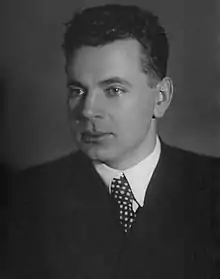 Mikhailov in 1939 | |
| Minister of Culture | |
| In office 21 March 1955 – 4 May 1960 | |
| Premier | Nikita Khrushchev |
| Preceded by | Georgy Aleksandrov |
| Succeeded by | Yekaterina Furtseva |
| First Secretary of the Central Committee of the Komsomol | |
| In office 23 November 1938 – 35 March 1954 | |
| Preceded by | Aleksandr Kosarev |
| Succeeded by | Alexander Shelepin |
| Full member of the 19th Presidium | |
| In office 16 October 1952 – 6 March 1953 | |
| Personal details | |
| Born | 10 October 1906 Moscow, Russian Empire |
| Died | 25 May 1982 (aged 75) Moscow, Russian SFSR, Soviet Union |
| Nationality | Soviet |
| Political party | Communist Party of the Soviet Union (1930–1970) |
| Profession | Politician, diplomat, journalist |
| Awards | Three  Order of the Great Patriotic War |
Biography
He was born in to the family of a shoemaker. After the October Revolution he worked for his father and then became a laborer at the Hammer and Sickle plant. He joined the Red Army in 1930 and became a member of the All-Union Communist Party (b) in the same year. He took three courses Faculty of Journalism at the Moscow State University.[1]
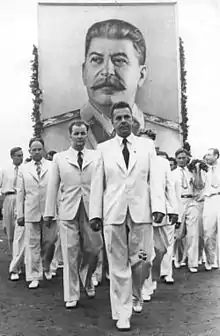
In 1933 he worked at the press department of the Moscow Committee of the VKP (b) and was later sent to work as an employee in the editorial board of the newspaper Pravda. In 1937 he was appointed executive editor of the newspaper Komsomolskaya Pravda. After the Great Purge he was appointed First Secretary of the Central Committee of the Komsomol in 1939 and held the position until 1952. From 1939 to 1952 he was a member of the Organization Bureau of the Communist Party of the Soviet Union.[2] Under his leadership, legends about "pioneer heroes" and "Komsomol heroes" were created, self-sacrifice was promoted, as well as educating the young on determination on loyalty to the Communist Party and Joseph Stalin.
From October 1952 to March 1953 he was a member of the Secretariat of the Central Committee of the CPSU and at the same time a member of the Presidium of the CPSU. From March 1952 to March 1954 he was first secretary of the Moscow Regional Committee of the CPSU.[2] He was a member of the Special Judicial Hearings of the Supreme Court of the Soviet Union in December 1953, who sentenced Lavrentiy Beria and a number of people close to him to capital punishment.
He was then sent to diplomatic work and was the Ambassador of the Soviet Union to the Polish People's Republic. From 1955 to 1960 he was the Minister of Culture of the USSR. Again at diplomatic work, he was the Soviet ambassador to Indonesia from 1960 to 1965.
From 1965 to 1970 he was the chairman of the Press Committee under the Council of Ministers of the Soviet Union.[3]
Mikhailov retired in Moscow in 1970. He died in May 1983 and was buried at the Troyekurovskoye Cemetery.
References
- "Михайлов Николай Александрович". hrono.ru. Retrieved 2021-05-29.
- "Handbook of the History of the Communist Party and the Soviet Union".
- "Николай Михайлов | Разумный Владимир Александрович". www.razumny.ru. Retrieved 2021-05-29.
Authority control  | |
|---|---|
| General | |
| National libraries | |