Norse cosmology
Norse cosmology is the study of the cosmos (cosmology) as perceived by the North Germanic peoples. The topic encompasses concepts from Norse mythology, such as notions of time and space, cosmogony, personifications, anthropogeny, and eschatology. Like other aspects of Norse mythology, these concepts are primarily recorded in the Poetic Edda, a collection of poems compiled in the 13th century, and the Prose Edda, authored by Icelander Snorri Sturluson in the 13th century, who drew from earlier traditional sources. Together these sources depict an image of Nine Worlds around a cosmic tree, Yggdrasil.
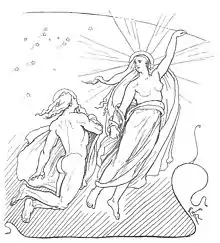
Time and space
Concepts of time and space play a major role in the Old Norse corpus's presentation of Norse cosmology. While events in Norse mythology describe a somewhat linear progression, various scholars in ancient Germanic studies note that Old Norse texts may imply or directly describe a fundamental belief in cyclic time. According to scholar John Lindow, "the cosmos might be formed and reformed on multiple occasions by the rising sea."[1]
Cosmogony
Drawing in part from various eddic poems, the Gylfaginning section of the Prose Edda contains an account of the development and creation of the cosmos: Long before the earth came to be, there existed the bright and flaming place called Muspell—a location so hot that foreigners may not enter it—and the foggy land of Niflheim. In Niflheim was a spring, Hvergelmir, and from it flows numerous rivers. Together these rivers, known as Élivágar, flowed further and further from their source. Eventually the poisonous substance within the flow came to harden and turn to ice. When the flow became entirely solid, a poisonous vapor rose from the ice and solidified into rime atop the solid river. These thick ice layers grew, in time spreading across the void of Ginnungagap.[2]
The northern region of Ginnungagap continued to fill with weight from the growing substance and its accompanying blowing vapor, yet the southern portion of Ginunngagap remained clear due to its proximity to the sparks and flames of Muspell. Between Niflheim and Muspell, ice and fire, was a placid location, "as mild as a windless sky". When the rime and the blowing heat met, the liquid melted and dropped, and this mixture formed the primordial being Ymir, the ancestor of all jötnar. Ymir sweated while sleeping. From his left arm grew a male and female jötunn, "and one of his legs begot a son with another", and these limbs too produced children.[3]
Ymir fed from rivers of milk that flowed from the teats of the primordial cow, Auðumbla. Auðumbla fed from salt she licked from rime stones. Over the course of three days, she licked free a beautiful and strong man, Búri. Búri's son Borr married a jötunn named Bestla, and the two had three sons: the gods Odin, Vili and Vé. The sons killed Ymir, and Ymir's blood poured across the land, producing great floods that killed all of the jötnar but two (Bergelmir and his unnamed wife, who sailed across the flooded landscape).[4]
Odin, Vili, and Vé took Ymir's corpse to the center of Ginunngagap and carved it. They made the earth from Ymir's flesh; the rocks from his bones; from his blood the sea, lakes, and oceans; and scree and stone from his molars, teeth, and remaining bone fragments. They surrounded the earth's lands with sea, forming a circle. From Ymir's skull they made the sky, which they placed above the earth in four points, each held by a dwarf (Norðri, Suðri, Austri and Vestri—Old Norse 'north, south, east, and west', respectively).[4]
After forming the dome of the earth, the brothers Odin, Vili, and Vé took sparks of light from Muspell and placed them around the earth, both above and below. Some remained fixed and others moved through the sky in predetermined courses. The trio provided land for the jötnar to leave by the sea. Using Ymir's eyelashes, the trio built a fortification around the center of the landmass to contain the hostility of the jötnar. They called this fortification Miðgarðr (Old Norse 'central enclosure'). Finally, from Ymir's brains, they formed the clouds.[5]
Personifications
Personifications, such as those of astronomical objects, time, and water bodies occur in Norse mythology. The Sun is personified as a goddess, Sól (Old Norse 'Sun'); the moon is personified as a male entity, Máni (Old Norse 'moon'); and the Earth too is personified (Jörð, Old Norse 'earth').[6] Night appears personified as the female jötunn Nótt (Old Norse 'night'); day is personified as Dagr (Old Norse 'day'); and Dagr's father, the god Dellingr (Old Norse 'shining'), may in some manner personify the dawn.[7] Bodies of water also receive personification, such as the goddess Rán, her jötunn husband Ægir, and their wave-maiden children, the Nine Daughters of Ægir and Rán.[8]
Yggdrasil
.jpg.webp)
Yggdrasil is a tree central to the Norse concept of the cosmos. The tree's branches extend into various realms, and various creatures dwell on and around it. The gods go to Yggdrasil daily to assemble at their things, traditional governing assemblies. The branches of Yggdrasil extend far into the heavens, and the tree is supported by three roots that extend far away into other locations; one to the well Urðarbrunnr in the heavens, one to the spring Hvergelmir, and another to the well Mímisbrunnr. Creatures live within Yggdrasil, including the dragon Níðhöggr, an unnamed eagle, and the stags Dáinn, Dvalinn, Duneyrr and Duraþrór.[9]
Nine Worlds
Old Norse texts mention the existence of Níu Heimar, translated by scholars as "Nine Worlds".[10] According to the second stanza of the Poetic Edda poem Völuspá, the Nine Worlds surround the tree Yggdrasil. As recalled by a dead völva in the poem:
|
|
The Nine Worlds receive a second and final mention in the Poetic Edda in stanza 43 of the Prose Edda poem Vafþrúðnismál, where the wise jötunn Vafþrúðnir engages in a deadly battle of wits with the disguised god Odin:
|
|
The Nine Worlds receive a single mention in the Prose Edda, occurring section 34 of the Gylfaginning portion of the book. The section describes how Odin threw Loki's daughter Hel into the underworld, and granted her power over all Nine Worlds:
Hel he threw into Niflheim and gave her authority over nine worlds, such that she has to administer board and lodging to those sent to her, and that is those who die of sickness or old age.[15]
The Old Norse corpus does not clearly list the Nine Worlds, if it provides them at all. However, some scholars have proposed identifications for the nine. For example, Henry Adams Bellows (1923) says that the Nine Worlds consist of Ásgarðr, Vanaheimr, Álfheimr, Miðgarðr, Jötunheimr, Múspellsheimr, Svartálfaheimr, Niflheimr (sometimes Hel), and perhaps Niðavellir.[16] Some editions of translations of the Poetic Edda and the Prose Edda feature illustrations of what the author or artist suspects the Nine Worlds to be in part based on the Völuspá stanza above.[17]
Anthropogeny
Ask and Embla—male and female respectively—were the first two humans, created by the gods from driftwood they encounter on a shore. The gods who form these first humans vary by source: According to the Poetic Edda poem Völuspá, they are Hœnir, Lóðurr and Odin, whereas in the Prose Edda they are Odin, Vili, and Vé.[18]
Eschatology
Ragnarök is a series of future events, including a great battle, foretold to ultimately result in the death of a number of major figures (including various deities), the occurrence of various natural disasters, and the subsequent submersion of the world in water. Afterward, the world will resurface anew and fertile, the surviving and returning gods will meet, and mankind will be repopulated by Líf and Lífþrasir, who will emerge from Yggdrasil.[19]
The Influence of Norse cosmology
Norse cosmology was studied by the North Germanic peoples or sometimes called Scandinavians. Norse cosmology was studied by the North Germanic peoples from 790-1100 CE. Many of the North Germanic people valued knowledge and wanted to understand the world around them, something that is one of the main causes of Norse cosmology. So that the North Germanic people could study the world, many of the Asatruer would create fictional stories to be studied by the people. Something else that the North Germanic people did to feel connected to Norse cosmology is to create artwork. Even though this cosmology is not used today or believed in anymore, there is a great deal of evidence of it seen particularly through their stories and artworks.
Norse Religion
The Norse religion is the religion that was practiced by the North Germanic people. As early as the 18th century, there is evidence of the Old Norse religion. The Old Norse religion is now known as the Norse religion, but before this there were beliefs in Norse cosmology but there were no rituals or many signs of the religion told through creative mediums of art, music, or stories.[20] "since contemporary sources called it...'the old custom' or 'the old way of life'. In other words, people in those days emphasised the religious practice, but in Icelandic literature there is very little information about ritual[21]." Once there were stories and artwork created for the religion, a sense of identity and culture grew towards the Norse religion. In addition to the works of art, it allows people today to learn more about the religion and understand what people thought and believed during this time.
Norse Religion Impact
There were many stories created for the North Germanic people by the Asatruers. These stories were commonly studied and were the basic foundation upon which the Norse religion was built.[22] The Norse religion was responsible for multiple artistic mediums for the North Germanic peoples to use to express themselves and their culture in the religion. One significant way they were able to have a connection and feel a sense of identity towards their religion was through their artwork and paintings. Art runs very deep in this religion "the artist is assigned the role of a prophet, priest, or savior; and art itself is celebrated in cultic ways.[23]" In addition to being known for fictional stories, this religion was often associated with its use of artwork. This is evident because it had such a sense of identity throughout the religion. Since this is such a big part of the religion, there is a great deal of evidence within these stories and art that can be studied today. Art was not the only creative format. There is also evidence of the religion in today’s culture through their music. There are so many genres of music that came from the Norse religion that include "contemporary black metal, Viking metal, Pagan metal, and neofolk music[24]"
Notes and citations
- Lindow (2001:42–43). For an overview of discussion regarding time and space in Norse myth, see for example Lindow (2001:40–45).
- Faulkes (1995 [1987]: 10).
- Faulkes (1995 [1987]: 10–11.
- Faulkes (1995 [1987]: 11).
- Faulkes (1995 [1987]: 11–12).
- On Sól, see Lindow (2001:278–280) and Simek (2007:297); on Máni, see Lindow (2001:222–223) and Simek (2007:201–202); and on Jörð, see Lindow (2001:205–206) and Simek (2007:179).
- On Nótt, see Lindow (2001:246) and Simek (2007:238); on Dagr, see Lindow (2001:91–92) and Simek (2007:55); and on Dellingr, see for example Thorpe (1851:143) and Lindow (2001:92–93).
- On Rán, see Lindow (2001:258–259) and Simek (2007:260); on Ægir, see Lindow (2001:47–49) and Simek (2007:1–2); and on their nine wave daughters, see Lindow (2001:49) and Simek (2007:2).
- For overviews of Yggrasil, see Lindow (2001:319–322) and Simek (2007:375–376).
- See, for example, Larrington (2014:4), Dodds (2014:26), and Bellows (2004 [1923]:3).
- Bellows (2004 [1923]:3).
- Dodds (2014:26).
- Bellows (2004:80).
- Dodds (2014:64).
- Faulkes (1995 [1985]:27).
- "The world of the gods (Asgarth), of the Wanes (Vanaheim ...), of the elves (Alfheim), of men (Mithgarth), of the giants (Jotunheim), of fire (Muspellsheim ...), of the dark elves (Svartalfheim), of the dead (Niflheim), and presumably of the dwarfs (perhaps Nithavellir ... but the ninth is uncertain)" (Bellows 2004 [1923]:3).
- For example, see "map of nine worlds" by Gabe Foreman in Dodds 2014:13.
- See discussion in, for example, Lindow 2001: 62–63 and Simek 2007: 21 & 74.
- On the topic of Ragnarök and Líf and Lífþrasir, see discussion in Lindow 2001: 209, 254 & 258, and Simek 2007: 189, 259–260.
- ANDRÉN, ANDERS (2005). "Behind "Heathendom": Archaeological Studies of Old Norse Religion". Scottish Archaeological Journal. 27 (2): 105–138. ISSN 1471-5767.
- ANDRÉN, ANDERS (2005). "Behind "Heathendom": Archaeological Studies of Old Norse Religion". Scottish Archaeological Journal. 27 (2): 105–138. ISSN 1471-5767.
- von Schnurbein, Stefanie (2016), "Germanic Neopaganism – A Nordic Art-Religion?", Norse Revival, Transformations of Germanic Neopaganism, Brill, pp. 298–350, doi:10.1163/j.ctt1w76v8x.17, retrieved 2021-12-09
- von Schnurbein, Stefanie (2016), "Germanic Neopaganism – A Nordic Art-Religion?", Norse Revival, Transformations of Germanic Neopaganism, Brill, pp. 298–350, doi:10.1163/j.ctt1w76v8x.17, retrieved 2021-12-09
- "Accept Terms and Conditions on JSTOR". www.jstor.org. doi:10.1163/j.ctt1w76v8x.17.pdf. Retrieved 2021-12-09.
References
- Bellows, Henry Adams. 2004 [1923]. Trans. The Poetic Edda: The Mythological Poems. Dover. ISBN 978-0-486-43710-1
- Dodds, Jeramy. 2014. Trans. The Poetic Edda. Coach House Books. ISBN 978-1-55245-296-7
- Faulkes, Anthony. 1995 [1987]. Trans. Edda. Everyman. ISBN 0-460-87616-3
- Larrington, Carolyne. 2014. Trans. The Poetic Edda. 2nd ed. Oxford World's Classics. ISBN 978-0-19-967534-0
- Lindow, John. 2001. Norse Mythology: A Guide to the Gods, Heroes, Rituals, and Beliefs. Oxford University Press. ISBN 0-19-515382-0
- Simek, Rudolf. 2007. Angela Hall trans. Dictionary of Northern Mythology. D.S. Brewer. ISBN 0-85991-513-1
- Thorpe, Benjamin. 1866. Trans. Edda Sæmundar Hinns Frôða: The Edda of Sæmund the Learned. Part I. London: Trübner & Co.
| Astronomical bodies | 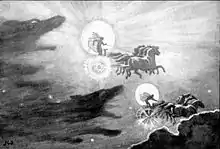 | |
|---|---|---|
| Time | ||
| Water bodies |
| |
| Worlds |
| |
| Cosmogenesis, cyclic time, and eschatology | ||
| Other | ||