No. 30 Squadron RAF
Number 30 Squadron of the Royal Air Force operates the Airbus A400M Atlas transport aircraft and is based at RAF Brize Norton, Oxfordshire.
| No. 30 Squadron RAF | |
|---|---|
 | |
| Active | 24 March 1915 – 1 April 1918 (RFC) 1 April 1918 – 1 April 1946 (RAF) 1 November 1947 – 6 September 1967 10 June 1968 – 8 December 2016[1] 28 September 2021 – present |
| Country |  United Kingdom United Kingdom |
| Branch |  Royal Air Force Royal Air Force |
| Type | Flying squadron |
| Role | Tactical air transport |
| Part of | No. 2 Group |
| Home station | RAF Brize Norton |
| Motto(s) | Ventre a terre (French for 'All out')[2] |
| Battle honours |
|
| Insignia | |
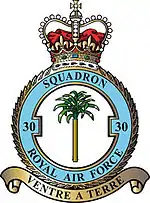
| Squadron badge heraldry | A date palm tree, signifying the squadron's long service in the Middle East. Approved by King George VI in May 1938. |
History
First World War
In November 1914 the British Royal Flying Corps despatched a flight of aircraft from Britain to Egypt to defend the Suez Canal, as war with the Turkish Empire became increasingly likely. Initial equipment consisted of Farman Longhorn and Shorthorn biplanes, which were soon supplemented by Royal Aircraft Factory B.E.2s and Farman HF.20s sent from India.[3][4] The flight, based at Ismailia Airfield, was redesignated No. 30 Squadron on 24 March 1915[5][6]
On 24 August 1915, the Mesopotamian Half Flight, a unit of the Australian Flying Corps stationed in Mesopotamia (now Iraq) was formally attached to 30 Squadron. For several months the Half-Flight, under Captain Henry Petre, and equipped with a mixture of Farman Shorthorns, Farman Longhorns and Caudron G.3s had been flying operations in support of the Indian Army, against Turkish ground forces, during the Mesopotamian campaign.[7][8][9]
On 26 August 1915, a second flight, equipped with Martinsyde Scouts, arrived at Basrah to join the 30 Squadron forces operating in Mesopotamia. The Martinsydes suffered from poor engine reliability in the heat and dusty conditions encountered.[10][11] Despite this, a forward deployed detachment of the squadron supported the army's advance along the Tigris river, with reconnaissance by the squadron's aircraft helping the British and Indian forces to win the Battle of Es Sinn and capture Kut al-Imara in September 1915.[12][13] In October 1915, the rest of the squadron moved to Mesopotamia, being relieved in Egypt by 14 Squadron.[14] On 7 November, the squadron was reorganised with headquarters and B Flight at Basra and A Flight deployed forward at Azizaya.[15]
The squadron continued to support the British forces as they advanced towards Bagdhad, until the advance was stopped by the Battle of Ctesiphon on 22–25 November 1915.[16] An air reconnaissance mission on the eve of the battle carried out by Major H. L Reilly of the squadron spotted that the Turkish positions in front of Ctesiphon had been heavily reinforced, but his aircraft was shot down by ground-fire and Reilly captured. It has been suggested in the Official Histories of the Air War and the Campaign in Mesopotamia, that if Reilly had successfully returned with his intelligence to the British lines, Major General Townshend, commander of the British force, would have aborted the attack.[17][18] After Ctesiphon, the British column retreated to Kut al-Imara, pursued by the Turkish Army, and Kut was besieged from 7 December 1915. Those aircraft that could evacuate left Kut earlier that day, but most of the personnel of the forward deployed A and B flights of the squadron, along with three unserviceable aircraft, were trapped in the besieged town.[19]
While reduced in serviceable strength to only a single B.E.2, the Squadron provided reconnaissance support to the force sent to relieve the troops trapped at Kut.[20] The squadron was reinforced by four more B.E.2s in February 1916.[21] The relief column failed to break through to Kut, and in April 1916, the squadron, with eight B.E.2s, together with seven RNAS aircraft, carried out one of the earliest air supply mission when it air-dropped food and other supplies to the besieged garrison. While 19,000 lb (8,600 kg) of food was dropped between 15 and 29 April, this was insufficient to feed the trapped troops and the civilian population of the town, and Major General Townshend surrendered on 29 April.[22][5]
1920s & 1930s
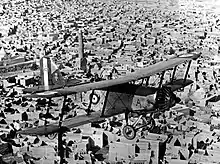
In 1919 the squadron was sent to Iran as part of the Norperforce.[23] This was followed by a posting to Iraq, for which it was re-equipped with DH.9As but by 1929 these in turn had been replaced by Westland Wapitis followed by Hawker Hardys (a tropicalised, general purpose version of the Hawker Hart light bomber) in 1935 and Blenheim Is in 1938.[24]
Second World War
In August 1939, as war loomed, the squadron moved back to RAF Ismailia in Egypt and carried out escort missions in the Western Desert and provided fighter defence of Alexandria.[25][26][lower-alpha 1] In November 1940, it was sent to Greece to operate its Blenheims in both the bomber and fighter roles, but in March 1941 the squadron was redesignated a fighter unit. After the fall of Greece and the Battle of Crete the squadron returned to Egypt and was re-equipped with Hawker Hurricanes and employed on night defence of Alexandria and shipping protection patrols before moving on to operations in the Western Desert.[27][28]
When the situation in the Far East worsened the squadron was ordered to reinforce allied forces in Java, but by the time the squadron left Egypt, Java, had already fallen, and the squadron was ferried by the aircraft carrier HMS Indomitable to Ceylon arriving on 6 March 1942, just in time to assist in resisting the Japanese carrier strike against the island.[29] This raid took place on 5 April 1942 with 21 aircraft being launched from its base at RAF Ratmalana whilst under heavy fire from Japanese aircraft. Seven of the squadron's Hurricanes were lost, with five of its pilots being killed or dying later of wounds received during the battle. It claimed 14 Japanese aircraft shot down, together with six probably destroyed and five damaged, out of a total claim for the whole of the island's defences of 24 shot down, 7 probables and 9 damaged. In fact, the Japanese lost seven aircraft, with a further 15 damaged.[30][31]
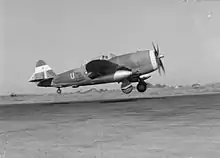
In February 1944, it moved to the Burma front flying escort and ground attack missions and in May 1944 was re-equipped with American Republic P-47 Thunderbolts, which it took back into action in October until May 1945.[32]
Post-War

After the Japanese surrender the squadron remained in India and its Thunderbolts were replaced by Hawker Tempest F Mk 2s in March 1946. No. 30 Squadron lost its aircraft on 1 December 1946, before being disbanded on 1 April 1947 at Agra.[33]
On 24 November 1947 the squadron was reformed at RAF Oakington, Cambridgeshire in the transport role, operating as a unit within the Royal Air Force Transport Command. It flew the Dakota on many humanitarian supply flights during the Berlin Airlift. Re-equipment with the Vickers Valetta came in December 1950. The heavier four-engine Blackburn Beverley was flown between April 1957 and September 1967. From November 1959 30 Squadron operated out of RAF Eastleigh in Kenya before moving on to RAF Muharraq in October 1964.[34]
Hercules and Atlas (1968 – present)
The Squadron temporarily disbanded in September 1967 but quickly reformed at RAF Fairford in June 1968 equipped with turbine-propeller powered Lockheed Hercules transports, maintaining the units transport role. the squadron moved to RAF Lyneham in September 1971.[8]

During 2008 'A' flight was based at RAF Al Udeid with the Hercules C.4.[35]
The squadron flew its last Hercules flight on 8 December 2016.[1] It then took on an administrative role and later reformed on 28 September 2021 to become the second frontline squadron operating the Airbus A400M Atlas.[36]
Aircraft operated
- Farman Longhorn 1915
- Farman Shorthorn 1915–1916
- Voisin LA.S 1915
- Henry Farman F27 1915
- Caudron G.3 1915
- Royal Aircraft Factory B.E.2 1915–1917
- Royal Aircraft Factory R.E.8 1917–19
- Airco D.H.9 1921–1929
- Westland Wapiti 1929–1935
- Hawker Hardy 1935–1938
- Bristol Blenheim 1938–1941
- Hawker Hurricane 1941–1944
- Republic P-47 Thunderbolt 1944–1946
- Hawker Tempest F2 1946
- Douglas Dakota 1947–1950
- Vickers Valetta 1950–1957
- Blackburn Beverley 1957–1967
- Lockheed C-130 Hercules 1968–2016
- Airbus A400M Atlas 2021 – present
Battle honours
- On the squadron standard
Egypt, 1915: Mesopotamia, 1915–1918: Egypt & Libya, 1940–1942: Greece 1940–1941, Mediterranean, 1940–1941, Ceylon April, 1942: Arakan, 1944: Burma 1944–45
- Others
Iraq, 1919–1920: North West Persia, 1920: Kurdistan, 1922–1924: Iraq, 1923–1925: Iraq, 1928–1929: Kurdistan, 1930–1931: Northern Kurdistan, 1932: Gulf, 1991: Afghanistan, 2001–2014: Iraq, 2003–2011: Libya, 2011
Memorials
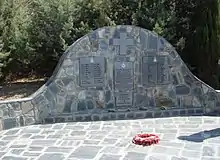 Memorial to members of 30 and 33 Squadrons RAF killed in battle of Crete
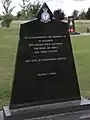 Front panel of No. 30 Squadron RAF at the National Memorial Arboretum
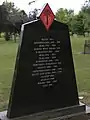 Back panel of No. 30 Squadron RAF
There is a Royal Air Force (RAF) memorial in Crete to the airmen of 30 and 33 Squadrons who died during the Battle of Crete. The memorial is located (35.525363°N 23.828619°E) behind the roadside hedge between Maleme and Tavronitis overlooking the (35.526625°N 23.825604°E) Iron Bridge across the Tavronitis River and the end of Maleme Airport runway.
Another memorial was unveiled at the National Memorial Arboretum in Staffordshire in September 2008.[37][38]
References
Notes
- Some of its Blenheims had been converted to Blenheim If long-range fighter configuration, with an under fuselage gun pack.[26]
Citations
- "No 30 Squadron". Air of Authority. Retrieved 15 May 2020.
- Pine, L.G. (1983). A dictionary of mottoes (1 ed.). London: Routledge & Kegan Paul. p. 247. ISBN 0-7100-9339-X.
- Jones 1935, pp. 160–161.
- Halley 1988, p. 76.
- Halley 1988, p. 75.
- Jones 1935, p. 166.
- Warner, Guy (2010). "Only a sideshow? The RFC and RAF in Mesopotamia 1914-1918" (PDF). Royal Air Force Historical Society. High Wycombe: Royal Air Force (48): 9–10. ISSN 1361-4231. Retrieved 12 December 2021.
- Halley 1985, p. 61.
- Jones 1935, p. 256.
- Jones 1935, p. 257.
- Bruce 1982, pp. 274–276.
- Jones 1935, pp. 258–261.
- Bruce 1982, pp. 275–276.
- Jones 1935, pp. 165–166, 257.
- Jefford 1988, p. 34.
- Jones 1935, pp. 261–264.
- Jones 1935, pp. 262–264.
- Moberly 1924, pp. 58–59.
- Jones 1935, pp. 264–265.
- Jones 1935, pp. 266–267.
- Jones 1935, pp. 268–269.
- Jones 1935, pp. 278–281.
- Cecil John Edmonds (2009), East and West of Zagros, Brill Academic Publishers, OCLC 593346009, OL 25432016M
- Ashworth 1989, p. 96.
- Halley 1985, pp. 60–61.
- Shores, Massimello & Guest 2012, p. 16.
- Ashworth 1989, pp. 96–101.
- Shores, Massimello & Guest 2012, p. 310.
- Shores, Cull & Izawa 1993, pp. 385–387.
- "Early day motion 502 - No. 30 SQUADRON RAF AND THE BATTLE OF CEYLON". UK Parliament. Retrieved 20 July 2017.
- Shores, Cull & Izawa 1993, pp. 395–397, 401–404.
- Ashworth 1989, p. 101.
- Lake 1999, p. 202.
- Fairbarn 1991, pp. 55–56.
- Cotter 2008, p. 34.
- "Royal Guest Helps 30 Squadron Mark Its Reformation". Forces Network. 28 September 2021. Retrieved 28 September 2021.
- "Memorial listing | National Memorial Arboretum". www.thenma.org.uk. Archived from the original on 4 April 2016. Retrieved 20 July 2017.
- "30 Squadron RAF Memorials of Past Campaigns and Incidents". 30squadronassociation.com. Retrieved 20 July 2017.
Bibliography
- Ashworth, Chris (1989). Encyclopaedia of Modern Royal Air Force Squadrons. Wellingborough: Patrick Stephens. ISBN 1-85260-013-6.
- Bruce, J. M. (1982). The Aeroplanes of the Royal Flying Corps (Military Wing). London: Putnam. ISBN 0-370-30084-X.
- Cotter, Jarrod (2008). Royal Air Force celebrating 90 years. Stamford, UK: Key Publishing Ltd. ISBN 978-0-946219-11-7.
- Fairbarn, Tony (1991). Action Stations Overseas. Yeovil: Patrick Stephens. ISBN 1-85260-319-4.
- Halley, James J (1985). The Squadrons of the Royal Air Force (2 ed.). Tonbridge: Air-Britain. ISBN 0-85130-083-9.
- Halley, James J (1988). The Squadrons of the Royal Air Force and Commonwealth 1918–1988. Tonbridge, UK: Air-Britain (Historians) Ltd. ISBN 0-85130-164-9.
- Jefford, C. G. (1988). RAF Squadrons, a Comprehensive Record of the Movement and Equipment of all RAF Squadrons and their Antecedents since 1912. Shrewsbury, UK: Airlife Publishing. ISBN 1-85310-053-6.
- Jones, H. A. (1935). The War in the Air: Being the Story of the part played in the Great War by the Royal Air Force: Vol. V. History of the Great War. Oxford: Clarendon Press.
- Lake, Alan (1999). Flying Units of the RAF. Shrewsbury: Airlife. ISBN 1-84037-086-6.
- Moberly, F. J. (1924). The Campaign in Mesopotamia 1914–1918: Volume II. History of the Great War. London: His Majesty's Stationery Office.
- Shores, Christopher; Cull, Brian; Izawa, Yasuho (1993). Bloody Shambles: Volume Two: The Defence of Sumatra to the Fall of Burma. London: Grub Street. ISBN 0-948817-67-4.
- Shores, Christopher; Massimello, Giovanni; Guest, Russell (2012). A History of the Mediterranean Air War 1940–1945: Volume One: North Africa: June 1940 – January 1942. London: Grub Street. ISBN 978-1-908117-07-6.
- "Sqn Histories 26–30". Air of Authority – A History of RAF Organisation. rafweb.org. Archived from the original on 18 March 2012.
- Tennant, Lieutenant Colonel J. E. In the Clouds above Baghdad. London: Cecil Palmer, 1920.
Further reading
- Everidge, J. (1920). History of No. 30 Squadron. Finsbury Park, London: Macaire, Mould & Co for the Squadron.
- Hamlin, John F. (2002). Flatout – The Story of 30 Squadron Royal Air Force. Tunbridge Wells, Kent, UK: Air-Britain (Historians) Ltd. ISBN 0-85130-308-0.
- de Normann, Roderick (November–December 1996). "Mespot Squadron: No 30 Squadron in Mespotamia 1916–1917". Air Enthusiast. No. 66. Stamford, Lincs, UK: Key Publishing. ISSN 0143-5450.
- Shores, Christopher (2005). Air War For Burma: The Allied Air Forces Fight Back in South-East Asia 1942–1945. London: Grub Street. ISBN 1-904010-95-4.
External links
 |
Wikimedia Commons has media related to No. 30 Squadron RAF. |