Siberian Turkic languages
The Siberian Turkic or Northeastern Common Turkic languages, are a sub-branch of the Turkic language family. The following table is based upon the classification scheme presented by Lars Johanson (1998).[1]
| Siberian Turkic | |
|---|---|
| Northeastern Turkic | |
| Geographic distribution | Siberia |
| Linguistic classification | Turkic
|
Early form | |
| Subdivisions |
|
| Glottolog | nort2688 (North) sout2693 (South) |
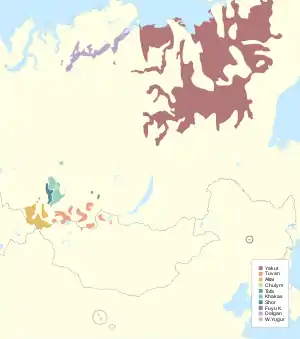 Map showing the geographic distribution of the ten Siberian Turkic languages | |
Siberian Turkic languages by native speakers
The Turkic languages are a language family of at least 35[3] documented languages, spoken by the Turkic peoples. The number of speakers derived from statistics or estimates (2019) and were rounded:[4][5]
| Number | Name | Status | Native Speakers | Main Country |
|---|---|---|---|---|
| 1 | Yakut language | Vulnerable | 400,000 |  Russia Russia |
| 2 | Tuvan language | Vulnerable | 300,000 | Russia |
| 3 | Southern Altai language | Severely endangered | 60,000 | Russia |
| 4 | Khakas language | Definitely endangered | 50,000 | Russia |
| 3 | Northern Altai language[2] | Critically endangered | <5,000 | Russia |
| 5 | Western Yugur language | Severely endangered | 5,000 |  China China |
| 6 | Shor language | Severely endangered | 3,000 | Russia |
| 7 | Kumandin language[6][7] | Critically endangered | 2,000 | Russia |
| 8 | Teleut language[8] | Critically endangered | 2,000 | Russia |
| 8 | Chelkan language[9] | Severely endangered | 1,000 | Russia |
| 10 | Dolgan language | Definitely endangered | 1,000 | Russia |
| 5 | Fuyu Kyrgyz language | Critically endangered | 600(?) | China |
| 11 | Tofa language | Critically endangered | 100 | Russia |
| 12 | Chulym language | Critically endangered | 50 | Russia |
| 13 | Soyot language | Extinct, partly revitalized[10] | Russia | |
| Total | Siberian Turkic languages | Vulnerable | 800,000 | Russia |
Classification
| Proto-Turkic | Common Turkic | Northeastern Common Turkic (Siberian) | North Siberian | ||
| South Siberian | Sayan Turkic | ||||
| Yenisei Turkic |
| ||||
| Chulym Turkic |
| ||||
| Altai Turkic[17] |
| ||||
| Old Turkic | |||||
Alexander Vovin (2017) notes that Tofa and other Siberian Turkic languages, especially Sayan Turkic, have Yeniseian loanwords.[18]
References
- Lars Johanson (1998) "The History of Turkic". In Lars Johanson & Éva Ágnes Csató (eds) The Turkic Languages. London, New York: Routledge, 81-125. Classification of Turkic languages at Turkiclanguages.com
- "Northern Altai". ELP Endangered Languages Project. Retrieved 2021-07-15.
- Dybo A.V., Chronology of Türkic languages and linguistic contacts of early Türks, Moscow, 2007, p. 766, "Archived copy" (PDF). Archived from the original (PDF) on 2005-03-11. Retrieved 2005-03-11.CS1 maint: archived copy as title (link) (In Russian)
- https://www.ethnologue.com/
- https://glottolog.org/
- "Kumandin". ELP Endangered Languages Project. Retrieved 2021-07-15.
- Bitkeeva, A.N. "The Kumandin Language". Endangered Languages of Indigenous Peoples of Siberia. UNESCO. Retrieved 2021-07-16.
- Nevskaya, I.A. "The Teleut Language". Endangered Languages of Indigenous Peoples of Siberia. UNESCO. Retrieved 2021-07-16.
- Tazranova, A.R. "The Chelkan Language". Endangered Languages of Indigenous Peoples of Siberia. UNESCO. Retrieved 2021-07-16.
- Rassadin, V.I. "The Soyot Language". Endangered Languages of Indigenous Peoples of Siberia. UNESCO. Retrieved 2021-07-18.
- "Northern Altai". ELP Endangered Languages Project. Retrieved 2021-07-16.
- Deviating. Probably of South Siberian origin (Johanson 1998)
- Coene 2009, p. 75
- Coene 2009, p. 75
- Concise Encyclopedia of Languages of the World. Contributors: Keith Brown, Sarah Ogilvie (revised ed.). Elsevier. 2010. p. 1109. ISBN 978-0080877754. Retrieved 24 April 2014.CS1 maint: others (link)
- Johanson, Lars, ed. (1998). The Mainz Meeting: Proceedings of the Seventh International Conference on Turkish Linguistics, August 3-6, 1994. Turcologica Series. Contributor: Éva Ágnes Csató. Otto Harrassowitz Verlag. p. 28. ISBN 3447038640. Retrieved 24 April 2014.
- Some dialects are close to Kirghiz (Johanson 1998)
- Vovin, Alexander. 2017. "Some Tofalar Etymologies." In Essays in the history of languages and linguistics: dedicated to Marek Stachowski on the occasion of his 60th birthday. Krakow: Księgarnia Akademicka.
Authority control: National libraries  |
|---|
This article is issued from Wikipedia. The text is licensed under Creative Commons - Attribution - Sharealike. Additional terms may apply for the media files.