OMNY
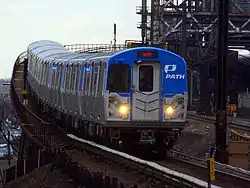
OMNY (/ɒmˈni/ [OM-nee], short for One Metro New York) is a contactless fare payment system, currently being implemented for use on public transit in New York City and the surrounding area. When OMNY is completely rolled out, it will replace the MetroCard on the New York City Subway, the Staten Island Railway, PATH trains, MTA buses, Bee-Line buses, and NICE buses. OMNY will also expand beyond the current scope of the MetroCard to the Long Island Rail Road and Metro-North Railroad. As of December 31, 2020, OMNY is available on all MTA buses and at all subway stations.
 | |
| Location | New York City, United States |
|---|---|
| Launched | May 31, 2019 |
| Predecessor | MetroCard |
| Technology | |
| Operator | Cubic Transportation Systems |
| Manager | Metropolitan Transportation Authority |
| Currency | United States dollar |
| Validity | |
| Website | omny |
The MetroCard, a magnetic stripe card, was first introduced in 1993 and was used to pay fares on MTA subways and buses, as well as on other networks such as the PATH train. Two limited contactless-payment trials were conducted around the New York City area in 2006 and in 2010. However, formal planning for a full replacement of the MetroCard did not start until 2016.
The OMNY system is designed by San Diego-based Cubic Transportation Systems, using technology licensed from Transport for London's Oyster card. OMNY began its public rollout in May 2019, with contactless bank cards and mobile payments accepted at select subway stations and on buses in Staten Island. The Staten Island Railway received OMNY readers in December 2019, and rollout on the New York City Subway and on MTA buses was completed on December 31, 2020, after having been delayed due to the COVID-19 pandemic. The MTA began offering OMNY contactless cards in October 2021, and expects to offer reduced-fare and time-based fare options sometime thereafter. Full deployment to other NYC-area transit systems is expected by 2023, after which MetroCard will be completely phased out.
Predecessors
Previous fare media
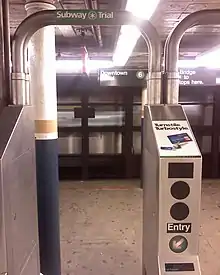
Subway tokens had been used as the MTA subway and bus systems' form of fare payment since the 1950s. MetroCards made by Cubic Transportation Systems started to replace the tokens in 1992; the MetroCards used magnetic stripes to encode the fare payment. By 2003, the MetroCard was the exclusive method of fare payment systemwide.[1]
Payment system trials
MasterCard and Citibank funded a trial of contactless payments, branded as PayPass. The trial was conducted at 25 subway stations, mostly on the IRT Lexington Avenue Line,[lower-alpha 1] beginning in July 2006. The trial was limited to select Citibank cardholders, but it proved popular enough to be extended past its original end date of December 2006.[2][3][4][5]
In light of the success of the first contactless payment trial in 2006, another trial was conducted from June to November 2010.[6][7] The 2010 trial initially only supported MasterCard-branded cards, expanding to Visa PayWave cards in August.[8][9] The 2010 trial eventually expanded to include multiple Manhattan bus routes, two New Jersey Transit bus routes, and most PATH stations.[lower-alpha 2]
Proposal
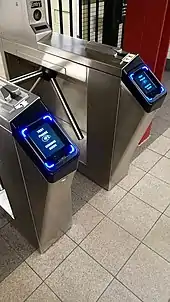
In 2016, the MTA announced that it would begin designing a new contactless fare payment system to replace the MetroCard.[10][11][12] The replacement system was initially planned for partial implementation in 2018 and full implementation by 2022.[13] In October 2017, the MTA started installing eTix-compatible electronic ticketing turnstiles in 14 stations in Manhattan. The eTix system, already used on the Long Island Rail Road and Metro-North Railroad, allows passengers to pay their fares using their phones. The system would originally be for MTA employees only.[14]
On October 23, 2017, it was announced that the MetroCard would be phased out and replaced by a contactless fare payment system also by Cubic, with fare payment being made using Android Pay, Apple Pay, Samsung Pay, debit/credit cards with near-field communication enabled, or radio-frequency identification cards.[15][16] The announcement called for a phased rollout, culminating in the discontinuation of the MetroCard by 2023.[16] The replacement fare system was criticized because the new turnstiles could be hacked, thereby leaving credit card and phone information vulnerable to theft.[17] The payment system would use technology licensed from Transport for London's Oyster card.[18]
Rollout
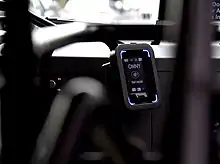
In June 2018, the MTA revised the timeline for implementation of the then-unnamed new payment system. The first stage of implementation would take place in May 2019. In the second stage, all subway stations would receive OMNY readers by October 2020, in preparation for the third stage, which involved the launch of a prepaid OMNY card by February 2021.[20][21]: 13 The fourth stage involved the installation of OMNY vending machines by March 2022,[21]: 13 and the MetroCard would be discontinued in 2023.[22]
Initially, there were disagreements about what the payment system should be called; some executives wanted a "traditional" name that resembled the MetroCard's name, while others wanted more unusual names. Possible names included "MetroTap", "Tony", "Liberty" and "Pretzel". The name "OMNY" was eventually chosen as being "modern and universal".[23][24] The OMNY name was announced in February 2019.[25][26][27] "OMNY" is an acronym of "One Metro New York," intended to signify its eventual broad acceptance across the New York metropolitan area.[27]
An internal trial launched in March 2019, involving over 1,100 MTA employees and 300 other participants. Over 1,200 readers were installed in subway stations and buses for the public trial, and the OMNY.info website was created.[21]: 14–15 [28] Weeks before the beginning of the public launch, $85.4 million had been spent on the project, out of a total budget of $644.7 million.[21]: 14 The budget had risen to $677 million by June 2020 and to $732 million by November 2020.[29]: 37 The budget was $772 million by June 2021.[30]: 83
Buses and rapid transit
At a presentation in May 2019, the MTA's Capital Program Oversight Committee specified the following items to be implemented at an unspecified future date: launch a mobile app, add OMNY readers to Access-a-Ride paratransit vehicles, and add readers on Select Bus Service buses to support all-door boarding.[21]: 17 However, the committee expressed concerns that some bank cards would not be accepted, and that OMNY transactions could take longer than MetroCard transactions, increasing crowding at turnstiles.[21]: 21 All-door boarding at Select Bus Service routes with OMNY was to begin sometime in early 2020.[31]
OMNY launched to the public on May 31, 2019, on Staten Island buses and at 16 subway stations.[lower-alpha 3] At first, OMNY only supported single-ride fares paid with contactless bank cards; mobile payments such as Apple Pay and Google Pay were also accepted, and free transfers between OMNY-enabled routes were available with the same transfer restrictions placed upon the MetroCard.[32][33][34] In June and July 2019, Mastercard offered "Fareback Fridays" to promote the system, where it would refund up to two rides made using OMNY on Fridays.[35][36] The OMNY system reached one million uses within its first 10 weeks and two million uses within 16 weeks.[37]: 58 On one day in June, 18,000 taps were recorded from bank cards issued in 82 countries.[38]
In November 2019, the MTA announced its first expansion. Over the following month, 48 additional stations would be outfitted with OMNY readers the following month, thereby bringing the system to all five boroughs,[lower-alpha 4] and by January 2020 the system would then be expanded to Manhattan bus routes.[37]: 57 Furthermore, the MTA would begin launching pilot programs on Select Bus Service, the city's bus rapid transit system, and add self-service features.[37]: 60 By then, over three million riders with bank cards from 111 countries had used OMNY.[39][40][41][37]: 58 According to an internal MTA report, these riders had used over 460,000 unique payment methods between them, or about 2,000 new payment methods per day.[37]: 58 With the implementation of OMNY on the Staten Island Railway in December 2019, public transit in Staten Island became fully OMNY-compatible.[42] The next month, MTA officials announced that OMNY had seen its 5-millionth use, and also that it would expand to 60 more subway stations by the end of the month.[lower-alpha 4] In addition, the MTA launched a marketing campaign for OMNY.[43][44] After another expansion the next month, there were over 180 OMNY-equipped stations and OMNY had been used over 7 million times.[45] This grew to 10 million uses by the time yet another expansion was announced in March.[46]
No new OMNY installations were added from March to June 2020 due to the COVID-19 pandemic in New York City.[47] The pandemic delayed the target date for which OMNY would be implemented at all subway stations and MTA bus routes, which was pushed back from October to December 2020.[48][42] OMNY installation in Manhattan was completed in July 2020.[29]: 29
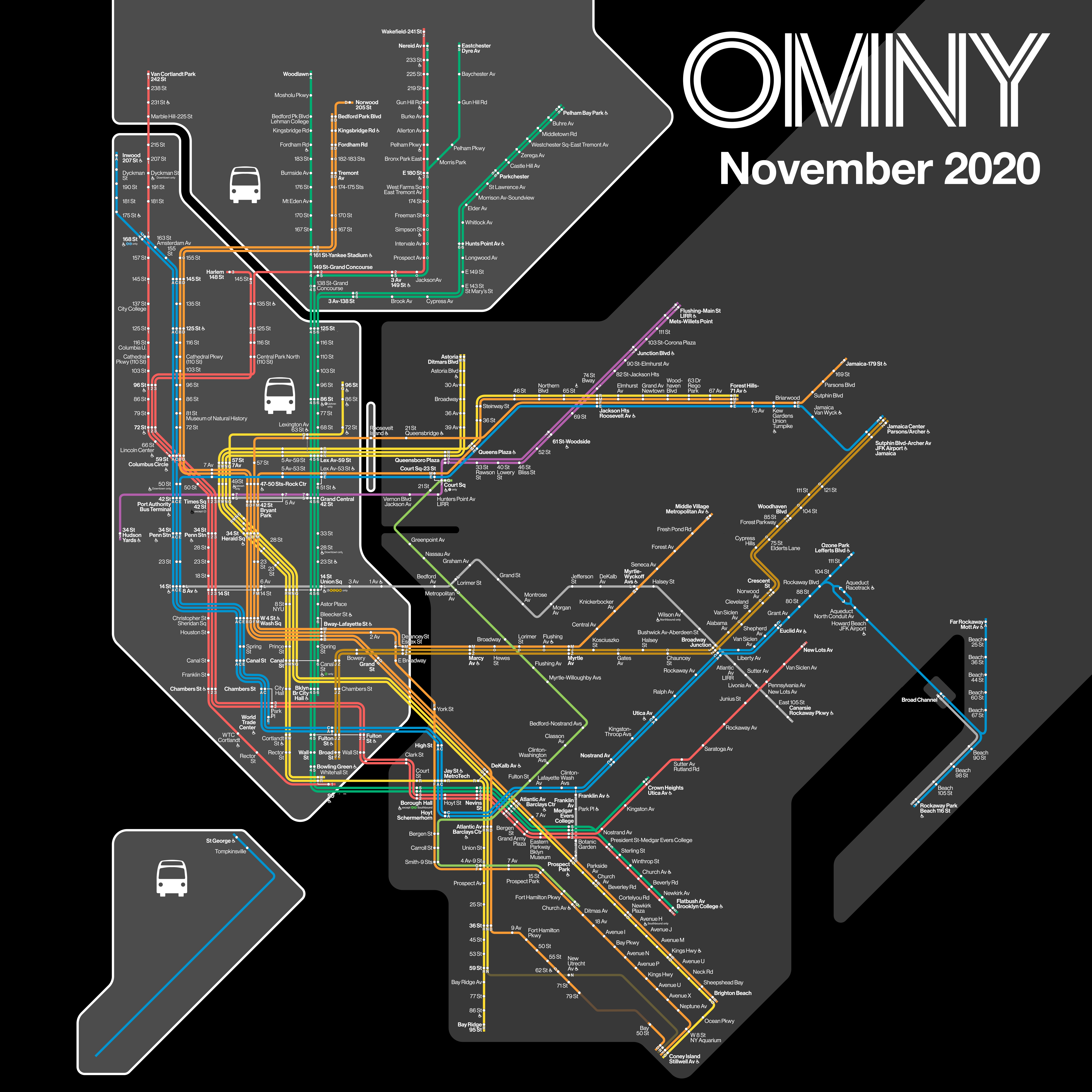
By that September, two-thirds of subway stations were OMNY-equipped; this included all stations in the Bronx, Manhattan, and Staten Island, as well as buses in the latter two boroughs.[49][50] As of November 2020, there were 3,900 active OMNY readers. OMNY infrastructure was also installed in 2,666 buses, representing 44.9% of the total, with 6,400 OMNY readers installed.[29]: 29 By December, OMNY had been rolled out to 458 subway stations, representing 97% of the total, and OMNY had been used 30 million times.[51] On December 31, 2020, the MTA announced that OMNY was active and available on all MTA buses and at all subway stations.[52][53][54] Unlimited ride options are not available but were planned for 2021.[55][56]
By July 2021, one-sixth of all fares paid on the bus, subway, and Staten Island Railway were being paid through OMNY, and 100 million fares had been paid using the fare system.[57] In October 2021, the MTA started selling a standard-design OMNY card at certain retail locations throughout New York City, such as CVS and Duane Reade drugstores, as well as bodegas and dollar stores that sold MetroCards. The MTA planned to expand the rollout to vending machines inside stations. OMNY cards featuring commemorative designs, as well as special fare-classes such as students, senior citizens, and MTA employees, were not available at the time of the rollout.[58]
PATH and commuter rail
As of 2019, the MTA also plans to use OMNY on the Long Island Rail Road and Metro-North Railroad over "the next several years".[59] In June 2019, the Port Authority of New York and New Jersey announced it was in talks with the MTA to implement OMNY on the PATH by 2022.[60] There are no plans for OMNY to be used on NJ Transit, which plans to implement a new fare payment system with a different contractor.[61]
Plans for OMNY installation on the LIRR and Metro-North were still being revised as of November 2020.[29]: 31 The COVID-19 pandemic had pushed back the implementation of fare cards on the commuter railroads from February 2021 to June 2022, and that of in-system vending machines from March 2022 to June 2023.[29]: 29 As of June 2021, there were delays in the commuter railroads' mobile ticketing system as well as vending machines. According to the MTA's independent engineering consultant, this could potentially delay full rollout of OMNY for six months from the original projected completion date of July 2023.[30]: 82
Timeline
This list shows when direct entry by OMNY reader became possible on each bus line and subway segment. A green row indicates when a subway line fully implemented OMNY.





Physical attributes
The standard OMNY card is valid for seven years from purchase. It contains two barcodes on the front and back; one barcode is used to record the card being purchased, and the other is used to encode fare information. On the standard card, half of the front side contains a barcode, which is oriented to resemble railroad tracks, while the other half of the front side contains a white-on-black OMNY logo. The back of the card contains the card number, card security code, expiration date, and the other barcode.[58]
Fares
On all modes of transport except for NYC Ferry, all fare payments must be made using MetroCard, coins (except for express buses and subways, and excluding half-dollars and pennies), or OMNY.[72] Both MetroCard and SmartLink are accepted on PATH; however, SmartLink cannot be used on any other transit system in New York City. Subways and express buses within New York City only accept MetroCard and OMNY as payment.
As of December 31, 2020, all subway stations, St. George and Tompkinsville Staten Island Railway stations, and all MTA-operated buses are equipped with OMNY readers. OMNY is currently available only for full-fare, pay-per-ride trips, and MetroCard remains the only option for discounted or unlimited-ride fares.[73]
NYC Ferry fares are paid using physical or digital tickets, which are not compatible with the MetroCard or OMNY,[74] or with any of the city's other modes of transport.[75]
Base fares
All fares are in US dollars. Except for NYC Ferry, kids under 44" tall ride for free with fare-paying rider; limit is 3.[76]: 47
| MTA Bus/NYC Bus: Local, Limited-Stop, Select Bus Service, Bee-Line (except BxM4C bus), NICE, PATH NYC Subway, SIR, Roosevelt Island Tramway |
Express buses (MTA and Academy bus SIM23/SIM24) |
BxM4C bus[77] | Student MetroCard[78] | NYC Ferry[79] | AirTrain JFK[80] | Access-A-Ride (NYC paratransit) |
Able-Ride[81] (Nassau County paratransit) | |||||
|---|---|---|---|---|---|---|---|---|---|---|---|---|
| Full | Reduced | Full | Reduced (off-peak) |
Full | Reduced (off-peak) |
Full | Half- fare |
NICE[81] | ||||
| $2.75[82]
|
$1.35[82]
|
$6.75 [82] | $3.35 [82] | $7.50 | $3.75 | Free | $1.25 | $2.25 | $2.75
($3.75 for cyclists with bikes) |
$7.75 | $2.75 | $3.75
($75 for a book of 20 tickets) |
Transfer restrictions:
| ||||||||||||
Unlimited-ride fares
All fares are in US dollars. There is a $1 purchase fee for all new MetroCards issued within the subway system or at railroad stations (except for expiring or damaged MetroCards or MetroCards bought as part of a UniTicket).[91]
In March 2022, the MTA plans to cap all fares made using OMNY. Users of OMNY will pay the base fare on buses, subways, and the Staten Island Railway until they have paid more than the cost of the 7-Day Unlimited MetroCard option for fares within a single week, upon which they do not pay fares for subsequent trips. As of December 2021, this means that passengers will pay the $2.75 for each of the first 12 rides made in a week; after they have paid for more than 12 rides ($33), their fare payment medium becomes an unlimited-fare option.[92]
| 7-Day Unlimited[93] | 30-Day Unlimited[94] | 1-Day Unlimited SmartLink[83] | 7-Day Unlimited SmartLink[83] | 30-Day Unlimited SmartLink[83] | 7-Day Express Bus Plus[95] | 10-Trip AirTrain JFK[80][96] | 30-Day AirTrain JFK[80][96] | Monthly NYC Ferry[79] | |
|---|---|---|---|---|---|---|---|---|---|
| Full fare | $33 | $127 | $10 | $34.50 | $106 | $62 | $25 | $40 | $121
($141 for cyclists with bikes) |
| Reduced fare | $16.50 | $63.50 | |||||||
Notes:
| |||||||||
Transfers
MetroCard and OMNY
All transfers with MetroCard or OMNY are free from bus to subway, local bus to local bus, and subway to local bus. For transfers from local bus or subway to express buses (except the BxM4C), an additional $3.75 is charged.[97] With coins, transfers are available to different local buses only, with some restrictions, and issued upon request when boarding only. All transfers are good for two hours.[85][86][87]
There are no transfers to the BxM4C.[98] There are also no free transfers to or from PATH.[99]
SingleRide tickets are valid for one ride within two hours after purchase on local buses and the subway. One bus-to-bus transfer is allowed;[100] however, transfer between buses and subways in either direction are not allowed.[101]
On the Select Bus Service routes except S79, customers paying with coins requiring a transfer must board via the front door and request a transfer from the operator. All other customers may board via any of the three doors on Select Bus Service buses.[102]
Bee-Line customers needing to transfer to Connecticut Transit (I-Bus and route 11),[103] Transport of Rockland (Tappan ZEExpress),[104] Putnam Transit (PART 2),[105] or Housatonic Area Regional Transit (Ridgefield-Katonah Shuttle)[106] services must ask for a transfer, even if paying with MetroCard. The BxM4C does not accept or issue any transfers.[107][108]
NICE customers needing to transfer to City of Long Beach N69, Suffolk County Transit, or Huntington Area Rapid Transit[109] services must ask for a transfer, even if paying with MetroCard.
NYC Ferry
As NYC Ferry uses a separate fare payment system from the rest of New York City's transportation system, it does not provide any free transfers to any other modes of transportation using MetroCard or OMNY. However, passengers can request one free transfer to a connecting NYC Ferry route, valid within 90 minutes of the passenger boarding the first route. Tickets are checked prior to boarding, when the boat arrives at the station.[79][75]
Transfer restrictions
There are restrictions on transfers, as noted below. The transfer rules and restrictions are identical for MetroCard and OMNY, where OMNY is available.[110]
Subway
Pay-Per-Ride MetroCard and OMNY customers cannot make subway-to-subway transfers by exiting the turnstile and entering again. There are two exceptions:
- Upper East Side, Manhattan – Lexington Avenue/59th Street on the IRT Lexington Avenue and BMT Broadway Lines (4, 5, 6, <6>, N, R, and W trains) and Lexington Avenue/63rd Street on the 63rd Street lines (F, <F>, and Q trains).[111]
- Brownsville, Brooklyn – Livonia Avenue (L train) and Junius Street (3 train).[112]
Until 2011, an extra out-of-system subway-to-subway transfer was allowed in Long Island City, Queens, between 23rd Street–Ely Avenue/Long Island City–Court Square on the IND Queens Boulevard and Crosstown Lines and 45th Road–Court House Square on the IRT Flushing Line. This transfer was eliminated with the opening of an in-system transfer passageway among the three stations.[113]
Additional out-of-system transfers are added on a case-by-case basis, usually whenever a regular transfer is unavailable due to construction. Past instances included two transfers in Williamsburg and Bedford–Stuyvesant, Brooklyn, due to the 14th Street Tunnel shutdown from 2019 to 2020;[114] a transfer in Gravesend, Brooklyn, due to the BMT Sea Beach Line (N train)'s partial suspension from 2019 to 2020;[115] and two transfers in Inwood, Manhattan, in 2019 due to the closure of the 168th Street station (1 train).[116]
Bus
For Pay-Per-Ride MetroCard and OMNY customers, there is no free transfer back onto the same route on which the fare was initially paid, or between the following buses:[117]
- No transfer in the opposite direction:
- M1, M2, M3, M4
- M101, M102, M103
- Bx1 and Bx2
- M31 and M57
- No transfer in either direction:
- M50
- M96 and M106
- Bx40 and Bx42
- No transfers between NICE bus routes that are not listed on the timetable of the route on which fare is paid. Essentially, one cannot transfer between bus routes that do not intersect.[118]
- Express:
- No transfers to/from BxM4C, even with a Pay-Per-Ride MetroCard.[119][120]
- No transfers between different Union Turnpike express buses (QM1, QM5, QM6, QM31, QM35, QM36) traveling in the opposite direction.
Subway-to-bus
There are no subway-to-bus or bus-to-subway transfers allowed without a MetroCard or OMNY, with one exception:
- At the Rockaway Parkway Intermodal Center on the BMT Canarsie Line (L train), westbound B6, B82 Local, and B82 Select Bus Service customers arriving from East New York and Canarsie, eastbound B6 Local customers on trips terminating at Rockaway Parkway, and all B42 customers, are transported directly into the subway system's fare control without having to pass through turnstiles (as the former trolley line had a loop installed within fare control). Similarly, subway passengers can transfer to B42 and westbound B6 and B82 Local service without using a MetroCard or OMNY (westbound B82 SBS customers must still obtain proof of payment, but have a second transfer to another route).
Differences from MetroCards
The technology for making a transfer on MTA buses and subways differs slightly between MetroCards and OMNY devices. To allow for operation on vehicles disconnected from the MTA communications network, MetroCards store information about the transfer on the card itself.[121] Third-party digital wallets, debit cards, credit cards generally cannot store transit-specific information on the consumer card or device. OMNY solves this problem by only charging riders once a day,[122] after vehicles have had a chance to return to base and download boarding data. Though the second entry may display to the rider that the full fare is being charged, as long as the same device was used within the two-hour window, it is discounted when calculating the amount to actually be paid.[122]
The OMNY system is also able to measure the usage of OMNY cards.[123] In October 2021, the MTA considered enabling a fare cap on OMNY cards and devices, similar to the fare caps on Oyster cards.[123][124] Under the proposal, an OMNY card or device would be charged a pay-per-ride fare on MTA buses and subways if a passenger has made fewer than a specified number of trips in a certain time period. After the passenger makes more than that quantity of trips, they would be charged the unlimited rate. For example, with a pay-per-ride fare of $2.75 and a weekly unlimited MetroCard cost of $33 (as of October 2021), a passenger would still pay $2.75 per trip if they made 12 or fewer trips in a week; under the proposal, they would pay no more than $33 within a week, even if they made 13 or more trips.[123] As of December 2021, the fare caps will be implemented as a pilot program from March to June 2022.[125][126]
Concerns
The oversight group Surveillance Technology Oversight Project (STOP) has stated concerns about the lack of privacy regulation in the OMNY system, specifically that trip data may be used by the New York City Police Department for police surveillance or might be shared with U.S. Immigration and Customs Enforcement to track undocumented immigrants.[127][128][129]
In February 2020, the MTA warned that some customers using Apple Pay's Express Transit feature might be accidentally double-charged if they were using a MetroCard. This occurred when riders unintentionally had their phones in proximity to the OMNY readers. At that point, the issue was relatively rare, having been reported 30 times.[130]
See also
Notes
- The following subway stations participated in the 2006 trial:
- 23 stations on the IRT Lexington Avenue Line from 125th Street to Bowling Green
- Borough Hall/Court Street in Brooklyn
- 23rd Street-Ely Avenue in Queens
- The following bus routes and subway stations participated in the 2010 trial:
- the IRT Lexington Avenue Line (4, 5, 6, and <6> trains) from 138th Street–Grand Concourse or Third Avenue–138th Street stations in the Bronx to Borough Hall station in Brooklyn,
- the M14, M23, M79, M86, M101, M102, M103 New York City Transit local bus routes, and the BxM7 MTA Bus express bus route,
- most of the PATH train stations (except for Christopher Street and 9th Street),
- #6 (Ocean Avenue – Journal Square), #80 (Newark Avenue), and #87 (King Drive) New Jersey Transit bus routes.
- A new route service was added at an unknown date: one was able to use the Newark Liberty International Airport's AirTrain monorail system to terminals A, B, and C and the long-term parking areas of the airport. However, this was only good for going to the airport, away from the Newark Liberty International Airport Station, and did not apply when leaving the airport, towards the station.
- "pay-as-you-go" RFID card scan at select turnstiles or locations; or,
- pre-funded fares via a pilot website called the "NY/NJ Transit Trial" for multiple and unlimited ride discounts. Pre-funded fares ceased to be available on the trial website on October 16, 2010, and the free trial ended on November 30, 2010.
- All stations on the 4, 5, 6, and <6> trains between Grand Central–42nd Street and Atlantic Avenue–Barclays Center were in the initial OMNY pilot.
- See § Timeline for a list of additional stations.
- De facto implementation, as OMNY has been implemented on all stations that include this line.
- These are the only two Staten Island Railway stations with turnstiles.[62]
- In July 2020, all stations in the Bronx were equipped with OMNY. The only line where this had not been installed yet was the Concourse Line.[67] The entire A Division (numbered routes) was equipped with OMNY readers, except for the Eastern Parkway–Brooklyn Museum of the IRT Eastern Parkway Line, which was undergoing renovations at the time.[50]
References
- "About NYC Transit – History". October 19, 2002. Retrieved September 18, 2016.
- Chan, Sewell (January 31, 2006). "A Test at 25 Stations Subway Riding Without the Swiping". The New York Times. ISSN 0362-4331. Retrieved February 10, 2016.
- Steinemann, Jeremy (August 5, 2009). "The Future of the MetroCard Part 3". Second Ave. Sagas. Archived from the original on August 11, 2009.
- Bacheldor, Beth (January 31, 2006). "RFID to Ride N.Y. Subways". RFID Journal. Retrieved August 2, 2019.
- Blass, Evan (February 1, 2006). ""Select customers" to trial RFID NYC subway pass". Engadget. Archived from the original on February 3, 2006.
- "New Jersey and New York Transit Agencies Partner with MasterCard on Tap & Go Payment System to Enhance Commuter Experience". MasterCard (Press release). June 1, 2010. Retrieved August 1, 2019.
- Kaminer, Ariel (June 11, 2010). "Testing PayPass on New York's Buses and Trains". The New York Times. Retrieved March 25, 2016.
- Glucksman, Randy (July 2010). "Commuter and Transit Notes". The Bulletin. 53 (7). Electric Railroaders' Association. p. 10.
- "About the Trial". NY/NJ Transit Trial. Archived from the original on November 18, 2010. Retrieved March 25, 2016.
- Hinds, Kate (June 1, 2015). "Finally: The MTA Has an Approved Capital Program". WNYC. Retrieved July 28, 2016.
- Smith, Dave (January 11, 2016). "All New York City subway stations will have WiFi by the end of this year". Business Insider. Retrieved September 11, 2017.
- Rivoli, Dan; Gregorian, Dareh (April 12, 2016). "MTA to solicit proposals for 'New Fare Payment System,' taking first step in finding MetroCard replacement". New York Daily News. Retrieved November 30, 2016.
- Siff, Andrew (September 11, 2017). "MetroCard Replacement Is Coming Soon: MTA". NBC New York. Retrieved September 11, 2017.
- Rivoli, Dan (October 6, 2017). "MTA testing new tech that could replace MetroCard". NY Daily News. Retrieved October 9, 2017.
- Rivoli, Dan (October 23, 2017). "MTA approves plan to scrap MetroCards for 'tap' payment system". NY Daily News. Retrieved October 24, 2017.
- Barron, James (October 23, 2017). "New York to Replace MetroCard With Modern Way to Pay Transit Fares". The New York Times. ISSN 0362-4331. Retrieved October 24, 2017.
- Barron, James (October 27, 2017). "New Fare System Raises Security Concerns, but Officials Promise Safety". The New York Times. ISSN 0362-4331. Retrieved October 27, 2017.
- Hoscik, Martin (October 11, 2018). "TfL set to extend Cubic's contactless fares licensing deal after netting £15m in royalties in just two years". MayorWatch. Retrieved August 1, 2019.
- "MTA: OMNY will be phased in to replace MetroCards in NYC". ABC7 New York. February 23, 2019. Retrieved February 24, 2019.
- "Avoiding replacing the MetroCard with ... chaos". am New York. April 2, 2019. Retrieved April 4, 2019.
- "Capital Program Oversight Committee Meeting" (PDF). Metropolitan Transportation Authority. May 20, 2019. Retrieved May 19, 2019.
- "MetroCards to start tapping out in May". am New York. June 13, 2018. Retrieved June 14, 2018.
- Berger, Paul. "Liberty? Tony? Pretzel? New York Officials Puzzle Over Fare Card Name". WSJ. Retrieved August 7, 2019.
- Meyer, David (August 5, 2019). "MetroCard's flashy replacement was almost named 'Pretzel'". New York Post. Retrieved August 7, 2019.
- "No More MetroCards? MTA To Test New Fare System Where Riders Pay Using Smartphone". CBS New York. February 23, 2019. Retrieved February 24, 2019.
- "MTA to phase out MetroCard: Out with the swipe, in with the tap". News 12 The Bronx. February 23, 2019. Retrieved February 24, 2019.
- Rivoli, Dan (February 22, 2019). "Why not Apple Card? Or Gotham Card? MTA's tap-n-go fare card has unimaginative name". nydailynews.com. Retrieved August 3, 2019.
- "MTA to begin pilot for MetroCard replacement next week". New York Post. February 22, 2019. Retrieved February 24, 2019.
- "Capital Program Oversight Committee Meeting November 2020". Metropolitan Transportation Authority. November 18, 2020. Retrieved April 20, 2018.
- "Capital Program Oversight Committee Meeting". Metropolitan Transportation Authority. June 23, 2021. Retrieved January 18, 2019.
- MTA Press Conference - 12/11/2019. Metropolitan Transportation Authority. December 11, 2019. Retrieved December 17, 2019 – via YouTube.
- Chung, Jen. "OMNY Is Alive: MTA Opens Up Tap Payment System In Limited Subway Pilot". Gothamist. Archived from the original on June 3, 2019. Retrieved June 3, 2019.
- "6,000 tap into new MTA fare system on first full day". am New York. Retrieved June 3, 2019.
- "MTA begins rollout of 'tap-and-go' fare payment system". brooklyn.news12.com. Retrieved June 3, 2019.
- "New York's MTA Gets Apple Pay and Google Pay: Here's How to Set It Up". Fortune. Retrieved June 3, 2019.
- "Fareback Fridays Promotion". www.mastercard.us. Retrieved June 3, 2019.
- "Capital Program Oversight Committee Meeting". Metropolitan Transportation Authority. November 12, 2019. Retrieved May 19, 2019.
- Fitzsimmons, Emma G. (July 30, 2019). "So Long, Swiping. The 'Tap-and-Go' Subway Is Here". The New York Times. ISSN 0362-4331. Retrieved August 1, 2019.
- Meyer, David (November 12, 2019). "MTA's tap-and-go fare system coming to 48 subway stations in December". New York Post. Retrieved November 13, 2019.
- Glasser-Baker, Becca (November 13, 2019). "MTA announces the expansion of OMNY". Metro US. Retrieved November 14, 2019.
- "MTA Expanding OMNY to All Boroughs by End of 2020". Spectrum News NY1 | New York City. November 13, 2019. Retrieved November 14, 2019.
- Bascome, Erik (June 5, 2020). "MTA: OMNY installation to be completed on time despite coronavirus outbreak". silive. Retrieved July 18, 2020.
- Bascome, Erik (January 8, 2020). "OMNY reaches 5 million taps; MTA rolls out new marketing campaign". silive. Retrieved January 8, 2020.
- "Press Release - MTA Headquarters - OMNY Surpasses 5 Million Taps Ahead of Expansion to 60 More Stations by End of January". MTA. January 7, 2020. Retrieved January 19, 2020.
- "OMNY payment program expands to Bronx subway lines". amNewYork. February 3, 2020. Retrieved February 3, 2020.
- "OMNY contactless payment system to go live on all Manhattan buses". Intelligent Transport. March 3, 2020. Retrieved March 4, 2020.
- "MTA expands OMNY contactless readers to half of subway station, accelerates bus timeline by 6 months". ABC7 New York. June 4, 2020. Retrieved January 2, 2021.
- Berger, Paul (June 2, 2020). "Contactless Payment on New York City Subway Is Delayed by Coronavirus". Wall Street Journal. ISSN 0099-9660. Retrieved July 18, 2020.
- Hallum, Mark (August 12, 2020). "OMNY payment system now at turnstiles in most subway stations: MTA". amNewYork. Retrieved August 14, 2020.
- "New York MTA's OMNY system on track with new installations". Mass Transit Magazine. August 13, 2020. Retrieved August 14, 2020.
- Humbrecht, Rebeka (December 6, 2020). "Full OMNY rollout nears completion, as system records 30 millionth tap, MTA says". silive. Retrieved December 29, 2020.
- "MTA: Every NYC Subway Station Now Equipped With OMNY Contactless Payment System". CBS New York – Breaking News, Sports, Weather, Traffic And The Best of NY. December 31, 2020. Retrieved January 1, 2021.
- Pozarycki, Robert (December 31, 2020). "'It's OMNY time': MTA wraps up installation of contactless fare payment system". amNewYork. Retrieved January 1, 2021.
- Chang, Sophia (January 1, 2021). "OMNY Pay Scanners Now Available At All Subway Stations And MTA Buses". Gothamist. Retrieved January 5, 2021.
- MTA Press Conference - 12/11/2019. Metropolitan Transportation Authority. December 11, 2019. Retrieved December 17, 2019 – via YouTube.
- "It's OMNY Time - Everywhere!" (Press release). Metropolitan Transportation Authority. December 31, 2020. Retrieved January 5, 2021.
- Guse, Clayton (July 6, 2021). "MTA says one in six NYC Transit fares now paid through OMNY". New York Daily News. Retrieved October 2, 2021.
- Bonanos, Christopher (October 1, 2021). "This Is the OMNY Card, and You Might Be Able to Buy One Today". Curbed. Retrieved October 2, 2021.
- "Say hello to tap and go, with OMNY". MTA. Retrieved February 24, 2019.
- "PATH Implementation Plan" (PDF). PANYNJ. Archived from the original (PDF) on December 13, 2019. Retrieved June 20, 2019.
- Higgs, Larry (June 6, 2019). "NJ Transit takes a small step toward getting its own fare card, similar to NYC". NJ.com. Retrieved October 2, 2019.
- Mooney, Jake (September 7, 2008). "Soon, It Won't Even Pay to Walk". The New York Times. ISSN 0362-4331. Retrieved October 8, 2015.
- Guse, Clayton (February 2, 2020). "MetroCard replacement OMNY coming to 37 more subway stations in the Bronx this month". nydailynews.com. Retrieved February 3, 2020.
- "NY: MetroCard replacement OMNY coming to 37 more subway stations in the Bronx this month". Mass Transit. February 2, 2020. Retrieved February 3, 2020.
- Krisel, Brendan (March 2, 2020). "More Harlem Train Stations To Be Equipped With OMNY System: MTA". Harlem, NY Patch. Retrieved March 4, 2020.
- "MTA adds OMNY contactless fare payment at all Bronx subway stations". ABC7 New York. July 16, 2020. Retrieved July 18, 2020.
- Guse, Clayton (July 15, 2020). "All Bronx subway stations now equipped with new tap-and-pay OMNY system". New York Daily News. Retrieved July 18, 2020.
- OMNY Update: August 2020 (Video). Metropolitan Transportation Authority. August 13, 2020. Retrieved October 3, 2020 – via YouTube.
- OMNY Update: September 2020 (Video). Metropolitan Transportation Authority. September 3, 2020. Retrieved October 3, 2020 – via YouTube.
- OMNY Update: October 2020 (Video). Metropolitan Transportation Authority. October 12, 2020. Retrieved October 3, 2020 – via YouTube.
- OMNY Update: November 2020 (Image). Metropolitan Transportation Authority. November 2020. Retrieved December 29, 2020.
- "MTA/New York City Transit - Fares and MetroCard". Retrieved October 28, 2015.
- "About OMNY". omny.info. Retrieved September 2, 2020.
OMNY supports a full-fare, pay-per-ride option first, with free transfers at OMNY-enabled subway stations and bus routes. Additional fare options will be available during future phases of the rollout, such as unlimited ride passes, reduced fares, student fares, and more.
- Langfield, Amy (August 21, 2015). "Citywide Ferry Plan Will Not Integrate With MTA's MetroCard for Transfers". DNAinfo New York. Archived from the original on March 15, 2017. Retrieved May 1, 2017.
- Warerkar, Tanay (May 1, 2017). "Everything you need to know about NYC's new citywide ferry". Curbed NY. Retrieved September 18, 2017.
- "Fares at a glance". mta.info. April 2019.
- BxM4C schedule notes (page 2)
- NYC Department of Education, Student MetroCards page
- "Ticket Portal". NYC Ferry. Retrieved May 1, 2017.
- "Cost and Tickets". Retrieved October 28, 2015.
- "Fares & Passes". Retrieved October 28, 2015.
- "MTA/New York City Transit - Fares and MetroCard". Retrieved October 28, 2015.
- "Fares - PATH - The Port Authority of NY & NJ". Retrieved October 28, 2015.
- Rein, Lisa (July 8, 1997). "Two-hour leeway & then some". New York Daily News. Retrieved February 27, 2019.
- "How to Ride the Bus", under 'Making Connections', MTA.info
- NICE bus schedule for N6 (Local) and N6X (Express) - 'Fare Information' Archived October 3, 2013, at the Wayback Machine (page 2), nicebus.com
- Bee-Line fares
- "MTA Staten Island Railway Fare and Transfer Information", MTA.info
- MTA Regional Bus Operations. "B62 bus schedule" (PDF). p.11
- Revisions to LaGuardia Airport Service, mta.info
- About the $1 New Card Fee, MTA.info
- Ley, Ana (December 13, 2021). "To Win Riders Back, M.T.A. to Offer Free Rides for 'Tap-and-Go' Customers". The New York Times. ISSN 0362-4331. Retrieved December 14, 2021.
- 7 day Unlimited ride price]
- 30 day Unlimited ride price]
- 7 day Express Bus Plus ride price
- AirTrain JFK Unlimited ride price
- MTA Regional Bus Operations. "QM1 bus schedule" (PDF). p.2
- http://transportation.westchestergov.com/images/stories/Schedules/Rte_BxM4C_TT_Spr13.pdf%5B%5D BxM4C schedule notes (page 2)
- "Path fares".
- "mta.info - Buses". Retrieved October 28, 2015.
- "mta.info - New Fare Information". Retrieved October 28, 2015.
- Select Bus Service fare payment, MTA.info
- I-Bus fare structure Archived February 8, 2014, at the Wayback Machine
- TappanZEExpress schedule, transfer connections (page 1)
- Bee-Line bus map Archived October 18, 2015, at the Wayback Machine (page 1)
- HART "FIXED ROUTE FARES" under 'CONNECTING BUS SYSTEMS' Archived April 7, 2014, at the Wayback Machine
- "BxM4C" (PDF). Retrieved January 17, 2020.
- "Fares and MetroCard". transportation.westchestergov.com. Retrieved January 17, 2020.
- HART fares Archived April 7, 2014, at the Wayback Machine
- "How OMNY works". omny.info. Retrieved September 2, 2020.
The same free transfer rules that apply to MetroCard also apply to OMNY.
- Out-of-system transfer detail, MTA.info
- Guse, Clayton (June 1, 2020). "MTA ends free transfer between overlapping Brooklyn subway stations". New York Daily News. Retrieved June 2, 2020.
- "New Transfer at Court Square". Metropolitan Transportation Authority. June 3, 2011. Retrieved July 27, 2016.
- "Press Release - MTA Headquarters - Next Phase of L Project Construction Starts Tonight – Much of Tunnel Construction Work is Well Underway". MTA. April 26, 2019. Retrieved April 27, 2019.
- "Preparing for Climate Change: Protecting the Coney Island Yard". mta.info. Metropolitan Transportation Authority. September 16, 2019. Retrieved September 17, 2019.
- "Station Info (168 St)". MTA. Retrieved December 14, 2018.
- "Regular MetroCard Conditions of Use", MTA.info
- NICE bus schedule for N6 (Local) and N6X (Express) - 'Fair Information' Archived October 3, 2013, at the Wayback Machine (page 2), nicebus.com
- "BxM4C" (PDF). Retrieved January 17, 2020.
- "Fares and MetroCard". transportation.westchestergov.com. Retrieved January 17, 2020.
- "Everything you need to know about transit fares and tolls in New York". Retrieved January 8, 2020.
- "OMNY / Frequently asked questions". Retrieved January 8, 2021.
- Duggan, Kevin (October 27, 2021). "Cap crunch: MTA honchos working on fare limits for OMNY". amNewYork. Retrieved October 31, 2021.
- Baquero, Lynda (October 28, 2021). "MTA Explores Fare Capping Program That Would Turn Single Rides Into Unlimited Passes". NBC New York. Retrieved October 31, 2021.
- Ley, Ana (December 13, 2021). "To Win Riders Back, M.T.A. to Offer Free Rides for 'Tap-and-Go' Customers". The New York Times. ISSN 0362-4331. Retrieved December 14, 2021.
- Jones-Gorman, Jessica (December 13, 2021). "Will NYC mass transit riders soon be able to earn free rides via OMNY?". silive. Retrieved December 14, 2021.
- Budds, Diana (October 3, 2019). "A new report outlines privacy risks for the MTA's contactless payment system". Curbed NY. Retrieved November 1, 2019.
- a_henning (October 2, 2019). "Privacy group raises OMNY security concerns". CSNY. Retrieved November 1, 2019.
- Nessen, Stephen (May 30, 2019). "MTA's New Fare Payment OMNY Launches Friday Amid Questions About Data Security & Durability". Gothamist. Archived from the original on November 1, 2019. Retrieved November 1, 2019.
- "Apple Pay can double-charge commuters who use MTA's OMNY". ABC7 New York. January 10, 2020. Retrieved February 23, 2020.
External links
 |
Wikimedia Commons has media related to OMNY. |
| ||||||||||||||||||||||||||||||||||||||||||||||||||||||||||||||||||||||||||||||||||||||

.jpg.webp)