Octopus aquaculture
The development of octopus aquaculture, the farming of octopuses, is being driven by strong market demands in the Mediterranean and in South American and Asian countries.[1] Octopus live short lives, grow quickly and matures early,[2] which is an advantage to culture them. They typically reach 2-3 kg (high weights for invertebrates). Octopuses are 75-90% muscle of their total live weight,[3] basically a pure protein food with very little fat.
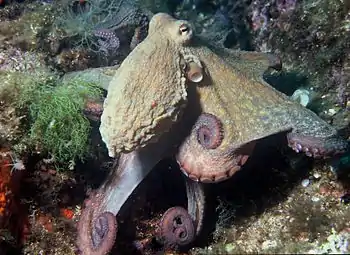
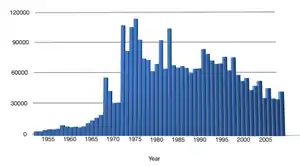
In nature there is little overlap between successive generations,[4]what makes them sensitive to changing environmental conditions,[5] like Climate Change, so culturing them could help by breeding them artificially and then restocking the natural populations.[6] The supply of octopus has been constrained by overfishing in many key fisheries.[7] The common octopus seems particularly suitable for aquaculture.
Also, it is currently difficult to culture the early life stages of octopus and maintain high survival rates for their paralarvae,[8] mainly because of high mortality rates by poor zoo-technical conditions or equipment, and also because of conspecific cannibalism;[9] requirement of live and high-quality food (e.g. crab zoea[10] or rotifer, since Artemia+microalgae or pellets are not enough). This difficulties are limiting the development of fully closed life cycle octopus hatchery systems. However, recently the Nueva Pescanova Group located in Spain, have recently achieved many generations of Octopus vulgaris by culture with great success.[11]
Species
The aquaculture potential of several octopuses species has been investigated in recent years, including Octopus maya (red octopus),[13] Octopus bimaculoides (California two-spot octopus),[14] Octopus ocellatus (now re-named Amphioctopus fangsiao)[15], Octopus mimus (changos octopus),[16] Enteroctopus megalocyathus (Patagonian red octopus)[17] and Robsonella fontaniana.[18]
The common octopus, Octopus vulgaris, appears to be the most serious candidate for aquaculture in terms of its biological and market potential.[19] It has a worldwide distribution in tropical, subtropical and temperate waters. It is a benthic species occurring from the coastal line to the outer edge of the continental shelf, at depths to 200 m and in very diverse marine habitats.[20] The common octopus is easily adapted to captive conditions and has a rapid growth rate of 5% body weight per day.[19] It also has a high feed conversion rate with 30–60% of ingested food being incorporated in its own weight,[21][22] and a high fecundity of 100,000–500,000 eggs per female.[21]
Octopus cuisine
The reason to culture, is to eat, and the taste of its meat varies according to the species, but in general it is characterized by an umami flavor, due to the high content of glutamic acid and glutamate (free amino acid) and nucleotides: inosinate and adenylate in its muscle tissue.[23] The Japanese try to preserve the natural flavor while preparing an octopus dish, meanwhile China, Vietnam and Thailand try to make the dish taste like fish, and they add spicy touches.[23]
A wide range of recipes exist for the octopus cooking, among them: Tako-sushi; Sudako-tako; Italian-way octopus salad; dried; broth: Glazed octopus arms with lentils and mushrooms; grilled; potato chips with suckers; pulpo a la Gallega; baked octopus arms with sweet potatoes, chipotle, and lovage; steamed and cooked, and cool smoked-arm.[24]
Temperature
There is an optimum temperature at which a cold-blooded species does best in terms of growth, survival and food intake. The common octopus is sensitive to temperature, with an optimum range for commercial growth of 16–21°C.[22] Above its optimal thermal range, growth and food intake decrease, and above 23 °C loss in weight and increased mortality has been recorded.[22] A narrow thermal band can mean seasonality in growth due to seasonal variations in water temperatures. The incorporation of temperature control mechanisms, such as in the use of closed or onshore farming systems, can reduce seasonal variances in production.[22]
Nutrition
Crustaceans, such as crabs and lobster are an important dietary constituent of both natural and captive populations of octopus.[25] Fish are not as important. Fish-based diets have been shown to provide both lower growth rates and food conversion to growth ratios in captive octopus. This may be because of high lipid levels in fish flesh.[22] Cephalopods, such as octopus and squids, show low lipid digestibility as a result of low lipid requirements. Consequently, a large component of the fish feed will not be taken up.[26] Crustacean diets are favored possibly as a result of their high protein relative to lipid levels.[22]
Whether octopus farming is profitable depends in large part on how much it costs to maintain a steady supply of crustaceans.[25] Economic profitability can be maximized without significantly compromising biological productivity by incorporating a mix of fish and crustacean-based feed strategies. García García and Cerezo Velverde (2006) found a feeding regime of one day of crab followed by three days of fish can reduce the cost of producing one kg of octopus by a predicted value of €2.96.[25]
Juveniles
Commercial aquaculture so far has been confined to starting with young juveniles caught in the wild, weighing about 750 g. In Spain, these juveniles are purchased from local fishermen and transferred to offshore floating sea cages. There they are fattened with bycatch (fish, molluscs and crabs) for several months until a commercial size, about 3 kilograms, is reached. However, acquiring juveniles in this way, from the wild, further increases the fishing pressure on octopus stocks that are already managed badly, possibly producing cascades in marine ecosystems. A cost analysis of this practice found that over 40% of total costs went into acquiring the juveniles. The profitability of this approach is low, depending as it does on fishing and the supply of sub-adults, a costly and highly variable process.[27]
Paralarva
The bottleneck currently hindering the commercial development of octopus aquaculture is the difficulty of rearing octopus during their early paralarva stage.[28][29] Paralarva is the name given to the larva of cephalopods.[8] Paralarvae are small, less than 3 millimetres at hatching, with a long planktonic life stage. Current rearing techniques are inadequate, resulting in very high mortality rates.[30] Results vary when octopus paralarvae are fed different combinations of prey. The best results have been with a mix of brine shrimp and other living prey, such as crab zoeae.[1][28] However the survival and settlement rates of the paralarvae is typically low in such studies, highlighting the difficulties in raising octopus paralarvae. Maintaining high survival rates for paralarvae appears to be the main factor limiting the development of a fully closed life cycle octopus hatchery system.[31]
To achieve both profitable and environmentally sustainable results, much research has been focused on paralarval rearing.[29] In 2005, scientists from the principal research groups in the field concluded the key factor affecting paralarval mortality is nutrition, making nutritional research the highest priority.[31] There is "no reason not to believe that the aquacultural rearing of octopus will be of great economic potential" as soon as the rearing technology and nutritional issues have been addressed.[27] Research in these areas is promising.[27]
References
- Iglesias, J., Otero, J.J., Moxica, C., Fuentes, L., Sánchez, F.J. (2004) "The completed life cycle of the octopus (Octopus vulgaris, Cuvier) under culture conditions: paralarval rearing using Artemia and zoeae, and first data on juvenile growth up to 8 months of age" Aquac. Int. 12: 481–487.
- Amodio, Piero; Boeckle, Markus; Schnell, Alexandra K.; Ostojíc, Ljerka; Fiorito, Graziano; Clayton, Nicola S. (2019-01-01). "Grow Smart and Die Young: Why Did Cephalopods Evolve Intelligence?". Trends in Ecology & Evolution. 34 (1): 45–56. doi:10.1016/j.tree.2018.10.010. ISSN 0169-5347. PMID 30446408. S2CID 53567421.
- Semmens, J. M.; Pecl, G. T.; Villanueva, R.; Jouffre, D.; Sobrino, I.; Wood, J. B.; Rigby, P. R. (2004-06-24). "Understanding octopus growth: patterns, variability and physiology". Marine and Freshwater Research. 55 (4): 367–377. doi:10.1071/MF03155. ISSN 1448-6059.
- Boyle, P.R., Rodhouse, P.G. (2005) Cephalopods: ecology and fisheries Wiley-Blackwell. ISBN 978-0-632-06048-1.
- Pierce, Graham J.; Valavanis, Vasilis D.; Guerra, Angel; Jereb, Patricia; Orsi-Relini, Lydia; Bellido, Jose M.; Katara, Isidora; Piatkowski, Uwe; Pereira, João; Balguerias, Eduardo; Sobrino, Ignacio (2008-10-01). "A review of cephalopod–environment interactions in European Seas". Hydrobiologia. 612 (1): 49–70. doi:10.1007/s10750-008-9489-7. ISSN 1573-5117. S2CID 23789779.
- Nabhitabhata, Jaruwat; Segawa, Susumu (2014), Iglesias, José; Fuentes, Lidia; Villanueva, Roger (eds.), "Aquaculture to Restocking", Cephalopod Culture, Dordrecht: Springer Netherlands, pp. 113–130, doi:10.1007/978-94-017-8648-5_7, ISBN 978-94-017-8648-5, retrieved 2021-11-21
- FAO (2010) The State of the World Fisheries and Aquaculture 2010. FAO, Rome. Page 41.
- Institute of Malacology.; Malacology, Institute of; Michigan, University of (1988). Malacologia. 29. [Ann Arbor: Institute of Malacology].
- Ibáñez, Christian M.; Keyl, Friedemann (2010-03-01). "Cannibalism in cephalopods". Reviews in Fish Biology and Fisheries. 20 (1): 123–136. doi:10.1007/s11160-009-9129-y. ISSN 1573-5184. S2CID 38200526.
- Villanueva, Roger (1994-12-01). "Decapod crab zoeae as food for rearing cephalopod paralarvae". Aquaculture. 128 (1): 143–152. doi:10.1016/0044-8486(94)90109-0. ISSN 0044-8486.
- "Nueva Pescanova will commercialize the first octopus raised in aquaculture in the summer of 2022". Spain's News. 2021-11-08. Retrieved 2021-11-21.
- Octopus vulgaris FAO: Species Fact Sheets, Rome.
- Rosas, C., Cuzon, G., Pascual, C., Gaxiola, G., Chay, Lòpez, N., Maldonado, T., Domingues, P.M. (2007) "Energy balance of Octopus maya fed crab or an artificial diet" Marine Biology, 152: 371–381.
- Solorzano, Y., Viana, M.T., López, L.Mc, Correa, J.G.,True, C.C., Rosas, C. (2009) "Response of newly hatched Octopus bimaculoides fed enriched Artemia salina: Growth performance, ontogeny of the digestive enzyme and tissue amino acid content" Aquaculture, 289: 84–90.
- Segawa, S., Nomoto, A. (2002) "Laboratory growth, feeding, oxygen consumption and ammonia excretion of Octopus ocellatus" Bulletin of Marine Science, 71: 801–813.
- Baltazar, P., Rodríguez, P., Rivera, W., Valdivieso, V. (2000) "Cultivo experimental de Octopus mimus, Gould 1852 en perú" Revista Peruana de Biología, 7: 151–160.
- Uriarte, Íker; Farías, Ana (2014), Iglesias, José; Fuentes, Lidia; Villanueva, Roger (eds.), "Enteroctopus megalocyathus", Cephalopod Culture, Dordrecht: Springer Netherlands, pp. 365–382, doi:10.1007/978-94-017-8648-5_19, ISBN 978-94-017-8648-5, retrieved 2021-11-21
- Uriarte, Íker; Farías, Ana (2014), Iglesias, José; Fuentes, Lidia; Villanueva, Roger (eds.), "Robsonella fontaniana", Cephalopod Culture, Dordrecht: Springer Netherlands, pp. 467–475, doi:10.1007/978-94-017-8648-5_25, ISBN 978-94-017-8648-5, retrieved 2021-11-21
- Iglesias J., Sánchez F.J. and Otero J.J. (1997) "Primeras experiencias sobre el cultivo integral del pulpo (Octopus vulgaris, Cuvier) en el Instituto Español de Oceanografía". In: Costa J., Abellán E., García García B., Ortega A. and Zamora S. (Eds.), VI Congreso Nacional de Acuicultura, Cartagena, Spain, pp. 221–226.
- Guerra, A. (1992) "Mollusca: Cephalopoda" In: Ramos, M.A., et al. (Eds.) Fauna Iberica, vol. 1. Museo Nacional de Ciencias Naturales, CSIC, Madrid, p. 327. ISBN 84-00-07010-0.
- Mangold, K.M. (1983) "Octopus vulgaris". In: Boyle, P.R. (Ed.), Cephalopod Life Cycles, vol. 1. Academic Press, London, pp. 335–364.
- Aguado, F., García García, B. (2002) "Growth and food intake models in Octopus vulgaris Cuvier/1797: influence of body weight, temperature, sex and diet" Aquac. Int. 10: 361–377.
- Mouritsen, Ole G.; Styrbæk, Klavs (2021), Mouritsen, Ole G.; Styrbæk, Klavs (eds.), "Cephalopods Are Nutritious and Tasty, Too", Octopuses, Squid & Cuttlefish: Seafood for Today and for the Future, Cham: Springer International Publishing, pp. 85–92, doi:10.1007/978-3-030-58027-8_6, ISBN 978-3-030-58027-8, S2CID 235851408, retrieved 2021-11-21
- Mouritsen, Ole G.; Styrbæk, Klavs (2021), Mouritsen, Ole G.; Styrbæk, Klavs (eds.), "Cephalopod Cuisine—Its Global Reach", Octopuses, Squid & Cuttlefish: Seafood for Today and for the Future, Cham: Springer International Publishing, pp. 115–196, doi:10.1007/978-3-030-58027-8_8, ISBN 978-3-030-58027-8, S2CID 235867715, retrieved 2021-11-21
- García García, B., Cerezo Valverde, J. (2006) "Optimal proportions of crabs and fish in diet for common octopus (Octopus vulgaris) ongrowing" Aquaculture, 253: 502–511.
- Lee P.G. (1994) "Nutrition of cephalopods: Fueling the system" In: Pörtner H.O., O’Dor R.K. and Mac- millan D.L. (eds), Physiology of Cephalopod Molluscs: Lifestyle and Performance Adaptations Gordon & Brench Publishers, Switzerland, pp. 35–51.
- García García, J., Rodriguez Gonzalez, L.M., García García, B. (2004) "Cost analysis of octopus ongrowing installation in Galicia" Span. Jour. Agr. Res. 2(4): 521-537.
- Carrasco, J.F., Arronte, J.C., Rodríguez, C. (2006) "Paralarval rearing of the common octopus, Octopus vulgaris (Cuvier)" Aquac. Res. 37: 1601–1605.
- Vaz-Pires, P., Seixas, P., Barbosa, A. (2004) "Aquaculture potential of the common octopus (Octopus vulgaris Cuvier, 1797): a review" Aquaculture, 238(1–4): 221–238.
- Moxica, C; F. Linares, J. J. Otero, J. Iglesias and F. J. Sánchez(2002) "Cultivo intensivo de paralarvas de pulpo, Octopus vulgaris Cuvier, 1797, en tanques de 9 m3" Archived 2012-06-30 at the Wayback Machine Bol. Inst. Esp. Oceanogr., 18 (1-4): 31-36.
- Iglesiasa J.; F.J. Sáncheza, J.G.F. Bersanob, J.F. Carrascoc, J. Dhontd, L. Fuentesa, F. Linarese, J.L. Muñozf, S. Okumurag, J. Rooh, T. van der Meereni, E.A.G. Vidalj and R. Villanuevak (2007) "Rearing of Octopus vulgaris paralarvae: Present status, bottlenecks and trends" Aquaculture, 266 (1-4): 1–15.
External links
- Jiménez, Lourdes; Virgilio Arenas, Daniel Méndez, Gerardo Preciado, Ana Gabriela Díaz and Mitzy Blanco (2009) Sustainable Octopus Fishery Program in Veracruz Reef System National Park, Mexico World Aquaculture Society, , World Aquaculture 2009. Conference presentation
- Seixas, Pedro F. and Manuel Rey-Méndez (2006) Potential use of octopus species for aquaculture: Present state of the situation, perspectives and limitations World Aquaculture Society, AQUA 2006, Firenze, Italy. Conference presentation
| ||||||||||||||||||
| ||||||||||||||||||