One-sided limit
In calculus, a one-sided limit refers to either one of the two limits of a function of a real variable as approaches a specified point either from the left or from the right.[1][2]


.svg.png.webp)



The limit as decreases in value approaching ( approaches "from the right" or "from above") can be denoted:[1][2][3]


The limit as increases in value approaching ( approaches "from the left" or "from below") can be denoted:[1][2][3]

If the limit of as approaches exists then the limits from the left and from the right both exist and are equal.[3] In some cases in which the limit

does not exist, the two one-sided limits nonetheless exist. Consequently, the limit as approaches is sometimes called a "two-sided limit".
It is possible for exactly one of the two one-sided limits to exists (while the other does not exist). It is also possible for neither of the two one-sided limits to exists.
Formal definition
If represents some interval that is contained in the domain of and if is point in then the right-sided limit as approaches can be rigorously defined as the value that satisfies:[3][4]



and the left-sided limit as approaches can be rigorously defined as the value that satisfies:


Examples
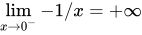
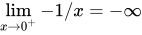
Example 1: The limits from the left and from the right of as approaches are



The reason why is because is always negative (since means that with all values of satisfying ), which implies that is always positive so that diverges[note 1] to (and not to ) as approaches from the left. Similarly, since all values of satisfy (said differently, is always positive) as approaches from the right, which implies that is always negative so that diverges to




).svg.png.webp)
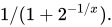
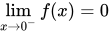
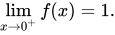
Example 2: One example of a function with different one-sided limits is (cf. picture) where the limit from the left is and the limit from the right is To calculate these limits, first show that
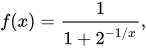

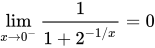
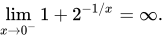
(which is true because ) so that consequently,


whereas because the denominator diverges to infinity; that is, because Since the limit does not exist.


Relation to topological definition of limit
The one-sided limit to a point corresponds to the general definition of limit, with the domain of the function restricted to one side, by either allowing that the function domain is a subset of the topological space, or by considering a one-sided subspace, including [1] Alternatively, one may consider the domain with a half-open interval topology.


Abel's theorem
A noteworthy theorem treating one-sided limits of certain power series at the boundaries of their intervals of convergence is Abel's theorem.
Notes
- A limit that is equal to is said to diverge to rather than converge to The same is true when a limit is equal to


References
- "One-sided limit - Encyclopedia of Mathematics". encyclopediaofmath.org. Retrieved 7 August 2021.
- Fridy, J. A. (24 January 2020). Introductory Analysis: The Theory of Calculus. Gulf Professional Publishing. p. 48. ISBN 978-0-12-267655-0. Retrieved 7 August 2021.
- "one-sided limit". planetmath.org. 22 March 2013. Archived from the original on 26 January 2021. Retrieved 7 August 2021.
- Giv, Hossein Hosseini (28 September 2016). Mathematical Analysis and Its Inherent Nature. American Mathematical Soc. p. 130. ISBN 978-1-4704-2807-5. Retrieved 7 August 2021.