Orbital Reef
Orbital Reef is the name given to the planned low Earth orbit (LEO) space station designed by Blue Origin and Sierra Nevada Corporation's Sierra Space for commercial space activities and space tourism uses. Blue Origin has referred to it as a "mixed-use business park".[1] The companies released preliminary plans on 25 October 2021. The station is being designed to support 10 persons in 830 m3 of volume.[2] The station is supposed to be operational in the second half of the 2020s.[3]
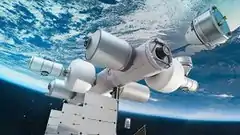 A computer rendering of the planned station | |
| Station statistics | |
|---|---|
| Launch | TBD |
| Mission status | Planned |
| Pressurized volume | 830 m3 (29,000 cu ft) |
On 2 December 2021, NASA announced it had selected Blue Origin, as one of three companies, to develop designs of space stations and other commercial destinations in space. Blue Origin was awarded $130 million.[4] These Space Act Agreements are the first phase of two with which NASA aims to maintain an uninterrupted U.S. presence in low-Earth orbit by transitioning from the International Space Station to other platforms.[5]
Partners
Blue Origin and Sierra Space have partnered with several companies and institutions to realize the project:[6][7]
- Blue Origin: Partner, providing vehicle utility core systems, large-diameter modules, and the reusable heavy-lift New Glenn launch system
- Sierra Space: Partner, providing Large Integrated Flexible Environment (LIFE) modules, node modules, and runway-landing Dream Chaser spaceplane for crew and cargo transportation
- Boeing: Providing science modules, space station operations and maintenance, and the Starliner crew spacecraft
- Redwire Space: Providing payload operations and deployable structures, and support for microgravity research, development, and manufacturing
- Genesis Engineering Solutions: Providing the Single Person Spacecraft for routine external operations and tourist excursions
- Arizona State University: Providing research advisory services and public outreach through a global consortium of fourteen leading universities
See also
 Spaceflight portal
- Aurora Space Station – Design concept for a commercial space station
- BA 2100 – Space habitat conceptualized by Bigelow Aerospace
- B330 – Space habitat designed by Bigelow Aerospace
- Bigelow Expandable Activity Module – Experimental Bigelow inflatable module
- Axiom Orbital Segment – Planned ISS component
- Starlab Space Station – Planned LEO station designed by Nanoracks
- O'Neill cylinder – Space settlement concept
References
- Chappell, Bill (25 October 2021). "Blue Origin says it will build an orbiting mixed-use business park in space". NPR. Retrieved 29 November 2021.
- Grush, Loren (25 October 2021). "Blue Origin reveals plans for future commercial space station called Orbital Reef". The Verge. Retrieved 29 November 2021.
- Wall, Mike (25 October 2021). "Blue Origin unveils plans to build a private space station called Orbital Reef by 2030". Space.com. Retrieved 29 November 2021.
- Howell, Elizabeth (2 December 2021). "NASA awards $415 million for private space stations amid ISS transition questions". Space.com. Retrieved 6 December 2021.
- "NASA Selects Companies to Develop Commercial Destinations in Space". 2 December 2021.
- Blue Origin. "Public announcement by Blue Origin, Sierra Space and several other companies and institutions" (PDF). Blue Origin.
- Blue Origin (25 October 2021). "BLUE ORIGIN AND SIERRA SPACE DEVELOPING COMMERCIAL SPACE STATION New Orbital Destination Opens Up Space For Business And Travel, Creating New Ecosystem" (PDF). Blue Origin. Retrieved 26 October 2021.
External links
| Organizations |  | ||||
|---|---|---|---|---|---|
| Vehicles |
| ||||
| Living in space | |||||
| Space competitions | |||||
| Space tourists |
| ||||
| Space tourism missions |
| ||||
| Related | |||||
| Current | 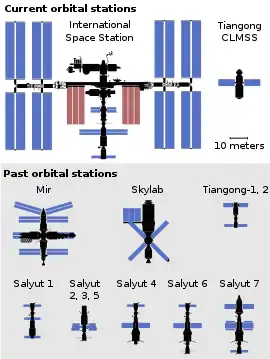 | ||||||||
|---|---|---|---|---|---|---|---|---|---|
| Past |
| ||||||||
| Canceled |
| ||||||||
| In development |
| ||||||||
| Concepts |
| ||||||||
| Related |
| ||||||||
Notes: † Never inhabited due to launch or on-orbit failure, ‡ Part of the Almaz military program, ° Never inhabited, lacks docking mechanism. | |||||||||