Order of Philip the Magnanimous
The Order of Philip the Magnanimous (German: Orden Philipps des Großmütigen) was an order of chivalry established by Louis II, Grand Duke of Hesse on 1 May 1840, the name day of Philip I, Landgrave of Hesse, in his honour to award extraordinary military or civil merit.[1] It was the second-highest order of the Grand Duchy of Hesse before 1876, when it was displaced to third by the revived Order of the Golden Lion, the former paramount order of the Electorate of Hesse.
| Order of Merit of Philip the Magnanimous Verdienstorden Philipps des Großmütigen | |
|---|---|
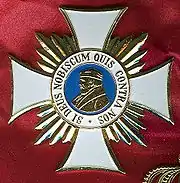 Cross of the order | |
Awarded by  The Grand Duke of Hesse The Grand Duke of Hesse | |
| Type | Order of Merit |
| Established | 1 May 1840[1] |
| Motto | SI DEUS NOBISCUM QUIS CONTRA NOS |
| Status | Monarchy dissolved in 1918. |
| Sovereign | Grand Duke of Hesse |
| Statistics | |
| Last induction | 1918 |
| Precedence | |
| Next (higher) | Ludwig Order (before 1875); Order of the Golden Lion (after 1875) |
| Next (lower) | Order of the Star of Brabant |
 Ribbon bar of the order | |
After the First World War and the fall of the German monarchies, the order—along with all other grand ducal decorations—was formally abolished in 1919.
Overview
The order was initially divided into four grades: Grand Cross, Commanders 1st and 2nd classes, and knight. On the anniversary of its founding in 1849, a new class was created, the Silver Cross, with the introduction of crossed swords in gold or silver for the class. From 10 November 1859 the knight class was further divided into two grades, 1st and 2nd classes. In 1876, the order was renamed the "Grand Ducal Hessian Order of Philip" (German: Großherzoglich Hessischer Philipps-Orden), though that decree was withdrawn a year later.
From 1881, the order could be awarded with a golden crown, as a special distinction; the order with swords for military merit was from 1893 restricted to those with outstanding achievements during war. In 1900, another new class, the Cross of Honor (German: Ehrenkreuz) was created, which was below commander 2nd class and above knight 1st class.
Recipients
Grand Crosses
- Alexander II of Russia
- Alexander of Battenberg
- Prince Alexander of Hesse and by Rhine
- Alfred, Duke of Saxe-Coburg and Gotha
- Prince Arthur, Duke of Connaught and Strathearn
- Friedrich von Beck-Rzikowsky
- Theobald von Bethmann Hollweg
- Otto von Bismarck
- Bernhard von Bülow
- Prince Charles of Hesse and by Rhine
- Rudolf von Delbrück
- Edward VII
- Hermann von Eichhorn
- Emich, Prince of Leiningen
- Prince Ernest Augustus, 3rd Duke of Cumberland and Teviotdale
- Ernest Louis, Grand Duke of Hesse
- Ferdinand, Landgrave of Hesse-Homburg
- Prince Francis Joseph of Battenberg
- Ganga Singh
- Georg Donatus, Hereditary Grand Duke of Hesse
- Gustav, Landgrave of Hesse-Homburg
- Gustav, Prince of Vasa
- Prince Henry of Battenberg
- Kamehameha V
- Prince Leopold, Duke of Albany
- Louis II, Grand Duke of Hesse
- Louis III, Grand Duke of Hesse
- Louis IV, Grand Duke of Hesse
- Prince Louis of Battenberg
- Edwin Freiherr von Manteuffel
- Jean-Baptiste Nothomb
- Hugo von Radolin
- Otto Graf zu Stolberg-Wernigerode
- Prince Frederick William of Hesse-Kassel
- Alfred von Tirpitz
- Illarion Vorontsov-Dashkov
- William I, German Emperor
Commanders 1st Class
Commanders 2nd Class
Crosses of Honour
References
- Bernard Burke, ed. (1858). "Hesse (Grand Duchy)". The Book of Orders of Knighthood and Decorations of Honour. London: Hurst & Blackett. pp. 137–138.
Literature
- Jörg Nimmergut: Deutsche Orden und Ehrenzeichen bis 1945, Band I – Anhalt-Hohenzollern, Zentralstelle für wissenschaftliche Ordenskunde, München 1997, ISBN 3-00-00-1396-2
.svg.png.webp)
















_-_ribbon_bar.png.webp)
_-_ribbon_bar.png.webp)
_-_ribbon_bar.png.webp)




_-_ribbon_bar.png.webp)
_-_ribbon_bar.png.webp)





_pasador.svg.png.webp)
.jpg.webp)

.jpg.webp)
.jpg.webp)
.jpg.webp)